
The Tao Te Ching has been put into English more often than any other Chinese book — well over a hundred times — and the two versions most people own were made by writers who do not read Chinese. That is not a scandal; both of them say so in their own prefaces. It is, though, the first thing to know when someone asks for the best Tao Te Ching translation, because the honest answer is a question back: do you want the words of a Chinese text, and if so, which text? There are four candidates, they disagree, and no single English book gives you all of them. What follows compares seventeen editions against the original, in the same way as our guide to the Analects, and ends with what we would actually buy.
Start with the text, because there are four of them
Every translation is a translation of something, and for this book the something has changed twice in living memory. The version Chinese readers have used for seventeen centuries is the text fixed by the commentator Wang Bi (王弼, 226–249): eighty-one chapters, the “Dao” half first, the “De” half second, which is where the title comes from. A slightly different text travelled with the Heshanggong commentary (河上公章句), and the two were the only witnesses anyone had until 1973.
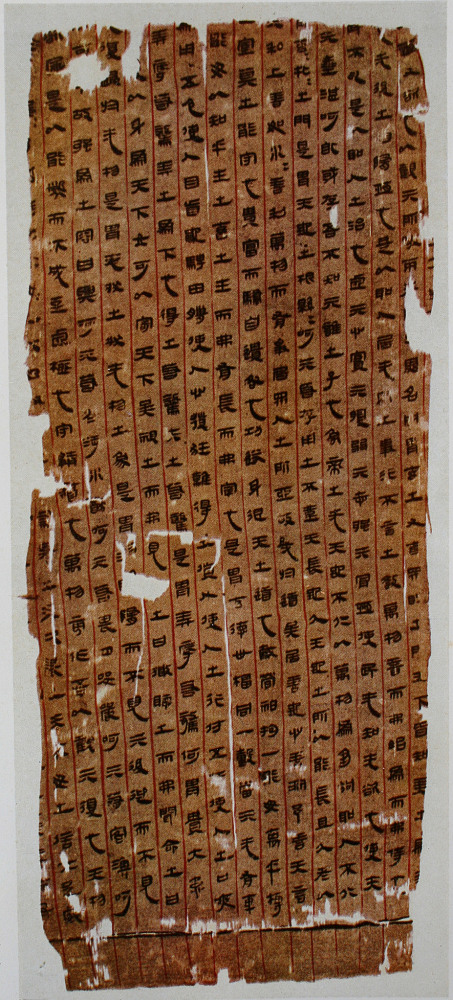
That year two silk copies were excavated at Mawangdui (馬王堆), near Changsha, from a tomb sealed in the second century BCE. They are older than Wang Bi by four hundred years, they lack the eighty-one chapter divisions, and they run the two halves in the opposite order — De first, then Dao — which is why the Chinese Text Project files them as 老子甲德經 before 老子甲道經, and why one translator called his book the Te-Tao Ching. In 1993 an older witness still came out of a tomb at Guodian (郭店) in Hubei: three bundles of bamboo slips, from around 300 BCE, carrying roughly two fifths of the received text in a different order, with wording that is sometimes strikingly different.
Here is the difference in one chapter. Chapter 19 of the received text opens with three famous renunciations:
The received text — chapter 19
絕聖棄智,民利百倍;絕仁棄義,民復孝慈;絕巧棄利,盜賊無有。
“Cut off sageliness, discard wisdom, and the people benefit a hundredfold; cut off benevolence, discard righteousness, and the people return to filial love; cut off cleverness, discard profit, and there are no thieves.”
《道德經》第十九章,王弼本 · Check the original at ctext.org
The Guodian bamboo text, c. 300 BCE — the same passage
絕智棄辯,民利百倍。絕巧棄利,盜賊亡有。絕偽棄慮,民復季子。
“Cut off wisdom, discard disputation, and the people benefit a hundredfold. Cut off cleverness, discard profit, and there are no thieves. Cut off artifice, discard scheming, and the people return to being children.”
郭店楚簡《老子甲》第一簡 · Check the original at ctext.org
“Cut off benevolence, discard righteousness” — the line that made the Tao Te Ching look like a direct attack on Confucius — is not in the oldest copy we have. In its place is a line about artifice and scheming. Whether the anti-Confucian edge was sharpened later or the Guodian scribe copied a different tradition is a live scholarly argument, and this is not the place to settle it. The point for a buyer is simpler: a translation that says “abandon benevolence” is translating Wang Bi, and a translation that does not may be translating Guodian, and the difference between them is not the translator’s taste. Before you compare English, check which Chinese is underneath.
What is actually in each edition
The table sorts the seventeen editions most often recommended in English by the three things that matter: what Chinese text they translate, whether the Chinese is printed beside the English, and how much apparatus you get. “Version” in the first column means the author does not work from the Chinese.
| Edition | First published | Base text | Chinese printed? | Apparatus |
|---|---|---|---|---|
| James Legge | 1891 (Sacred Books of the East) | Wang Bi | No (parallel text online at ctext.org) | Full commentary, dated but thorough |
| Arthur Waley, The Way and Its Power | 1934 | Wang Bi | No | Long introduction, historical notes |
| D. C. Lau (Penguin) | 1963 | Wang Bi | No | Introduction, appendices on the text |
| D. C. Lau (Chinese University Press) | 1982 | Wang Bi and Mawangdui, both | Yes, facing | Bilingual; the scholar’s Lau |
| Wing-tsit Chan, The Way of Lao Tzu | 1963 | Wang Bi | No | Notes on every chapter |
| Gia-fu Feng & Jane English | 1972 | Wang Bi | Yes, as calligraphy | Photographs; minimal notes |
| Stephen Mitchell, A New English Version | 1988 | Version — from other translations | No | Brief notes |
| Robert Henricks, Te-Tao Ching | 1989 | Mawangdui | Yes | Chapter-by-chapter textual notes |
| Victor Mair | 1990 | Mawangdui | No | Afterword on text and dating |
| Addiss & Lombardo (Hackett) | 1993 | Wang Bi, with Mawangdui variants | Yes | Sparse, deliberately |
| Red Pine (Bill Porter) | 1996; rev. 2009 | Wang Bi, with variants | Yes | Selected Chinese commentaries, translated |
| Ursula K. Le Guin | 1997 | Version — from Carus’s 1898 gloss | No | Her own commentary |
| Robert Henricks (Guodian) | 2000 | Guodian | Yes | Full textual apparatus |
| Moss Roberts | 2001 | Wang Bi, with variants | Yes | Historical and political commentary |
| Philip J. Ivanhoe | 2002 | Wang Bi | No | Philosophical notes |
| Ames & Hall, A Philosophical Translation | 2003 | Wang Bi, Guodian in appendix | Yes | Extensive philosophical commentary |
| Edmund Ryden (Oxford World’s Classics) | 2008 | Received text, informed by Mawangdui and Guodian | No | Notes, introduction by Benjamin Penny |
| Brook Ziporyn | 2023 | Received text | No | Very extensive notes |
The scholars’ translations
James Legge (1891)
The Victorian missionary-scholar’s version is in the public domain, which is why it is the one you meet on every free website and the one the Chinese Text Project prints beside the Chinese. Legge is a careful reader and an awkward writer; his English is heavy, his notes are long, and he was working before any of the excavated texts existed. Read him for the parallel Chinese and for a sense of how the book was first understood in English, not for pleasure.
Arthur Waley (1934)
Waley’s title, The Way and Its Power, tells you his approach: he read the book as a historical document of Warring States thought, and his long introduction is still one of the best things written about it in English. His translation is plain and slightly dry. Out of copyright in some countries, not in others.
D. C. Lau (1963 and 1982)
Lau’s Penguin Classics translation has been the standard scholarly English for sixty years, and it deserves it: accurate, unadorned, never poetic where the Chinese is not. It comes in two forms. The Penguin has no Chinese. The Chinese University of Hong Kong Press edition of 1982 prints Lau’s translation of the Wang Bi text and, separately, his translation of the Mawangdui silk texts, each with the Chinese facing. If you buy one book on this list, that is the book.
Robert Henricks (1989 and 2000)
Henricks is the translator of the excavated texts. His 1989 Te-Tao Ching is the Mawangdui silk manuscripts, in their own order, with the Chinese and a note on every place where they differ from the received text; his 2000 volume does the same for the Guodian bamboo slips. Neither is a first Tao Te Ching, but if the chapter 19 comparison above interested you, Henricks is where you go next.
Red Pine (1996, revised 2009)
Bill Porter, writing as Red Pine, translates the text and then, for every chapter, translates selections from the Chinese commentary tradition — Wang Bi, Heshanggong, and dozens of later voices down to the twentieth century. It is the only English edition that lets you watch Chinese readers argue with the book across two thousand years, and it prints the Chinese. A translation of this kind on a site about the commentary tradition needs no further recommendation.
Ames & Hall (2003), Ivanhoe (2002), Ziporyn (2023)
Three philosophers’ editions. Roger Ames and David Hall render the book in the vocabulary of process philosophy — dao as “way-making” — and print the Chinese with a Guodian appendix; you will either find their reading illuminating or feel that the translators are standing between you and the text. Philip Ivanhoe’s Hackett edition is the cleanest classroom translation, with short philosophical notes. Brook Ziporyn’s 2023 Liveright translation is the most recent serious attempt, with notes so extensive that reviewers have called them the point of the book.
The versions: Mitchell and Le Guin
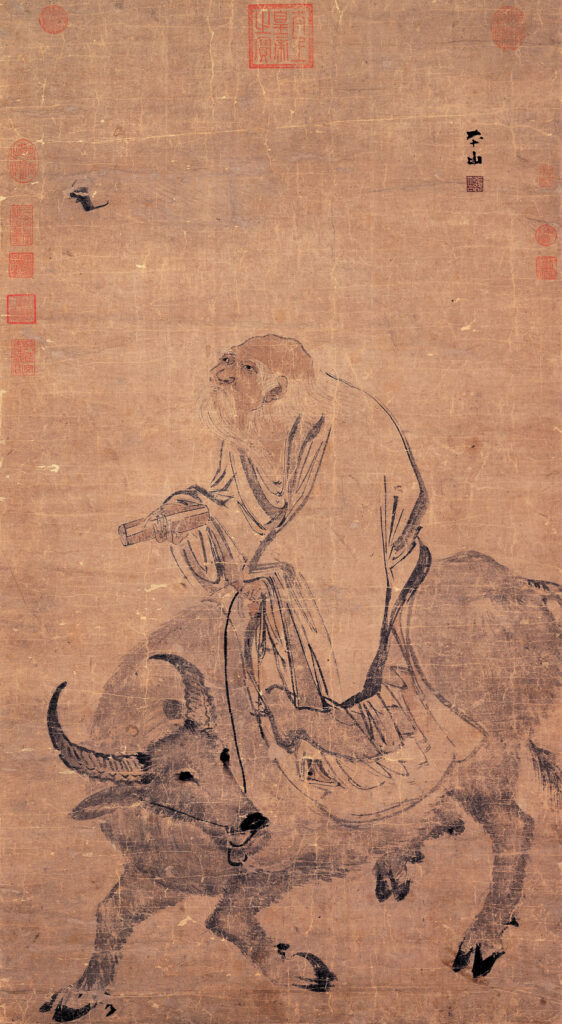
Stephen Mitchell’s 1988 book carries the subtitle A New English Version, and his own website explains what that means: he worked from Paul Carus’s literal 1898 rendering, consulted dozens of translations in English, German and French, and drew on fourteen years of Zen training. He does not claim to read Chinese. His foreword puts the method in one sentence — “If I haven’t always translated Lao-tzu’s words, my intention has always been to translate his mind” — which is an honest description of a poem written in the shape of a Chinese classic.
Ursula K. Le Guin’s 1997 book is the same kind of thing, made by a better poet and described more carefully still: she calls it a rendition, says plainly that she does not read Chinese, and explains that she worked for decades with Carus’s edition, which prints the characters with a word-for-word gloss, alongside a sinologist collaborator. Her commentary is worth reading on its own.
Neither author has hidden anything. The problem is downstream. Mitchell’s is the version most quoted on the internet, and so lines that exist only in English — smoothed, modernised, sometimes with a metaphor replaced by a different one — circulate as “Lao Tzu said”. If you want a beautiful English poem that grew out of the Tao Te Ching, buy Mitchell or Le Guin and enjoy them. If you want to know what the Chinese says, or to quote it, use them for nothing, and check any line you have seen attributed to Laozi against a translation with the Chinese beside it.
Side by side: the first line in eight translations
Any comparison of Tao Te Ching translations ends in the same place — chapter one, first line. Four characters, said twice. It is the most quoted sentence in the book, and what a translator does with one word in it, 常 (cháng), tells you most of what you need to know about the edition in your hands.
The received text — chapter 1, opening
道可道,非常道。名可名,非常名。
“A way that can be made a way is not the constant way. A name that can be named is not the constant name.”
《道德經》第一章,王弼本 · Check the original at ctext.org
常 is the hinge. It means constant, regular, the thing that holds. Keep it plain and you get a Way that simply does not change; reach for “eternal” or “immortal” and you have imported a metaphysics the character does not carry on its own. Here is where each edition lands.
| Edition | 常道 becomes | Checked against |
|---|---|---|
| Legge (1891) | “the enduring and unchanging Tao” | Out of copyright; three transcriptions agree |
| Waley (1934) | “an Unvarying Way” | Independent transcriptions only |
| D. C. Lau (1963) | “the constant way” | Independent transcriptions only |
| Mitchell (1988) | “the eternal Tao” | The translator’s own website |
| Henricks (1989) | “the constant Way” | Independent transcriptions only |
| Red Pine (1996) | “the Immortal Way” | Independent transcriptions only |
| Le Guin (1997) | “the real way” | Independent transcriptions only |
| Ames & Hall (2003) | “way-making” | Independent transcriptions only |
Two of those can be quoted in full here, because both can be checked against something that is not another person’s retyping. Legge, 1891:
“The Tao that can be trodden is not the enduring and unchanging Tao. The name that can be named is not the enduring and unchanging name.”
And Mitchell, 1988, from his own website:
“The tao that can be told / is not the eternal Tao. / The name that can be named / is not the eternal Name.”
Legge makes 道 something you walk on — “trodden” — which is closer to the character’s ordinary sense of a road than almost anything published since. Mitchell’s is shorter, cleaner, and has moved from a road to an absolute. Neither is a mistake. They are answers to different questions, and the question you are asking is what decides which one belongs on your shelf.
How this table was checked. ctext.org now shows Legge’s 1891 translation with the romanisation modernised, so “Tao” appears there as “Dao”; the wording above is Legge’s own, as printed in 1891, agreed by three unrelated transcriptions. For the six editions marked “independent transcriptions only” we could not reach a publisher page or a scan, so each was compared across two to four unrelated transcriptions that agree word for word. That is good evidence, not proof — which is why those six are given as a phrase rather than a full quotation. If you have one of these editions on your shelf and we have a word wrong, tell us.
What we would actually buy
For a first reading, at no cost: Legge, on the Chinese Text Project, with the Chinese in the next column. You will not love the English, but you will see the book.
For the one book to own: D. C. Lau in the Chinese University Press bilingual edition, which gives you the received text and the silk text, both translated by the same careful hand, with the Chinese facing. If that is hard to find, the Penguin Lau with Henricks’s Te-Tao Ching beside it does the same job in two volumes.
For the commentary tradition — for what the book has meant to the people who read it in Chinese — Red Pine. For a philosopher’s reading with the Chinese printed, Ames and Hall. For the oldest words we have, Henricks’s Guodian volume. For the English as poetry, Le Guin, read as what she says it is.
The thing to avoid is not any particular book. It is the habit of quoting a version as though it were the text. Chapter 19 is the reminder: the difference between the copies is bigger than the difference between the translators, and only a bilingual edition lets you see it.
Where to go from here
The spelling of the title is its own small history: Dao or Tao explains why the same word appears both ways. The concepts the book turns on — 道, 德, 無為 — have entries in the concepts library, each defined from the passage where the text defines it. The classical texts section will carry the book chapter by chapter as entries are verified.
The same question runs through Buddhist translation from Chinese, where a single character has to carry two Sanskrit words at once: “Mind-Only” or “Consciousness-Only”? takes that case apart.
Two further entries bear on any choice of translation: did Laozi live before Confucius?, on what the Guodian bamboo slips do and do not settle about the text a translator is working from, and wuwei was political before it became self-help, on the term that most English versions quietly redefine.
For a classic whose English titles hide a similar choice, see hexagram 15 of the Yijing.
FAQ
Is Stephen Mitchell’s Tao Te Ching a real translation?
By his own account, no: it is a “version” made from earlier translations and a literal gloss, by an author who does not read Chinese, and it is subtitled accordingly. It is a widely loved English poem. It is not evidence of what the Chinese text says.
Which translation is closest to the original?
For the received Wang Bi text, D. C. Lau; for the Mawangdui silk texts, Robert Henricks or Lau’s 1982 bilingual edition; for the Guodian bamboo slips, Henricks’s 2000 volume. “Closest” also depends on which of those three Chinese texts you mean, since they differ from one another.
Why do some editions put the “De” half first?
Because the Mawangdui silk manuscripts do. Translations of those texts — Henricks, Mair — keep their order, which is why Henricks titled his book Te-Tao Ching. Editions of the received text keep the traditional order, Dao first.
Do I need the Chinese printed in the book?
If you will ever quote the book, yes. Even with no Chinese at all, a facing text lets you see that a chapter is four lines long in the original and twelve in the English, which tells you how much the translator has added. Lau (CUHK), Henricks, Red Pine, Addiss and Lombardo, Roberts, and Ames and Hall all print it.
The same class of decision — how much to import into a phrase the Chinese leaves open — turns up in miniature in English versions of the Loushi Ming, where translators disagree over three characters.
What is the best English translation of the Tao Te Ching?
There is no single best one, and any page that names one without first asking what you want it for is guessing. If you want to know what the Chinese says, D. C. Lau or Robert Henricks. If you want the archaeology, Henricks, who translated the excavated manuscripts directly. If you want something that reads aloud well, Le Guin. Mitchell is the best-selling English version and is not a translation from Chinese — he says so himself in his own preface.
Is the Dao De Jing the same book as the Tao Te Ching?
Yes. 道德經 is one book with two common romanisations: Tao Te Ching is Wade-Giles, Daodejing or Dao De Jing is Hanyu Pinyin. The pinyin spelling is closer to how the first character is actually said. We go through that split in Dao or Tao — which spelling is right?
Which Tao Te Ching translation is most accurate?
Accurate has to be accurate to something, and there are four different base texts — see the top of this page. Measured against the received Wang Bi text, Lau is the usual scholarly answer; measured against the excavated Mawangdui and Guodian manuscripts, Henricks, because he worked from those manuscripts rather than adjusting a received-text version to match them.
For a close look at how much a single chapter can differ between these editions, see our reading of chapter 5 in Heaven and Earth Are Not Benevolent: Laozi’s Straw Dogs, where Legge, Waley, Lau and Mitchell are set side by side.
For a line where the English translations diverge sharply from the Chinese, see govern a great nation as you cook a small fish.
Chapter 41 is a useful test of any edition. The received text has the great vessel arriving late; the Guodian slips and the Mawangdui silk do not — see Da Qi Wan Cheng: The Oldest Copies of Laozi Do Not Say ‘Late’.
Translators lose words in the other direction too. 阿羅漢 is defined in Chinese as a 果位, a fruit attained, and arrives in English as a kind of person — see arhat meaning: three Chinese readings.
Translators split the same way over a single character in Zhuangzi — slime, spit or froth for 沫: Zhuangzi: Forget Each Other in the Rivers and Lakes.
Sources
- 《道德經》王弼本 — 中國哲學書電子化計劃:第一章、第十九章、第六十四章原文;並列 Legge 1891 英譯(accessed 2 Sep 2026)
- 郭店楚簡《老子甲》 — 中國哲學書電子化計劃・出土文獻:第一簡「絕智棄辯……絕偽棄慮,民復季子」(accessed 2 Sep 2026)
- 馬王堆帛書《老子甲》德經/道經 — 中國哲學書電子化計劃・出土文獻:德經在前、道經在後之編次(accessed 2 Sep 2026)
- 《老子河上公章句》 — 中國哲學書電子化計劃(accessed 2 Sep 2026)
- 教育部《重編國語辭典修訂本》「老子」「道德經」 — dict.revised.moe.edu.tw:「書名。春秋時老聃撰,分上、下篇。闡述道、德的意義。也稱為《道德經》、《道德真經》。」(accessed 2 Sep 2026)
- 丁原植《郭店竹簡老子釋析與研究(增修版)》,臺北:萬卷樓 — 書目(Taiwanese scholarly edition of the Guodian text; accessed 2 Sep 2026)
- Stephen Mitchell, “Tao Te Ching” — stephenmitchellbooks.com: worked from Carus’s literal version, consulted dozens of translations, Zen training; foreword sentence quoted above (accessed 2 Sep 2026)
- Oxford University Press, Daodejing, tr. Edmund Ryden, intr. Benjamin Penny — global.oup.com: published 15 Oct 2008; draws on Mawangdui and Guodian (accessed 2 Sep 2026)
- Open Letters Review, “Daodejing by Laozi, translated by Brook Ziporyn” — openlettersreview.com: Liveright, 2023; on the notes (accessed 2 Sep 2026)
- Dharma & Dao, “The Tao Te Ching in English — a guide to the translations” — dharmadao.press: on Mitchell and Le Guin working without Chinese (secondary; accessed 2 Sep 2026)
- James Legge, The Tao Te Ching (1891), chapter 1 — public domain; wording cross-checked against three unrelated transcriptions. Note that ctext.org’s parallel edition displays Legge with the romanisation modernised to “Dao” (accessed 15 Sep 2026).
- Stephen Mitchell, chapter 1 — stephenmitchellbooks.com (accessed 15 Sep 2026).
- Renderings of 常道 by Waley, Lau, Henricks, Red Pine, Le Guin, and Ames & Hall — each compared across two to four unrelated transcriptions that agree word for word; no publisher page or scan was reached for these six (accessed 15 Sep 2026).



