
Ask an English-language site about I Ching hexagram 15 and you will be told three things: that it is called Modesty, that it is the only hexagram in which every line is favourable, and that it teaches humility. The first is a translator’s choice, the second is nearly true, and the third is true in a way the sites do not mean. The Chinese text of 謙 is addressed to someone who holds land and commands soldiers. Its “image” tells him to redistribute wealth. Its fifth line tells him when to invade. This entry gives the whole text, in the original and in my own translation, so that the humility the Yijing actually recommends can be seen with its politics still attached.
Hexagram 15 at a glance
Most people who look up hexagram 15 have just drawn it and want the bare facts before anyone starts interpreting. Here they are, with the Chinese each of them rests on. The argument of this article starts in the next section.
- Number and neighbours. Fifteen in the received King Wen order, after Da You (14) and before Yu (16). The Xu gua gives the reason for the placement: 有大者不可以盈,故受之以謙 — one who possesses greatly must not be full, so Qian comes next.
- Name. 謙, qiān, Englished as Modesty or Humility. The Shuowen gloss is a single character: 敬, respect.
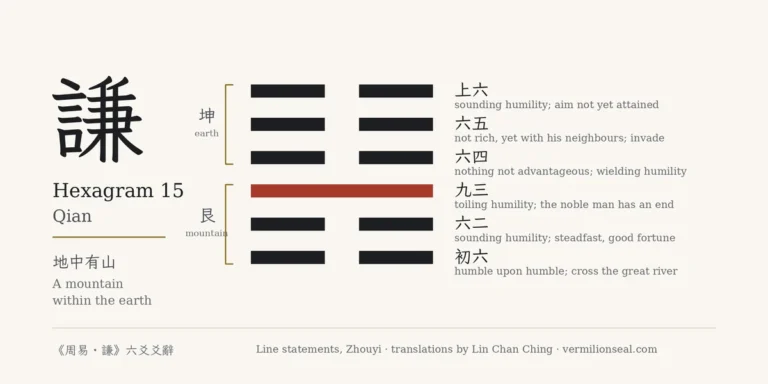
- Trigrams. Mountain 艮 below, Earth 坤 above. The Image takes the picture literally: a mountain sitting inside the earth rather than on top of it.
- Lines. Five yin and one yang, the yang in third place. That single solid line is the one the Xici stops to discuss, and it is why the hexagram is not simply about keeping your head down.
- Judgment. 謙:亨,君子有終。 "Qian: it goes through. The noble man has an end."
The six line texts, in order, each with the reading used throughout this article:
- 初六:謙謙君子,用涉大川,吉。 First six: humble upon humble, the noble man; use it to cross the great river; good fortune.
- 六二:鳴謙,貞吉。 Second six: sounding humility; steadfast, good fortune.
- 九三:勞謙,君子有終,吉。 Third nine: toiling humility; the noble man has an end; good fortune.
- 六四:无不利,撝謙。 Fourth six: nothing not advantageous; wielding humility.
- 六五:不富,以其鄰,利用侵伐,无不利。 Fifth six: not rich, yet with his neighbours; advantageous to invade and attack; nothing not advantageous.
- 上六:鳴謙,利用行師,征邑國。 Top six: sounding humility; advantageous to move an army, to attack one’s own towns and state.
Two of those six move an army. That is the half the English summaries tend to drop, and it is where the rest of this article goes.
The hexagram and its name
Hexagram 15 is 謙, ䷎: three broken lines above (the trigram Kun, earth), and beneath them two broken lines topped by the hexagram’s single unbroken one (the trigram Gen, mountain). The Xugua — the appendix that explains why the sixty-four hexagrams come in the order they do — puts it after hexagram 14, Great Possession: 有大者不可以盈,故受之以謙, “one who has what is great must not be full; hence it is followed by Qian”. That is the frame. The hexagram is not about people who have little. It is about what a person who has a great deal must do next.
The character itself is glossed in the Shuowen, the Han dictionary, as 敬也, “respect”, written with the speech radical. James Legge left it untranslated in 1882, giving only a romanisation; Richard Wilhelm’s German and its English version by Cary Baynes made it “Modesty”, and “Modesty” has stuck. “Humility” and “humbling” are also in use. None is wrong. The trouble is that all of them, in English, describe a private disposition, and the text describes a public conduct.
The judgment and the two commentaries
Judgment, Tuan, and Image
謙:亨,君子有終。
彖曰:謙,亨,天道下濟而光明,地道卑而上行。天道虧盈而益謙,地道變盈而流謙,鬼神害盈而福謙,人道惡盈而好謙。謙尊而光,卑而不可踰,君子之終也。
象曰:地中有山,謙;君子以裒多益寡,稱物平施。
“Qian: it goes through. The noble man has an end. — Tuan: Qian goes through. The way of heaven sends down its help and is bright; the way of earth lies low and moves upward. The way of heaven diminishes the full and adds to the humble; the way of earth alters the full and lets it flow to the humble; ghosts and spirits harm the full and bless the humble; the way of people hates the full and loves the humble. Humble in an honoured place, one shines; humble in a low place, one cannot be overstepped. That is the noble man’s end. — Image: within the earth there is a mountain: Qian. The noble man, accordingly, takes from the many to add to the few, weighs things and distributes evenly.”
《周易・謙》卦辭、彖傳、象傳 · ctext.org
Two things in that text do not survive translation into “modesty”. The first is 有終, “has an end”: not an ending but a completion, the ability to carry something through to its finish. The Taiwanese Yijing site Yixue Wang (易學網), whose chapter-by-chapter reading of the sixty-four hexagrams is the fullest free commentary in Traditional Chinese I know of, glosses the judgment as 君子能實踐到最後, “the noble man can practise it all the way to the end” — the virtue is endurance, not self-effacement.
The second is the Image. 裒多益寡,稱物平施 is an instruction about goods, not about feelings. 裒 means to take away or gather up; 多 and 寡 are the many and the few; 稱物 is to weigh things; 平施 is to give out evenly. Legge, translating in a Victorian register, turned this inward: the superior man “diminishes what is excessive in himself, and increases where there is any defect”. The Chinese has no “in himself”. Yixue Wang reads it as the noble man 運用謙德調和貧富, “using the virtue of Qian to even out rich and poor”, which is what the words say. The mountain inside the earth is a large thing that keeps itself level with what surrounds it, and the person who takes that as his model is a person with enough to level.
The six lines
Line statements with their Xiang commentary
初六:謙謙君子,用涉大川,吉。象曰:謙謙君子,卑以自牧也。
六二:鳴謙,貞吉。象曰:鳴謙貞吉,中心得也。
九三:勞謙,君子有終,吉。象曰:勞謙君子,萬民服也。
六四:无不利,撝謙。象曰:无不利,撝謙;不違則也。
六五:不富,以其鄰,利用侵伐,无不利。象曰:利用侵伐,征不服也。
上六:鳴謙,利用行師,征邑國。象曰:鳴謙,志未得也。可用行師,征邑國也。
“First six: humble upon humble, the noble man; use it to cross the great river; good fortune. (Xiang: humble upon humble, the noble man — he herds himself by lowliness.) Second six: sounding humility; steadfast, good fortune. (Gained in the centre of the heart.) Third nine: toiling humility; the noble man has an end; good fortune. (The myriad people submit.) Fourth six: nothing not advantageous; wielding humility. (He does not go against the rule.) Fifth six: not rich, yet with his neighbours; advantageous to invade and attack; nothing not advantageous. (To punish those who do not submit.) Top six: sounding humility; advantageous to move an army, to attack one’s own towns and state. (The aim is not yet attained. He may move an army against his own towns and state.)”
《周易・謙》六爻爻辭與小象 · ctext.org
Now the famous claim. Three lines end in 吉, good fortune; two end in 无不利, nothing not advantageous; the top line has 利, advantageous, but no 吉, and its commentary says the aim has not been reached. So: five lines plainly good, one qualified, none bad. “The only hexagram with no unlucky line” is a fair summary; “all six lines auspicious” is a rounding-up. Yixue Wang is careful here too — it notes that the good fortune throughout is 不是物質、實質上的一種「得」,比較是修養上、精神上的獲得, “not a material, substantive gain, but more a gain in cultivation, in spirit”. That is a modern reading, and a gentle one, given what the fifth line says.
Line five: the humble man goes to war
利用侵伐 means what it says: it is advantageous to invade and attack. The Xiang commentary adds the justification, 征不服也, “to punish the unsubmissive”, and Yixue Wang spells out the political picture: the fifth line is the ruler’s position, and the ruler 能以謙虛懷柔而收服身邊近處的人心,但對於遠方不服者則以武力討伐 — “wins over those near him by humility and conciliation, but those far away who do not submit he subdues by force”. 不富以其鄰, “not rich, yet with his neighbours”, is read as the ruler who needs no wealth to bring his neighbours along; they follow him because of the conduct the earlier lines describe.
This is the line that English summaries drop, and it is the line that tells you what kind of virtue 謙 is. It belongs to someone who has an army. The Yijing is a book for people who decide things — its earliest layer is a divination manual for a court — and its humility is the humility of a lord who does not overreach, levels his holdings, and is therefore followed. When he does use force, the text presents it as the natural extension of the same posture: punishing the unsubmissive is what the man everyone else has already submitted to does. Whether one likes that or not, it is the text.
Line two: “sounding humility, steadfast, good fortune”
The second line, 鳴謙,貞吉, is the one most often lifted out for calligraphy and for names, so it is worth getting right. 貞 in the Confucian reading is steadfastness or correctness — “hold firm and it will go well”. In the oldest layer of the text it was probably the technical word for the divination itself, “the inquiry is favourable”; the two senses have coexisted for two thousand years and the Xiang commentary already reads it the moral way.
鳴 is harder. It means to sound, to cry out, as a bird or a bell does. Legge has “humility that has made itself recognised”. Yixue Wang lists three possibilities — 求問, to inquire; 呼應、回應、唱和, to answer or sing in response, on the model of the crane in hexagram 61 whose young answer its call; and 歡呼, to cheer — and settles on the second: 唱和式的謙虛, “a humility that answers”, a soft line that follows the capable strong line above it (the third, the hexagram’s only unbroken line) and is glad to. The Xiang‘s 中心得也, “gained in the centre of the heart”, says the humility is not for show.
The proof that position matters more than wording in this book is that the same two characters, 鳴謙, return at the top line with a different verdict. There the Xiang says 志未得, the aim unattained, and the only thing left to do is march on one’s own towns. Yixue Wang’s comment: at the very top of a hexagram whose whole value lies in staying low, sounding humility is 最高調的謙卑,因此是虛假、徒具虛名, “the loudest possible humility, and therefore false, an empty name”. Line two’s humility answers someone; line six’s announces itself.
Line three and what Confucius is made to say about it
The third line, 勞謙, “toiling humility” — the one who does the work and stays humble about it — carries the hexagram’s judgment inside it (君子有終) and is the only yang line. The Xici, the Great Commentary, gives it a gloss in Confucius’s voice that is the tradition’s most candid statement of what this virtue is for:
The Great Commentary on line three
「勞謙君子,有終吉。」子曰:「勞而不伐,有功而不德,厚之至也,語以其功下人者也。德言盛,禮言恭,謙也者,致恭以存其位者也。」
“‘Toiling humility; the noble man has an end; good fortune.’ The Master said: ‘To toil and not boast, to have merit and not count it as one’s own virtue — that is the height of generosity. It speaks of one who, with his achievements, places himself below others. In virtue it means fullness; in ritual it means respectfulness. Qian is bringing respectfulness to its height in order to keep one’s position.’”
《周易・繫辭上》 · ctext.org
以存其位: “in order to keep one’s position”. Not to lose the self, not to become nothing — to stay where one is. It is a prudential virtue with a political payoff, and the commentary is not embarrassed to say so. The same idea is in a proverb still in everyday use in Taiwan, 滿招損,謙受益, “fullness invites loss, humility receives gain”, which comes from the Book of Documents and which the Tuan commentary above is plainly echoing when it lists what heaven, earth, spirits and people each do to the full.
This site does not cast or interpret hexagrams, and this entry is not a reading. If you want to see how the Chinese-speaking world does consult the text, the free commentary at Yixue Wang goes line by line through all sixty-four, and for how a Taiwanese temple asks a yes-or-no question without any book at all, see jiaobei and fortune sticks. For the way another classic’s advice to rulers got turned into advice for individuals, see wu wei; for the general problem of choosing an English version of a Chinese classic, see which Tao Te Ching translation; and for a Confucian text whose first sentence has its own two-character dispute, see the Great Learning’s three principles.
The humility sentence that is not in this hexagram
Ask a Chinese reader for the classic line about humility and you will almost certainly get 滿招損,謙受益 — fullness invites loss, humility receives benefit. It sits so comfortably beside the Tuan commentary here, 天道虧盈而益謙, that the two end up filed together. They are not from the same book, and they are not doing the same work.
The Ministry of Education’s Dictionary of Chinese Idioms names the source without hedging: 《書經.大禹謨》, the Counsels of Yu the Great in the Book of Documents, where the sentence runs in full 惟德動天,無遠弗屆,滿招損,謙受益,時乃天道. The gloss is nine characters: 自滿會招致失敗,謙虛會得到好處。 The entry then cites Chen Shidao of the Song for later usage. The Book of Changes is not mentioned, and the sentence does not appear anywhere in the text of this hexagram.
The difference matters more than the shelving. The Documents line is a maxim with a reward attached: be modest and good things follow. The Tuan is addressed to nobody. It describes what the world does — heaven diminishes the full, earth overturns it, ghosts and spirits harm it, people dislike it — and the humble man is simply standing where the damage is not falling. That is a statement of the same kind as Laozi on heaven and earth not being benevolent: a description of how things go, not an encouragement.
A quieter shift has happened to the hexagram’s other famous phrase. 謙謙君子 opens the first line here, where it reads 謙謙君子,用涉大川,吉 — humility doubled, and then a river to cross. The Xiang commentary restates it as 謙謙君子,卑以自牧也, he herds himself by lowliness, and it is the commentary’s half that the idiom dictionary cites and that modern Chinese kept: the entry glosses 謙謙君子 as 謙虛有禮、嚴以律己的人, a courteous man who is strict with himself. Self-discipline is in the commentary. The great river is not in the idiom at all. Phrases lose their second halves on the way into ordinary speech more often than readers expect, which is the whole subject of Three in the Morning and of Mei xia yu kuang.
The hexagram has a livelier afterlife in Taiwan than any of that suggests. In December 2024 the astrologer Tao Wen, writing in the Commercial Times, took it as the figure for the year ahead on the Taiwanese market, and the picture caption put the practical reading in one line: 從「地山謙」的卦象來看,鎖定權值強勢股以來回運作的方式,反而容易營造其中的財富 — read through Earth-over-Mountain, wealth comes from working the heavyweight stocks back and forth rather than chasing them. This site describes what people do with the classics and does not cast or read hexagrams for anyone; but it is worth noticing where Qian turns up. Not on a museum label. In the stock pages, in a sentence about weighted indices, printed without explanation because none was thought necessary.
The hexagrams next door
A hexagram is never alone. Change one of its lines and you have a different figure; overlap its middle lines and you get another; turn it upside down, or flip every line, and you get two more. Those derivations are standard, mechanical and entirely public — each one below follows from the figure itself, five yin with one yang in third place, and anyone holding Qian can check every one in a minute. This site does not tell readers what their reading means, and is not about to start. But the arithmetic belongs to the text, and leaving it out helps nobody.
Change a single line and Qian becomes:
- First line moving → 36, 明夷 Ming Yi, brightness wounded.
- Second line → 46, 升 Sheng, pushing upward.
- Third line → 2, 坤 Kun. Take away the one solid line and nothing is left but earth — which is a fair comment on the line the Xici praises most.
- Fourth line → 62, 小過 Xiao Guo, small exceeding.
- Fifth line → 39, 蹇 Jian, limping.
- Top line → 52, 艮 Gen, keeping still.
And the three standard derivations:
- Nuclear, built from lines two to four and three to five: 40, 解 Xie, release.
- Reversed, the whole figure turned upside down: 16, 豫 Yu.
- Opposite, every line changed: 10, 履 Lü, treading.
The reversed one is the interesting case, because it is also the next hexagram in the sequence. Qian and Yu are a single arrangement of six lines read from either end, and the Xu gua pairs them deliberately: possessing greatly must not become fullness, so Qian; and then Yu. Whatever the received order is doing, it is not treating modesty as a terminus.
FAQ
What does I Ching hexagram 15 mean?
Qian (謙), usually translated Modesty or Humility: a mountain inside the earth, something great that keeps itself low. The judgment says it “goes through” and that the noble man “has an end”, that is, can carry things to completion. The Image commentary tells him to take from the many and add to the few and distribute evenly.
Is hexagram 15 really the only one with all six lines favourable?
Nearly. Three lines say good fortune, two say nothing not advantageous, and the top line says advantageous but its commentary adds “the aim not yet attained”. No line is unlucky, which no other hexagram can claim, but “all six auspicious” slightly overstates the top line.
What does 鳴謙貞吉 mean?
Line two: “sounding humility; steadfast, good fortune”. A humility that answers or responds to someone worthier, held firmly, brings good fortune; the commentary says it is “gained in the centre of the heart”. The same phrase at the top line is judged hollow, because loud humility in the highest place is for show.
Why does a hexagram about modesty talk about invading?
Because its subject is a ruler. Line five says the humble lord who has won over his neighbours may “advantageously invade and attack”, and the commentary explains this as punishing those who do not submit. The humility of the Yijing is the conduct of someone with power, not the absence of power.
What are the trigrams of hexagram 15?
Mountain 艮 below and Earth 坤 above, which is why the Image reads 地中有山, within the earth there is a mountain. In line terms: five yin lines with a single yang in third place.
What does hexagram 15 change into?
That depends on which line moves. First line gives 36 Ming Yi, second 46 Sheng, third 2 Kun, fourth 62 Xiao Guo, fifth 39 Jian, top 52 Gen. Its nuclear hexagram is 40 Xie, its reversal is 16 Yu, and its opposite is 10 Lü. These are derivations from the figure, not interpretations of anybody’s reading.
Is "pride brings loss, modesty brings benefit" from the I Ching?
No. 滿招損,謙受益 is from the Book of Documents, in the Counsels of Yu the Great, and the Ministry of Education’s idiom dictionary cites it there. The resemblance to the Tuan commentary on this hexagram is real but it is a resemblance, and the two sentences do different work: one promises a reward for modesty, the other describes what heaven and earth do to whatever is full.
Sources
- 《周易・謙》卦辭「謙:亨,君子有終」、彖傳、象傳「地中有山,謙;君子以裒多益寡,稱物平施」、六爻爻辭與小象(含理雅各英譯對照) — ctext.org (accessed 5 Sep 2026)
- 《周易・繫辭上》「勞謙君子,有終吉。子曰:勞而不伐,有功而不德……謙也者,致恭以存其位者也」 — ctext.org;《周易・序卦》「有大者不可以盈,故受之以謙」 — ctext.org (accessed 5 Sep 2026)
- 易學網(台灣)Jack〈15. 謙卦(地山謙)〉,《易經今解》:「君子能實踐到最後」「運用謙德調和貧富」「唱和式的謙虛……鳴有許多種可能的解釋」「君王能以謙虛懷柔而收服身邊近處的人心,但對於遠方不服者則以武力討伐」「最高調的謙卑,因此是虛假、徒具虛名」 — eee-learning.com (accessed 5 Sep 2026)
- 《說文解字・言部》「謙:敬也。从言兼聲」 — ctext.org;《尚書・大禹謨》「滿招損,謙受益,時乃天道」 — ctext.org (accessed 5 Sep 2026)
- Ministry of Education, Dictionary of Chinese Idioms (2020), entry 滿招損,謙受益, ID 10002: gloss 自滿會招致失敗,謙虛會得到好處, source given as 《書經.大禹謨》 — dict.idioms.moe.edu.tw (accessed 1 Oct 2026)
- Ministry of Education, Dictionary of Chinese Idioms (2020), entry 謙謙君子, ID 7140, source given as 《易經.謙卦.象曰》 — dict.idioms.moe.edu.tw (accessed 1 Oct 2026)
- Tao Wen, 〈2025 台灣國運經濟與台股趨勢〉, Commercial Times, December 2024 — tw.stock.yahoo.com (accessed 1 Oct 2026)



