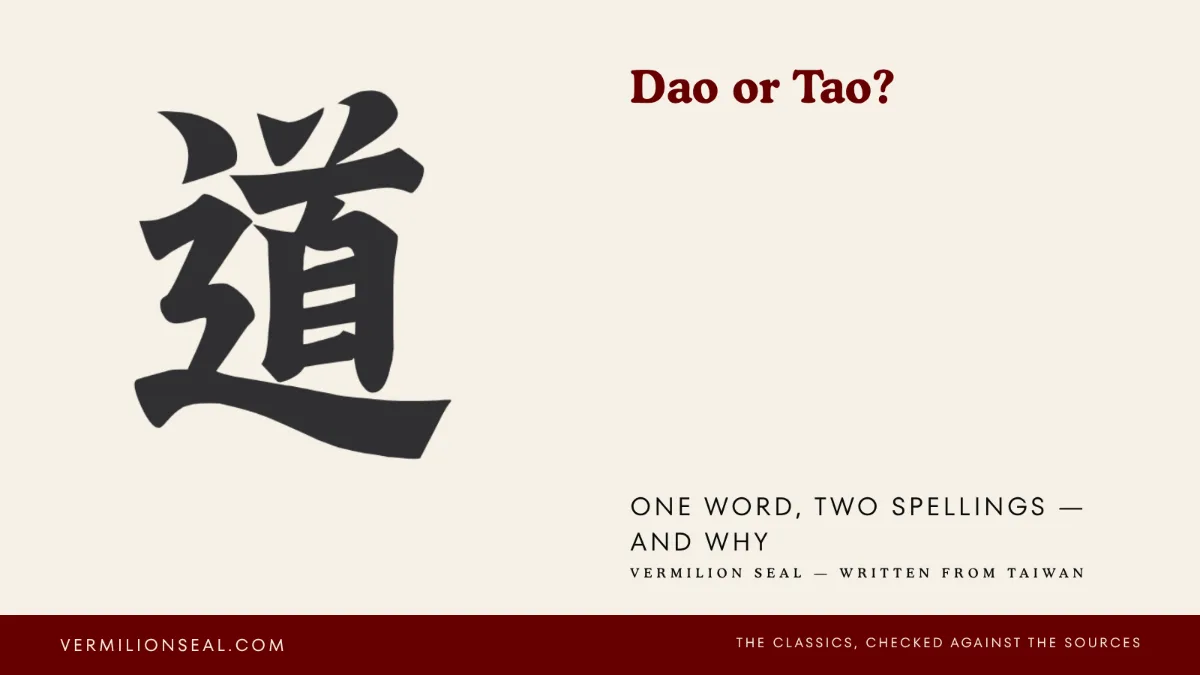
The book is called the Tao Te Ching and the concept is called dao. Both spellings are correct, they refer to exactly the same word, and the reason there are two of them is a nineteenth-century punctuation mark that almost everybody stopped printing.
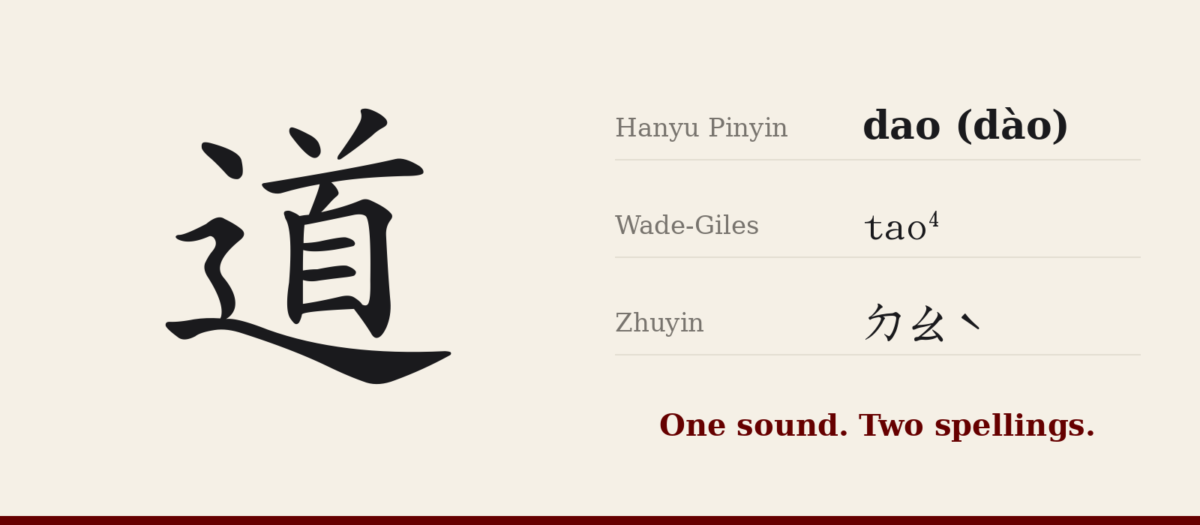
The character is 道. In Mandarin it is pronounced dào — falling tone, and the consonant is closer to an English d than an English t. Taiwan’s Ministry of Education gives the readings side by side in its official romanisation converter: Hanyu Pinyin dào, Wade–Giles tao⁴, Zhuyin ㄉㄠˋ. One sound, two spellings, and the older spelling starts with a letter that misleads every English speaker who meets it.
Where the T came from
The older system is Wade–Giles. It was begun by Thomas Francis Wade, a British diplomat in China who published The Peking Syllabary in 1859 and, in 1867, what is generally described as the first English textbook of the Beijing dialect; in 1888 he became Cambridge’s first Professor of Chinese. Herbert Giles then reworked it for his Chinese–English Dictionary; the Encyclopaedia Britannica credits the 1912 edition with the modification that fixed the system, though the dictionary’s first edition appeared in 1892.
Wade was solving a real problem. Mandarin has pairs of consonants that English does not distinguish the same way. English t and d differ mainly in voicing. Mandarin’s pair differs in aspiration — the puff of air — and both members are voiceless. The phonetic description of Standard Chinese by Lee and Zee in the Journal of the IPA lists the stops as p pʰ, t tʰ, k kʰ: voiceless throughout, separated by that puff.
Wade’s answer was to write both members with the same letter and mark the aspirated one with an apostrophe. So t is the unaspirated consonant and t’ is the aspirated one. 道 is tao; a genuinely t-like syllable is t’ao. The Library of Congress conversion chart still records the pairing: Wade–Giles tao becomes pinyin dao, and t’ao becomes pinyin tao.
The system works. What broke it was that printers, typists and everyone downstream dropped the apostrophes. Once they go, tao and t’ao collapse into one spelling for two different syllables — and the surviving spelling tells English readers to say the wrong one. As the Wikipedia summary of the system puts it, people unfamiliar with Wade–Giles often omit the marks “unaware that they represent vital information.”
That is the whole of it. Tao is not an older or more authentic form of the word. It is dao with a diacritic missing.
Where the D came from
Hanyu Pinyin was approved by the People’s Republic on 11 February 1958, at the fifth session of the first National People’s Congress. It assigns the unaspirated consonant its own letter — d — and reserves t for the aspirated one, so no apostrophe is needed and nothing is lost when the typesetting is careless.
It spread outward in stages. The United Nations recommended it for Chinese geographical names by resolution III/8 in 1977, at the Third UN Conference on the Standardization of Geographical Names in Athens. The PRC required it in diplomatic and foreign-language publications from 1 January 1979. It became ISO 7098 in 1982. The Library of Congress announced its conversion in November 1997 and switched on 1 October 2000, taking American library catalogues with it.
That last date matters more than it looks. Almost every English book about Chinese thought published before 2000 was catalogued, indexed and cross-referenced in Wade–Giles. The spelling in your library is a record of when the book entered it.
What Taiwan uses, and why the answer has changed twice
Taiwan is not a footnote here. It is where this site is written, and its romanisation history is genuinely more complicated than the mainland’s.
In 2002 the Ministry of Education promulgated the Principles for the Use of Chinese Romanisation, filed with the Executive Yuan that August and promulgated on 18 September. The system adopted then was Tongyong Pinyin, a made-in-Taiwan scheme. Six years later the Cabinet reversed it: the Taipei Times reported the decision of 16 September 2008 to move to Hanyu Pinyin nationwide from 1 January 2009. The amended text, promulgated that December, says it plainly: except where otherwise provided, Chinese romanisation in this country follows Hanyu Pinyin.
The switch was never retrofitted to everything. Older street signs, personal names on passports, and the spelling of places like Kaohsiung and Taichung all predate it and were mostly left alone. If you have travelled in Taiwan and found the signage inconsistent, that is not carelessness. It is three systems’ worth of sediment.
One consequence for reading: Taiwan-published English scholarship from before 2009 is generally in Wade–Giles, and the older romanisation is still what you will meet in temple signage and in the names of institutions that were named decades ago. We write about why this site is written from Taiwan separately.
So why is it still the Tao Te Ching?
Because some words entered English early enough to stop being romanisations and start being English words.
The Oxford English Dictionary’s first attestations tell the story: Tao in 1736, Taoism in 1903, Daoism not until 1948. By the time pinyin arrived, Tao had been in English for over two centuries. Merriam-Webster still gives Taoism as the headword with Daoism as a less common variant — and then lists the pronunciation with the d-sound first. English spells it with a T and says it with a D.
Scholarship went the other way. The Stanford Encyclopedia of Philosophy explains the double spelling in a footnote to its Daoism entry, notes that Western scholarship was dominated by Wade–Giles, and calls the situation a temporary inconvenience of the same kind as Peking and Beijing. Academic style guides now default to pinyin while exempting words already familiar to English readers in their older form; the Tang Center at Columbia lists the Dao, fengshui and Tiananmen as examples.
And the older spellings hold on hardest where an institution has a name to protect. Peking University’s own English website says Peking, in a city that has been Beijing in every atlas for forty years.
Which should you use?
There is no correct answer, only a consistent one. What we do here, and what we would suggest:
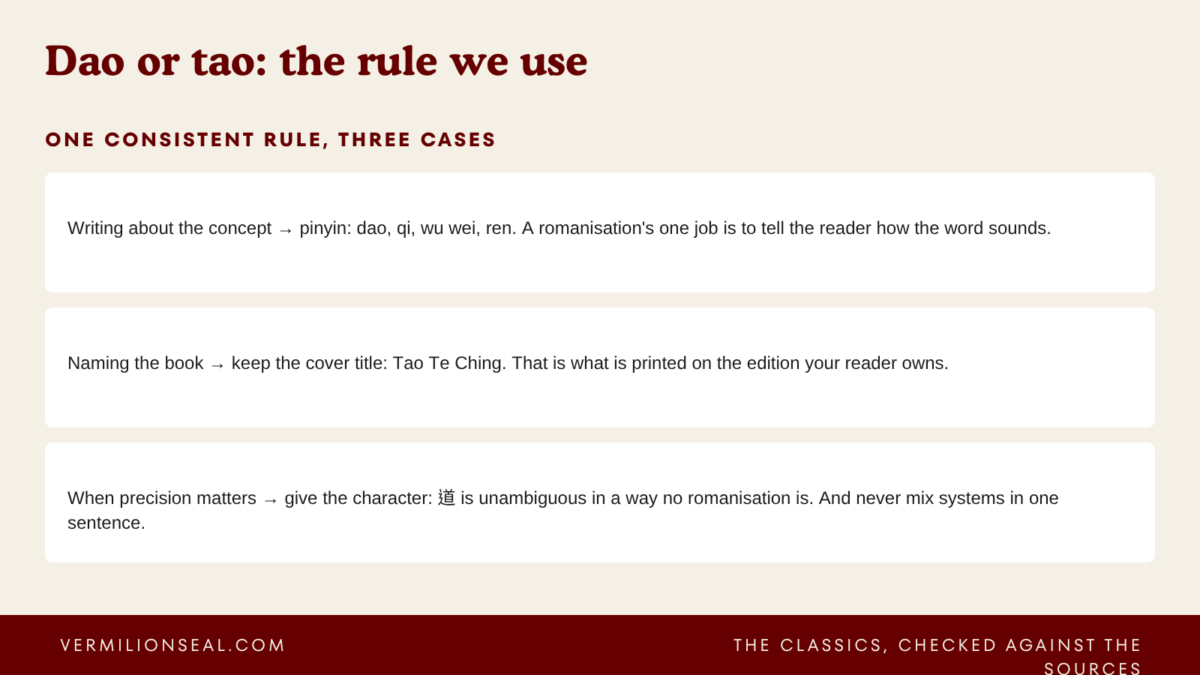
- Use pinyin for the concept. Write dao, qi, wu wei, ren. It tells the reader how the word sounds, which is the job of a romanisation.
- Keep the traditional English title of a book. Tao Te Ching is what is printed on the cover of the edition your reader owns. Writing Daodejing is defensible and helps nobody find their copy.
- Give the character. 道 is unambiguous in a way no romanisation is. Every entry on this site carries the original alongside the English for exactly this reason.
- Never mix systems in one sentence. “The Tao is expressed through dao” is not a sentence; it is two spellings of one word pretending to be a distinction.
If you are searching for something and coming up empty, try the other spelling. A great deal of the best twentieth-century work on Chinese thought is filed under a T.
The one thing the spelling does not tell you
Neither spelling tells you what the word means, and the English reader arrives already holding an answer — usually something like a flow, a force, a thing one aligns with.
Classical Chinese uses 道 far more plainly than that. Depending on the sentence it is a road, a method, a doctrine, a school of thought, or the verb to speak. The oldest definition available to us, from the Shuowen Jiezi of around 100 CE, is simply “the road that is walked” — no metaphysics at all. And the Confucian 道 and the Daoist 道 are not one idea sharing a character; they are two arguments about what the word should mean.
The concepts library defines these terms from the passages where the tradition defines them itself, and the character library covers how 道 is built and where its parts come from. How every entry is checked is set out on the methodology page; when we get something wrong, the correction is public in the corrections log.
The same century-old system that gives the book two spellings gives Taiwan’s cities theirs: why Taipei is not spelled Taibei follows the story into the postal tables and the government regulation that fixed it. And once the spelling is settled, the harder question is which English to read: seventeen Tao Te Ching translations compared.
The argument about how to spell a Chinese word in English is being had again right now over a different one. Chinese dragon vs Western dragon covers the case for writing “loong” instead of “dragon”, and the case against it.
The spelling is the easy question about the author of this book. The hard one — when he lived, and whether he lived at all — is taken up in did Laozi live before Confucius?
For a second word that English kept in two spellings and one mistranslation, see what arhat means, where 羅漢 turns up as lohan, as luohan, and on a packet of sweetener as a monk.
For a live example of the same argument still unresolved on government websites, the sea goddess 媽祖 is spelled three different ways in official Republic of China English — Matzu by the Office of the President, Mazu and Matsu by the Tourism Administration, in one sentence — and the islands named after her carry the oldest of the three. Which spelling of Mazu is right, and why three of them are official works through that case in detail.