
There are more than a dozen English Analects in print and they disagree with each other on almost every line that matters. That is not a scandal. The text is short, elliptical, and two and a half thousand years old, and every translator has to decide what it means before they can put it into English. The useful question is not which translation is correct. It is which one shows you the decision.
Below: what each of the standard editions actually is, what it gives you, and which one to buy for which purpose. No affiliate links. The free option is listed first because for many readers it is genuinely the right answer.
Start free, and find out what you want
James Legge’s translation is out of copyright and readable in full at Project Gutenberg. More usefully, the Chinese Text Project puts the Chinese and Legge’s English side by side, chapter by chapter, free, with every passage individually addressable — for example Book 4, Li Ren.
Spend an hour there before spending money. You will discover quickly whether you want a book that reads well, a book that argues with itself in the footnotes, or a book with the Chinese on the facing page. Those are three different purchases.
Every quotation on this site links back to ctext for the same reason: you should be able to check us.
What is actually in each edition
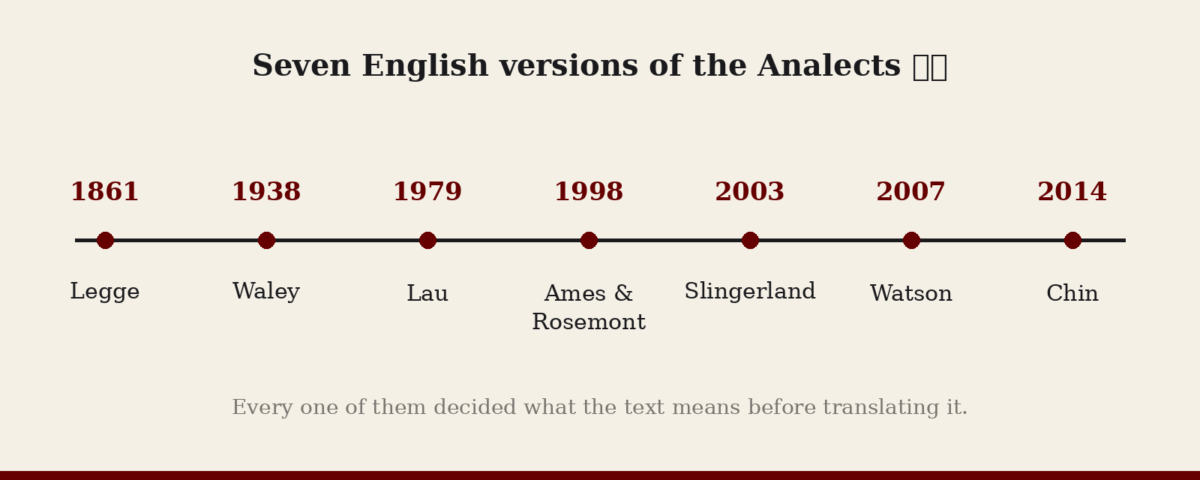
| Edition | First published | Chinese text | Commentary |
|---|---|---|---|
| James Legge | 1861; rev. 1893 | Yes, parallel | Extensive, his own |
| Arthur Waley | 1938 | No | Introduction and notes |
| D. C. Lau (Penguin) | 1979 | No | Introduction, appendices |
| Ames & Rosemont | 1998 | Yes | Extensive, philosophical |
| Edward Slingerland | 2003 | No | Traditional Chinese commentaries, translated |
| Burton Watson | 2007 | No | Deliberately minimal |
| Annping Chin | 2014 | Yes | Extensive, commentary-informed |
James Legge (1861, revised 1893)
The Victorian missionary edition, and still the one most often quoted in English, because it is free and because it was first. Legge printed the Chinese, the English and his own dense notes together — a genuinely scholarly apparatus that most modern trade editions do not match.
Its weakness is the one Edward Slingerland names directly: Legge’s reading was “heavily influenced by his Christian faith”. It shows in the vocabulary — Heaven doing work that looks a great deal like Providence, virtue that reads like Christian virtue. Legge was not concealing this; he was a missionary translating for missionaries. But if you read only Legge you will absorb a nineteenth-century Protestant Confucius without noticing.
Buy it if: you want the Chinese, the English and heavy annotation for nothing.
Arthur Waley (1938)
The one that reads best. Slingerland calls it “perhaps the smoothest and most literary of Analects translations, with excellent notes”, and that is the consensus. Waley was a translator of poetry first, and it shows: the English has rhythm, and Confucius sounds like a person speaking rather than a monument being quoted.
The cost of that fluency is that the seams do not show. Where the Chinese is ambiguous, Waley usually gives you one confident English sentence. It is a beautiful book to read and a poor one to argue from. In print from Vintage.
Buy it if: you want to read the Analects straight through, once, and enjoy it.
D. C. Lau (Penguin, 1979)
For decades the default — Slingerland’s bibliography calls it “the classic and most commonly read translation”. Lau was a Chinese philosopher writing in English, and the translation is careful, unshowy and reliable. The Penguin Classics edition carries an introduction, a glossary and appendices on Confucius and the disciples; it does not carry the Chinese. A separate bilingual edition exists from Chinese University Press in Hong Kong.
Buy it if: you want one safe modern translation and are not sure what else you need.
Ames & Rosemont (1998)
A philosophical translation, and it says so on the cover. Ames and Rosemont argue that standard English renderings smuggle in Western assumptions — that translating 仁 as “benevolence” imports a whole moral psychology the Chinese does not have — and they retranslate the core vocabulary accordingly. It prints the Chinese and was the first English translation to take account of the Dingzhou manuscript, an excavated text released in 1997.
Not everyone is convinced. Slingerland describes it as a “rather untraditional interpretation of the text”, which in a bibliography is a warning label. Read it as a strong argument about how to read the Analects, not as a neutral rendering — and notice that the same is true of every other translation here, just less openly.
Buy it if: you already know the text and want it defamiliarised.
Edward Slingerland (Hackett, 2003)
The one we would put in most people’s hands, for a reason that has nothing to do with the English.
Slingerland translates the Analects and then translates a selection of the classical Chinese commentaries alongside it — He Yan, Zhu Xi and the rest of the tradition that spent two millennia arguing about what these lines mean. Paul Kroll’s blurb on the publisher’s page calls it the version of choice for undergraduate teaching, and the reason is visible on any page: you see the passage, and then you see three people who read Chinese natively disagreeing about it.
That is the whole difference between reading a translation and reading a text. Every other edition on this list hands you one reading. This one hands you the argument.
Buy it if: you want to understand the Analects rather than have read it.
Burton Watson (Columbia, 2007)
Short, clean, and deliberately unhelpful: Columbia’s description says it keeps explanatory notes to a minimum. Watson was one of the great translators of Chinese literature and the English is excellent. At 176 pages it is the most portable of the serious editions.
Buy it if: you have read the text before and want it without apparatus.
Annping Chin (Penguin Classics, 2014)
The best-equipped recent edition. It prints both the English and the Chinese, carries commentary throughout, works through the commentarial tradition rather than around it, and draws on recently excavated manuscripts. At 432 pages it is roughly two and a half times the length of Watson’s for the same text — all of that difference is apparatus.
Buy it if: you want the Chinese and commentary in one modern volume.
The thing worth knowing before you choose
The Analects has never been read alone. For most of its life it was read through commentary — He Yan in the third century, Zhu Xi in the twelfth, and a long argument between them and after them. When Zhu Xi’s reading became the basis of the imperial examinations, it became, for six hundred years, what the text meant.
So a translation with no commentary is not a neutral one. It is a translation that has made all the same decisions and simply not shown them to you. When two English versions of a line disagree, the disagreement is usually not about Chinese grammar. It is about which commentator the translator followed.
This is why we would rank Slingerland first for a reader who wants to get somewhere. It is not a better English style than Waley — it is not — but it is the only one on this list that lets you watch the decision being made.
What we would actually buy
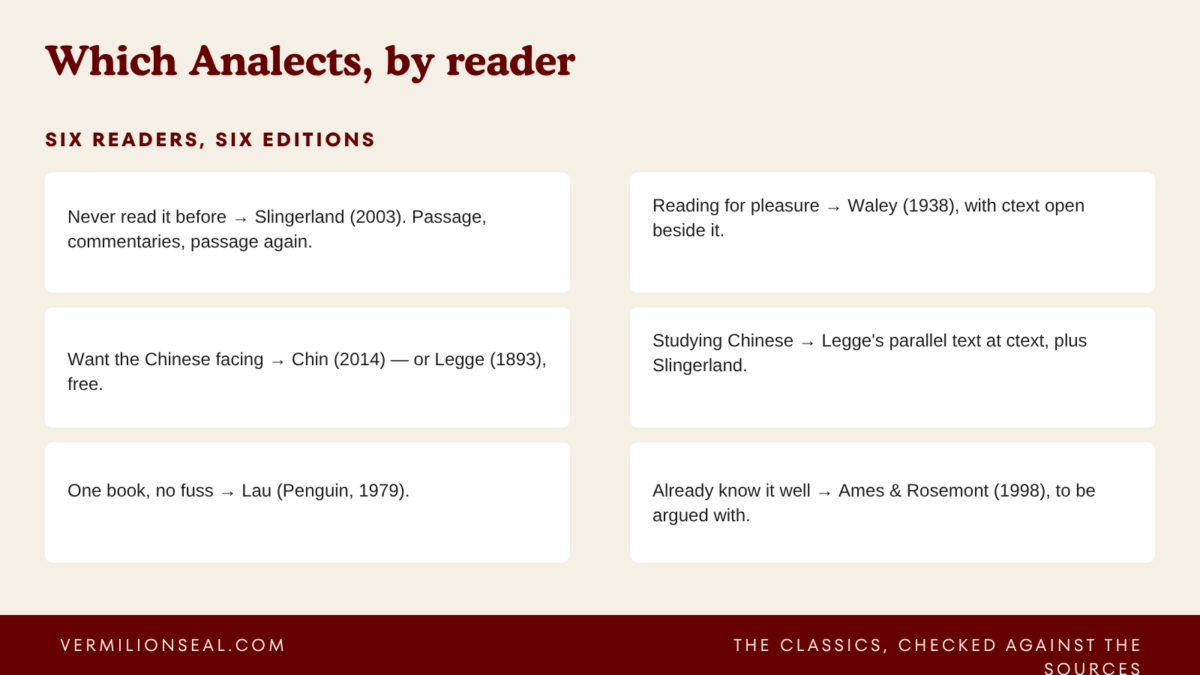
- Never read it before: Slingerland. Read the passage, then the commentaries, then the passage again.
- Want to read it for pleasure: Waley, and keep ctext open when a line stops you.
- Want the Chinese facing: Chin, or Legge for free.
- Studying Chinese: Legge free at ctext for the parallel text, plus Slingerland for what the tradition made of it.
- One book only, no fuss: Lau.
- Already know it well: Ames & Rosemont, to be argued with.
And a note on price: the free Legge at ctext is not a lesser option. It is a full parallel text with the translator’s own notes, and it costs nothing. Read there until you know what you are missing, then buy the edition that supplies it.
Where to go from here
Our classical texts section covers what each book is and how the commentary tradition shaped it; the quotations library gives individual passages with the original beside the English and a link to the source text; the concepts library handles the terms — 仁, 禮, 道 — that the translations disagree about most.
Which editions we read here, and how translations on this site are made and checked, is set out on the methodology page. When we get something wrong, the correction is public in the corrections log.
The companion guide does the same exercise for the other book everyone quotes: which Tao Te Ching translation to read, where the two best-selling versions turn out not to be translations at all.
Two related entries: who made the Confucius we read in the Analects?, on how the compilers shaped the text every translator starts from, and can the Kongzi Jiayu be trusted?, on the longer book from which many “Confucius said” quotations actually come.
For the same problem in the Four Books’ shortest text, see the Great Learning’s three principles and the order of its eight steps.
For a much shorter test case in the same vein, compare the English versions of the Loushi Ming, eighty-one characters over which translators still differ.



