Four characters, 相濡以沫, turn up on Taiwanese wedding banners, in diamond-anniversary write-ups and in a mayoral candidate’s Facebook post. They are usually glossed as devotion: two people keeping each other alive through hard years. The characters are from Zhuangzi, and in Zhuangzi they are the first half of a sentence. The second half says it would be better to forget each other in the rivers and lakes. That half does not travel. This piece follows the sentence through three Taiwanese government dictionaries and four English translations to work out exactly where it gets cut, and by whom.
The half that survived
The idiom means, officially, mutual help in adversity. Taiwan’s Ministry of Education Dictionary of Chinese Idioms glosses it as a figure for 同處於困境,互相以微力救助 — being in difficulty together and helping one another with what little strength one has. Three of its four sample sentences are about friends; the remaining one is about a married couple. The Concise Mandarin Chinese Dictionary gives one example: 他們兩人感情深厚,並曾共同度過一段相濡以沫的艱苦日子 — the two of them are deeply attached, and once got through a hard stretch together.
Nothing in that is a misreading of the four characters on their own. The fish do moisten each other. The trouble is what Zhuangzi says next, which is that he would rather they did not have to.
What 《莊子・大宗師》 actually says
The passage sits in the sixth of the inner chapters, between a statement that life and death are simply given and the line about the Great Clod that burdens us with a body. The Ministry of Education’s idiom dictionary prints the whole run in its source field:
《莊子・大宗師》
死生,命也,其有夜旦之常,天也。人之有所不得與,皆物之情也。……泉涸,魚相與處於陸,相呴以濕,相濡以沫,不如相忘於江湖。與其譽堯而非桀也,不如兩忘而化其道。
Death and life are given; that they come round as regularly as night and morning is heaven’s doing. There are things a person cannot take part in, and that is simply how things are. … When the spring dries up, the fish are left together on dry land. They breathe damp air over one another; they wet one another with froth from the mouth. It would be better to forget one another in the rivers and the lakes. Rather than praising Yao and condemning Jie, better to forget them both and be transformed along with the Way. (My translation.)
Text as printed in the Ministry of Education 《成語典》, entry 1523, source field.
Two things about the shape of it. The fish on dry land are not an image of love; they are an image of an emergency, and the emergency is the drying up of the spring. And the sentence does not stop at the emergency. It is built as a comparison — 不如, not as good as — and the thing being compared unfavourably is precisely the mutual moistening. The same grammar runs again in the next line about Yao and Jie: praising one and condemning the other is 不如 forgetting both. Zhuangzi is not warming up to the fish. He is using them as the weaker term.
涸, 呴, 濡, 沫: four characters, from Taiwan’s own dictionaries
It is worth slowing down on the vocabulary, because one of these characters is the reason the English translations disagree with each other.
涸 (hé) is given by the Revised Mandarin Chinese Dictionary as 水乾竭、乾枯 — water running dry, drying up. The dictionary’s own citation is from Wang Bo’s preface to the Pavilion of Prince Teng, and from chapter five of Dream of the Red Chamber: 其中水涸泥乾,蓮枯藕敗.
呴 (xǔ) is to breathe or blow out; the dictionary’s second sense is 張口哈氣使對方溫潤, opening the mouth and breathing to make something else warm and damp. So 相呴以濕 is fish panting over each other, not fish touching.
濡 (rú) is simply to wet or soak — the idiom dictionary’s own note on this passage glosses it 沾溼.
沫 (mò) is the interesting one. The Revised dictionary gives two nominal senses, in this order: bubbles that form and float on the surface of a liquid — 泡沫, soap suds, the froth on tea — and, second, saliva: 口沫, 唾沫, 飛沫. Both senses are official, both are current, and the line does not tell you which is meant. Each translator has had to choose, and that is where the split between slime and spit comes from — a genuine ambiguity in the Chinese rather than anyone’s carelessness.
Where the cut falls
Here is the part I did not expect. The sentence is not shortened once, somewhere in the past, by someone anonymous. It is shortened in specific fields of specific dictionary entries, and you can watch it happen inside a single page.
Entry 1523 of the Ministry of Education Dictionary of Chinese Idioms has a source field and, further down, a citations field. The source field prints the sentence whole. The citations field prints it twice — once from 大宗師, once from the parallel passage in 天運 — and the two citations stop in different places:
教育部《成語典》ID 1523, citations field
《莊子.大宗師》:「泉涸,魚相與處於陸,相呴以濕,相濡以沫。」(源)
《莊子.天運》:「泉涸,魚相與處於陸,相呴以溼,相濡以沫,不若相忘於江湖!」(源)
Same editor, same page, the same passage quoted from two different chapters — and two different stopping points. The chapter the idiom is actually sourced from is the one that gets cut; the parallel passage keeps its ending.
Entry 1523, advanced edition. The two chapters differ elsewhere too — 濕 against 溼, and 不如 against 不若. Those are variants, not errors.
Widen the frame and the same cut appears in three more places. The Revised Mandarin Chinese Dictionary entry for the idiom quotes Zhuangzi directly and closes the quotation marks after 相濡以沫. The Concise edition quotes nothing at all and offers the couple sentence. And the single-character entry for 呴 cites the parallel chapter and stops at the same four characters — even though the 天運 text is the one place the ending does survive, over in entry 1523 of the idiom dictionary.
| Where a reader lands | Quotes the Chinese? | Keeps 不如相忘於江湖? |
|---|---|---|
| Idioms, entry 1523, source field | Yes, in full | Yes |
| Idioms, entry 1523, 典故說明 (story) field | Paraphrase | No — paraphrased, not quoted |
| Idioms, entry 1523, citations field (大宗師) | Yes | No |
| Idioms, entry 1523, citations field (天運) | Yes | Yes |
| Revised, entry 109640 | Yes | No |
| Concise, entry 27903 | No | No |
| Revised, character 呴, entry 4831 | Yes | No |
Of the seven places in the table, the two that print the clause in full are the source field and the 天運 citation, and both sit inside the advanced idiom entry — the deepest of the three layers. I want to be fair about this, because the advanced entry does the job properly. Its 典故說明 field — the one that retells the allusion, not the 釋義 that defines it — spells the point out: the fish wetting each other look close, but it is 不如當初仍在水中,互相不認識時的快樂 — nothing like the ease of being back in the water and not knowing one another. It then says, in so many words, that the idiom was 從原文摘出: extracted from the original. The dictionary knows. It says so. And then, four fields later, it prints the extract as the citation.
Slime, spit, moist breath: four translators who kept the ending
My first guess was that English translation had done the damage, in the way it is often said to have done to the straw dogs of Laozi’s fifth chapter. It had not. Working back through four standard versions, I could not find one that drops the second half.
James Legge, in 1891, has the fishes keeping one another wet by their slime, and then: it would be better for them to forget one another in the rivers and lakes.
Burton Watson, whose version is the one most English readers meet, chooses spit for 沫 and spew each other with moisture for 呴, and ends with the fish being better off if they could forget each other in the rivers and lakes
— the 1968 wording. Brook Ziporyn (2009) also reaches for spitting and keeps the comparison. Christopher Tricker, whose version reorganises the book into themes, heads this passage When the springs dry up
and keeps the comparison intact.
So what variation there is between the English versions concerns 沫, not the ending — and all four reach for a mouth-fluid word rather than the froth sense the Ministry’s dictionary lists first. All four agree on the ending, from 1891 to 2022. Whatever happened to this sentence happened inside Chinese, to Chinese readers, through the machinery of idiom lexicography. In these four versions it is not a translation problem at all. That is the opposite of what this site usually finds, and it is worth saying plainly.
相忘 has no entry of its own
The missing half is missing in a narrower sense too. Search the three Ministry of Education dictionaries’ own headword indexes for 相忘 and all three return nothing: the Revised dictionary reports 找到正文0則,附錄0則, the Concise edition the same, and the idiom dictionary returns zero for 相忘 and for 相忘於江湖. Those searches work — the same interface returns three entries for 相濡 and four for 沫, so the zeroes are real and not a broken query. The clause itself does appear inside entry 1523, in the source field and in the 天運 citation quoted above. What it has nowhere is an entry of its own.
The idiom dictionary does list three variant forms under entry 1523: 以沫相濡, 沫相濡, 濡沫涸轍. Every one of them is built out of the half Zhuangzi was arguing against. Half a sentence has four registered forms; the other half has none.
Taiwan in practice: a resignation note and a Qixi post
You can watch both readings in circulation here, a few years apart, in the same newspaper.
In November 2019, when two figures left a Taiwanese political party, the Liberty Times reported that one of them had written the whole sentence into his resignation document: 相濡以沫,不如相忘於江湖 (the line appears in the paper’s photo caption). Read against the full line, it works as a parting formula — we kept each other going while the water was low, and now we should stop having to. The second half is doing the work.
In August 2022, a Qixi post reported by the same paper ran the other way: 獻給天下情人:相濡以沫,白頭偕老 — to all the lovers in the world: moisten each other, and grow old together. Here the four characters are paired with a different idiom, 白頭偕老, and the result is a blessing. The pairing also turns up in Taiwanese local-government coverage of long marriages: a 2025 report on a Tainan district office’s diamond-wedding ceremony uses it to praise sixty years together.
None of these uses is illiterate. Two of them are simply running on the dictionary definition, which is what a dictionary is for. But put the 2019 and 2022 uses side by side and the four characters mean, in the first, we should part, and in the second, we should never part. That is a wide gap for one phrase to hold, and the gap opens exactly where the quotation was cut.
The complete sentence does circulate in Taiwan when someone wants its actual force. A 2024 column by Hsu Min-hsiung for the Christian site 信望愛 (fhl.net) takes the whole line as its title and reads it as permission: relationships have their seasons, and wishing someone well on a different road is not a failure of the relationship.
So is 相濡以沫 wrong?
No, and that is not the interesting question. A language is allowed to extract four characters from a sentence and give them a life of their own; the same thing happened to 朝三暮四, which drifted from “the arithmetic is identical” to “fickle” without anyone deciding it should. Idioms are not quotations and are not obliged to behave like them.
What is worth noticing is narrower. When a national dictionary prints a classical sentence inside quotation marks and attributes it to a chapter, it is not making an idiom; it is making a citation, and a citation that stops one clause before the clause which reverses it is doing something to the reader. The 2019 resignation note shows the cost: a writer who knows the full line can use it to mean let us part well, and most readers, equipped with the dictionary’s half, will read it as we were devoted.
Zhuangzi is unusually consistent on this point. Drumming on a tub after his wife’s death, the empty boat that nobody resents, the tree too useless to fell — the preferred state is nearly always the one where the strain has been removed rather than heroically borne. The fish in the puddle are being admired for coping. Zhuangzi’s reply is that it would be better not to need to.
FAQ
What does 相濡以沫 (xiāng rú yǐ mò) mean?
Literally, to wet one another with froth or saliva. The Ministry of Education glosses it as a figure for people in difficulty together, helping each other with what small strength they have. The four characters come from a sentence in Zhuangzi in which that help is explicitly rated worse than the alternative.
What is the full sentence?
泉涸,魚相與處於陸,相呴以濕,相濡以沫,不如相忘於江湖。 When the spring dries up, the fish are left together on dry land, breathing damp air over one another and wetting one another with froth; it would be better to forget one another in the rivers and the lakes.
Which chapter is it from?
The sixth inner chapter, 大宗師, usually rendered The Great and Venerable Teacher. A close parallel appears in the outer chapter 天運, with 不若 in place of 不如 and an exclamation at the end.
Is it a romantic idiom?
In current Taiwanese and Chinese usage, often yes — the Ministry’s idiom dictionary illustrates it with a married couple, and the Concise edition with two people who got through hard years together. In Zhuangzi it is not a compliment. Both facts are true at once; they belong to different layers of the language.
Did Zhuangzi mean it as praise?
No. The construction 不如 marks what precedes it as the inferior term, and the next sentence repeats the structure with Yao and Jie. The fish are the thing being compared unfavourably.
Why do English translations say slime and spit?
Because 沫 has both senses in standard Mandarin and the line does not disambiguate. The Ministry of Education’s Revised dictionary lists bubbles on a liquid first and saliva second. Legge chose slime, Watson spit, Ziporyn spitting, Tricker spit. The disagreement is real and it is in the source. For a longer look at how translator choices compound, see our comparison of Tao Te Ching translations and the pun at the end of the happiness-of-fish debate.
Sources
- Ministry of Education, Dictionary of Chinese Idioms (2020), entry 1523, 相濡以沫 — source, 典故說明 and citations fields: dict.idioms.moe.edu.tw, entry 1523, advanced edition.
- Ministry of Education, Revised Mandarin Chinese Dictionary (2021), 相濡以沫: entry 109640.
- Ministry of Education, Concise Mandarin Chinese Dictionary (2021), 相濡以沫: entry 27903.
- Ministry of Education, Revised dictionary, single characters: 涸, entry 4761; 呴, entry 4831; 沫, entry 1066.
- James Legge, The Texts of Tâoism (Sacred Books of the East XXXIX, 1891), Book VI, 大宗師, section 5: sacred-texts.com/tao/sbe39/sbe39127.htm.
- Burton Watson, The Complete Works of Chuang Tzu (Columbia University Press, 1968; reissued 2013 as The Complete Works of Zhuangzi, with pinyin romanisation), chapter 6. Quoted here in the 1968 wording.
- Brook Ziporyn, Zhuangzi: The Essential Writings (Hackett, 2009), p. 43.
- Christopher Tricker, The Cicada and the Bird (2022), theme 5.1, drawn from chapter 6: thecicadaandthebird.com/when-the-springs-dry-up.
- Liberty Times, 8 November 2019, on two resignations from a political party: news.ltn.com.tw/news/politics/breakingnews/2971972.
- Liberty Times, 4 August 2022, on the Qixi post: news.ltn.com.tw/news/politics/breakingnews/4014224.
- Liberty Times, 17 October 2025, on Tainan’s diamond-wedding ceremony: news.ltn.com.tw/news/life/breakingnews/5214885.
- Hsu Min-hsiung, 〈相濡以沫,不如相忘於江湖〉, Fhl, 31 March 2024: fhl.net/nbg/sms/sms210934.html.
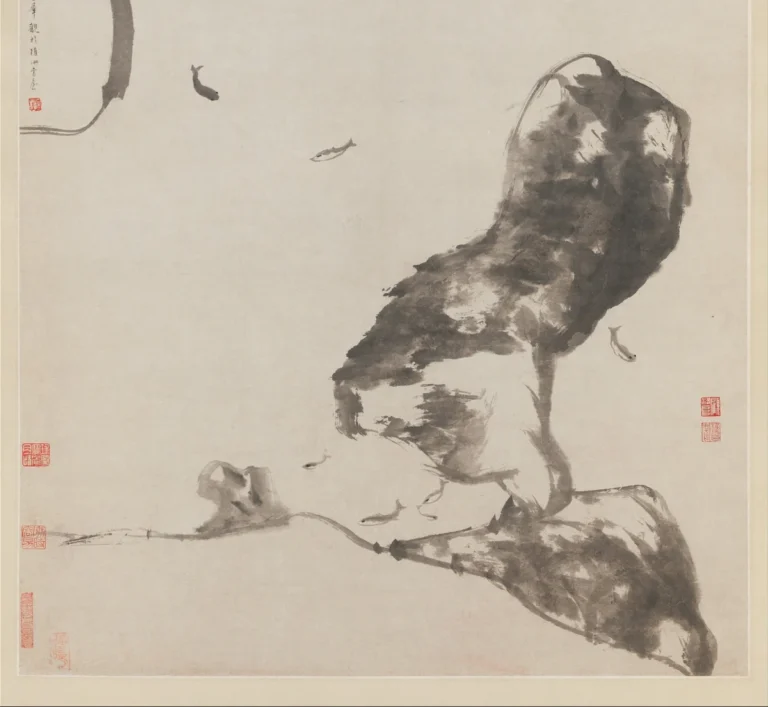
- Bada Shanren, Fish and Rocks, Metropolitan Museum of Art, accession 1989.363.137, released CC0; file page on Wikimedia Commons.