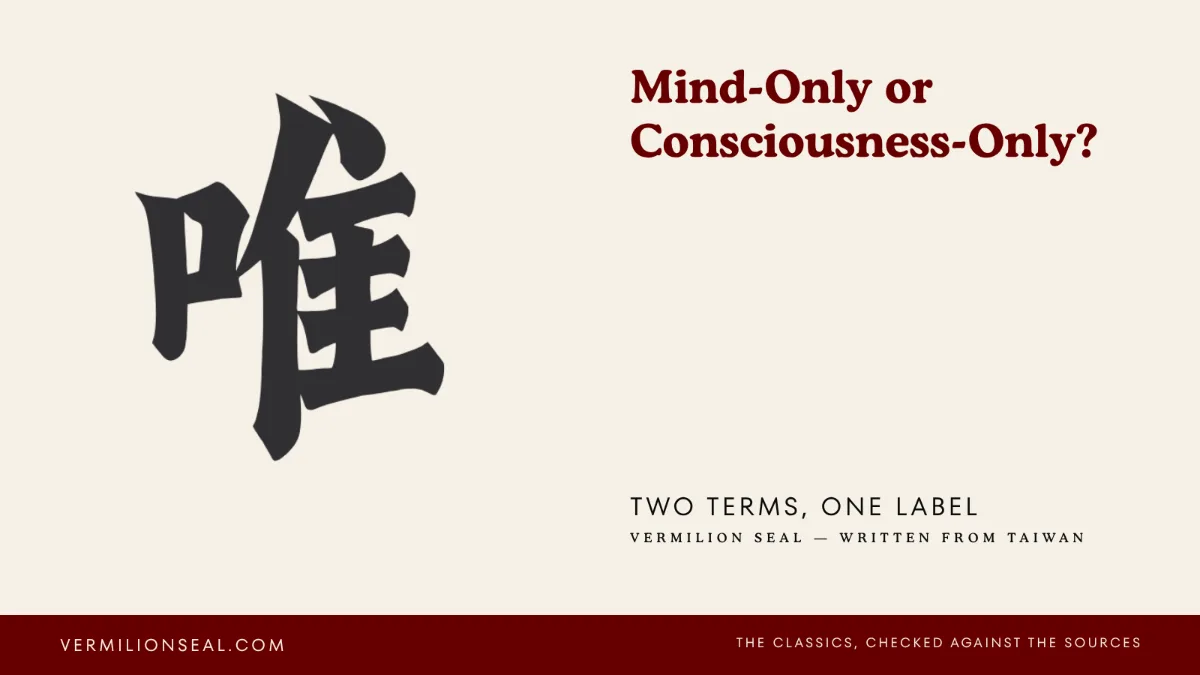
Open almost any English introduction to Buddhist philosophy and the school of the eight consciousnesses will be labelled “Mind-Only”. It is a handsome phrase, it has been in use for over a century, and it does something the Chinese does not do: it merges two different terms into one. Chinese Buddhism distinguishes 唯心 from 唯識. They render two different Sanskrit words, they enter Chinese through two different texts, and the relation between them is one of the things Chinese Buddhist thought spent centuries arguing about. “Mind-Only” translates the first and is used as the name of the school that goes by the second.
Two phrases, two sources
唯心 — “mind alone” — comes from a sutra. The locus classicus is the Ten Grounds chapter of the Huayan (Avataṃsaka) scripture, at the sixth ground:
Where “mind alone” starts
三界虛妄,但是心作;十二緣分,是皆依心。
“The three realms are unreal; they are made by mind alone. The twelve links of dependent arising all rest on mind.”
《華嚴經・十地品》第六現前地 · 引自陳一標〈三界唯心與星雲大師的經典詮釋〉,2019
That is where the famous four-character formula 三界唯心, “the three realms are mind alone”, comes from, and it is a sutra statement — scriptural, compressed, and open to being developed in more than one direction. Chinese Buddhism duly developed it in more than one direction.
唯識 is not a sutra phrase. It is the name of a philosophical position, and it comes from the titles of two treatises by Vasubandhu — the Viṃśatikā and the Triṃśikā, the Twenty Verses and the Thirty Verses — both of which end in vijñapti-mātratā-siddhi. As the Hong Kong philosopher 霍韜晦 Fok Tou-hui pointed out in the 《華岡佛學學報》 in 1983, the word in those titles is not the word for mind and not the word for consciousness:
事實上,唯識學派的開山大師世親……的兩本主要作品:《二十唯識論》、《三十唯識頌》,原題用的就是「唯表」。玄奘全部譯為「唯識」,便把問題的重心轉移了。
“In fact the founding master of the Yogācāra school, Vasubandhu … in his two principal works, the Twenty Verses and the Thirty Verses, used in the original titles precisely ‘representation-only’. Xuanzang translated all of it as ‘consciousness-only’, and thereby shifted the centre of gravity of the problem.”
The seam inside 識
Sanskrit has two words here. Vijñāna is consciousness as the knowing subject — the thing there are eight of. Vijñapti is what shows up: the making-known, the appearing, the presented item. They are related and they are not the same, and the difference is exactly the point at issue in a school that argues that what we take for an outside world is a presentation rather than an encounter.
Xuanzang rendered both with the same Chinese character. Fok’s judgement is blunt about the cost:
唯識家特別將之名為 vijñapti — 此字玄奘未能正視其價值,仍譯之為「識」,這就與代表主體意義的識(vijñāna)相混。
“The Yogācārins gave it the special name vijñapti — a word whose value Xuanzang failed to face squarely, still rendering it ‘consciousness’, which then confused it with the vijñāna that stands for the subject.”
This is a criticism worth reading carefully, because it is not the criticism it looks like. Xuanzang was the most exacting translator in the history of Chinese Buddhism; he had a written policy for when not to translate a Sanskrit word at all, and he applied it to two of the eight consciousnesses. The choice to translate vijñapti as 識 was a choice, and it had a defensible basis: his own commentary defines 識 not as awareness but as 了別, discriminating — an activity of making-out, which is much closer to vijñapti than “consciousness” is. In Chinese, the seam is nearly invisible because the character was already doing double duty. In English it reopens, because “consciousness” carries none of that.
What 唯識 asserts, in two halves
Xuanzang’s chief disciple 窺基 Kuiji (632–682) glossed the two characters separately, and the gloss is the cleanest short definition the tradition produced:
Kuiji’s gloss
「唯」謂簡別,遮無外境。「識」謂能了,詮有內心。
“‘Only’ means discriminating off: it excludes any outer object. ‘Consciousness’ means the capacity to make out: it affirms an inner mind.”
窺基《成唯識論述記》序 · 引自霍韜晦〈唯識五義〉,《華岡佛學學報》第 6 期,1983
Two moves, not one. 唯 is a negation — it rules out the outer object. 識 is an affirmation — it grants the inner discriminating. English “Mind-Only” runs them together into a single positive claim about what everything is made of, which is precisely the reading that invites the comparison with Berkeley, and precisely the reading the Chinese formulation avoids by keeping the two halves apart. The standard four-character summary in Chinese is not “everything is mind” but 唯識無境: consciousness only, no object-field. It is a denial with a remainder, not a metaphysics of stuff.
Why the merge costs something
Three things get lost when the two Chinese terms are collapsed into one English label.
A scriptural claim is mistaken for a philosophical one. 三界唯心 is a line from a sutra about the three realms and dependent arising. 唯識 is a position defended by argument in treatises, with a theory of eight consciousnesses, seeds and perfuming behind it. Reading the first as a summary of the second flattens the difference between what a scripture announces and what a treatise undertakes to prove.
An interpretive step disappears. The Yogācāra reading of the sutra line — taking 唯心 to mean 唯識 — is itself a move, and a documented one. As Chen Yi-piao of Fo Guang University puts it, when the school interprets “mind alone” as “consciousness alone”, what the “only” excludes is the object-field. That is a specific reading of an open phrase, made by one school among several. In English it looks like a translation.
A live disagreement is smoothed over. The 唯心 line runs through the Huayan tradition and the treatises on the awakening of faith; the 唯識 line runs through Xuanzang’s translations and the Faxiang school. These two streams did not agree about the mind, and their disagreement is a large part of what Chinese Buddhist philosophy consists of after the seventh century. “Mind-Only” is the name of one of them being used for the other.
So what should it be called?
There is no settled answer, and the honest position is to know what each candidate buys. “Consciousness-Only” is the literal rendering of Xuanzang’s Chinese and the safest for anything quoting the Chinese sources. “Representation-Only” or “Cognition-Only” render Vasubandhu’s Sanskrit and are what Fok is arguing for when he says the original title says 唯表; they are more accurate to the Indian text and unfamiliar to most readers. “Yogācāra” — practice of yoga, the school’s other name — dodges the question and is what most specialists now use. “Mind-Only” is the one to be careful with, not because it is indefensible, but because English readers hear a claim in it that neither the Sanskrit nor the Chinese quite makes.
This is the same problem, in a different room, as choosing between translations of the Daoist classics: the question is never only which English words are prettiest, but which text and whose reading you are being handed. We compare seventeen English editions of one book in which Tao Te Ching translation should you read?, and the moral there is the moral here — check what is underneath the English before quoting it.
For the eight consciousnesses that 唯識 is a theory about, see the eight consciousnesses in Xuanzang’s Chinese; for the storehouse consciousness and the modern comparison to the unconscious, this entry.
For another pair of Chinese renderings that are not the synonyms they look like, see yuanjue and dujue.
FAQ
Is Yogācāra the same as idealism?
The Chinese formulation does not put it that way. Kuiji’s gloss splits the term into a denial and an affirmation — “only” excludes the outer object, “consciousness” affirms inner discriminating — and the standard summary is 唯識無境, “consciousness only, no object-field”. Whether that amounts to idealism in the European sense is a live scholarly argument; the English label “Mind-Only” settles it in advance, which is the problem with it.
What is the difference between 唯心 and 唯識?
唯心 “mind alone” is a scriptural phrase, from the Ten Grounds chapter of the Huayan sutra — “the three realms are unreal; they are made by mind alone”. 唯識 “consciousness alone” is the name of a philosophical position, from the titles of Vasubandhu’s two treatises. The Yogācāra school reads the first as meaning the second; that reading is a move, not a synonym.
Did Xuanzang mistranslate vijñapti?
He translated it with the same character he used for vijñāna, which merges a distinction the Sanskrit keeps. Fok Tou-hui calls this a shift in the centre of gravity of the problem. In Xuanzang’s defence, his own commentary defines that character as 了別, “discriminating” — an activity rather than an awareness — which is much nearer vijñapti than the English “consciousness” is.
Which English term should I use?
“Yogācāra” if you want to avoid the question; “Consciousness-Only” when quoting the Chinese sources; “Representation-Only” or “Cognition-Only” when working from Vasubandhu’s Sanskrit. Reserve “Mind-Only” for contexts where you have room to explain what it does and does not claim.
Sources
- 霍韜晦〈唯識五義〉,《華岡佛學學報》第 6 期,臺北:中華學術院佛學研究所,1983 — chibs.edu.tw:窺基定義「唯謂簡別,遮無外境。識謂能了,詮有內心」;vijñapti/vijñāna混同之議;世親原題「唯表」(accessed 4 Sep 2026)
- 陳一標〈三界唯心與星雲大師的經典詮釋〉,《2019 星雲大師人間佛教理論實踐研究》,佛光大學佛教學系 — 臺大佛學數位圖書館全文:《華嚴經・十地品》「三界虛妄,但是心作;十二緣分,是皆依心」;唯識學派以「唯識」解「唯心」時所遮者為「境」(accessed 4 Sep 2026)
- 《成唯識論》卷二,玄奘譯(大正藏 T1585) — CBETA:「『了』謂了別,即是行相。識以了別為行相故」(accessed 4 Sep 2026)
- 法雲《翻譯名義集》(大正藏 T2131) — CBETA:玄奘「五種不翻」(accessed 4 Sep 2026)