
On the sports pages in Taiwan, da qi wan cheng is a compliment with a faint apology folded into it. A badminton player wins her first tour title at twenty-six; a golfer reaches the Olympics at thirty-three. Each time, the headline reaches for the same four characters: 大器晚成 — the great vessel is late in the making, so the talent ripened late. The Ministry of Education’s 《成語典》 agrees, and files the phrase under Laozi, chapter forty-one.
The citation is the problem. The two oldest surviving copies of that chapter do not contain the character 晚, “late”, at all.
What the received text actually says
Chapter 41 of the Daodejing in the Wang Bi recension — the version most English translations are made from — runs through a list of things that look like their own opposites. Then it arrives at four parallel clauses.
大方無隅;大器晚成;大音希聲;大象無形;道隱無名。
The great square has no corner; the great vessel is late in completion; the great note is faint in sound; the great image has no shape; the Dao is hidden and without a name.
Chinese Text Project, 《道德經》, chapter 41.
Read the four clauses side by side and one of them behaves differently from the others. A great square has no corner. A great note has almost no sound. A great image has no shape. Three negations, and then a great vessel that is merely slow. The odd clause out is not a paradox at all; it is a scheduling note. That reading of the parallelism is my own, but it is not eccentric: the Ministry of Education’s own idiom dictionary makes the same observation, as we will see.
James Legge, translating in 1891, heard the rhythm and kept the delay, rhyming it into his quatrain: “Its largest square doth yet no corner show; A vessel great, it is the slowest made; Loud is its sound, but never word it said; A semblance great, the shadow of a shade.” Translations made from the received text keep the delay, and Legge’s is only the most ornate of them. Editions worked up from the excavated manuscripts are dealing with a different character altogether, which is one reason two English Tao Te Chings can part company at exactly this line.
Guodian, around 300 BCE: 大器曼成
In 1993 a looted but still substantially intact tomb at Guodian, near Jingmen in Hubei, produced a cache of bamboo slips including three separate bundles of Laozi material, conventionally labelled A, B and C. The tomb is usually dated to around 300 BCE, which on the standard datings makes these the oldest known manuscripts of the text by something like a century. Bundle B carries our passage.
…大方亡隅,大器曼成,大音希聲,天象亡形,道…
…the great square has no corner; the great vessel 曼-completes; the great note is faint in sound; the 天-image has no shape; the Dao…
Chinese Text Project, 《郭店・老子乙》. The transcription is editorial; the slips themselves are damaged and the surrounding graphs are partly lost.
Three characters have changed. 無 is written 亡, a routine early variant that changes nothing. 大象, “the great image”, is written 天象, “the heavenly image” — 天 and 大 are close in the early script and easily confused, and the Mawangdui silk has 天象 too. And 晚 is written 曼, which changes a great deal, because nobody agrees what 曼 is standing in for. The editorial team that published the slips read it as a loan for 晚, “late” — which is to say, they read it back into the text they already knew. Qiu Xigui, one of the most careful palaeographers of the last half-century, suspected it stood for 䟂(慢), “slow”. Both readings are reported, side by side and without a verdict, in the Ministry of Education’s own entry.
Mawangdui, early second century BCE: 大器免成
Tomb 3 at Mawangdui, near Changsha, was sealed in 168 BCE and contained two silk copies of the Laozi, conventionally A and B, with B written in clerical script and generally taken to be the later of the pair. In the Chinese Text Project’s transcription of the Mawangdui corpus, a full-text search for 大器 returns exactly one match, and a search for 大方 likewise returns one: the corresponding stretch of manuscript A does not appear in that transcription at all. Manuscript B does.
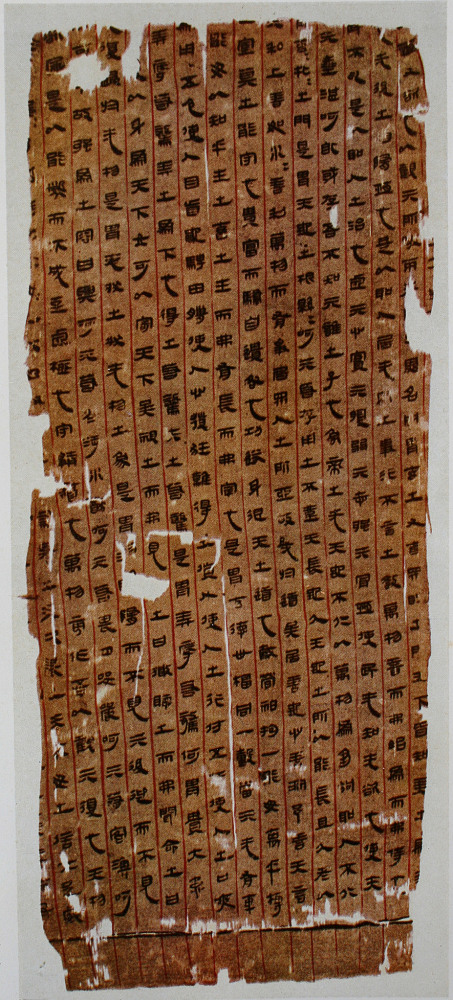
大方無禺,大器免成,大音希聲,天象無刑,道褒無名。
The great square has no corner; the great vessel escapes completion; the great note is faint in sound; the 天-image has no form; the Dao is vast and without a name.
Chinese Text Project, 《馬王堆・老子乙德經》. 禺/隅 and 刑/形 are ordinary early loans; 天 for 大 is the same variant the Guodian slips show.
免 means to escape, to be exempt from, to avoid. On this reading the clause is not about a long build. It says that the greatest vessel is never finished — that it falls outside the category of things that get completed, in the same way that the great square falls outside the category of things with corners. The Ministry of Education’s 《成語典》 glosses it in exactly those terms: 「『道』像最偉大的器物,不是人力所能製作的」 — the Dao is like the greatest of vessels, not something human effort can manufacture. And then, in the same paragraph, the dictionary concedes the point I have just spent three sections making: 「這種意思和上下文的『大方無隅』、『大音希聲』、『大象無形』較能呼應」. This sense fits the surrounding lines better.
But “late” is old too, and that matters
It would be tidy to stop here and call 晚成 a scribal accident of the imperial period. The corpus will not allow it. Han Feizi’s 〈喻老〉 — a chapter whose entire purpose is to illustrate Laozi with political anecdotes — quotes the line in its “late” form, and uses it to praise King Zhuang of Chu for spending three years doing nothing visible before seizing the initiative.
莊王不為小害善,故有大名;不蚤見示,故有大功。故曰:「大器晚成,大音希聲。」
King Zhuang did not let small harms spoil the good, and so he won a great name; he did not show his hand early, and so he achieved great things. Hence the saying: “The great vessel is late in completion; the great note is faint in sound.”
Chinese Text Project, 《韓非子・喻老》.
The 《呂氏春秋・樂成》 quotes the same form without attribution — 「大智不形,大器晚成,大音希聲」 — and it too is a third-century BCE compilation. Wang Chong, writing around 80 CE, treats it as a settled proverb about slow worth: 「大器晚成,寶貨難售者」, great vessels are late in the making, precious goods are hard to sell, in a passage that sets fast-growing maple and paulownia, whose timber never hardens, against the sandalwood that leafs late and is strong enough to be made into a cart axle.
So the two readings are roughly contemporaries. What the excavated manuscripts show is not that somebody once made a mistake; it is that by the third century BCE the line was already circulating in at least two shapes, and that the shape which survived into the standard printed editions is, to my eye and to the 《成語典》’s, the one that sits least easily with the grammar of its own sentence. That is a more interesting fact than a scribal error, and a harder one to write a headline about. The same shape turns up elsewhere in the book: chapter 5 and its straw dogs is likewise a case where the later reading is the one everybody learned first.
How a vessel became a person
The move from “a great vessel” to “a great man” is not modern, and it is not a mistranslation. It is a commentary programme, and you can watch it being carried out — much as the political afterlife of chapter 60’s small fish was built by its commentators rather than found in it. The Heshanggong commentary — one of the earliest surviving line-by-line readings of the Laozi, though its date is still argued over — converts the entire series into character types — the 大方正之人, the person of great rectitude; the 大法象之人, the person of the great pattern — and our clause with them.
大器晚成,大器之人,若九鼎瑚璉,不可卒成也。
“The great vessel is late in completion”: a person of great capacity is like the nine tripod cauldrons or the ritual grain vessels — not to be finished in haste.
Chinese Text Project, 《老子河上公章句》, chapter 41.
Wang Bi, whose text became the standard, keeps the “late” reading and reasons from it: 「大器成天下不持全別,故必晚成也」 — a difficult sentence that commentators still argue over, but unmistakably an argument for lateness rather than a report of it (see the 《道德真經註》).
The idiom as Taiwanese schoolchildren learn it, though, is fixed by a biography rather than a commentary. In the Sanguozhi, Cui Yan defends his obscure younger cousin Cui Lin against a family that thinks little of him: 「此所謂大器晚成者也,終必遠至」 — this is what is meant by a great vessel late in the making; he will go far in the end. Cui Lin did go far. After that sentence, 大器晚成 is a phrase about careers, and the vessel is gone for good. By the time the eighteenth-century novel 《儒林外史》 uses it — 「二位先生高才久屈,將來定是大器晚成的」 — nobody needs to be told that no pottery is involved.
What the two Ministry dictionaries do with all this
Taiwan’s two standard reference works are both published by the Ministry of Education, and they handle the same phrase very differently.
The 《重編國語辭典修訂本》 gives the received account and stops: 「本指大的器具非一朝一夕可完成。語出《老子》第四一章……後引申指一個人的成就較晚」, with the 《儒林外史》 line as its sole textual witness. No manuscripts, no variants.
The 《成語典》 does something braver and stranger. Its headline definition is the ordinary one — 「貴重的器物需要長時間才能完成……後用『大器晚成』比喻卓越的人才往往成就較晚」 — and its example sentences are pure late-bloomer encouragement: 「這位畫家大器晚成,年輕時毫無名氣。」 But its explanatory note then reports the Guodian 曼, the dispute over how to read it, the Mawangdui 免, the metaphysical sense that follows from 免, and the judgement that this sense fits the chapter better. Then it appends the whole thing with the formula 「並附載於此,以供參考」 — recorded here for reference — and leaves the definition untouched.
I do not think this is a blunder. A dictionary of idioms has two jobs that can pull apart: recording what a phrase means to the people using it now, and recording where it came from. For 大器晚成 those two answers are no longer the same answer, and the 《成語典》 has chosen to print both rather than pretend otherwise. It is the most honest thing in the entry, and it is in the small print.
So is everyone quoting it wrong?
No — and this distinction is worth being careful about, because it is the one that usually gets lost.
大器晚成 is a genuine Chinese idiom with a documented history of more than two thousand years. When the Central News Agency writes that a twenty-six-year-old shuttler is 大器晚成, the idiom is doing precisely what idioms do, and there is nothing to correct. A phrase does not owe its ancestors anything.
What does not survive scrutiny is the footnote. “As Laozi said, great talents mature late” is a sentence about a text, and the text is not on its side. A corpus search bears this out with some force, in the way counting a phrase across the whole corpus tends to: across the Chinese Text Project’s pre-Qin and Han collection, 大器晚成 returns six matches and 大器免成 returns one — the Mawangdui silk itself — while in the post-Han collection 大器晚成 returns five and 大器免成 returns none at all. The variant does not merely lose. It leaves no trace at all in that post-Han corpus, and survives to be read only because two tombs were opened in the twentieth century.
Chapter 41 is not career advice. It is a list of things whose greatness consists in lacking the property you would expect them to have, delivered to an audience the chapter openly expects to laugh — the same negative grammar that makes wu wei so hard to render as advice. Read 免成 and the great vessel joins that list: unfinished, unfinishable, outside the reach of making. Read 晚成 and it becomes a promise that your effort will pay off eventually. One of those is the harder thought, which may be some of the reason the other one won.
FAQ
What does 大器晚成 mean in Taiwan today?
It means that outstanding people often succeed late — the Ministry of Education’s 《成語典》 defines it as 「比喻卓越的人才往往成就較晚」. It is used warmly, most often of athletes, artists and writers who broke through in their thirties or later, and its listed antonym is 小時了了, “brilliant as a child”.
Does 大器晚成 really come from the Daodejing?
The phrase as we have it does appear in chapter 41 of the received text, and both Ministry dictionaries cite it there. But the two excavated manuscripts of that chapter read differently — the Guodian slips have 曼 and the Mawangdui silk has 免. 免 does not mean “late”; how 曼 should be read is still unsettled, with the slips’ editors taking it for 晚 and Qiu Xigui for 慢. The idiom’s pedigree is real; the wording it rests on is contested.
What would the line mean if it read 大器免成?
Roughly: the greatest vessel escapes completion. It would belong with the great square that has no corner and the great image that has no shape — a statement that the Dao cannot be made, rather than that it takes a while. The 《成語典》 itself notes that this sense fits the surrounding lines better.
Which came first, the “late” reading or the “escapes completion” reading?
Neither, as far as the evidence goes. The Guodian slips are the oldest manuscript witness, from around 300 BCE, and do not read 晚; but 《韓非子》 and 《呂氏春秋》, both third century BCE, quote the “late” form. The two readings appear to have coexisted from very early on, with one of them subsequently driving the other out of the transmitted text.
Here the Ministry files the counter-evidence in small type and leaves the definition alone. With 每下愈況 it does something stranger: one entry calls the everyday form an error, while another prints a twelfth-century source for it. See Mei Xia Yu Kuang: Zhuangzi’s Phrase Now Means the Opposite.
The same dictionary does something similar with 朝三暮四: the older sense is stated once, and every model sentence and usage note that follows teaches the later one. See Zhuangzi’s three in the morning.
The excavated recensions bear on a question readers ask more often than they ask about this phrase: when the man the book is named after actually lived. Nothing dates him — and the earliest quotation of this book that names him, in the 《莊子・天下》, agrees with the Mawangdui silk against the received text at the point where the two differ. Did Laozi live before Confucius? sets out what the sources allow.
Sources
- Chinese Text Project, 《道德經》 chapter 41 (received text, with Legge’s translation).
- Chinese Text Project, 《郭店・老子乙》 — Guodian bamboo-slip Laozi, bundle B.
- Chinese Text Project, 《馬王堆・老子乙德經》 — Mawangdui silk manuscript B.
- Chinese Text Project, 《老子河上公章句》 chapter 41.
- Chinese Text Project, 王弼 《道德真經註》.
- Chinese Text Project, 《韓非子・喻老》.
- Chinese Text Project, 《呂氏春秋・樂成》.
- Chinese Text Project, 王充 《論衡・狀留》.
- Chinese Text Project, 《三國志・魏書十二》 (Cui Yan’s biography).
- Chinese Text Project corpus searches: 大器晚成, pre-Qin and Han; 大器免成, pre-Qin and Han; 大器晚成, post-Han; 大器免成, post-Han.
- Ministry of Education (Taiwan), 《成語典》 「大器晚成」 (ID 155).
- Ministry of Education (Taiwan), 《重編國語辭典修訂本》 「大器晚成」 (ID 41311).
- Central News Agency, 「26歲邱品蒨大器晚成 摘BWF巡迴賽首冠頭皮發麻」, 9 November 2025.
- Central News Agency, 「錢珮芸大器晚成 生涯首度征戰奧運高爾夫」, 16 July 2024.



