Ask anyone in Taiwan what 朝三暮四 means and you will be told it describes a person who cannot hold to a decision — the colleague who changes jobs every spring, the candidate who changes position every week. Zhuangzi’s three in the morning, in the passage where the phrase begins, is about nothing of the kind. The parable runs to about fifty characters, nobody in it tells a lie, and its conclusion is not that the monkeys were fools. The deception that Taiwan’s own dictionaries attribute to Zhuangzi is real enough, but it belongs to a different book.
Fifty characters, no lie
Here is the whole of it, as the received text stands in the Zhuangzi, chapter two.
勞神明為一,而不知其同也,謂之朝三。何謂朝三?曰狙公賦芧,曰:「朝三而莫四。」眾狙皆怒。曰:「然則朝四而莫三。」眾狙皆悅。名實未虧,而喜怒為用,亦因是也。是以聖人和之以是非,而休乎天鈞,是之謂兩行。
To wear out your spirit making things into one, without knowing that they are already the same — this is called three in the morning. What is three in the morning? The monkey keeper, handing out acorns, said: three in the morning and four at dusk. The monkeys were all angry. He said: then four in the morning and three at dusk. The monkeys were all pleased. Neither the name nor the substance had been diminished, yet anger and delight were put to work. This too follows from taking a this. And so the sage harmonises the affirmations and the denials and rests at the potter’s wheel of heaven. This is called walking two roads.
Text: Chinese Text Project, Zhuangzi – The Adjustment of Controversies
The load-bearing clause is 名實未虧: neither the name nor the substance was diminished. Three plus four and four plus three are the same seven. The keeper offered two arrangements that were identical in name and identical in substance, and the monkeys were furious at one and delighted by the other. Zhuangzi does not then say that monkeys are irrational, or that the keeper was clever. He says 是之謂兩行 — this is called walking two roads. The sage does not choose between the two framings and does not rank them. He keeps both, and stops arguing.
Two small things in that passage are worth holding on to, because they come back later. The first is 芧, the thing being handed out. The Ministry of Education’s own note on this passage glosses it plainly: 芧:音ㄒㄩˋ,橡樹的果實 — the fruit of the oak, an acorn. The second is that the received text writes 莫, not 暮, in both halves of the offer. 莫 is the older graph from which 暮 was later differentiated, so the idiom’s modern spelling is a normalisation of its own source. That is ordinary philology and nobody hides it — except, as it turns out, in one place.
There is also a coincidence in the keeper’s title that no translation carries across. The Ministry’s note glosses the character plainly: 狙,音ㄐㄩ,猴子, a monkey. In modern Chinese that same character carries the sense of lying in wait, which is why a sniper is a 狙擊手. To a present-day reader the man is named twice over — for the animal he keeps, and for the thing he is about to be accused of doing.
Where the trick comes from
Accused by whom? By the Liezi, which tells the same story at four times the length, with a motive, a household, and a political moral.
宋有狙公者,愛狙,養之成群,能解狙之意;狙亦得公之心。損其家口,充狙之欲。俄而匱焉,將限其食。恐眾狙之不馴於己也,先誑之曰:「與若茅,朝三而暮四,足乎?」眾狙皆起而怒。俄而曰:「與若茅,朝四而暮三,足乎?」眾狙皆伏而喜。物之以能鄙相籠,皆猶此也。聖人以智籠群愚,亦猶狙公之以智籠眾狙也。若實不虧,使其喜怒哉!
In Song there was a monkey keeper who loved monkeys. He raised them into a troop and could read their minds; the monkeys could read his. He cut his own household’s rations to satisfy the monkeys’ appetites. Before long he ran short and had to put them on a limit. Fearing they would turn on him, he first deceived them, saying: I will give you three in the morning and four at dusk — is that enough? The monkeys all rose up angry. Shortly he said: then four in the morning and three at dusk — enough? The monkeys all bowed down, pleased. So do the capable cage the base, in everything. The sage cages the many fools with his wits, just as the monkey keeper caged the monkeys with his.
There is the deception, in one word: 先誑之曰, he first deceived them, saying. And there is the reading that made the idiom’s later career possible: 聖人以智籠群愚,亦猶狙公之以智籠眾狙也 — the sage cages the many fools with wit, just as the keeper cages the monkeys with wit. That is not a remark about perception. It is a theory of rule, and a sour one.
The Liezi also explains something the Zhuangzi leaves blank. The keeper is not running an experiment; he is broke. He has been starving his own family to feed the troop, the food has run out, and he needs the cut accepted without a riot. Whether the Liezi is drawing on the Zhuangzi or on shared older material is a question I am not competent to settle here. What matters for the idiom is only which book contains which idea, and on that the two pages are not ambiguous.
One honest note about the copy I read. The Chinese Text Project’s base text prints 茅, thatch grass, where the Zhuangzi parallel prints 芧, acorn, and closes with 若實不虧 rather than 名實未虧. Commentators emend the first; I have translated it as acorns to match the parallel, and I am telling you that I did, because the page itself does not.
An entry that records the older sense and then declines to teach it
Taiwan’s standard reference for this material is the Ministry of Education’s Dictionary of Chinese Idioms. Its entry for 朝三暮四 is entry number six, which gives some sense of how basic the phrase is held to be. The definition field reads:
餵養猴子時,早晨給三升橡樹果實,晚上給四升,但亦可改變為「朝四暮三」。本為養猴人詐騙猴子的故事。典出《莊子.齊物論》。原用以比喻只變名目,不改實質。後用「朝三暮四」比喻人心意不定、反覆無常。亦可用於比喻事物變化無定。
When feeding monkeys, three pecks of acorns in the morning and four in the evening, though this may equally be changed to four in the morning and three in the evening. Originally the story of a monkey keeper defrauding his monkeys. Source: Zhuangzi, “The Adjustment of Controversies”. Formerly used to mean that only the labels change and the substance does not. Later used to mean that a person’s intentions are unsettled and inconstant. It may also be used of things that change without fixity.
Read that again as an evidential document rather than as a definition. It states an original sense — only the labels change, not the substance — which is exactly what 名實未虧 says. Then it states a later sense, inconstancy. Both are on the page. Now look at what the entry does with the rest of its space.
The usage field gives one sense and one only: 語義說明:比喻心意不定、反覆無常。貶義。使用類別:用在「意志不堅」的表述上。 — a metaphor for unsettled intentions and inconstancy, pejorative, used in statements about weakness of will. The model sentences that follow are all about people who change their minds. The historical citations run from the Liang dynasty to the Qing and are read, throughout, as inconstancy or as fraud. The earliest is Pei Ziye of the Liang, on Emperor Xiaowu’s appointments: 朝三暮四,其病愈甚也. The Old Book of Tang supplies a courtier who was 性惟狡詐,言不誠實, crafty by nature and untruthful in speech.
One citation in that list will not sit still, and the entry does not stop for it. Sima Guang, writing to the throne on revenue and its abuses, objects to measures that are 或朝三暮四,移左於右 — three in the morning and four at dusk, moving what is on the left over to the right. Moving something from the left to the right is not inconstancy. It is a total that has not changed while its presentation has, which is the older sense precisely, in an eleventh-century memorandum on public finance. The entry lists it with the others and reads the whole set as weakness of will.
So the entry does something more interesting than being wrong. It records the older meaning accurately, in a single clause, and then hands almost all of its space, its model sentences and its reading of its own evidence to the meaning it calls late. A reader who works through the entry in the order it is laid out will leave knowing one sense. This is the same shape I found in the Ministry’s entry for mei xia yu kuang, where the dictionary prints the evidence that undoes its own verdict, and in its entry for da qi wan cheng, where the counter-evidence is set in small type at the end.
The footnote that imports the Liezi
The entry’s source field carries a numbered gloss on the keeper. It begins: 狙公:相傳為古時善養猴者,能以智弄群猴 — traditionally an ancient keeper skilled with monkeys, able to manipulate the troop by his wits.
That clause, 能以智弄群猴, is the Liezi‘s 以智籠眾狙 with one verb swapped. It appears in a note attached to a quotation from the Zhuangzi, under a headword whose definition says the source is the Zhuangzi, in an entry that never mentions the Liezi at all. The manipulation is not in the text being annotated. It has been carried in from the other book and left there without a passport.
The Ministry’s other dictionary, the Revised Mandarin Chinese Dictionary, goes further in the same direction. Its entry, reproduced inside the idiom dictionary as supplementary material, reads: 本指一養猴人以果子飼養猴子,施以詐術騙猴的故事。見《莊子.齊物論》。後比喻以詐術欺人,或心意不定、反覆無常。 — originally the story of a keeper feeding monkeys fruit and working a fraud on them; see the Zhuangzi; later a metaphor for defrauding people by trickery, or for unsettled and inconstant intentions.
Set the two side by side. The idiom dictionary drops deception from the list of live senses and rewrites the original meaning as the neutral 只變名目,不改實質. The revised dictionary keeps deception as a live sense and attaches it, twice, to the Zhuangzi. Same ministry, same subject, two answers. And neither of them names the book where the fraud actually occurs.
Dusk, or dusk: one dictionary, two standards
This is the part I did not expect to find, and it is checkable in about ninety seconds.
The near-synonym 朝秦暮楚 — serving Qin in the morning and Chu at dusk — has its own entry in the same dictionary. That entry opens, before it says anything else at all, with a textual warning:
「朝秦暮楚」之「暮」,典源作「莫」。「莫」為「暮」的本字。
The 暮 of 朝秦暮楚 stands as 莫 in the source text. 莫 is the original graph for 暮.
And the source quotation in that entry duly preserves the reading: 朝秦而莫楚不恥. The dictionary flags the substitution, explains it, and leaves the evidence visible.
Entry six does none of this. It carries no such note, and inside its source quotation it prints 朝三而暮四 and 朝四而暮三 where the received Zhuangzi prints 莫 both times. That same quotation makes two further silent adjustments: it drops the 曰 that stands before 狙公賦芧 in the received text, and it stops at 而休乎天鈞, leaving out the four characters that follow: 是之謂兩行.
I am not alleging anything more than inconsistency. The likeliest explanation is dull: two entries, two editorial hands, a house style that normalises graphs inside quotations and an editor who thought it worth flagging in one case and not the other. But the consequence is not dull. A reader who trusts the source box has no way of telling which convention they are looking at, and in entry six the normalisation quietly aligns the quotation with the headword while the clause that tells you what to do about the whole problem — walk two roads — is the thing that falls off the end.
By the Song the later sense was already doing all the work. Huang Tingjian writes 安能朝四暮三浪憂喜, how can one worry and rejoice at random over four in the morning and three at dusk; Lu Jiuyuan, more cuttingly, describes men who 朝四暮三以悅眾狙, who play four in the morning and three at dusk to please the troop — and there the monkeys have become the audience, not the ones being counted for. Both citations sit in entry six’s list of variant forms.
What the English translators did with it
Four English versions, all of them still in circulation, and the interesting differences are not in the monkeys.
James Legge in 1891 gets the food right — acorns — and renders 名實未虧 as “His two proposals were substantially the same, but the result of the one was to make the creatures angry, and of the other to make them pleased.” Substance survives; name does not.
Herbert Giles, two years earlier, does something stranger. He turns the text’s bare self-interrogation into a conversation between two characters: “What is Three in the Morning?” asked Tzŭ Yu. “A keeper of monkeys,” replied Tzŭ Ch’i, “said with regard to their rations of chestnuts…” The received text has no speech attribution at this point; the two names are borrowed from the opening scene of the chapter and put to work here. Giles then disposes of 名實 altogether: “The actual number of the chestnuts remained the same, but there was an adaptation to the likes and dislikes of those concerned. Such is the principle of putting oneself into subjective relation with externals.”
Lin Yutang’s version follows Giles almost clause by clause — “rations of nuts”, “The actual number of nuts remained the same, but there was a difference owing to (subjective evaluations of) likes and dislikes” — which is worth knowing if you have been treating the two as independent witnesses.
Burton Watson is the one who leaves the machinery intact: “There was no change in the reality behind the words, and yet the monkeys responded with joy and anger… This is called walking two roads.” Name, substance and the two roads all arrive. A reader of Watson can see what the passage is for. A reader of Giles or Lin Yutang meets a tidy anecdote about subjectivity.
The chestnuts are not trivial either. The Ministry’s note on this passage glosses 芧 as 橡樹的果實, the fruit of the oak, and both Legge and Watson give acorns. Giles gives chestnuts; Lin Yutang, following him, gives nuts; and between them English readers have been handed the wrong crop for well over a century. It costs the argument less than the loss of 名實 does, but it is a reliable tell for which earlier version a later writer had open. If you want the longer version of how much a translator’s small decisions cost, that is the subject of which Tao Te Ching translation to read, and of the pun that vanishes from Zhuangzi’s happiness of fish.
Where the misquotation happens
The commonest error in English is not getting the source wrong. The parable really is in the Zhuangzi. The error is importing the Liezi‘s moral and calling it the original meaning of the Zhuangzi‘s words.
The most careful English source I found does this. Wiktionary’s entry is the only one I saw that gets the textual situation right, noting that the parable is “From a parable seen in both Zhuangzi (see quote below) and Liezi” — and it then quotes the Zhuangzi and labels “to deceive using tricks; to take in someone” as the “(original meaning, obsolete)”. Original to the Liezi, certainly. Not to the lines printed immediately above it.
The second error is teaching the late sense with no source at all. China Daily‘s English-teaching column gives the idiom as 比喻常常变卦,反复无常, glossed “change one’s mind frequently” and matched to the English “chop and change”. There is no Zhuangzi, no Liezi, no monkey and no acorn anywhere on the page. It is not incorrect about current usage. It simply leaves a reader with no way to know that the usage is a later arrival.
The third is confusing the phrase with 朝秦暮楚. The Ministry’s own discrimination table handles this well, and the way it handles it is itself revealing: 「朝秦暮楚」及「朝三暮四」都是用來比喻人反覆無常,意志不堅。「朝秦暮楚」側重於強調依附對象的反覆變更;「朝三暮四」則側重於強調心意和行為的變化不定。 — both, it says, are metaphors for inconstancy and weakness of will; the first stresses repeatedly switching whom one attaches oneself to, the second stresses unsettled intentions and behaviour. Both are defined by the late sense. The older meaning cannot even enter the comparison, because in the dictionary’s working vocabulary it no longer exists.
And then there is the argument from elsewhere. The Japanese descendant of the phrase, 朝三暮四 read chōsanboshi, is glossed — on Wiktionary’s authority, citing Daijirin — as “a focus on cosmetic differences between two objects without realizing that they are substantively identical, distinction without a difference”, with “the act of deceiving a person” second. The inconstancy sense is simply not there. Whatever happened to this idiom happened in Chinese, on the way from the Liang dynasty to the present, and not because a story about seven acorns was fated to become a story about fickle men.
One claim I will not make. English writing about the parable often presents it as an early experiment in framing, and the comparison is a fair one to draw — identical totals, opposite responses, is precisely what the framing literature studies. What the text does not contain is any verdict on the monkeys’ rationality. Zhuangzi’s own next move is 亦因是也, this too follows from taking a this, and then the two roads. I looked for a peer-reviewed behavioural-economics paper citing the parable and did not find one; that is a statement about my search, not about the literature.
How Taiwan actually uses it
Here is the part the dictionary cannot see, because it only reads books.
In December 2023, during the presidential campaign, Ko Wen-je attacked a rival’s housing-loan scheme, and ETtoday put his objection like this: 柯文哲18日批評,「侯康貸」讓他想起朝三暮四的故事,只是把頭期款挪到後面才繳 — the scheme reminded him of the three-in-the-morning story; it merely shifts the deposit to the back end. Further down the same report he is quoted directly: 他只是把頭期款移到後面去繳而已. The headline ran 批「侯康貸」宛如「猴子朝三暮四」. That is the older sense, used correctly, by a candidate, in public, about a mortgage, in a country whose schools teach the other one.
In August 2026 a market analyst, Ye Junmin, used it on Taiwanese exchange-traded funds and their distribution yields, quoted in the Chinatimes group’s investment title: 猴子早上拿3根香蕉、晚上4根,改成早上4根、晚上3根,看似變多,一天實際仍是7根 — three bananas in the morning and four at night, changed to four and three, looks like more, and is still seven. The acorns have become bananas and the arithmetic has survived intact for more than two thousand years.
Against that, the late sense, doing exactly what the dictionary describes. In February 2025 Li Wo-chiang, professor of finance at Tamkang University, wrote in ETtoday’s opinion section that 川普不按理牌出手,習慣性地髮夾彎,朝三暮四,常令金融市場捉摸不定 — Trump plays out of order, habitually executes hairpin turns, is three-in-the-morning about it, and leaves financial markets unable to get a grip. Note the company it keeps: 髮夾彎, hairpin bend, is Taiwan’s own contribution to the vocabulary of political reversal.
The split is cleaner than I expected. Where there is arithmetic in the room — a loan, a dividend, a total that has to add up — Taiwanese speakers reach for the older sense and it works. Where the subject is somebody’s character, the later sense takes over. Both senses are alive; the dictionary teaches one of them; and the one it teaches is the one that needs the phrase least, since Chinese has 反覆無常 and 出爾反爾 for inconstancy already and nothing else at all for the thing Ko Wen-je and the ETF analyst were pointing at.
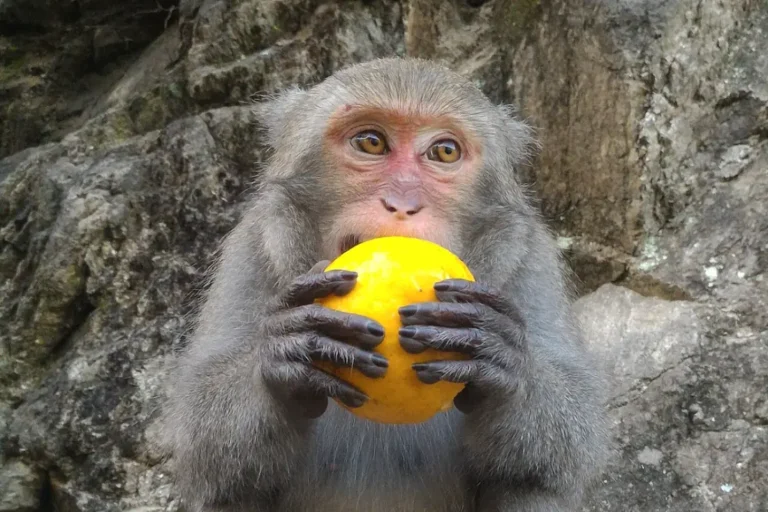
Taiwan also still has the monkeys. The Formosan rock macaque is endemic to the island; the one below was photographed with a piece of fruit at the Dengxian Bridge rest area in Taitung.
The parable’s own answer to the keeper was never that the monkeys should learn to add. It was 兩行: hold both arrangements, notice that you prefer one, and decline to build a philosophy on the preference. That is a harder lesson than inconstancy, which may be why it is the one that got lost. It is also the lesson that survives in the useless tree, where what counts as worth depends entirely on who is doing the counting.
FAQ
Is the monkey parable in the Zhuangzi or the Liezi?
Both, but not in the same form. The Zhuangzi, chapter two, has a compressed version of roughly fifty characters with no motive and no deception, ending in 名實未虧 and 兩行. The Liezi, in the “Huangdi” chapter, has an expanded narrative with the keeper’s ruined finances, the explicit verb 誑 (to deceive), and a closing moral about the sage caging fools by his wits. When a source tells you the idiom originally meant trickery and cites the Zhuangzi, it is describing the Liezi.
What does 朝三暮四 mean in Taiwan today?
In ordinary speech it means inconstant, unable to stick to a decision, and it is pejorative — that is the only sense the Ministry of Education’s usage field gives. But the older sense, that only the labels changed and the substance did not, is still in active use whenever the subject is money and the numbers have to add up: it turns up in campaign arguments about mortgage deposits and in analysts’ explanations of fund distributions.
Were they acorns or chestnuts?
Acorns. The Ministry of Education glosses 芧 as 橡樹的果實, the fruit of the oak. Legge and Watson both have acorns. Herbert Giles has chestnuts, and Lin Yutang, who follows Giles closely, has nuts — which is how the chestnut entered English.
Why do some texts write 朝三而莫四?
Because that is what the received Zhuangzi text says. 莫 is the original graph from which 暮, dusk, was later differentiated. The Ministry’s entry for the near-synonym 朝秦暮楚 states this explicitly and preserves 莫 in its source quotation; its entry for 朝三暮四 prints 暮 inside the quotation without a note.
Is 朝三暮四 the same as 朝秦暮楚?
They overlap in modern use and the Ministry lists each as a near-synonym of the other, but the sources are well over a thousand years apart: 朝三暮四 comes from the Warring States Zhuangzi, while 朝秦暮楚 is traced to two Song-dynasty pieces by Chao Buzhi. The dictionary’s discrimination note puts the difference as attachment versus intention: 朝秦暮楚 is about repeatedly switching sides, 朝三暮四 about unsettled intentions.
A phrase from the Book of Changes lost its second half the same way: 謙謙君子 kept the self-discipline and dropped the river it was supposed to cross.
Taiwan’s official layer is not consistent about Laozi himself either. The Ministry of Education’s entry on him opens with 「生卒年不詳」, dates unknown, and then supplies a period, a state, a county and a visit from Confucius with no hedge at all; the Interior Ministry’s page gives Confucius his conventional dates and gives Laozi none. Did Laozi live before Confucius? follows that gap back through the sources.
The same editorial habit shows up again in the Ministry of Education entry for 相濡以沫, where the quotation stops one clause before the clause that reverses it: Zhuangzi: Forget Each Other in the Rivers and Lakes.
Sources
- Chinese Text Project — Zhuangzi, “The Adjustment of Controversies” (Chinese text, checked character by character)
- Chinese Text Project — Liezi, “Huangdi” (Chinese text)
- Chinese Text Project — James Legge’s 1891 translation of the same chapter
- Ministry of Education (Taiwan), 成語典, entry 6 — 朝三暮四: definition, source, notes, historical citations, usage and discrimination fields
- Ministry of Education (Taiwan), 重編國語辭典修訂本 entry for 朝三暮四, as reproduced in the idiom dictionary
- Ministry of Education (Taiwan), 成語典, entry 692 — 朝秦暮楚: the graph note and the preserved source reading
- Wiktionary — 朝三暮四: etymology, the two Chinese senses, and the Japanese chōsanboshi entry citing Daijirin
- Herbert A. Giles, Chuang Tzŭ: Mystic, Moralist, and Social Reformer, chapter 2 (Project Gutenberg)
- Burton Watson’s translation of chapter 2 (Terebess Asia Online transcription)
- Lin Yutang’s “On Levelling All Things” (Terebess Asia Online transcription)
- China Daily language column, 18 June 2020 — the idiom glossed as “chop and change”, with no source given
- ETtoday, 18 December 2023 — Ko Wen-je on the “Hou-Kang loan” and the three-in-the-morning story
- Wantrich (Chinatimes group), 18 August 2026 — an analyst’s seven bananas and ETF distribution yields
- ETtoday opinion, 6 February 2025 — Li Wo-chiang on tariffs, hairpin turns and three in the morning