
Four English words carry most of the weight of this chapter: heaven and earth are not benevolent. They are usually quoted to prove that Laozi was a cold-eyed realist who thought the universe did not care. The line does say something bleak. It does not say that.
The chapter is the fifth in the received 王弼 text of the Daodejing, and it runs to thirty-odd characters. Two of them, 芻狗, have been mistranslated, half-translated and occasionally deleted outright for a hundred and thirty years. One of them, 仁, carries a technical meaning in Chinese that “benevolent” only partly reaches. What follows is the chapter, the two rival commentaries on it, and the route by which it became the title of a Sam Peckinpah film.
Daodejing, chapter 5
天地不仁,以萬物為芻狗;聖人不仁,以百姓為芻狗。天地之間,其猶橐籥乎?虛而不屈,動而愈出。多言數窮,不如守中。
Heaven and earth are not benevolent; they treat the ten thousand things as straw dogs. The sage is not benevolent; he treats the hundred families as straw dogs. Between heaven and earth — is it not like a bellows? Empty, yet it does not collapse; move it, and more comes out. Much speaking exhausts itself; better to hold to the centre.
《老子》第五章(王弼本) · ctext.org
A straw dog was a real object
It helps to know that the thing being named existed. A 芻狗 was a dog plaited out of straw and used in sacrifice. Taiwan’s state dictionary, the 《重編國語辭典修訂本》, defines it in one sentence and then does something useful: it cites the third-century Records of the Three Kingdoms for the point that the object was a sacrificial article, not a metaphor invented by Laozi.
What the dictionary says
古時用草編結成的狗形,供祭祀用,用完即丟棄。後比喻輕賤無用之物。《三國志.卷二九.魏書.方技傳.周宣》:「芻狗者,祭神之物。」
A dog-shape plaited from grass in ancient times, used in sacrifice and discarded once used. Later a figure for something cheap and useless. Records of the Three Kingdoms, book 29: “The straw dog is an article for sacrificing to the spirits.”
教育部《重編國語辭典修訂本》「芻狗」 · dict.revised.moe.edu.tw
So: a thing made for one occasion, handled with enormous care while the occasion lasts, thrown on the fire afterwards. That is the image. Whether Laozi meant it is a separate question, and it is the question the commentators split on.
The Zhuangzi passage that gave the line its chill
Almost every English reader who has felt a shiver at chapter 5 is feeling something that comes from a different book. The Zhuangzi, in the “Revolution of Heaven” chapter, describes the straw dog’s career in detail, and the detail is what hurts.
Zhuangzi, “Revolution of Heaven”
夫芻狗之未陳也,盛以篋衍,巾以文繡,尸祝齊戒以將之;及其已陳也,行者踐其首脊,蘇者取而爨之而已。
Before the straw dog is set out, it is kept in a hamper and draped in embroidered cloth, and the impersonator of the dead and the invocator fast before handling it. Once it has been set out, passers-by tread on its head and back, and the grass-gatherers pick it up for kindling.
《莊子・外篇・天運》 · ctext.org
Reverence, then boots. The Zhuangzi supplies the before-and-after that the Daodejing never states, and that before-and-after is the whole emotional content of the English reading. Take it away and chapter 5 is a much flatter, much stranger sentence. We have written elsewhere about how easily a Zhuangzi parable gets rewritten in transmission; this is the same mechanism running in the opposite direction, with a passage from one book lending its mood to a line in another.
Wang Bi read the two characters as two animals
Wang Bi, who died in 249 CE at twenty-three and whose edition of the text is the one most people read, glossed the line in a way that has often been taken to split the compound in half: fodder and dogs — grass that beasts eat, dogs that people eat — neither produced on purpose, both used all the same. Whether he meant that as a reading of 芻狗 or simply as an extension of Laozi’s thought is disputed. Callisto Searle, going through the commentary tradition in Religions in 2019, finds the split reading only partly supported by Wang Bi and Heshanggong, and notes that most later Chinese commentators, and nearly every English translator, kept the single object. So this is a minority route through the chapter, not the standard one. On it, though, the chapter is not about being discarded at all. It is about a world that provides without intending to provide, and therefore expects nothing back.
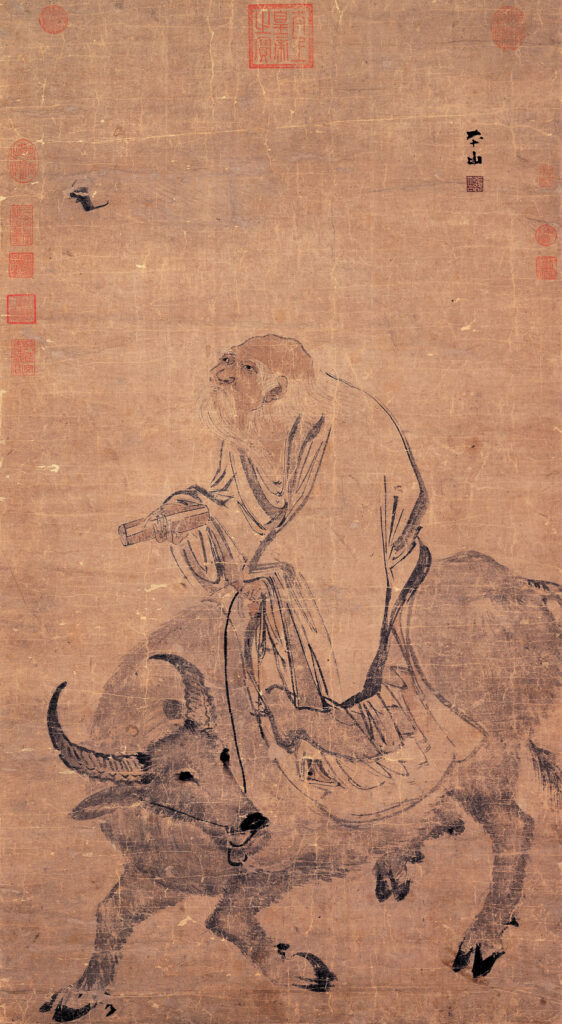
The two readings are not variations on a theme. They are incompatible. One gives you a universe that elevates you and then drops you; the other gives you a universe that never had you in mind in the first place and is not, on that account, hostile. Modern translators have almost all gone with the straw effigy, and the weight of the Chinese tradition is with them. But it is worth knowing that borrowing the Zhuangzi to explain the Daodejing is itself a habit with a history in English scholarship, and that the second half of the chapter — 聖人不仁, the sage is not benevolent — reads far more naturally on Wang Bi’s terms, as a description of the ruler who governs by not intervening.
不仁 is not cruelty, and in Chinese it is also numbness
The harder word is the one nobody stops on. 仁 is the central Confucian virtue: humaneness, the feeling that binds you to the people close to you. 不仁 is its negation, and the Taiwanese dictionary gives two senses, not one. The first is the expected one, unkind. The second is medical, and it is the one that changes the chapter: loss of sensation, a limb that has gone dead. The Zhu Xi Yulei entry quoted there asks whether the numbness of the four limbs might be a figure for the ten thousand things.
Read with the second sense in play, 天地不仁 is closer to heaven and earth do not feel with you than to heaven and earth are out to get you. A numb hand is not a malicious hand. That distinction is exactly what the standard English versions lose, and losing it is not a small matter, because the chapter is the single most-quoted evidence for the claim that Daoism is indifferent to human suffering.
How “straw dogs” got into English
James Legge, translating for the Sacred Books of the East in 1891, produced the awkward phrase that started the confusion — and then, in a footnote on the same page, explained the object correctly: straw tied into the shape of dogs, used in praying for rain, thrown aside afterwards and left uncared for. The footnote is right. The translation is not, and translations travel while footnotes stay behind.
Arthur Waley in 1934 gave the line its permanent English shape: heaven and earth are ruthless, and to them the ten thousand things are but as straw dogs. D. C. Lau’s Penguin version of 1963 kept ruthless through both halves: heaven and earth treat the myriad creatures as straw dogs, and the sage treats the people the same way. Between them they fixed a word in place that neither Wang Bi nor the dictionary supports, because ruthless imports intention. Something ruthless has decided not to spare you. 不仁 has decided nothing.
| Version | Renders 不仁 as | Renders 芻狗 as |
|---|---|---|
| Legge, 1891 | do not act from any wish to be benevolent | the dogs of grass |
| Waley, 1934 | ruthless | straw dogs |
| Lau, 1963 | ruthless | straw dogs |
| Mitchell, 1988 | — (absent) | — (absent) |
If you are choosing a copy to live with, the differences in this chapter are a fair sample of the differences everywhere, and we have compared the main editions in detail in our guide to which Tao Te Ching translation to read in English. The spelling of the title varies too, for reasons that have nothing to do with the Chinese and everything to do with two romanisation systems: that is the subject of our note on Dao or Tao.
The chapter Stephen Mitchell removed
Mitchell’s 1988 version is the best-selling English Tao Te Ching there has been, and his chapter 5 contains neither heaven and earth nor straw dogs. In their place is a sentence about the Tao not taking sides, giving birth to both good and evil, and a Master who welcomes saints and sinners alike. It is a serviceable sentiment. It is not this chapter. A reader who comes to Laozi through Mitchell — and an enormous number of readers do — will never learn that the text contains a straw dog at all, and so will never be in a position to ask what one was.
From Laozi to Peckinpah, and where the trail goes cold
Sam Peckinpah’s Straw Dogs, released at the end of 1971 and catalogued by the AFI under 1972, took its title from this chapter. The American Film Institute’s catalogue entry records the derivation and quotes the line in the ruthless … straw dogs wording, noting that the source novel had been called The Siege of Trencher’s Farm. The wording AFI quotes is Lau’s, down to the choice of myriad creatures, though the entry capitalises Earth, drops Lau’s two commas and names no translator at all — which makes Lau the likely route rather than a documented one.
Unverified: we could not find a statement by Peckinpah or by the producers saying who chose the title or which edition they were holding. Secondary accounts assert it was Peckinpah himself; none of the ones we checked cite a source. We are recording the AFI entry as fact and the rest as undocumented rather than repeating a story that may have been invented in a press kit.
Reading chapter 5 from Taiwan
In Taiwan the phrase is not exotic. It is in the national dictionary, which schoolchildren use, and the entry settles the straw-effigy reading as the standard one without mentioning that Wang Bi disagreed. The related idiom 土龍芻狗 survives too; the same dictionary glosses it, literally, as 泥塑的龍,草紮的狗 — a dragon of clay and a dog of straw — and figuratively as a name that does not match the thing. The line itself surfaces in newspaper opinion columns whenever a writer wants to set Daoist impartiality against Confucian preference — the classicist Liu Junzu 劉君祖 used it that way in his Storm Media column in 2019, glossing it as heaven and earth not making a display of kindness and letting the ten thousand things flourish and wither as they will.
Unverified: we looked for the line on temple plaques, in gallery calligraphy and on shop signs and did not find a documented example we could cite. That absence is itself mildly interesting. Taiwanese temples display couplets about blessing and response; a line denying that heaven has preferences is not what anyone commissions in gold leaf. If you have photographed one, we would like to see it.
What the chapter is doing, on either reading, is refusing a bargain. Heaven does not owe you rain because you were good. The bellows in the second half is the positive statement the first half sets up: the space between heaven and earth is empty and inexhaustible precisely because nothing in it is being played favourites with. Whether Laozi was a person who could have written that, and when, is a question we have looked at separately in did Laozi live before Confucius.
FAQ
Does “heaven and earth are not benevolent” mean the universe is cruel?
No. 不仁 negates a virtue rather than asserting a vice, and its second dictionary sense in Chinese is numbness, loss of feeling. The chapter denies that heaven has favourites; it does not claim heaven has malice. English versions that use “ruthless” add an intention the Chinese does not carry.
What is a straw dog in the Tao Te Ching?
On the standard reading, a dog plaited from straw for use in a sacrifice and discarded once the ceremony was over. A third-century gloss by Wang Bi has often been read as splitting it into two — fodder and dogs — neither of which heaven and earth produce on purpose, though that attribution is disputed and most commentators, then and since, kept the single object. The two readings are both old and they are not compatible.
Is Peckinpah’s film Straw Dogs named after this chapter?
Yes. The American Film Institute’s catalogue records that the title comes from the Daodejing and quotes the line. Who on the production chose it, and from which translation, is not documented in any source we could check, although the wording AFI quotes matches D. C. Lau’s 1963 translation exactly.
Wang Bi turns the same trick on another famous opening: see what chapter 60 means by governing a great nation as you cook a small fish, and the half-line an American president added to it.
Zhuangzi plays the same game with a word his opponent has just used. See the happiness of fish.
That flat cosmological claim does its practical work in Zhuangzi’s answer at his wife’s death, where the seasons turning is the whole of the consolation on offer.
Chapter 5 is not the only place where the reading everybody learned is the later one. The same thing has happened to the great vessel of chapter 41: Da Qi Wan Cheng: The Oldest Copies of Laozi Do Not Say ‘Late’.
The Tuan commentary to the fifteenth hexagram of the Changes makes a related observation without the straw dogs: heaven diminishes the full and adds to the humble, and nobody in that sentence is being rewarded either.
Sources
- 《老子》第五章(王弼本)「天地不仁,以萬物為芻狗」 — Chinese Text Project, Daodejing (checked 16 September 2026, verified character by character in-browser)
- 《莊子・外篇・天運》「夫芻狗之未陳也」段 — Chinese Text Project, Zhuangzi, “Revolution of Heaven”
- 教育部《重編國語辭典修訂本》「芻狗」詞條 — Ministry of Education, Taiwan
- 教育部《重編國語辭典修訂本》「不仁」詞條(含《後漢書・班超傳》「兩手不仁」、《朱子語類》「四肢痿痺為不仁」) — Ministry of Education, Taiwan
- James Legge, The Texts of Taoism, Sacred Books of the East vol. 39 (1891), chapter 5 and its note on grass-dogs — sacred-texts.com
- Stephen Mitchell, Tao Te Ching (1988), chapter 5 — terebess.hu full text
- Callisto Searle, “The Hermeneutics of Contentious Imagery: What Exactly the Zhuangzi Has to Say about the Straw Dogs in the Laozi“, Religions 10(6):359 (2019) — MDPI, open access
- Straw Dogs (1971), title derivation — AFI Catalog of Feature Films
- Alan K. L. Chan, “Laozi”, Stanford Encyclopedia of Philosophy — plato.stanford.edu
- 劉君祖,〈劉君祖專欄:萬物為芻狗,還有什麼可戀棧的呢?〉,《風傳媒》,2019-08-25 — storm.mg



