
Eighty-one characters, and every schoolchild in Taiwan and Hong Kong has had to learn them. The Loushi Ming — 陋室銘, an inscription for a mean little room — is short enough to fit on a fan, which is exactly what happens to it: it is sold as calligraphy on scrolls, carved into bamboo brush pots, hung in studies by people who have no intention of living in a mean little room. The English-speaking internet knows it mostly through those objects, and through a scattering of translations that disagree with each other about at least two lines.
What almost none of that material mentions is that one of the two Tang dynastic histories records a 陋室銘 written by somebody else entirely — a man who died thirty-three years before Liu Yuxi was born.
The text
Here is the whole thing, in the form it is taught, with my own translation.
Inscription on a Mean Room
山不在高,有仙則名。水不在深,有龍則靈。斯是陋室,惟吾德馨。苔痕上階綠,草色入簾青。談笑有鴻儒,往來無白丁。可以調素琴,閱金經。無絲竹之亂耳,無案牘之勞形。南陽諸葛廬,西蜀子雲亭。孔子云:何陋之有?
A hill need not be high: if an immortal lives on it, it has a name. Water need not be deep: if a dragon lives in it, it has power. This is a mean room; only my virtue gives it fragrance. Moss has come up the steps and greened them; the colour of the grass comes in through the blind. Those who talk and laugh here are great scholars; nobody without rank comes or goes. Here one may tune a plain zither and read the gold-lettered scriptures. No strings and pipes to disorder the ear, no official papers to wear out the body. Zhuge’s cottage at Nanyang; Ziyun’s pavilion in western Shu. Confucius said: “Where is the meanness in that?”
〈陋室銘〉,題劉禹錫撰 — text as printed in the Hong Kong Education Bureau’s recommended classical passages for junior secondary (accessed 7 Sep 2026)
I have kept one English word, “mean”, for every occurrence of 陋. That is clumsier than “humble”, which is what most translators use, but the essay is built on the repetition: it opens by conceding that the room is lou and closes by asking where the lou is. Translate the first as “humble” and the last as “crude” and the hinge disappears. 陋 covers shabby, cramped, coarse and — this matters for the final line — culturally backward.
What a ming is
The genre is doing more work here than the English word “essay” suggests. A 銘 was originally something cut into metal or stone: a bronze vessel, a stele, a basin. Because it had to be carved, it was short. Because it was carved on an object that would outlive the writer, it was declarative — it stated what a thing or a life was for. And because it was meant to be recited rather than skimmed, it rhymed.
The best-known survival of the habit is the phrase 座右銘, “the inscription at the right of one’s seat”, which English borrowed the concept of without the object: a motto. A ming praises, or warns, or both. So when this one says that a room with moss on the steps is sufficient, it is not making a private observation. It is issuing a statement of principle in the most durable literary form available, about a room that anyone can see is small.
The rhyme you cannot hear in English
Every translation I have looked at renders the piece as prose, and every one of them loses the reason it lodges in the memory. Eight of the nine clauses end on the same rhyme:
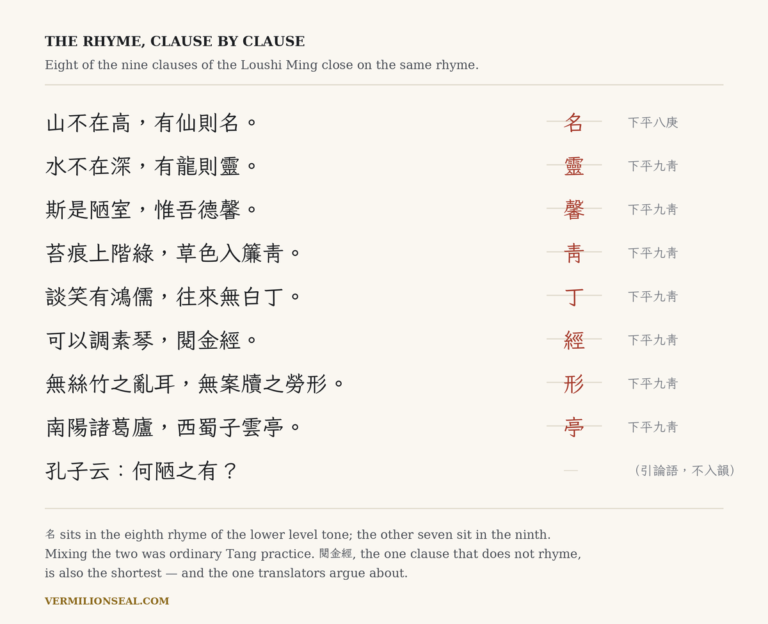
In the 平水韻 rhyme categories used for classical verse, 靈、馨、青、丁、經、形、亭 all sit in 下平九青, and 名 sits in the neighbouring 下平八庚. Mixing those two was ordinary practice. The effect in Chinese is a chain of eight chimes across eighty-one syllables, which is why people who cannot explain a single allusion in the piece can still recite the whole of it.
The clause lengths move too — four, four, four, then five, five, then a lopsided five-and-three, then six, six, then five, five — so the rhyme lands at uneven intervals rather than ticking. The one clause that does not rhyme, 閱金經, is also the shortest. It is the only place the pattern stumbles, and it happens to be the line translators argue about.
Hills, water, and a room
The opening is a syllogism dressed as scenery. Height does not make a hill notable; an immortal resident does. Depth does not make water potent; a dragon does. Therefore the size of a room is not the question either — the resident is. It is a tidy argument, and it is also a slightly aggressive one, because the writer has just compared himself to an immortal and a dragon before getting to the modesty.
德馨, “virtue’s fragrance”, is not an invention. It reaches back to the Book of Documents, where the Duke of Zhou’s successor is told: 「至治馨香,感于神明。黍稷非馨,明德惟馨。」 — perfect government has a fragrance that reaches the spirits; it is not the millet offerings that are fragrant, it is bright virtue. An educated Tang reader would have heard the allusion immediately, and with it the claim that what happens in this room is continuous with the moral vocabulary of high antiquity. The same phrase 明德 is the first of the three headings of the Great Learning, which we have taken apart elsewhere.
Moss, scholars, and a plain zither
The two lines about moss and grass are the only description in the piece, and they are doing something specific: green is climbing the steps and coming through the blind, which means nobody is sweeping and nobody is calling. The room is neglected. The writer presents the neglect as atmosphere.
Then comes the line that modern readers trip over. 談笑有鴻儒,往來無白丁 — the company is hongru, eminent scholars, and there is no baiding. A 白丁 is a commoner holding no office and no degree; the Hong Kong Education Bureau’s teaching gloss renders it as an ordinary person without learning. So the sentence that is usually quoted as a model of contented poverty also announces that the uneducated do not get through the door. Chinese critics have said so for a long time, and it is a fair complaint. The room is small; the guest list is not egalitarian. Whatever this essay is praising, it is not simplicity as such — it is a scholar-official’s version of simplicity, in which the furniture goes and the social sorting stays.
素琴, a “plain” zither, means a qin with no inlay, no ornament, nothing but the wood. It carries a specific ghost: Tao Yuanming, the great recluse poet of the fifth century, who according to his biography in the Book of Jin could not read music but kept a plain qin with neither strings nor fret-markers, and would stroke it at drinking parties, saying that if you catch the sense of the qin, why labour after the sound of the strings. To put a suqin in a poem about a small room is to put Tao Yuanming in the room.
Gold scriptures and the noise of strings
閱金經 is the crux. Jin jing is literally “gold scripture”, and translators have gone three ways with it. Howard Choy reads it flatly as “read the Diamond Sutra”. John Thompson’s guqin site hedges — “examine treasured classics (the Diamond Sutra?)” — and adds in a note that the phrase “does not necessarily refer to the famous Buddhist sutra as we know it”, though it most likely does mean Buddhist reading. Other versions in circulation go literal, with “golden-lettered scriptures” or simply “golden classics”. The Hong Kong teaching gloss keeps it broad: Buddhist scriptures, or treasured books generally.
The safest reading is the literal one. Sutras written in gold ink on dark paper were a real and expensive genre of Tang manuscript, and “gold scripture” describes the physical object without committing to a title. Choosing “the Diamond Sutra” imports a specific text on no evidence; choosing “classics” loses the Buddhist colouring that the word almost certainly has. This is the sort of decision that separates translations of the same eighty-one characters from one another, and it is the same class of problem we went through when comparing English versions of the Tao Te Ching.
The next line looks like a contradiction and is not. He has just said he plays a zither; now he says there are no 絲竹 — “silk and bamboo”, strings and pipes — to disorder his ear. But a qin is silk-strung. The resolution is that sizhu is not a materials list, it is an institution: the hired ensemble, the banquet band, music as entertainment supplied by other people. A man alone with an unornamented qin is not doing that. The pairing is exact — no hired music, no official paperwork — because both are things the outside world sends into a house and both take something out of the person who receives them. 案牘勞形 has since hardened into a set phrase; Taiwan’s Ministry of Education dictionary of idioms defines it as being worn out by a crushing load of documents, and Taiwanese office workers still use it.
Two huts and a borrowed ending
The last three clauses stop describing and start citing. 南陽諸葛廬 is the thatched cottage where Zhuge Liang was farming when Liu Bei came to recruit him — a small building whose occupant went on to run a state. 西蜀子雲亭 is the pavilion of Yang Xiong, courtesy name Ziyun, the Han philosopher and lexicographer from Chengdu who wrote in poverty and was read for two thousand years. Two men, two undistinguished buildings, both remembered because of who was inside. It is the opening syllogism again, now with names attached.
Then the essay stops mid-sentence and hands the ending to Confucius. 何陋之有 comes from Analects 9.14: the Master wanted to go and live among the nine tribes of the east, somebody objected that the place was lou — backward — and he replied, 「君子居之,何陋之有?」, if a gentleman lives there, where is the backwardness? The inscription quotes only the second half. The first half, the conditional clause that does all the work, is left for the reader to supply, and the whole essay is the argument that the writer qualifies as the gentleman in it. It is an elegant piece of construction, and it depends on the reader having the Analects by heart, which the intended reader did.
The story about the spiteful magistrate
Search for this essay in Chinese and you will meet a story. Liu Yuxi, demoted to Hezhou, is refused the official residence and put in three rooms outside the south gate. He writes a defiant couplet on the door; the local magistrate, annoyed, moves him to a smaller place; he writes another couplet; he is moved again, to a single room barely big enough for a bed and a desk — and there, in fury, he writes the Loushi Ming.
It is a good story and I can find no early source for it. It circulates through textbook teachers’ notes — a Taiwanese commentator tracing it found it in the background material accompanying a school edition, and hedged the whole discussion with “if this account is accurate”. It is not in the New Book of Tang, which I have read for this period; I have not been able to check the Old Book of Tang directly, so treat that half as open. What the New Book of Tang does record is administrative: Liu was moved from Kuizhou to Hezhou, served as its cishi — prefect, the senior official of the prefecture, not a man dependent on a county magistrate’s goodwill — and went from there to a post in the capital. The dates are the summer of 824 to 826. There is no room, no couplet, no feud.
Treat the magistrate as folklore until somebody produces a Tang or Song source for him. It is the kind of story that grows around a famous text to explain its tone, and the tone here is real enough to have invited one.
And then there is the other Loushi Ming
This is the part that is missing from the English pages.
The New Book of Tang contains a biography of Cui Mian (崔沔, 673–739), courtesy name Shanchong, a Chang’an official known for austerity. The biography says:
From the biography of Cui Mian
沔儉約自持,祿稟隨散宗族,不治居宅,嘗作陋室銘以見志。
Mian held himself to frugality, distributed his salary and stipend among his clan as it came, did not maintain a residence, and once wrote an “Inscription on a Mean Room” to make his purpose plain.
《新唐書》卷一百二十九・列傳第五十四〈崔沔傳〉 — Song dynasty, compiled by Ouyang Xiu and Song Qi (accessed 7 Sep 2026)
Cui Mian died in 739. Liu Yuxi was born in 772. So an official history compiled in the eleventh century credits a 陋室銘 to a man of the previous century, and does so in his own biography, as a documented fact about how he lived.
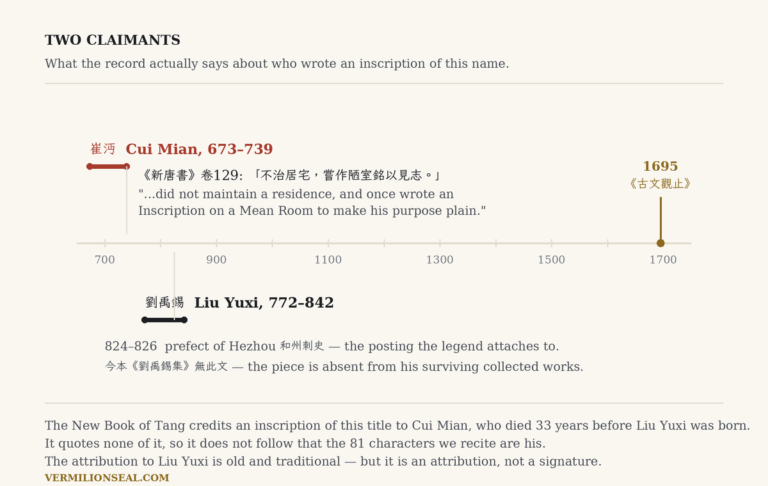
Set against that, the case for Liu Yuxi is weaker than its ubiquity suggests. The Hong Kong scholar Lau Wai-lam, writing in the Chinese University of Hong Kong’s Chinese Language Review, points out that the piece is absent from Liu Yuxi’s collected works as they survive — 今本《劉禹錫集》無此文 — and puts the position bluntly: Cui Mian’s composition of a Loushi Ming is on the record and dates earlier, while whether Liu Yuxi wrote a piece of the same name is still disputed. He returned to the question twenty years later in a peer-reviewed article devoted to it, examining the transmitted versions, the editorial history, and inscription evidence, and framing the problem as the relationship of the text to both men.
Two cautions, because the conclusion is easy to overstate. First, the New Book of Tang tells us Cui Mian wrote an inscription with that title; it does not quote a word of it. Nothing in that sentence proves that the eighty-one characters we have are his. Titles of this kind were not exclusive — “inscription on a mean room” is a description before it is a title, and more than one frugal official could arrive at it. Second, the attribution to Liu Yuxi is old rather than modern: reference works have carried it for centuries, and a Northern Song source is cited in the scholarly literature as linking his name to the piece well before the Qing anthology Guwen Guanzhi (1695) made it a set text for everybody.
What can be said cleanly is this. A Tang official demonstrably wrote a Loushi Ming and it was not Liu Yuxi. The text we recite is not in Liu Yuxi’s surviving collection. The attribution to him is traditional and early, but it is an attribution, not a signature — and Chinese scholarship has treated it as an open question since at least the 1970s. English-language sources, including the ones selling the calligraphy, present it as settled.
What the English versions do with it
There is no dedicated English Wikipedia article for this text, which tells you roughly where the field is. The translations in circulation fall into three groups.
The oldest is Herbert Giles’s, made for Gems of Chinese Literature in the 1880s under the title “My Humble Home”; it is out of copyright and drifts through the internet unattributed. The most carefully annotated free version is on John Thompson’s guqin research site, which comes at the essay sideways — as a piece of qin repertoire — and is the better for it, because the translator has actually thought about what a suqin is. Howard Choy’s is informed but reads the text through feng shui. Several Chinese translators have produced versions of their own, but these circulate in comparison threads rather than in books a reader can get hold of. The one properly edited scholarly treatment, in Readings in Classical Chinese Poetry and Prose from Princeton in 2018, sits behind a paywall and does not rank in ordinary search results at all.
The practical consequence is that a reader who wants this text in English will land on a product listing, a personal blog, or a machine translation — and at least one of the blogs that ranks well quotes lines from a completely different Liu Yuxi poem as though they belonged to this one. Comparing versions is the only defence, which is the same conclusion we reached about English editions of the Analects.
FAQ
Who wrote the Loushi Ming?
Tradition assigns it to the Tang poet Liu Yuxi (772–842) and every school edition prints his name. The attribution is early but not certain: the piece is missing from his surviving collected works, and the New Book of Tang records that the earlier official Cui Mian (673–739) wrote an inscription of the same title. No text of Cui Mian’s version survives, so the honest position is that the author of these particular eighty-one characters is disputed.
What does Loushi Ming mean in English?
“Inscription on a mean room”. 陋 means shabby, cramped or backward; 室 is a room; 銘 is an inscription of the kind carved on bronze or stone. Common English titles include “Inscription on a Humble Room”, “My Humble Home” and “Inscription for a Crude Dwelling”. “Room” is more accurate than “house” or “dwelling” — the subject is a single room.
Is the story about the magistrate who kept moving Liu Yuxi true?
There is no early source for it. The New Book of Tang does not mention it, and the story appears in modern textbook teaching notes. The verifiable facts are that Liu Yuxi was prefect of Hezhou from the summer of 824 to 826 and left for a post in the capital.
What does the last line mean?
何陋之有 is a quotation from Analects 9.14, where Confucius answers an objection that the eastern tribes’ country is backward by saying that if a gentleman lives there, there is no backwardness. The inscription quotes only the second half of the sentence and leaves the reader to restore the first — which is where the argument actually is.
Sources
- 〈陋室銘〉全文:「山不在高,有仙則名……孔子云:何陋之有?」 — text and teaching glosses (鴻儒、白丁、德馨、案牘、絲竹、金經), Hong Kong Education Bureau, recommended classical passages for junior secondary — edb.gov.hk (accessed 7 Sep 2026)
- 《新唐書》卷一百二十九・列傳第五十四〈崔沔傳〉:「崔沔字善沖,京兆長安人……沔儉約自持,祿稟隨散宗族,不治居宅,嘗作陋室銘以見志。」 — donglishuzhai.net (accessed 7 Sep 2026)
- 《新唐書》卷一百六十八・列傳第九十三〈劉禹錫傳〉:「……又徙連州,又徙夔州刺史……由和州刺史入為主客郎中……」 — no mention of a mean room or a hostile magistrate — donglishuzhai.net (accessed 7 Sep 2026)
- 《論語・子罕》第十四章:「子欲居九夷。或曰:『陋,如之何!』子曰:『君子居之,何陋之有?』」 — ctext.org (accessed 7 Sep 2026)
- 《尚書・周書・君陳》:「我聞曰:至治馨香,感于神明。黍稷非馨,明德惟馨。」 — ctext.org (accessed 7 Sep 2026)
- 劉衛林〈《漢語大詞典》「陋室」條釋義小議〉:「今本《劉禹錫集》無此文」「崔沔作《陋室銘》一事有案可稽,而劉禹錫是否有同名之作,反尚在爭議之間」 — 《中國語文通訊》第44期(1997年12月),香港中文大學中國文化研究所 — cuhk.edu.hk (accessed 7 Sep 2026)
- 劉衛林〈陋室銘考辨〉,《華人文化研究》第5卷第2期(2017年12月),頁137–146 — abstract: the transmitted 81-character text has long been disputed as to authorship; the article examines transmission, editions and inscription evidence and the relation of the text to both Liu Yuxi and Cui Mian — airitilibrary.com (accessed 7 Sep 2026)
- 教育部《成語典》「案牘勞形」:「案牘,指公事文書。形容因文書工作繁重而疲憊不堪。」 — dict.idioms.moe.edu.tw (accessed 7 Sep 2026)
- 平水韻:下平八庚(名)、下平九青(靈、馨、青、丁、經、形、亭) — sou-yun.cn (accessed 7 Sep 2026)
- “Lou Shi Ming: Inscription on a Crude Dwelling”, with translation and notes on 素琴 and 金經 (“does not necessarily refer to the famous Buddhist sutra as we know it”) — John Thompson, silkqin.com (accessed 7 Sep 2026)
- Howard Choy, “Loushi Ming — Inscription about a Crude Dwelling” (2013), translating 閱金經 as “read the Diamond Sutra” — howardchoy.wordpress.com (accessed 7 Sep 2026)
- Naiying Yuan, Haitao Tang and James Geiss, Readings in Classical Chinese Poetry and Prose, Princeton University Press, 2018 — includes “Inscription on a Humble Room”, pp. 214–218 — muse.jhu.edu (accessed 7 Sep 2026)
- 臧真白書劉禹錫〈陋室銘〉,桃園市立美術館典藏 — 文化部國家文化記憶庫 — tcmb.culture.tw (accessed 7 Sep 2026)



