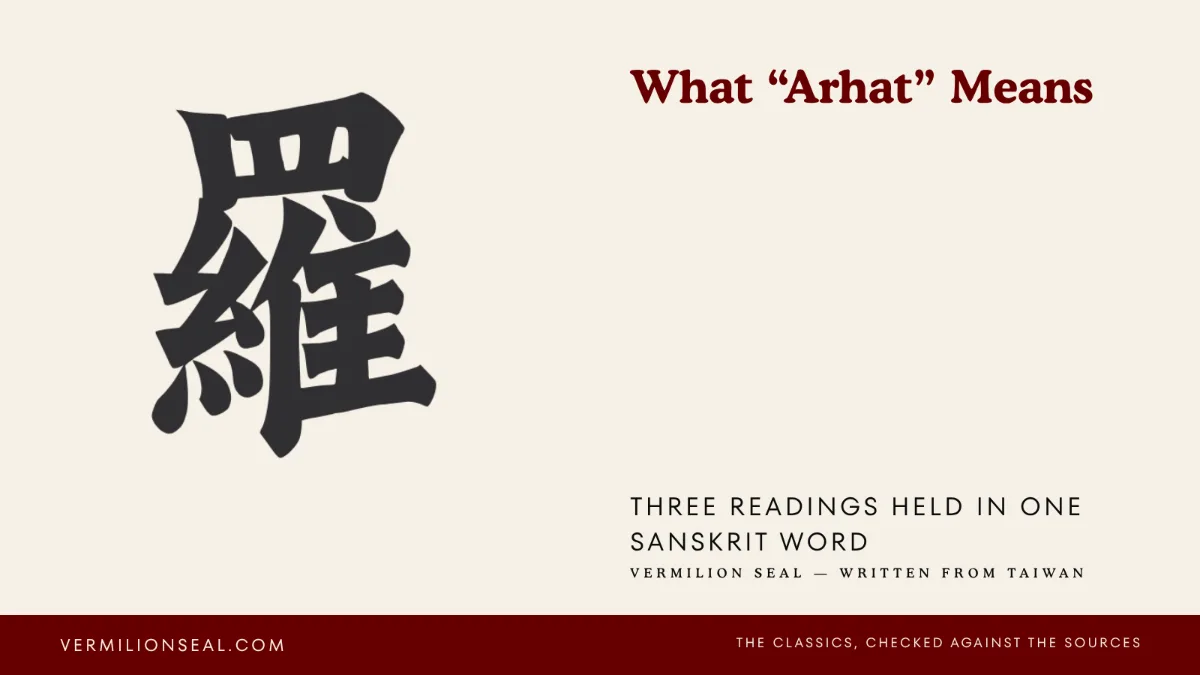
English dictionaries give the arhat meaning in a phrase: “one who has attained enlightenment”, “a Buddhist saint”, “a perfected person”. All of those are descriptions of what an arhat is. None of them is what the word means, and Chinese Buddhism, which had to decide sixteen hundred years ago what to do with this Sanskrit word, took the meaning seriously enough to refuse to translate it. The Chinese kept the sound — 阿羅漢, a-luo-han — and then explained it three ways at once. Those three readings, fixed in a commentary translated at the start of the fifth century, are still what a Taiwanese temple means by the eighteen figures along the walls of its main hall, and still why an old Taiwanese word for a homeless man is “arhat’s feet”.
Arhat: the short answer
Most readers arrive here from a search box, so the short form comes first. The rest of the page is the argument for it.
- Sanskrit arhat, stem arhant, the present participle of arh-, to deserve. Pali arahant. Merriam-Webster derives the English word from the present participle of arhati, “he deserves”, and gives a first known use of 1809 for that sense.
- Chinese 阿羅漢 ā luó hàn, commonly shortened to 羅漢 luó hàn. Japanese rakan. Older English writing uses lohan or luohan, and museums still do: the Metropolitan Museum catalogues its life-size Liao figure under the title Arhat (Luohan), giving both at once.
- Three Chinese glosses, in the order Taiwan’s Ministry of Education dictionary prints them: 殺賊 slayer of the thief, 應供 worthy of offerings, 不生 not born again.
- What the word names. This is where the two languages part. The English dictionaries I have checked define an arhat as a person. Taiwan’s Ministry of Education dictionaries open instead with 果位, a fruit attained — something reached rather than an office held — before going on to mention the disciples who reached it.
- Plural arhats. The abstract noun arhatship, which answers to 阿羅漢果, the fruit of arhatship, the last of four.
- Pronunciation Merriam-Webster gives ˈär-(ˌ)hət. In Taiwan the phonetic notation for 阿羅漢 is ㄚ ㄌㄨㄛˊ ㄏㄢˋ.
The entry doing most of the work below is 阿羅漢 in the Revised Mandarin Chinese Dictionary, which opens 佛教的果位 — a Buddhist fruit-attained. Not a saint, not a monk, not a man.
Three meanings in one word
The standard Chinese explanation comes from the Great Treatise on the Perfection of Wisdom (大智度論), a vast commentary on the Prajñāpāramitā sutra translated into Chinese by Kumārajīva between 402 and 406. The sutra it comments on opens, as most sutras do, by describing the audience: the Buddha at Rājagṛha with a great assembly of monks, “all of them arhats, their outflows exhausted, without further affliction”. The commentary stops at the word and asks what it means.
The three readings
云何名阿羅漢?「阿羅」名賊,「漢」名破;一切煩惱賊破,是名「阿羅漢」。復次,阿羅漢一切漏盡,故應得一切世間諸天人供養。復次,「阿」名不,「羅漢」名生;後世中更不生,是名「阿羅漢」。
“What is meant by ‘arhat’? Ara means ‘thief’, han means ‘destroy’: one who has destroyed all the thieves that are the afflictions is called an arhat. Again, an arhat has exhausted all outflows, and so deserves to receive the offerings of all the gods and humans in the world. Again, a means ‘not’, rahan means ‘born’: one who will not be born again in a later life is called an arhat.”
《大智度論》卷三,龍樹造,後秦 鳩摩羅什譯(CBETA T25, no. 1509, p. 80c18–81a1) · CBETA via deerpark.app
Later Chinese lexicographers boiled this down to three two-character labels that every seminary student in Taiwan still learns: 殺賊, “slayer of thieves”; 應供, “worthy of offerings”; 無生, “no more birth”. The twelfth-century dictionary of Buddhist terms, the Fanyi Mingyi Ji, quotes the passage above and then gives the reason the word was left in Sanskrit:
Why it was never translated
或言無翻,名含三義:無明穅脫,後世田中,不受生死果報,故云不生。九十八使煩惱盡故,名殺賊。具智斷功德,堪為人天福田,故言應供。含此三義,故存梵名。
“Some say it has no translation, because the name holds three meanings. The husk of ignorance has fallen away, and in the field of future lives he receives no further fruit of birth and death: hence ‘not born’. The ninety-eight afflictions are exhausted: hence ‘thief-slayer’. He possesses the merits of wisdom and of cutting-off and can serve as a field of merit for gods and humans: hence ‘worthy of offerings’. Because it holds these three meanings, the Sanskrit name is kept.”
《翻譯名義集》卷一,宋 法雲編(CBETA T54, no. 2131) · CBETA via deerpark.app
This is one of the rules Chinese translators worked by: a foreign word that carries several meanings is transliterated rather than translated, because any one Chinese equivalent would drop the others. “Worthy of offerings” would have been a fine translation of the Sanskrit — and, as it happens, the philologically correct one — but it would have lost the thief-slayer and the end of rebirth.
Which reading is the real etymology?
Only one. Sanskrit arhat is the participle of arh-, “to deserve, to be worthy”, so 應供, “deserving offerings”, is what the word actually says. The other two are what scholars call exegetical etymologies: the commentators split the word as ari-han, “enemy-killer”, and a-ruh, “not born”, to draw out doctrine. This was not a Chinese misunderstanding. The Pali commentaries do the same thing with arahant, deriving it from “far from” the defilements and from “having killed the enemies”, so the Chinese text is transmitting an Indian habit of reading, not inventing one. The point of the three readings was never linguistics. It was to say, in a form a student could memorise, what the person had done (destroyed the afflictions), what followed (no rebirth), and what that entitled him to (support from the laity).
Where the arhat stands
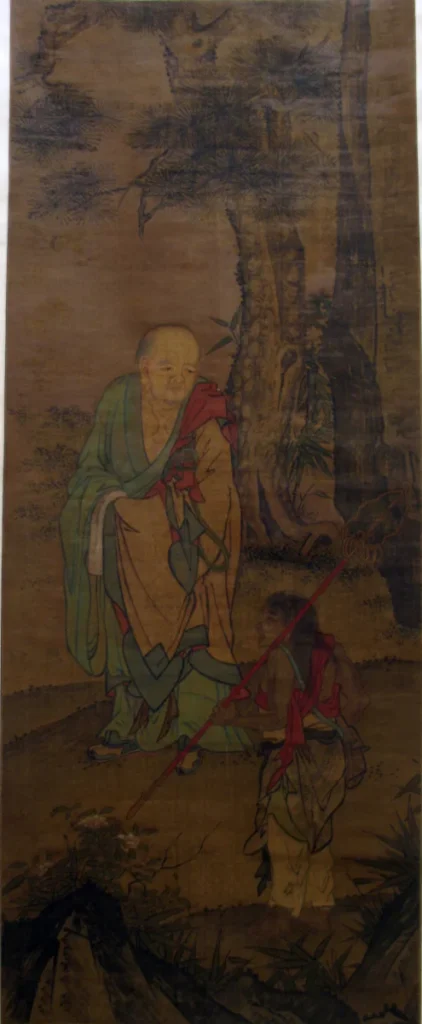
In the early canon the arhat is the goal. The path has four “fruits” — stream-enterer, once-returner, non-returner, arhat — and the fourth is the end of it: the person who will not be reborn. The Buddha himself is an arhat in this scheme, and “worthy of offerings” (應供) is one of his ten standard epithets. The sutra the Great Treatise comments on has the Buddha’s whole audience at that level.
The Mahāyāna texts that Chinese Buddhism built on kept the arhat and demoted him. In the three-vehicle scheme those texts use, the arhat is the fruit of the “hearer’s vehicle” (聲聞): he has heard the teaching, ended his own affliction, and stopped. Above him is the pratyekabuddha, who reaches the same cessation on his own, and above both is the Buddha, whose awakening includes the resolve to bring everyone else across. The Great Treatise itself, a few chapters after the passage quoted above, notes that arhats come in nine grades and that even a “small pratyekabuddha” is, in his liberation, 與阿羅漢無異, “no different from an arhat”. What distinguishes the vehicles is not how free one becomes but how much one set out to do.
So “Buddhist saint” is the least helpful gloss of all, because sainthood is a matter of virtue and veneration, and the arhat is defined by neither. The commentary’s own next sentence, on the phrase “outflows exhausted”, is the definition: 三界中三種漏已盡無餘, “the three kinds of outflow in the three realms are exhausted without remainder”. An arhat is someone in whom something has stopped.
Arhatship is a fruit, not a rank
Merriam-Webster’s entry runs to nine words: an arhat is “a Buddhist who has reached the stage of enlightenment”. Underneath it, as a run-on, sits arhatship. Read the two together and you get a noun for a kind of person plus a noun for the condition of being that person, which is how English handles knight and knighthood, or bishop and bishopric. In that treatment the word behaves like a title.
Open Taiwan’s Revised Mandarin Chinese Dictionary at the same word and the grammar is different. 阿羅漢 begins 佛教的果位, a Buddhist fruit-attained; the short form 羅漢 begins 佛教修證的果位, the fruit-attained of Buddhist cultivation and realisation. Neither entry starts with a person. The head of the definition is 果位, a compound built on 果, fruit — the result a practice ripens into, with 位 marking where in a sequence that result falls.
The sequence is old and the canon is explicit about what kind of thing it lists. In the ninth scroll of the Chinese Long Discourses, in the discourse called 〈十上經〉, the four fruits appear under the heading of things to be realised rather than things to be held:
Four things to be realised
云何四證法?謂四沙門果:須陀洹果、斯陀含果、阿那含果、阿羅漢果。
What are the four things to be realised? The four fruits of the śramaṇa: the fruit of stream-entry, the fruit of once-returning, the fruit of non-returning, the fruit of the arhat.
《長阿含經》卷九〈十上經〉, CBETA T01, no. 1, scroll 9 — cbetaonline.dila.edu.tw
Four fruits, each named with 果, and the last of them is the arhat’s. So the English arhatship, awkward as it looks, lands closer to the Chinese than arhat does. The abstract noun is right; it is the concrete one that misleads, because it turns the fourth fruit into the fourth rung of a ladder of persons, and a reader who has met bodhisattva first will assume the ladder goes on upwards and that the arhat is simply stuck low on it.
The dictionary is unusually candid about where that assumption comes from. Its own entry for 阿羅漢 keeps going after the definition and tells you that in early Buddhism the arhat was final, no different from Buddhahood, and that after the rise of the Mahāyāna the arhat was demoted and treated as no more than the highest fruit of the lesser vehicle, with the bodhisattva and the Buddha placed above. A monolingual dictionary that writes the polemic into the gloss is doing something most dictionaries avoid, and it is worth noticing that the demotion is recorded as history, not asserted as fact.
The eighteen along the wall
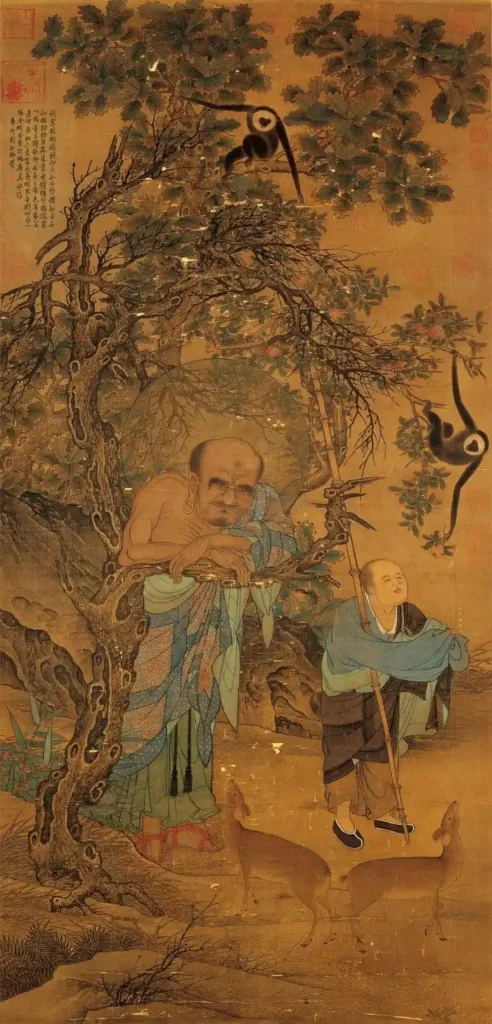
What visitors to a Taiwanese temple actually meet is not the doctrine but the statues. Walk into the main hall of a large Buddhist temple and there will usually be nine figures down each side wall: the Eighteen Arhats, 十八羅漢, each with a prop — a tiger, a dragon, long eyebrows, a bowl, a book. They are the reason ordinary Chinese drops the first syllable: the everyday word is 羅漢, luohan, and “eighteen arhats” is the phrase people know even if they could not say what an arhat is.
The number has a source and an accretion. The source is a short text translated by Xuanzang in 654, the Record of the Abiding of the Dharma, which reports that when the Buddha entered final nirvana 以無上法付囑十六大阿羅漢并眷屬等,令其護持使不滅沒, “he entrusted the supreme Dharma to sixteen great arhats and their followers, charging them to protect it and not let it perish”, and names them, beginning with Piṇḍola Bhāradvāja. Sixteen is the canonical number; the sixteen were painted in China from the ninth century on. The seventeenth and eighteenth were added later, in China, and the identity of the extra two was never settled — different temples and different painters chose different pairs. So when a temple guide in Taiwan tells you the eighteen arhats were the Buddha’s disciples, the first sixteen have a scripture behind them and the last two have a habit.
Arhat’s feet
The word also walked out of the temple. In Qing-dynasty Taiwan, the single men who crossed from Fujian to work the new land with no family and no household were called 羅漢腳, “arhat’s feet” — men who, like arhats, had no home and no descendants, and who wandered. The Ministry of Education’s dictionary of everyday Taiwanese still carries the term in its diminutive form, 羅漢跤仔 (lô-hàn-kha-á), glossed simply as 無家可歸的流浪漢, “a homeless vagrant”. The path from “worthy of the offerings of gods and men” to “man sleeping under a bridge” runs through the one thing they share, which is that neither has a house. Anyone who thinks the three-meaning gloss is over-subtle might notice that Taiwanese speakers, without reading a word of the Great Treatise, picked out the “no household, no continuation” sense and built a word on it.
For the other member of the pair that English usually flattens to “solitary Buddha”, see what pratyekabuddha means and why Chinese has two words for it. For how the Chinese tradition describes the mind that the arhat has stilled, see the eight consciousnesses and the four wisdoms. For what to do with your hands and feet when you are standing between the eighteen, see Taiwan temple etiquette; and for a Chan text that tells laypeople the practice is at home, not in the hall, see Huineng on correcting faults.
The fruit that lost its arhat
There is a small brown dried gourd in the health-food aisles of the English-speaking world, sold as a sweetener under the name monk fruit. Its Chinese name is 羅漢果: arhat fruit. Somewhere between the two the arhat turned into a monk, which is the one thing the word was built to say he is not. A monk is 比丘, a member of an order; an arhat, as the dictionaries above have it, is a fruit attained. Some English dictionaries build the confusion into the definition, which is how a name on a packet can be wrong and unremarkable at the same time.
The technical record did not make the mistake. The plant entered Western botany in 1941 in a paper by Walter T. Swingle titled Momordica grosvenori sp. nov. the source of the Chinese Lo Han Kuo. Swingle did not translate the name; he transliterated it. Kew’s record carries the Latin and nothing else. Three-quarters of a century later the United States Food and Drug Administration, answering a GRAS notice, still writes the substance up as “Siraitia grosvenorii Swingle (Luo Han Guo) fruit extract”.
You can watch the monk arrive. The same agency’s page for the general reader lists “Extracts from Siraitia grosvenorii Swingle fruit, also known as Luo Han Guo or monk fruit”. The Latin and the transliteration are what the file says; monk fruit is what gets added when the file is explained to the public. That is where the word lives — not in the science, in the shelf copy.
Where he came from I cannot say. I looked for a first use of monk fruit in English and found nothing citable: the early sources transliterate and the later ones assume. Until the citation turns up, the position is that a widely sold mistranslation of a Buddhist term into English has no documented author.
The Chinese name has a gap of its own, and it is worth being plain about it, because the gap is usually filled with confidence. Stories in circulation hold that the fruit honours a physician called Luohan, or that it is named for a resemblance to a shaven arhat’s head, or that Yao herbalists in Guangxi gave it the name. None of them carries a source I can follow. The physician story even has a government address: it sits on Taiwan’s Ministry of Agriculture knowledge portal, posted in December 2007 by a member under the handle HHK, who writes that the fruit is 以中國醫師羅漢(發現其藥效者)之名而命名, named after a Chinese physician called Luohan who discovered its medicinal effect. No citation is attached. A reader is entitled to know that the etymology is unsupported on both sides of the translation rather than merely disputed.
That forum post does get one thing right that an official dictionary gets wrong. HHK calls the plant 瓜科多年草藤蔓性植物, a perennial gourd-family vine, which is what it is. Taiwan’s Revised Mandarin Chinese Dictionary defines 羅漢果 as the fruit of 藤黃科常綠喬木, an evergreen tree of the Clusiaceae, with 單葉對生, simple leaves in opposite pairs. Kew’s Plants of the World Online places Siraitia grosvenorii in the Cucurbitaceae and calls it a climbing tuberous geophyte native to south-eastern China. Not a tree, not evergreen, not that family; and cucurbit leaves are standardly described as alternate rather than opposite.
The entry is not wrong about everything. Its second half — dried, the fruit clears heat and settles a cough — describes exactly the plant everybody means. So the botany and the pharmacology inside the same paragraph are pointing at two different plants. That is still the entry served today, in the version the site labels 臺灣學術網路第六版. How it happened I do not know; I can record that it is there, and date the reading.
The same slippage reaches the table. The dictionary’s entry for 羅漢菜 gives two senses, the second a dish of mixed vegetables, 也稱為「羅漢齋」. The usual English name for it is Buddha’s Delight. The Michelin Guide‘s article on the dish shows both at once: the headline reads 追本溯源:羅漢齋 and the address of the same page reads trace-the-roots-buddhas-delight. A sweetener that lost its arhat and a dish that gained a Buddha. Between them they are a fair account of what happens to 羅漢 in transit.
FAQ
What does arhat mean literally?
The Sanskrit means “one who is worthy” (of offerings). Chinese commentaries add two further readings, “slayer of the thieves that are the afflictions” and “not to be born again”, and the Great Treatise on the Perfection of Wisdom gives all three together. Because the word was held to carry three meanings, it was transliterated as 阿羅漢 rather than translated.
What is the difference between an arhat and a Buddha?
Both have ended affliction and rebirth. In the early canon the Buddha is himself an arhat. In Mahāyāna texts the arhat is the fruit of the hearer’s vehicle, who ends his own suffering, while the Buddha’s awakening includes complete knowledge and the resolve to liberate all beings; the difference lies in the scope of the vow, not the degree of freedom.
Is an arhat a Buddhist saint?
The gloss is common but misleading. A saint is defined by virtue and veneration; an arhat is defined by cessation — the commentary’s phrase is “the outflows in the three realms exhausted without remainder”. Arhats are venerated in Chinese temples, but that is not what the word means.
Why are there eighteen arhats in Chinese temples?
A text translated by Xuanzang in 654 names sixteen great arhats to whom the Buddha entrusted the Dharma. Chinese painters and temples later added two more, whose identities vary. Everyday Chinese shortens 阿羅漢 to 羅漢, so the group is the 十八羅漢.
How do you pronounce arhat?
Merriam-Webster gives ˈär-(ˌ)hət, two syllables, stress on the first, the second reduced — AR-hət, with the h sounded. The Mandarin is 阿羅漢 ā luó hàn, three syllables with the tones 1-2-4, or 羅漢 luó hàn for short. Japanese readers will know the same characters as rakan.
Is a lohan the same as an arhat?
The same word. Lohan and luohan are romanisations of 羅漢, the shortened Chinese form of 阿羅漢, which is itself the transcription of Sanskrit arhat. The usage has drifted apart in English rather than in Chinese, and museums carry both: the Metropolitan Museum titles its Liao-dynasty figure Arhat (Luohan), which is tidy, but a reader who meets the two spellings on separate pages can easily take them for two subjects. They are one subject in two spellings, and the spelling split is the same kind of accident that separated dao from tao.
Why is monk fruit called arhat fruit in Chinese?
Nobody has shown where the Chinese name came from. The circulating explanations — a physician called Luohan, a resemblance to an arhat’s head, a Yao origin in Guangxi — are repeated without sources. What can be established is that the name says arhat and not monk, that the 1941 botanical description and the current United States regulatory file both keep the Chinese name untranslated, and that Taiwan’s own dictionary describes the plant as a tree in the wrong family while describing its medicine correctly.
Sources
- 《大智度論》卷三「皆是阿羅漢……云何名阿羅漢?阿羅名賊,漢名破……復次,阿羅漢一切漏盡,故應得一切世間諸天人供養。復次,阿名不,羅漢名生……」「三界中三種漏已盡無餘,故言漏盡也」 — CBETA T25, no. 1509, p. 80c–81a — deerpark.app (CBETA mirror) (accessed 5 Sep 2026)
- 《大智度論》卷十八「是人不名佛,不名阿羅漢,名為小辟支迦佛,與阿羅漢無異……於九種阿羅漢中,智慧利勝」 — CBETA T25, no. 1509 — deerpark.app (accessed 5 Sep 2026)
- 《翻譯名義集》卷一〈阿羅漢〉條:「或言無翻,名含三義……含此三義,故存梵名」 — CBETA T54, no. 2131 — deerpark.app (accessed 5 Sep 2026)
- 《大阿羅漢難提蜜多羅所說法住記》,大唐三藏法師玄奘奉詔譯:「佛薄伽梵般涅槃時,以無上法付囑十六大阿羅漢并眷屬等,令其護持使不滅沒」「第一尊者名賓度羅跋囉惰闍」 — CBETA T49, no. 2030 — deerpark.app (accessed 5 Sep 2026)
- 教育部《臺灣台語常用詞辭典》「羅漢跤仔」lô-hàn-kha-á:「無家可歸的流浪漢。」 — sutian.moe.edu.tw (accessed 5 Sep 2026)
- 教育部《重編國語辭典修訂本》「阿羅漢」:「佛教的果位。為梵語arahan的音譯。意為殺賊、應供、不生……」 — dict.revised.moe.edu.tw, entry 146542
- 教育部《重編國語辭典修訂本》「羅漢」:「佛教修證的果位。屬度己為主的小乘佛教之極果……」 — dict.revised.moe.edu.tw, entry 66446
- 教育部《重編國語辭典修訂本》「羅漢果」:「一種藤黃科常綠喬木的果實……烘乾後可入藥,有清熱、止咳之效。」 — dict.revised.moe.edu.tw, entry 66449
- 教育部《重編國語辭典修訂本》「羅漢菜」:「雜合各類蔬果所烹煮的菜餚。也稱為「羅漢齋」。」 — dict.revised.moe.edu.tw, entry 66452
- 《長阿含經》卷九〈十上經〉, the four fruits as 四證法 — CBETA T01, no. 1, cbetaonline.dila.edu.tw, scroll 9
- Merriam-Webster, arhat (definition, run-on arhatship, etymology from arhati, first use 1809) — merriam-webster.com
- Walter T. Swingle, Momordica grosvenori sp. nov. the source of the Chinese Lo Han Kuo, 1941 — Biodiversity Heritage Library, part 183529
- Siraitia grosvenorii (Swingle) C.Jeffrey ex A.M.Lu & Zhi Y.Zhang, Cucurbitaceae, “a climbing tuberous geophyte” — Plants of the World Online, Kew
- US Food and Drug Administration, agency response to GRAS Notice GRN 000629, on “Siraitia grosvenorii Swingle (Luo Han Guo) fruit extract” — fda.gov
- US Food and Drug Administration, Aspartame and Other Sweeteners in Food: “Extracts from Siraitia grosvenorii Swingle fruit, also known as Luo Han Guo or monk fruit” — fda.gov
- The Metropolitan Museum of Art, Arhat (Luohan), Liao dynasty, ca. 1000, Yixian, Hebei — metmuseum.org, object 44799
- 農業知識入口網, member reply of 19 December 2007 on 羅漢果, source of the uncited physician story — kmweb.moa.gov.tw, item 1529
- Michelin Guide, 追本溯源:羅漢齋, 13 May 2019, published at the address trace-the-roots-buddhas-delight — guide.michelin.com