Somewhere in Taiwan this week a news anchor will say that a company’s finances are 每況愈下, and the meaning will pass without comment: things are getting worse, and steadily. The phrase comes out of the Zhuangzi, and in the Zhuangzi it does not mean that. It describes a method for finding something out — a man treading on a pig’s leg to judge how fat it is, and pressing lower down because lower down the answer is clearer.
Between the pig and the news bulletin, two things happened. The meaning turned over, and the characters changed places. Taiwan’s Ministry of Education documents both, and its own entries do not agree about what happened. One calls the modern form an error that people invented by guessing at the characters. Another prints a twelfth-century source for it. This piece works through the passage, the gloss, and the evidence the Ministry files against itself.
Where the phrase comes from
The passage sits in 知北遊, “Knowledge Rambling in the North,” and it is a short exchange about where the Dao is to be found. Dongguo Zi wants a location. Zhuangzi gives him four, each lower than the last.
東郭子問於莊子曰:「所謂道,惡乎在?」莊子曰:「無所不在。」東郭子曰:「期而後可。」莊子曰:「在螻蟻。」曰:「何其下邪?」曰:「在稊稗。」曰:「何其愈下邪?」曰:「在瓦甓。」曰:「何其愈甚邪?」曰:「在屎溺。」東郭子不應。
Dongguo Zi asked Zhuangzi: this thing you call the Dao — where is it? Zhuangzi said: there is nowhere it is not. Dongguo Zi said: name a place, then I can follow you. Zhuangzi said: in the ants. And why so low down? In the panic grass. And why lower still? In tiles and bricks. And why worse yet? In piss and dung. Dongguo Zi said nothing.
Text: Chinese Text Project, Zhuangzi – Knowledge Rambling in the North
Dongguo Zi’s silence is the hinge. He has taken each answer as a descent, and by the fourth he thinks he is being mocked. Zhuangzi’s reply explains that the descent was the method, not the insult.
夫子之問也,固不足質。正獲之問於監市履狶也,每下愈況。
Your question, sir, never got near the substance. It is like the officer Huo asking the market warden about treading on a pig: the lower down you go, the clearer it shows.
Text: Chinese Text Project, Zhuangzi – Knowledge Rambling in the North
Two small things about that line before anything else. The Chinese Text Project prints 固不足質; the Ministry of Education’s idiom dictionary prints 固不及質 in the same position, and uses the older graph 无 where the Chinese Text Project prints 無. Neither variant changes the argument, and both are quoted here as their sources print them rather than tidied into agreement. Readers who have followed the excavated readings of da qi wan cheng will recognise the habit: the variants are the evidence, so they stay.
The analogy is a trade practice. A market inspector judging a pig does not press the belly, where fat sits easily. He treads on the shank, the part that puts on flesh last, because a pig that is fat there is fat everywhere. The Ministry’s note on the phrase says exactly this: 監市履狶:市場管理員踩踏豬的小腿而知豬的肥瘦. Go lower, and the reading gets sharper. That is the whole of it. Zhuangzi is telling Dongguo Zi that ants and dung are not concessions but the better test.
The character that does the work is not “situation”
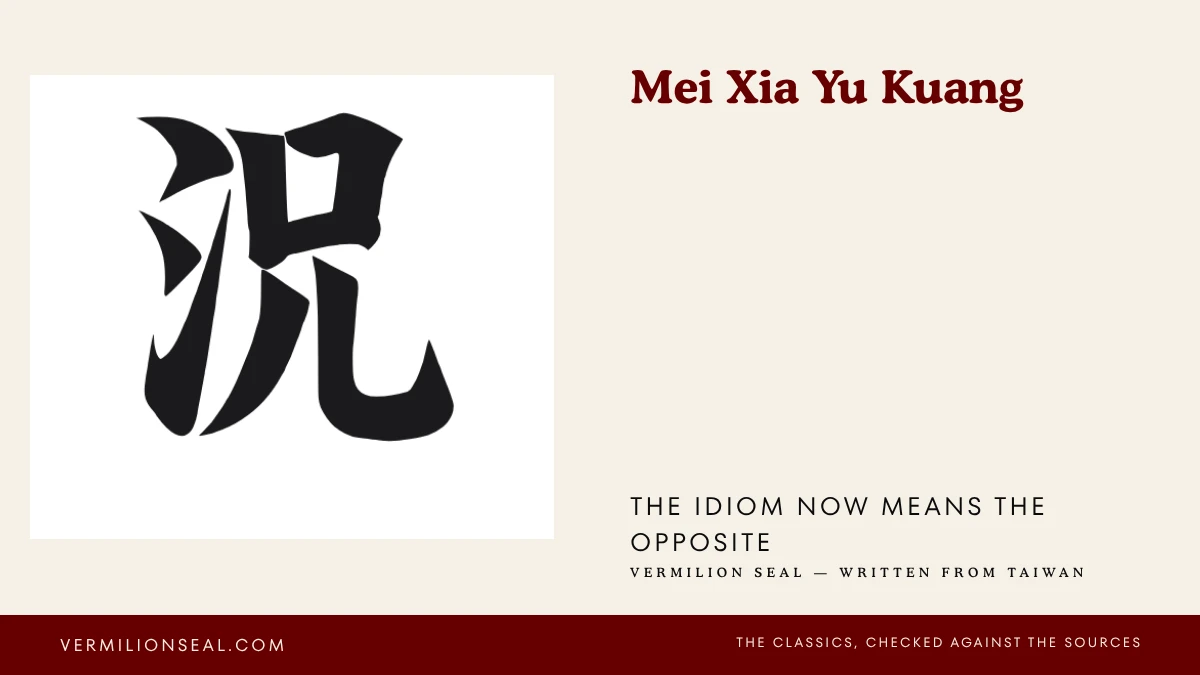
Everything turns on 況. In modern Chinese it lives inside 情況 and 狀況, so a reader meeting it alone will supply “situation” without noticing. In the Zhuangzi line it is doing something else, and the Kangxi Dictionary files it under the older sense.
況:〔古文〕𡶢《唐韻》許訪切……《說文》寒水也。又矧也,譬也。《莊子·知北遊》每下愈況。
Kuang: archaic form as shown; rhyme-book spellings omitted here. Per the Shuowen, cold water. Also: moreover; to liken. Zhuangzi, “Knowledge Rambling in the North”: the lower down, the clearer the likeness.
The imperial dictionary files this very line under the paired gloss 矧也,譬也 — moreover; to liken, to make plain by comparison. The Ministry of Education says the same thing in modern Chinese at the head of its entry: 況,因比擬而明顯、顯著, kuang meaning “evident by comparison.” So 每下愈況 is: the further down you test, the more evident the result. Nothing in the four characters says anything is deteriorating. The deterioration comes entirely from reading 況 as “situation” and 下 as “downhill.”
The Ministry records the reversal in its own entry
Here is where the entry stops being a dictionary and starts being evidence. Having explained the pig, the Ministry’s definition continues: 後轉用「每下愈況」比喻情況愈來愈壞 — later transferred to mean that circumstances are getting worse and worse. Every one of the usage examples it then supplies uses only the later sense: 自從患了心臟病後,他的健康狀態每下愈況, and 因為家境每下愈況,他不得不輟學打工來幫忙家計. A student who learns the phrase from the example sentences learns the meaning the entry has just finished contradicting.
The explanatory note is blunter still.
要了解這句成語須從《莊子》原文了解起,較為不易,所以後來有人從字面推測其義,更進而將成語改成「每況愈下」,雖屬訛用,但已成俗,備載於此,以供參考。
Understanding this idiom requires starting from the original text of the Zhuangzi, which is not easy; so later people guessed at its meaning from the surface of the characters, and went further, altering the idiom into mei kuang yu xia. Although this is an erroneous usage, it has become customary, and is recorded here for reference.
That is a state dictionary writing down, in its own entry, that the form now in everyday use is a mistake it has decided to live with. It is the same posture readers will have met in the entry for gu pen er ge, which defines a phrase by the grief it was coined to refuse, and in the footnote under da qi wan cheng, where the counter-evidence is printed in small type and the definition left alone.
One detail in the same entry deserves more attention than it gets. The second textual citation is Qing: Wu Jianren’s preface to a popular history, where 每下愈況 already carries the deteriorating sense while keeping the original order of characters. The new meaning, in other words, could ride on either shape of the phrase. Which change came first is not settled by these citations — the reordered form is attested earlier than this Qing preface, as the next section shows — but the two changes are clearly separable, and the order of the characters was never the whole of the problem.
The “error” has a Song dynasty source
Look up 每況愈下 in the same dictionary and the story changes shape. The entry defers to the other one — 義參「每下愈況」 — and then prints two attestations. The earlier is Hu Zai’s Tiaoxi Yuyin Conghua, a twelfth-century collection of remarks on poetry, which uses the phrase in a complaint about a comparison someone had made of Su Shi: 是何每況愈下?蓋其謬耳. The later is the Qing scholar Hong Liangji, and his sentence is the one worth stopping on: 南宋儒者似又竊釋氏緒餘,此即莊子所謂每況愈下也 — “this is what Zhuangzi called mei kuang yu xia.” A Qing writer attributing the reordered phrase to Zhuangzi, inside the Ministry’s own evidence, a century and a half before anyone could blame television.
A third entry abandons the error framing altogether. It sits in the dictionary’s supplementary reference layer, which reproduces material from the Ministry’s Revised Dictionary rather than the main idiom articles — so this is not three equal entries quarrelling, but the main entry and the older reference material pulling in different directions.
情況愈來愈壞。與「每下愈況」原為不同用法,惟後世相混,參見「每下愈況」條。宋.洪邁《容齋續筆.卷八.蓍龜卜筮》:「人人自以為君平,家家自以為季主,每況愈下,由是藉手于達官要人,舟車交錯於道路。」
Circumstances growing worse and worse. Originally a different usage from mei xia yu kuang; the two were confused by later ages. See the entry mei xia yu kuang. Song, Hong Mai, Rongzhai Xubi, scroll eight, “Divination by milfoil and tortoise”: every man takes himself for Junping, every household for Jizhu; it goes lower by the day, and so they work through high officials, their carriages crossing on the roads.
Source: Ministry of Education, Chengyu Dian, 每況愈下 supplementary reference
Read the two entries side by side and they are telling different stories. Entry 619: later people guessed from the characters and altered the idiom, and the result is 訛用, an erroneous usage. Entry 6514: the two were a different usage to begin with, later confused. They can be reconciled if you strain — perhaps the confusion is the error — but the strain is real, and it is the Ministry’s, not the public’s. The dictionary that tells Taiwan its everyday phrase is wrong also holds the twelfth-century citation that makes the verdict hard to keep.
What a corpus search settles, and what it does not
The Chinese Text Project’s full-text search is useful here, and it is useful in a narrow way. Running its searchu query against the pre-Qin and Han collection 先秦兩漢 for 每下愈況 returns one occurrence, the Zhuangzi line. The same query against the post-Han collection 漢代之後 returns one more, the Kangxi Dictionary entry quoted above. Querying either collection for 每況愈下 returns nothing at all.
It would be easy, and wrong, to present that zero as proof that nobody wrote the reordered form before modern times. The Hong Mai passage exists; the Hu Zai passage exists. They return zero because those books are not in the collection being searched — a search of the same corpus for 蓍龜卜筮, the title of Hong Mai’s own chapter, also returns nothing. The honest statement is narrower: within the curated classical corpus, the phrase Zhuangzi wrote appears twice in that corpus and the phrase now in daily use appears not at all. That is a fact about which texts got canonised, and it is the same limitation that had to be stated when the four-character form of wu yong zhi yong came back with a zero.
One other entry in the same dictionary is quietly reassuring about the shape of the original. Listed as a variant is 每下愈篤, from a letter by the fifth-century writer Yan Yanzhi that was later collected in the Buddhist anthology Hongming ji: 好生惡死,每下愈篤, loving life and hating death, which grows more pronounced the further down you go. The final character is doing something different — 篤 is “deep, pronounced,” not “evident by comparison” — but the frame is the same one, and the 下 is still a position on a scale rather than a slide into ruin. That is roughly seven centuries before the reordered phrase surfaces in Hu Zai.
Taiwan has been arguing about this in public
This is not a specialist quarrel. The National Taiwan Library keeps a page of selected reference questions — the things members of the public actually come to the desk and ask — and one of them, dated September 2023, is titled 到底是「每況愈下」還是「每下愈況」?, “so which is it?” The librarians answer by following entry 6514 rather than entry 619: the two were originally different, and the senses merged later. The word 訛 does not appear.
In 2015 the novelist Chang Ta-chun took the opposite side in public, arguing that 每況愈下 is the correct phrase for describing decline and has its own pedigree in Hong Mai. His philological support was that 況 there carries the sense it has in the Book of Songs line 亂況斯削 — circumstance, situation. It is a serious argument and it has a soft joint: the Kangxi Dictionary files that very line under a different gloss, 滋也, “to increase,” in the same paragraph where it files the Zhuangzi line under 譬. One Qing lexicographer is not the last word on the Book of Songs, and the point here is not that Chang is wrong. It is that the strongest reading available to either side comes out of the reference works, and the reference works do not agree with each other.
Meanwhile the usage carries on. Health declines, revenues decline, and the phrase people reach for has the characters in the order a Southern Song critic used and the meaning a Qing preface-writer had already given to the other form.
Common misquotations
“每下愈況 is the correct way to say things are getting worse.” Half true, and the half that is true is recent. The Ministry does gloss it that way, as a transferred sense. In the Zhuangzi it means the opposite kind of thing entirely: not that the situation worsens as you descend, but that the reading improves.
“每況愈下 is a modern corruption.” Not modern. The Ministry’s own citation for it is twelfth century, and a second citation is eighteenth. Whatever happened, it did not happen on the internet.
“Zhuangzi said 每況愈下.” He did not, and the attribution is old enough to have a name attached: Hong Liangji wrote precisely that in the Qing, and the Ministry prints his sentence as an attestation. If you want a single sentence that shows how a misquotation acquires authority, it is that one — an error preserved as evidence, in the dictionary that elsewhere calls it an error.
“The idiom is about a pig getting thinner.” It is about the inspector’s foot, not the pig’s condition. The pig is a constant; what changes as the foot moves down the leg is how much the test reveals. The same inversion — a passage about method reread as a passage about outcome — is what happened to Cook Ding and his ox, and to a fair number of the other parables in the Zhuangzi.
FAQ
What does mei xia yu kuang mean?
In the Zhuangzi it means that the lower down you test something, the more clearly the answer shows — from the practice of judging a pig’s fatness by treading on its shank. In modern Taiwanese usage, and in the Ministry of Education’s transferred gloss, it means that circumstances are getting steadily worse.
Is 每況愈下 wrong?
The Ministry of Education calls it 訛用, an erroneous usage that has become customary, in one entry — and in another entry describes it as a separate expression later confused with the first, citing a twelfth-century source. Both statements are official. Neither is going to stop anyone using it.
Why is there a pig in a passage about the Dao?
Because the question was where the Dao is, and the answers kept getting lower: ants, weeds, roof tiles, excrement. The pig analogy explains why the descent was not an evasion. A market inspector presses the leg, not the belly, because the least promising part of the animal gives the most reliable reading.
Did the characters get reordered, or did the meaning change first?
The Ministry’s citations do not settle it, and they run against the obvious guess. The reordered 每況愈下 is attested from the Song; the original order carrying the deteriorating sense appears in its evidence only in the Qing. What the entries do show is that the two changes are independent — the new sense can ride on either shape of the phrase.
A second case of the same dictionary pulling against itself: its entry for 茱萸 lumps three plants from two families under one word, and the English translations of Wang Wei took the wrong branch. See the Double Ninth in Taiwan.
A third case, and the sharpest: the Ministry’s entry for 朝三暮四 records the idiom’s older sense in a single clause and then teaches only the later one, while its entry for the near-synonym 朝秦暮楚 flags a change of graph that the first entry makes silently. See Zhuangzi’s three in the morning.
For another case where the received phrase and the line it came from have quietly parted company, see hexagram 15 and the humility sentence that is not in it.
Sources
- Chinese Text Project, Zhuangzi – “Knowledge Rambling in the North” — Chinese text and James Legge’s 1891 translation, which renders the line as testing a pig’s weight “as the foot descends lower and lower on the body.”
- Chinese Text Project, Kangxi Zidian, water radical, five strokes — the 況 entry, glossing the Zhuangzi line under 矧也,譬也 and the Book of Songs line 亂況斯削 under 滋也.
- Ministry of Education, Chengyu Dian, entry 619 每下愈況 — definition, source text, explanatory note, textual citations and usage examples.
- Ministry of Education, Chengyu Dian, entry 1360 每況愈下 — the Hu Zai and Hong Liangji attestations, and the variants 每下愈篤 and 每變愈下.
- Ministry of Education, Chengyu Dian supplementary reference, entry 6514 每況愈下 — the “originally a different usage” formulation and the Hong Mai citation.
- National Taiwan Library, Selected Reference Questions: 到底是「每況愈下」還是「每下愈況」?, 22 September 2023.
- ETtoday, “每況愈下 or 每下愈況?”, 17 July 2015 — Chang Ta-chun’s argument from Hong Mai and from 亂況斯削.
- National Palace Museum, Taipei, collection record for 清院本清明上河圖 卷 — painters, date (清高宗乾隆元年(1736)) and accession number for the illustration.
- Wikimedia Commons, 清院本清明上河圖 卷 — CC0; authorship and licence details for the illustration.