
Most English introductions give Laozi a date — “sixth century BC” — and a scene: the young Confucius travels to the Zhou capital to ask the old archivist about ritual, and comes away comparing him to a dragon. The date puts Laozi before Confucius, and the scene makes the older man the deeper one. Neither is a fact in the way the phrasing suggests. The earliest biography we have hedges on the man’s identity three times over; a generation of the best Chinese scholars of the 1920s and 30s argued that the book was written long after Confucius died; and a tomb opened in Hubei in 1993 changed what could be said — without settling the question people usually think it settled. This entry sets out what the sources allow, and where the guessing starts.
The short answer
No source gives Laozi a birth year or a death year. Taiwan’s Ministry of Education opens its entry on him — filed under his supposed personal name, 李耳 — with 「生卒年不詳」, dates unknown. The Ministry of the Interior’s religion portal, which puts Confucius’s conventional 551–479 BC in brackets on the same page, gives Laozi no dates at all. If you came here from a search box with a figure already in mind, that is the finding: the figure is not in the sources, in either language.
Three questions, as briefly as they can honestly be answered.
When did Laozi live? Unknown. The earliest biography offers three candidates for who he was, one of them active around 350 BC — a century and a quarter after Confucius died — and ends by saying nobody knows which is right. The one line in the early material that gives Confucius his own age sits inside a book of parables: 《莊子・天運》 opens a scene with 「孔子行年五十有一而不聞道,乃南之沛,見老聃」 — Confucius in his fifty-first year, travelling south to Pei to see Lao Dan. Taken as a report that would put the meeting around 500 BC; it is not offered as a report. There is one other route in, and it has been tried. The ritual chapter discussed below has Confucius assisting at a funeral with Lao Dan when the sun went dark, and eclipses can be calculated backwards. Commentators from the Qing onwards did that calculation and arrived at different years, because the anecdote never says which eclipse it was. Candidates are not a date.
Where did Laozi live? Two places, and the first is itself a dating problem. 《史記》 makes him a man of Ku county in Chu, and an archivist at the Zhou court. The county name is a problem, the word Chu is a problem, and the shape of the address is a third problem; the Zhou posting, for its part, comes with no city attached at all. All of it is set out below.
Did he live before Confucius? The sources do not establish it. What they establish is a floor under the book: part of it lay in a tomb sealed around 300 BC. Nothing dates the man, and the historian who tried said so.
Here is the whole evidential base in one view, oldest material first. The column that matters is the last one.
| Source | Date | What it says bearing on the dates | What it can carry |
|---|---|---|---|
| 《禮記・曾子問》 | Han compilation of older ritual material | Confucius cites 老聃 four times on mourning and tablet ritual, once as an eyewitness to a burial they attended together | That a figure named Lao Dan was remembered as a ritual authority senior to Confucius. No dates, and no book. |
| 《莊子》, five chapters | 4th–3rd c. BC, edited later | Staged meetings in 〈天地〉〈天道〉〈天運〉〈田子方〉〈知北遊〉; 〈天運〉 gives Confucius’s age as fifty-one; 〈天下〉 quotes him by name | That the meeting was a literary commonplace by the Warring States, and that lines of the book were attributed to a named Lao Dan by then. Not a chronology. |
| 《韓非子・解老》〈喻老〉 | 3rd c. BC | Explains selected chapters clause by clause, a hundred quotations in all, and never names him in the body | That the text circulated as anonymous authority. Evidence about the book’s standing, not about the man. |
| 《呂氏春秋・不二》 | c. 239 BC | 「老耽貴柔,孔子貴仁……」, with Lao Dan named first | That the two were paired as holders of doctrines. A list of positions, not of lifetimes. |
| Guodian Tomb 1 bamboo (郭店楚墓竹簡) | Excavated 1993; burial dated 戰國中期偏晚, c. 300 BC | Three bundles, about two thousand characters of the book, differently ordered | A floor under the book. Nothing about an author. |
| Mawangdui silk (馬王堆帛書) | Excavated 1973; the Interior Ministry dates the manuscripts 秦末至西漢初之際 | Two copies, 《德經》 before 《道經》, unchaptered | The book’s shape before the received order settled. Nothing about an author. |
| Peking University bamboo (北大漢簡) | Acquired 2009; the Interior Ministry: 可能抄寫于西漢武帝后期 | Carries the titles 老子上經 and 老子下經, in 77 chapters | The earliest manuscript that names the book after him — and it is Han, not Zhou. |
| 《史記・老子韓非列傳》 | c. 90 BC | Three candidates; 「世莫知其然否」 | That the question was already open in the Han, and the historian said so in as many words. |
| 《史記・孔子世家》 | Same book | 「適周問禮,蓋見老子云」 | The same historian hedging the same visit in his Confucius chapter. |
| 《史記・陳杞世家》 | Same book | 「遂滅陳而有之。是歲,孔子卒。」 | That Sima Qian put Chu’s annexation of Chen in the year Confucius died. The 《左傳》 separates the two by a year, so even the synchronism is contested. |
| 《後漢書・郡國志二》 | 5th c. AD | Lists 苦 under 陳, noting 「春秋時曰相。有賴鄉。」 | That Eastern Han officials identified Ku with a Spring and Autumn town called Xiang, and filed it under their own kingdom of Chen. Han administrative geography, not a Zhou map. |
| Ministry of Education, 《重編國語辭典修訂本》, 李耳 | Current | 「生卒年不詳……春秋時楚國苦縣人……孔子嘗往問禮」 | Taiwan’s standard reference, asserting in one breath what it has just said is unknown. |
Sima Qian’s three Laozis
The only early biography is Sima Qian’s, in the 《史記》 (c. 90 BC). It opens confidently — Laozi was a man of Chu, surnamed Li, personal name Er, an archivist of the Zhou court — and it tells the story of Confucius’s visit and the dragon remark. Then it starts to hedge. Perhaps, it says, Laozi was the same person as a certain Lao Laizi, also of Chu, who wrote fifteen chapters and was a contemporary of Confucius. Perhaps he lived a hundred and sixty years, or two hundred, because he cultivated the Way. And then this:
The historian gives up
自孔子死之後百二十九年,而史記周太史儋見秦獻公……或曰儋即老子,或曰非也,世莫知其然否。老子,隱君子也。
“A hundred and twenty-nine years after the death of Confucius, the records say that Dan, Grand Historian of Zhou, had an audience with Duke Xian of Qin … Some say Dan was Laozi; some say he was not. No one in the world knows which is so. Laozi was a gentleman in hiding.”
司馬遷《史記・老子韓非列傳》 · ctext.org
Read the numbers. Confucius died in 479 BC; a hundred and twenty-nine years later is 350 BC. If the Grand Historian Dan was Laozi, then Laozi was active a century and a quarter after Confucius, not before him — and Sima Qian, who had the archives, could not rule it out. The biography is not a source for “Laozi lived before Confucius”. It is a source for the fact that, by the first century BC, nobody knew when Laozi lived, and the historian said so in as many words. The story of the visit and the dragon sits in the same chapter as the confession that the man might have lived a hundred years later. Those who quote the first and not the second are doing the selecting, not Sima Qian.
Two dragons, and a hedge in the other chapter
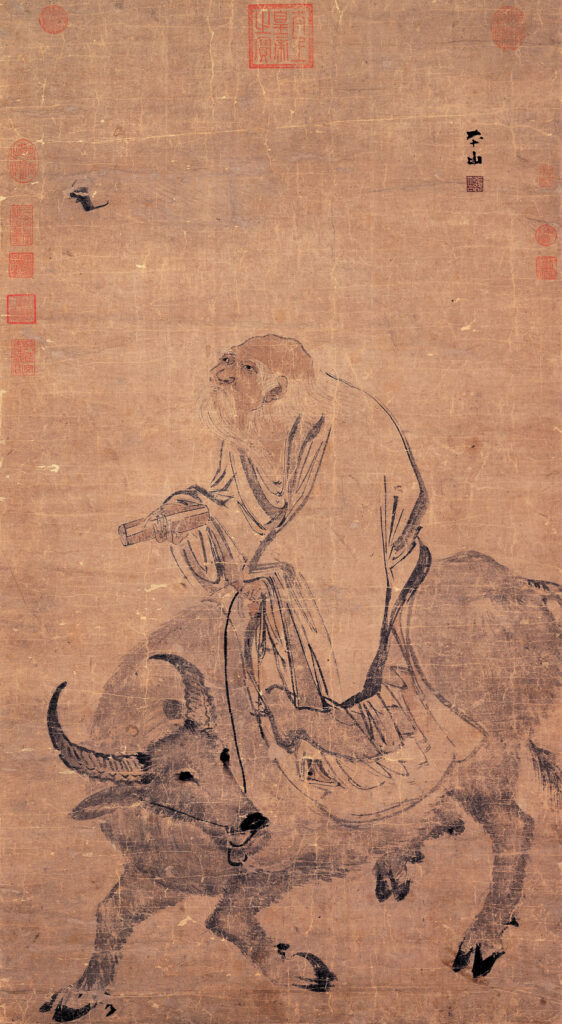
The dragon is the detail that travels. Confucius comes away from the meeting, the story goes, and tells his disciples that he has seen a dragon. In English the line is nearly always traced to Sima Qian, and the Ministry of Education’s dictionary agrees: its entry for 猶龍, “dragon-like”, now a stock epithet for Laozi, gives the source as 《史記・老子韓非列傳》 and reproduces the passage in full, down to 「吾今日見老子,其猶龍邪!」
But there is an earlier dragon, in a different book, and it belongs to a scene that nobody would mistake for reportage. 《莊子・天運》 has Confucius return from Lao Dan and say nothing for three days; the disciples ask what he brought back; and the answer is 「吾乃今於是乎見龍」 — only now have I seen a dragon — followed by a dragon that gathers into a body and scatters into patterning, rides the cloud-vapour and feeds on yin and yang. Then Zigong, unsatisfied, goes to see Lao Dan himself 「以孔子聲」, borrowing his master’s voice, and is told off. The chapter uses the visit five separate times as a device.
So the image is a Zhuangzi motif before it is a biographical particular, and Sima Qian’s wording — the wording the dictionary canonised — is the later, tidier version of it. That is not an accusation of invention. It is the ordinary way a parable hardens into a fact about a person.
What is harder to explain away is that Sima Qian tells the visit twice, in two chapters of one book, and flags it in only one of them. In the Laozi chapter it is narrated straight. In the Confucius chapter it reads like this:
The same visit, in the Confucius chapter
魯南宮敬叔言魯君曰:「請與孔子適周。」魯君與之一乘車,兩馬,一豎子俱,適周問禮,蓋見老子云。
“Nangong Jingshu of Lu said to the ruler of Lu, ‘Let me go to Zhou with Confucius.’ The ruler of Lu gave him a carriage, two horses and a serving lad to go with them; they went to Zhou to ask about ritual, and it is said that he saw Laozi.”
司馬遷《史記・孔子世家》 · ctext.org
The two characters doing the work are 蓋 and 云, the frame a Han historian puts round something he has from report rather than record: it is said that. They do not appear in the Laozi chapter. Nor do the carriage, the pair of horses and the serving lad, which belong to the Confucius chapter alone — the version with the hedge is also the version with the circumstantial detail. And the parting advice differs completely. In the Confucius chapter Laozi sends him off with 「吾聞富貴者送人以財,仁人者送人以言」, a remark about what the rich and the humane each give as a parting gift. In the Laozi chapter he gets the famous rebuke about the good merchant who hides his goods deep, and the dragon. The word 老子 occurs exactly twice in the whole of the Confucius chapter, both times in the passage above.
One historian, one book, two accounts of one meeting, and the one he marked as hearsay is the one inside the life of Confucius. Anyone who presents the visit as a dated event has chosen the unmarked version — and the choosing, not the reporting, is where the sixth-century Laozi comes from.
The county that did not exist yet
The biography begins with an address. 「老子者,楚苦縣厲鄉曲仁里人也,姓李氏,名耳,字耼,周守藏室之史也。」 A man of Quren hamlet, Li village, Ku county, in Chu; surname Li, given name Er; archivist of the Zhou court. It is the most concrete sentence in the whole early record about him, and it is the reason every encyclopaedia can give him a birthplace while admitting it has no birth year.
Follow the geography. The 《後漢書》 treatise on commanderies and kingdoms lists Ku — and it lists it under Chen, not Chu, with a note attached:
「春秋時曰相。有賴鄉。」 In the Spring and Autumn it was called Xiang. It has a Lai village. Take that for exactly what it is: an Eastern Han treatise recording what Han officials believed about an old place-name, and filing the county under their own kingdom of Chen. It is not a Zhou map, and it cannot be made into one. But two things do follow from it. The village in the biography, 厲鄉, appears here one character different, as 賴鄉. And the name the biography uses, Ku, is by this account not the name the place carried in the period the biography puts Laozi in.
Then there is the form of the address itself, which is the part that needs no contested chronology at all. 縣, 鄉, 里 — county, village, hamlet — is the administrative ladder of the Qin and Han empires, not of a Zhou state. Whoever first wrote that sentence was giving directions in the vocabulary of his own bureaucracy. That alone places the address in the layer it survives in, whatever the borders were doing.
When did it become Chu? Sima Qian answers that himself, four scrolls away:
The year the map changed
二十四年,楚惠王復國,以兵北伐,殺陳湣公,遂滅陳而有之。是歲,孔子卒。
“In the twenty-fourth year, King Hui of Chu, having recovered his state, marched north, killed Duke Min of Chen, and so extinguished Chen and took it for his own. In that year Confucius died.”
司馬遷《史記・陳杞世家》 · ctext.org
Notice what the historian does here. He dates the annexation by the reign-year of the duke he says was killed in it, and then fixes that year by Confucius’s death. The 《左傳》 does not agree with him. There the death stands in Duke Ai’s sixteenth year — 「夏.四月.己丑.孔丘卒」 — and the fall of Chen in the seventeenth: 「秋.七月.己卯.楚公孫朝帥師滅陳」. A year apart, in the other canonical chronology.
The disagreement does not damage the point; it sharpens it. On either reckoning Chu took Chen at the very end of Confucius’s life, not before it. And Chen had changed hands more than once already in the late Spring and Autumn, so no single year settles the map in any case. Which is why what belongs here is a fork rather than a verdict. Either the address is late vocabulary and late geography laid over an older figure, or the figure’s home was somewhere the Han editors have misplaced. I cannot settle which, and for the question on this page it makes no difference: neither branch supplies a date. What both rule out is reading 楚苦縣厲鄉曲仁里 as sixth-century testimony.
This is not a forgery and it is not even carelessness. Han writers routinely located old people in the administrative world their readers knew, exactly as one might say today that someone was born in New Taipei City without implying the city existed at the time. But it settles what the sentence can be used for. The address is not independent testimony about a sixth-century man; it is Han cartography applied to a figure of uncertain date. It tells you where Sima Qian’s informants thought he came from. It does not tell you when.
The other half of the address fares no better. 周守藏室之史, archivist of the Zhou treasury of records, names an office and no city — the biography never says where the court was when Confucius is supposed to have visited it. The 《莊子》 version of the same post calls it 周之徵藏史 and gives the errand a direction instead of a destination: 「孔子西藏書於周室」, Confucius went west to deposit his books in the house of Zhou, and Zilu suggested applying to the archivist, who refused him. A direction, an office, a refusal. No year, no city, and in the 《莊子》 telling not even a successful meeting.
Where modern maps put the hamlet is a separate question from where the sources put it. The Interior Ministry’s page follows the standard identification and glosses the address as 「今屬河南省鹿邑縣」, in present-day Luyi county, Henan. That identification rests on the 《後漢書》 note and later commentary, which is to say on the same Han and post-Han layer, not on anything from the sixth century BC. The dating of the manuscripts, by contrast, rests on things that were dug up; that is why the excavated recensions carry weight the address cannot — a point this site takes up in the great vessel takes longest to finish, where an unearthed reading overturns a received one outright.
Four times in the Liji, and not a word about the Dao
There is one early layer in which Lao Dan appears neither as a sage to be visited nor as the author of anything, and English accounts of the dating question tend to mention it in a clause and move on. The chapter is 〈曾子問〉, in the 《禮記》, and it is worth reading rather than being told about.
Four of its exchanges turn on Lao Dan’s authority. Three use the formula 「吾聞諸老聃曰」 — I heard it from Lao Dan — and one, the longest, closes with 「吾聞諸老聃云」 instead. The fourth of the four is not a reply to Zengzi at all but to Zixia, a few exchanges later; the chapter is named after its principal questioner, not its only one. The name 老聃 occurs eight times in the chapter altogether. Every one of the four is about funerals: where the spirit tablets go when a ruler dies or flees his state, whether a coffin already moving may turn back, what coffin an infant gets, and whether mourning is suspended for war.
The longest is the one with the eclipse.
Confucius, as the junior at a funeral
昔者吾從老聃助葬於巷黨,及堩,日有食之,老聃曰:「丘!止柩,就道右,止哭以聽變。」既明反而後行。曰:「禮也。」反葬,而丘問之曰:「夫柩不可以反者也,日有食之,不知其已之遲數,則豈如行哉?」老聃曰:「諸侯朝天子,見日而行,逮日而舍奠;大夫使,見日而行,逮日而舍。夫柩不早出,不暮宿。見星而行者,唯罪人與奔父母之喪者乎!日有食之,安知其不見星也?且君子行禮,不以人之親痁患。」吾聞諸老聃云。
“Once I was assisting Lao Dan at a burial in Xiangdang. We had reached the road when the sun was eclipsed. Lao Dan said, ‘Qiu! Halt the coffin, draw up on the right of the road, stop the wailing and wait on the change.’ When it was light again we went on. He said: ‘That is ritual.’ After the burial I asked him: ‘A coffin cannot turn back. When the sun is eclipsed one does not know whether it will end soon or late — would it not be better to keep going?’ Lao Dan said: ‘When a feudal lord goes to court before the Son of Heaven he travels by daylight and halts for the evening offering while the sun is still up; when a great officer goes on a mission he travels by daylight and halts while the sun is still up. A coffin does not set out too early and does not lodge at dusk. Those who travel by starlight are criminals and men hurrying to a parent’s funeral. When the sun is eclipsed, how do you know the stars will not come out? Besides, a gentleman performing a rite does not expose another man’s parent to harm.’ This I heard from Lao Dan.”
《禮記・曾子問》 · ctext.org
Read that against the biography and the difference is in the furniture. There is no court, no dragon, no departure through a mountain pass, no five thousand characters. There is a road, a coffin, a wailing party told to be quiet, and a younger man addressed by his personal name — 丘, Qiu — being corrected on a procedural point and then arguing back about it. Lao Dan wins the argument on grounds that are entirely practical: coffins do not travel in the dark, an eclipse makes it dark, and you do not put another family’s dead at risk to keep your own schedule. Nothing he says would look out of place in a handbook. Nothing he says resembles a line of the 《老子》.
That last point cuts both ways, and the honest version is worth stating. In favour of an early Lao Dan: here is a named ritual authority, quoted four times by Confucius as a junior quotes a senior, on a subject — mourning observance — with no doctrinal axe to grind. The scholar Chen Guying, writing on early Daoist attitudes to ritual in 《漢學研究》 in 2000, treats these four passages as the substantial early record of Confucius consulting Lao Dan on funerals, and the point is well taken: they are not the kind of thing anyone would invent to support a philosophical claim.
Against, and this needs saying plainly: the 《禮記》 as we have it was assembled in the Han, no earlier than the 《史記》. The chapter is not an older document than the biography; what is different about it is the kind of material it preserves, not its date of compilation. The exchanges carry no date of their own. Qing critics went further and rejected the whole tradition of Confucius consulting Lao Dan, these passages included, as later construction — too strong, I think, for material this incidental and this uninterested in making a case, but the possibility is real and the reader should have it. A remembered teacher is not a dated man. And the Lao Dan of this chapter has no book, no Dao, no 無為 — he has opinions about coffins. Whether he is the same person as the author later assigned the five thousand characters is precisely the question the sources leave open, and the ritual chapter does not close it. What it does do is show that the earliest Lao Dan we can reach is a specialist in exactly the thing the 《老子》 is famously impatient with.
Who names him, and when
One of the arguments the 1920s sceptics leaned on concerns naming: if the book were old and famous, early writers would cite it by name. The strongest case for that is also the strangest, and it can be checked by counting.
Two chapters of the 《韓非子》, from the third century BC, are given over to the 《老子》. 〈解老〉, “Explaining Lao”, runs to some 5,800 characters and works through a selection of chapters clause by clause, introducing each quotation with the formula 「故曰」 — hence the saying — sixty-six times. 〈喻老〉, “Illustrating Lao”, runs to about 2,500 and does it thirty-four times, more loosely. A hundred quotations between them. And across both chapters the strings 老子, 老聃, 李耳 and 道德經 occur a combined total of zero times in the body.
A hundred quotations, no attribution
德則無德,不德則在有德。故曰:「上德不德,是以有德。」
“Where there is deliberate virtue there is no virtue; where virtue is not deliberate, virtue is present. Hence the saying: ‘The highest virtue is not virtuous, and therefore it has virtue.’”
《韓非子・解老》 · ctext.org
The titles use the name; the arguments inside never do. Worth stating narrowly, because that is all it shows: whoever headed those chapters knew the book was “Lao’s”, and whoever wrote the arguments treated its lines the way one treats a proverb — something the reader will already grant, needing no author behind it. It is evidence about how the text was used, not about whether a man existed.
That is as far as the naming argument goes, though, and it does not go where the sceptics wanted. Two texts of the same period or slightly earlier do name him, and one of them quotes the book:
The last chapter of the 《莊子》 — a survey of the schools, and itself probably late — comes to Guan Yin and Lao Dan, 「古之博大真人哉」, and attributes to Lao Dan a passage that corresponds to chapter 28 of the received book — though not word for word: 「老聃曰:『知其雄,守其雌,為天下谿;知其白,守其辱,為天下谷。』」 Know the male, keep to the female, and be the valley-stream of the world. Now set that beside the received text. Wang Bi’s version pairs white with black and puts the valley somewhere else: 「知其白,守其黑,為天下式」, and then, as a separate couplet, 「知其榮,守其辱,為天下谷」. The 《莊子》 pairs white with 辱 instead, and hangs the valley on that pair.
Which turns out not to be a slip of the brush. Published transcriptions of the two Mawangdui silk copies read the way the 《莊子》 does — white with 辱, the valley with it, written 浴 — while also carrying a separate couplet with 黑 and 式. The silk is damaged and written with duplication marks, so the wording belongs to the transcriptions rather than to a clean reading; the pairing, though, is not in doubt, and the pairing is the point. A third-century BC quotation that names him agrees with the manuscripts against the text we read, at exactly the place where manuscripts and received text diverge. That cuts against the 1920s method from a direction nobody arguing in 1930 could have anticipated: an argument built on the received wording is an argument about an edition.
And the 《呂氏春秋》, compiled around 239 BC, opens a list of thinkers with him: 「老耽貴柔,孔子貴仁,墨翟貴廉,關尹貴清,子列子貴虛……」 Lao Dan prizes yielding, Confucius prizes benevolence, Mo Di prizes restraint. He is first in the list and Confucius second — which is worth noticing and worth not over-reading. The same list puts Guan Yin, whom the tradition makes Laozi’s contemporary at the frontier pass, in fourth place, after Mo Di; the order is not chronological even by its own lights. And it spells the name 老耽, not 老聃. The passage is arranging doctrines, not lifetimes, and the chapter’s argument is that a state cannot run on more than one of them at once.
So the precise statement is narrower than the slogan. Nobody in the surviving pre-Han record gives Laozi a date. But by the third century BC a book existed, lines from it were attributed to a named Lao Dan, and the most thorough commentary on it declined to name anyone. Even his name is unsettled across the witnesses: the 《史記》 text gives 字耼, the 《呂氏春秋》 writes 老耽, and the Ministry of Education’s entry supplies 「字伯陽,諡曰聃」, a style name and a posthumous title from the commentarial tradition rather than from the base text. A man with four names and no years is a man known through other people’s books. For what the instability does to the book’s title in English, see Dao or Tao?; for what it does to a single famous line, heaven and earth are not benevolent follows one chapter through its translators.
The 1920s: the case for putting Laozi after Confucius
In 1919 Hu Shih published the first volume of his Outline of the History of Chinese Philosophy and began it with Laozi, then Confucius — a decision that broke with the older habit of starting from the sage-kings, and that set Laozi first in time as well as in the table of contents. The reaction, traced in a 2019 essay by Chu Yu-piao for the Taiwanese history site StoryStudio, came quickly and from the top of the profession. Liang Qichao, reviewing the book in 1922, argued that the Laozi was a late Warring States text and must be later than Confucius. Qian Mu, in a 1930 study of the date of the book’s composition, pushed it later still — after Zhuangzi. Feng Youlan’s own History of Chinese Philosophy (1930) put Confucius before Laozi. Gu Jiegang, in 1932, used the Lüshi Chunqiu to argue that the man was later than Zhuangzi and the book was put together between Qin and Han.
These were not cranks; they were, between them, the founders of modern Chinese historiography, and their argument was about method. The received Laozi reads like a text that knows the debates of the fourth and third centuries BC; its vocabulary and its polemic against ritual and “benevolence and righteousness” seem to answer positions that did not exist in the sixth century; and the two chapters of the Han Feizi that explain it line by line never name a book or an author. Hu Shih did not budge. In May 1933 he published an essay reviewing his critics’ methods, and his position, as Chu quotes it, is a model of how to hold a line without overclaiming:
我不反對老子移後,也不反對其他懷疑老子之說。但我總覺得這些懷疑的學者都不曾指出充分的證據。我這篇文字只是討論他們的證據的價值,並且評論他們的方法的危險性。
“I do not object to moving Laozi later, nor to the other sceptical theories about him. But it always seems to me that these sceptical scholars have never produced sufficient evidence. This essay only discusses the value of their evidence, and comments on the dangers of their method.”
Qian Mu’s memoir recalls that the two of them argued the point “certainly more than three or four times”, after which Hu no longer enjoyed discussing Laozi with him. There is a story — told by Zhang Zhongxing, who was at Peking University — that Qian once cornered Hu in a common room with “the evidence is conclusive, you needn’t keep insisting”, and Hu replied that if the evidence ever convinced him, “I would give up my own laozi” — the word also means “old man”, one’s father. The joke is better in Chinese. The point underneath it is that Hu was not claiming Laozi was early; he was claiming his opponents had not shown he was late.
1993: a tomb changes the terms
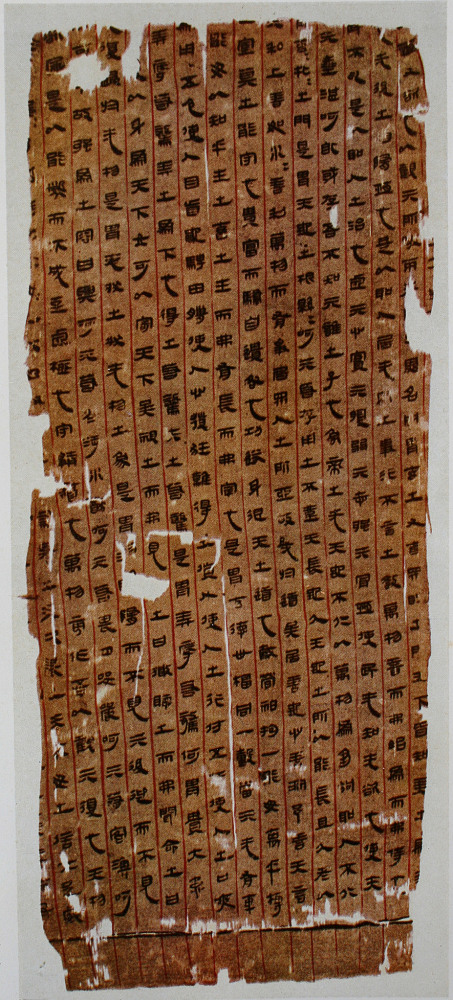
In October 1993 archaeologists opened Tomb No. 1 at Guodian, near Jingmen in Hubei, in what had been the territory of Chu. Among the bamboo slips were three bundles of text that correspond to about two thousand characters of the received Laozi — a bit under two-fifths of the book — in a different order, with some passages differing in ways that matter. The excavators dated the burial to the later part of the middle Warring States period, around 300 BC. That is the date the Taiwanese scholarship I have relied on reports: a 2019 survey in the 《漢學研究集刊》 of National Yunlin University summarises the excavators’ conclusion as 戰國中期偏晚, and notes that some Japanese specialists, Ikeda Tomohisa among them, have questioned whether Chinese archaeological dating is fine enough to be that confident, and would allow a date toward the end of the period.
Take the excavators’ date. A text of the Laozi was in the ground by about 300 BC, which means it was in circulation before that. Gu Jiegang’s Qin–Han composition is out. Qian Mu’s “after Zhuangzi” is very hard to hold, since Zhuangzi himself is usually placed around the same decades. Liang Qichao’s “late Warring States” is at best pushed back into the middle of the period. On the narrow question of the book, the sceptics of the 1920s went too far, and Hu Shih’s insistence that they had not proved their case is the one that, in Chu’s phrase, 比較站得住腳 — stands up rather better — than it seemed to in 1933.
What Guodian does not settle
Here is where the English summaries usually take a step the evidence does not support. Guodian shows that parts of the Laozi existed by about 300 BC. It does not show that the book existed in the sixth century BC, and it does not show that a man called Laozi wrote it, taught Confucius, or lived at all. Three things stand in the way.
The first is the gap. Confucius died in 479 BC. Guodian is around 300 BC. A text in circulation by 300 BC is compatible with composition any time in the two centuries before that — including well after Confucius. The tomb closes the late end of the range; it says nothing about the early end.
The second is the shape of the text. The Guodian bundles are shorter than the received book, ordered differently, and in places say different things. Chu notes the general lesson the finds have taught: the pre-Qin texts we read were mostly edited into their present form by Western Han hands, which is why arguments built on the received text’s wording — the 1920s method — can mislead in both directions. It also means “the Laozi existed in 300 BC” needs an asterisk: a Laozi did, and it is not quite ours.
The third is Sima Qian, who still stands where he stood. Nothing found at Guodian names an author, gives a date, or mentions a meeting with Confucius. The biography’s three candidates — Li Er the archivist, Lao Laizi, and the Grand Historian Dan of 350 BC — are exactly as open as they were, and the last of them would fit a text of around 300 BC rather comfortably. Whether the man existed, and when, is a question the historian could not answer with the Han archives in front of him, and the bamboo has not answered it either.
What this looks like in Taiwan
In Taiwan the question “when did Laozi live” is answered twice by the same government, differently, and not at all at the altar. None of the three is wrong for what it is; together they are a fair picture of how a figure like this survives.
Start with the dictionary. The Ministry of Education’s 《重編國語辭典修訂本》 files him under 李耳 and opens like this:
Dates unknown, and then four facts
人名。生卒年不詳。字伯陽,諡曰聃,春秋時楚國苦縣人。曾任周朝守藏室之史。主無為之說,後世以為道家始祖。孔子嘗往問禮,著有《道德經》五千餘言。
“A personal name. Dates of birth and death unknown. Style name Boyang, posthumous name Dan, a man of Ku county in the state of Chu in the Spring and Autumn period. He held the post of archivist of the Zhou treasury of records. He advocated the doctrine of non-action, and later ages took him for the founder of the Daoist school. Confucius once went to ask him about ritual. He composed the Daodejing in rather more than five thousand words.”
教育部《重編國語辭典修訂本》「李耳」 · dict.revised.moe.edu.tw
The second sentence says the dates are unknown. The fifth gives him a period, a state and a county; the eighth has Confucius come to see him; the last makes him the author. There is not one hedging word in any of them — no 相傳, no 一說, nothing. The county is 楚國苦縣, Sima Qian’s Han geography passed on intact two thousand years later, into a reference work used by schoolchildren.
Now the other ministry. The Interior Ministry runs the state’s religion portal, and its page on Laozi as a religious figure is written to a visibly different standard. The string 春秋 does not occur on it anywhere. It opens:
The same man, at the other ministry
老子,一般認為姓李名耳,字伯陽,著有《道德經》,被奉為道教始祖及道家思想的創始人。歷史對於老子的生平,在漢司馬遷《史記・老子韓非列傳》卷63,已經有幾種不同的說法。
“Laozi is generally held to have been surnamed Li, with the given name Er and the style name Boyang; he composed the Daodejing and is revered as the founder of the Daoist religion and the originator of Daoist thought. As for the historical record of Laozi’s life, in Sima Qian’s Shiji, chapter 63, the biography of Laozi and Han Fei, there are already several different accounts.”
內政部全國宗教資訊網〈老子〉 · religion.moi.gov.tw
一般認為 — generally held. The visit is 「相傳孔子曾經問禮於老子」, it is handed down that Confucius once asked Laozi about ritual. The page uses 一說, 相傳, 傳說, 據說 and 有學者認為 as it goes, walks the reader through all three of the biography’s candidates including the Grand Historian Dan, and cites the 《莊子》 fifty-first-year scene by name. It also gives Confucius the bracketed dates (公元前551年-公元前479年) and gives Laozi none — on the same page, in the same paragraph. That omission is the most careful thing any official source on this site’s beat has done with the question.
The same portal’s page on the 《道德經》 is better on the manuscripts than most English reference entries on the man. Authorship there is attributed, not asserted — 「根據《史記》記載」, according to the record in the 《史記》 — and all three excavated recensions are listed with dates: Guodian, 1993, 「年代大約戰國中期,是目前所見最早的傳本」; Mawangdui, 1973, 「秦末至西漢初之際」; and the Peking University bamboo, 「可能抄寫于西漢武帝后期」, bearing the titles 老子上經 and 老子下經 and divided into seventy-seven chapters rather than the familiar eighty-one.
Then there is the altar, where the register changes completely. Sanqing Gong at Dongshan in Yilan styles itself the head temple of Daoism in Taiwan — a designation that comes from the religious community rather than from any rank conferred by the state — and the county government’s own tourism page describes it this way: 「主殿供奉道教無極界最高神祇『三清道祖』,即玉清元始天尊、上清靈寶天尊及太清道德天尊」 — the main hall enshrines the highest deities of the Daoist limitless realm, the Three Pure Ones: the Jade Pure Celestial Worthy of Primordial Beginning, the Upper Pure Celestial Worthy of Numinous Treasure, and the Great Pure Celestial Worthy of the Way and its Virtue. The third of those is the one the dictionary and the ministry are talking about. He is not absent from the page; he is present under a divine title, with no life attached to it. The page never connects the title to the man and never gives a date — the words 老子 and 春秋 do not appear on it at all. One page is not the whole of official Taiwan and I am not claiming it is. But it is the page a county government wrote about the temple it sends visitors to, and on the question this entry is about it says nothing.
So: on the temple page a title with no biography; at the Interior Ministry a man with no dates; at the Ministry of Education a man whose dates are unknown and who nonetheless has a birthplace, a period and a famous visit. The gap is not between a Chinese view and a Taiwanese one — all three pages are Taiwanese, and two of them are the same state. It is a gap between three jobs. A dictionary has to be usable in a sentence, so it compresses. A religion portal has to describe what people believe and how scholars dispute it, so it hedges. A temple is not in the information business; what is worshipped there was never a man with a birth year to begin with. The error only enters when the compressed version is quoted as though it came from a source. That pattern — an official gloss travelling further than the text it glosses — is the one this site keeps running into; three in the morning, four in the evening is the same problem inside a single dictionary entry, and the empty boat is what happens when the gloss drifts far enough to lose the story.
What can be said, in one paragraph
The book called Laozi was in circulation by around 300 BC, on the archaeologists’ dating of the Guodian tomb, in a form shorter than and different from the one we read. Its composition before that is undated; a sixth-century date is a tradition, not a finding. The man Laozi is recorded only in a biography whose author lists three candidates for him and says that no one knows which is right. “Laozi lived before Confucius” is therefore not something the evidence establishes; “the Laozi was written after Confucius” is not something it establishes either, though it is compatible with the text. What the evidence establishes is a floor under the book, a remembered ritual authority named Lao Dan, a birthplace written in Han administrative vocabulary, and no date for the man. Not no clues — there are clues, the fifty-first year and the eclipse among them — but clues lodged in a parable and an anecdote, which is why the datings built out of them come back mutually exclusive. Candidates are what the sources yield, and candidates are not a date. That is less than either side in the 1920s wanted, and it is what there is.
If you are choosing an English version of the book, the same finds bear on which text a translator is working from; see which Tao Te Ching translation should you read? For why the title itself has two spellings, see Dao or Tao? The parallel problem on the Confucian side — how far the Analects is a record of Confucius and how far a construction by his editors — is taken up in who made the Confucius we read in the Analects?
FAQ
Did Laozi live before Confucius?
The only early biography, Sima Qian’s, tells the story of Confucius visiting Laozi but then offers two other candidates for who Laozi was — one of them active in 350 BC, a century after Confucius died — and concludes that no one knows. The question of the man’s dates is undecided in the sources themselves.
When was the Tao Te Ching written?
Parts of it were in a tomb at Guodian, Hubei, sealed around 300 BC according to the excavators, so the text existed before that. How much earlier is not known from evidence; the traditional sixth-century date rests on the biography’s story, not on any datable text.
What did the Guodian bamboo slips prove?
That a version of the Laozi — about two thousand characters in three bundles, differently ordered — was circulating by the middle Warring States period. This rules out the 1930s theories that the book was compiled between Qin and Han or after Zhuangzi. It does not date the author or confirm the meeting with Confucius.
Why did Hu Shih and Qian Mu disagree?
Qian Mu, with Liang Qichao, Feng Youlan and Gu Jiegang, argued from the received text’s language and ideas that it was late; Hu Shih replied that their evidence was insufficient and their method risky. Hu did not claim Laozi was early — he claimed the case for lateness had not been made. Guodian later showed that the most extreme late datings were wrong.
When did Laozi live?
No source gives a year. The Ministry of Education’s entry on him begins 「生卒年不詳」, dates unknown; the Interior Ministry’s page gives Confucius 551–479 BC and Laozi nothing. The three candidates in Sima Qian’s biography are spread across two centuries, the last of them an official active around 350 BC. The one early detail that gives Confucius an age is the 《莊子・天運》 scene that opens with him in his fifty-first year, which would mean about 500 BC — in a chapter that uses the meeting five times as a literary device. The eclipse in 〈曾子問〉 has also been used to date the meeting by calculation, and the years proposed do not agree with one another.
Where does the date 571–471 BC come from?
Not from any of the sources checked on this page. The 《史記》 gives no birth year; the Ministry of Education says the dates are unknown; the Interior Ministry declines to supply any. What the figures do have is a shape. In the standard regnal tables 571 BC is the first year of King Ling of Zhou — a conventional peg for a birth with no record behind it — and 471 is 571 less a round hundred. The span is not stable across popular reference works either. I have not been able to trace a derivation for it in any primary or scholarly source; where it is quoted without one, treat it as a figure that has been copied rather than found.
Where did Laozi live?
The biography gives an address: Quren hamlet, Li village, Ku county, in Chu. The 《後漢書》 lists Ku under the Han kingdom of Chen, notes that in the Spring and Autumn it was called Xiang, and spells the village 賴鄉 rather than 厲鄉; Chu’s annexation of Chen is placed by Sima Qian in the year of Confucius’s death and by the 《左傳》 a year after it; and the ladder of county, village and hamlet in the address is Qin and Han administrative vocabulary in any case. The standard modern identification, which the Interior Ministry follows, is present-day Luyi county in Henan. His other recorded location is an office rather than a place — archivist of the Zhou treasury of records, with no city named in any version.
Was Laozi Confucius’s teacher?
That is more than the sources say. 《禮記・曾子問》 has Confucius cite Lao Dan four times on mourning ritual and once describe assisting him at a burial, which is the closest thing to a teaching relation in the early record — and it is entirely about ritual procedure, not about the Dao. The 《莊子》 meetings are parables, and Sima Qian narrates the visit twice, hedging it in one of the two chapters. “An older authority whom Confucius quoted on funerals” is what the evidence supports.
Sources
- 司馬遷《史記・老子韓非列傳》:「老子者,楚苦縣厲鄉曲仁里人也……」「孔子適周,將問禮於老子……」「或曰:老萊子亦楚人也……」「自孔子死之後百二十九年……或曰儋即老子,或曰非也,世莫知其然否。老子,隱君子也。」 — ctext.org (accessed 5 Sep 2026)
- 朱育鑣〈原本說「老子都不老子」的胡適,為什麼轉而撂下狠話:「我連老子都不要了」?〉,故事 StoryStudio,2019-07-06 — storystudio.tw:梁啟超 1922、錢穆 1930、馮友蘭 1930、顧頡剛 1932 諸說;胡適 1933-05〈評論近人考據老子年代的方法〉引文(本站轉引);錢穆《師友雜憶》、張中行〈紅樓點滴〉;郭店 1993 出土與 2046 字 (accessed 5 Sep 2026)
- 工藤卓司〈近二十年來日本學者郭店《老子》之研究〉,《漢學研究集刊》第 28 期,國立雲林科技大學漢學應用研究所,2019-06,頁 1–40 — PDF:「郭店楚簡於 1993 年出土於湖北省荊門市郭店一號楚墓」;「發掘者推斷該墓下葬年代約爲戰國中期偏晚」;池田知久等對編年精度之質疑 (accessed 5 Sep 2026)
- 胡適〈評論近人考據老子年代的方法〉,1933;錢穆〈關於老子成書年代之一種考察〉,1930;梁啟超〈評胡適之中國哲學史大綱〉,1922;顧頡剛〈從《呂氏春秋》推測《老子》之成書年代〉,1932(依朱育鑣文轉引,本站未見原文)
- 《禮記・曾子問》:「吾聞諸老聃曰:天子崩,國君薨,則祝取群廟之主而藏諸祖廟,禮也。」「昔者吾從老聃助葬於巷黨,及堩,日有食之……吾聞諸老聃云。」「吾聞諸老聃曰:昔者史佚有子而死,下殤也。」「吾聞諸老聃曰:昔者魯公伯禽有為為之也。」 — ctext.org (four citations of Lao Dan, three with 曰 and one with 云; the fourth answers Zixia, not Zengzi. Checked against the chapter 8 Oct 2026)
- 司馬遷《史記・孔子世家》:「魯南宮敬叔言魯君曰:『請與孔子適周。』魯君與之一乘車,兩馬,一豎子俱,適周問禮,蓋見老子云。辭去,而老子送之曰:『吾聞富貴者送人以財,仁人者送人以言……』」 — ctext.org (the name 老子 occurs twice in the whole chapter, both in this passage; checked 8 Oct 2026)
- 司馬遷《史記・陳杞世家》:「二十四年,楚惠王復國,以兵北伐,殺陳湣公,遂滅陳而有之。是歲,孔子卒。」 — ctext.org (checked 8 Oct 2026)
- 《後漢書・郡國志二》陳國下「苦」:「春秋時曰相。有賴鄉。」 — ctext.org (listed under Chen, not Chu; checked 8 Oct 2026)
- 《莊子・天運》:「孔子行年五十有一而不聞道,乃南之沛,見老聃。」「孔子見老聃歸,三日不談。弟子問曰……孔子曰:『吾乃今於是乎見龍。』」 — ctext.org (checked 8 Oct 2026)
- 《莊子・天道》:「孔子西藏書於周室,子路謀曰:『由聞周之徵藏史有老聃者……』往見老聃,而老聃不許。」 — ctext.org (checked 8 Oct 2026)
- 《莊子・天下》:「老聃曰:『知其雄,守其雌,為天下谿;知其白,守其辱,為天下谷。』」「關尹、老聃乎!古之博大真人哉!」 — ctext.org (corresponds to chapter 28 of the received text but not word for word — Wang Bi has 守其黑 and 知其榮,守其辱 as separate couplets; checked 8 Oct 2026)
- 《呂氏春秋・不二》:「老耽貴柔,孔子貴仁,墨翟貴廉,關尹貴清,子列子貴虛,陳駢貴齊……」 — ctext.org (checked 8 Oct 2026)
- 《韓非子・解老》:「德則無德,不德則在有德。故曰:『上德不德,是以有德。』」 — ctext.org (about 5,850 Chinese characters; 故曰 66 times; 老子, 老聃, 李耳 and 道德經 nil. Counted on the chapter page 8 Oct 2026)
- 《韓非子・喻老》 — ctext.org (about 2,540 Chinese characters; 故曰 34 times; no personal or book name. Counted 8 Oct 2026)
- 教育部《重編國語辭典修訂本》「李耳」:「人名。生卒年不詳。字伯陽,諡曰聃,春秋時楚國苦縣人。曾任周朝守藏室之史……孔子嘗往問禮,著有《道德經》五千餘言。」 — dict.revised.moe.edu.tw, entry ID 61889 (checked 8 Oct 2026)
- 教育部《重編國語辭典修訂本》「猶龍」:「本指老子的道如龍之深遠不可測,因以『猶龍』為老子的代稱。語出《史記.卷六三.老子韓非傳》……」 — dict.revised.moe.edu.tw, entry ID 154122 (checked 8 Oct 2026)
- 內政部全國宗教資訊網〈宗教人物・老子〉:「老子,一般認為姓李名耳……」「相傳孔子曾經問禮於老子。」「歷史對於老子的生平,在漢司馬遷《史記・老子韓非列傳》卷63,已經有幾種不同的說法。」 — religion.moi.gov.tw (the string 春秋 does not occur on the page; Confucius is given 551–479 BC and Laozi no dates. Checked 8 Oct 2026)
- 內政部全國宗教資訊網〈宗教經典・道德經〉:「根據《史記》記載,此書為春秋時代周王朝史官老子所撰。」郭店「年代大約戰國中期,是目前所見最早的傳本」;馬王堆「秦末至西漢初之際」;北大漢簡「可能抄寫于西漢武帝后期……共分為77章」。 — religion.moi.gov.tw (checked 8 Oct 2026)
- 宜蘭縣政府〈道教總廟三清宮〉:「主殿供奉道教無極界最高神祇『三清道祖』,即玉清元始天尊、上清靈寶天尊及太清道德天尊」 — travel.yilan.gov.tw (neither 老子 nor 春秋 occurs on the page; checked 8 Oct 2026)
- 《春秋左氏傳・哀公》:十六年「夏.四月.己丑.孔丘卒」;十七年「秋.七月.己卯.楚公孫朝帥師滅陳」 — zh.wikisource.org (the two events stand a year apart here, against 《史記・陳杞世家》’s 「是歲,孔子卒」; checked 8 Oct 2026)
- 《老子》帛書甲、乙本第二十八章對應段(維基文庫轉錄):兩本皆以「白」配「辱」並繫「浴」,另有「黑」「式」一組 — zh.wikisource.org (a reading transcription carrying duplication marks and lacunae, not a facsimile; checked 8 Oct 2026)
- 《道德經》第二十八章(王弼本):「知其雄,守其雌,為天下谿。……知其白,守其黑,為天下式。……知其榮,守其辱,為天下谷。」 — ctext.org (checked 8 Oct 2026)
- 陳鼓應〈先秦道家之禮觀〉,《漢學研究》第 18 卷第 1 期,2000 年 6 月 — ccsndb.ncl.edu.tw, National Central Library (on the four 〈曾子問〉 passages; this page takes the point and does not reproduce the wording)



