Yes, you may go in. Taiwanese temples are public places, visitors of any faith or none are welcome, and nobody expects a foreigner to know the liturgy. The actual rules of taiwan temple etiquette are few, and almost all of them concern the same three things: which door you use, where you pay respects first, and what you photograph. Here they are, sourced from the temples and the Ministry of the Interior rather than from travel-forum guesswork — written by someone who has spent a lot of time on the receiving side of visitors’ questions.
The doors: enter by the dragon, leave by the tiger
A traditional temple front hall — the 三川殿, “three-river hall” — has three openings. The centre door belongs to the gods. In folk custom it is the passage the deities themselves use, which is why many temples fence it off or place a screen behind it; ordinary visitors do not walk through the middle. Some temples relax this outside major rituals, but if you simply never use the centre door you will never be wrong.
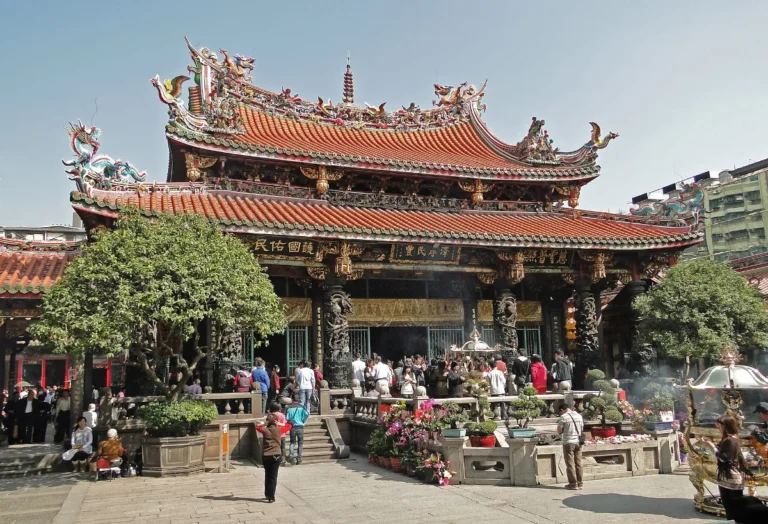
The two side doors are the working entrances, and they have names: the dragon door and the tiger door. Facing the temple from the courtyard, the dragon door is on your right, the tiger door on your left. You enter through the dragon and leave through the tiger. The Ministry of the Interior’s religious-knowledge encyclopaedia records the saying behind it: 「入龍喉祈好運,出虎口解厄運」 — enter the dragon’s throat to pray for good fortune, come out of the tiger’s mouth to shed misfortune. It is a circuit, not a superstition test: in one side, round the halls, out the other.
What the rule actually says
入龍喉祈好運,出虎口解厄運
Enter the dragon’s throat to pray for good fortune; come out of the tiger’s mouth to shed misfortune.
Ministry of the Interior, 宗教知識+〈廟〉 · Check the original
Two smaller door habits are worth copying from the locals. Step over the raised threshold, not on it — a courtesy custom that also happens to protect century-old woodwork — and give way to anyone carrying offerings, who has right of way for obvious practical reasons.
The order: sky first, then the main hall
Inside, worship follows the censers (incense burners), and the censers are ordered. The general convention across Taiwan is to begin at the censer of the Jade Emperor — the 天公爐, which stands in the forecourt or just inside the entrance and is faced outward, toward the sky — then the main deity in the central hall, then the side halls. Large temples make this foolproof: censers are numbered, arrows are posted, and the service desk (服務台) will hand you the route if you ask. When in doubt, follow the numbers; when there are no numbers, follow the grandmothers, who are never wrong.
A visitor who is not there to worship does not need to perform any of this. Walking the same circuit quietly, hands at your sides, is perfectly acceptable. If you do want to pay respects, the minimal form is universal: face the altar, press your palms together, bow slightly. That is enough anywhere.
Incense, or none at all
How many incense sticks, and whether incense at all, varies by temple — which surprises visitors who expect one universal rule. Many temples issue one stick per censer; others use three; a growing number have reduced or removed incense altogether for air-quality and safety reasons. The most famous case is Xingtian Temple in Taipei, which removed its great censers in 2014. Its own published teaching is that sincerity replaces the hardware: worship there is done with pressed palms — 雙手合十 — and the temple’s guidance states that arriving without incense or offerings is no obstacle, since 「若一個人的心地善良,自然會散發出道德的馨香」 — a good heart gives off its own fragrance. Practical translation: take your cues at the door. If you see no incense in anyone’s hands, there is none to buy.
Offerings are optional
Tables of fruit, biscuits and drinks in front of the altars are offerings brought by worshippers. Nothing obliges a visitor to bring any, and at least one major temple teaches explicitly that none are expected. If you do bring offerings, place them on the table, never directly on the altar, and never touch or move anyone else’s. The pyramids of goods are private transactions between other families and the deity; treat them like other people’s shopping.
Photography: the honest rules
There is no island-wide ban, and most temples tolerate or welcome photography of the architecture — the roofs alone justify the trip. The courtesies that actually matter are these: obey posted signs (some temples forbid photographing the principal deity’s statue); do not photograph worshippers at close range, and especially not people undergoing rites such as the soul-settling ceremony (收驚) common at Xingtian Temple; no flash during any ritual; and if a temple worker waves you off, that settles it. When unsure, point at your camera and raise your eyebrows at the nearest staff member — the answer is usually a smile and a nod.
Dress and behaviour
There is no formal dress code of the kind Thai or Balinese temples enforce, and you will see locals in shorts and sandals. Modest and tidy is simply safer: shoulders covered reads as respect in the more conservative halls. Keep voices down during rituals, do not eat inside the halls, and do not sit on altar steps or censers’ platforms. Children are welcome everywhere — Taiwanese temples are noisy, living places, not museums, and nobody will shush a toddler.
The taboos you may have read about
Visitors sometimes arrive having read that menstruating women, pregnant women or people in mourning must not enter a temple. These taboos exist in older folk practice, but they are unevenly held, widely relaxed, and in most temples today simply not policed — the norm is that everyone is welcome, and the stricter rules survive mainly for specific rituals rather than for entry. The honest statement is that practice varies by temple and family; if it concerns you, follow the temple’s own guidance and no one else’s. We flag this one deliberately: it is the single most over-stated “rule” in English-language writing about Taiwanese temples.
Shoes stay on, and other relieving news
Two reassurances for visitors arriving with habits from other Asian temple traditions. First, shoes: in Taiwanese folk temples they almost always stay on. This is not Japan or Thailand; the halls are stone-floored working spaces and nobody removes footwear at the door. The only exception is the occasional inner shrine or Buddhist meditation hall with a raised wooden or matted floor — if shoe racks and a step up appear in front of you, that is the sign, and it is rare. Second, money: no temple charges admission, and nobody will press you for a donation. Donation boxes (油香箱) stand in the halls for those who wish to give; a small note is normal, nothing is expected, and no one watches.
A five-minute circuit for the first-time visitor
Putting it all together, here is the entire protocol in one pass. Cross the courtyard and take the right-hand door, stepping over the threshold. Pause inside — this is the front hall — and let your eyes adjust. If you wish to pay respects, start at the outward-facing censer of the Jade Emperor, palms together, slight bow, then move to the main hall and greet the principal deity the same way. Circle into the side halls left of the main altar and onward as the numbers or arrows indicate. Photograph the roofline, the carvings, the door gods; skip the worshippers and anything a sign tells you to skip. Leave through the left-hand door — out of the tiger’s mouth, taking your bad luck with you. Total time, five minutes; total equipment, none.
What visitors get wrong most often
In practice, the errors that actually make temple staff wince are a short list: walking through the centre door, standing on the threshold for a photograph, flash photography during a ceremony, and handling offerings or ritual objects — including the crescent-shaped moon blocks and the cylinder of fortune sticks, which are instruments in use, not props. Everything else is forgiven instantly. Temples here run on the assumption that people are learning; the same tolerance extends through the crowded rituals of Ghost Month, when the halls are at their fullest and first-timers are everywhere.
The stone columns you walk between on the way in are dragons, and the creature carved on them is not the one Western readers picture. Chinese dragon vs Western dragon sets out what the Chinese sources actually define, and why the two traditions built such different animals.
Much of what is chanted and taught in those temples rests on a body of Chinese Buddhist analysis that reached East Asia through one translator: the eight consciousnesses, in Xuanzang’s own Chinese.
For the system that sends a temple’s goddess out on the road once a year, see why Mazu has to travel; for why Taiwanese address her by a kinship term rather than her title, why Taiwan calls her Mazu; and for the halls where oaths are sworn and complaints lodged against the living, why people swore oaths before Chinese gods.
For who the eighteen figures along the side walls are, see what “arhat” means.
FAQ
Can tourists visit Taiwanese temples?
Yes. Temples are open public spaces and no faith is required. Quiet observation is welcome in every hall that is not closed for a ritual.
Which door do you enter a temple by?
Facing the temple, enter by the right-hand door (the dragon door) and leave by the left-hand one (the tiger door). The centre door is for the deities, not for visitors.
Do I have to bring offerings or burn incense?
No. Offerings are optional everywhere, and incense practice varies by temple — some, like Taipei’s Xingtian Temple, have removed incense entirely and worship with pressed palms.
Can I take photos inside a temple?
Usually yes, of the architecture. Obey posted signs, avoid close shots of worshippers and rituals, never use flash during a ceremony, and defer to staff.
Sources
- Ministry of the Interior, 全國宗教資訊網「宗教知識+」:〈廟〉 — three-river hall, dragon/tiger doors, 「入龍喉祈好運,出虎口解厄運」. religion.moi.gov.tw (accessed 1 Sep 2026)
- NOWnews 保庇網, 〈進廟不能走中門!拜拜走對門很重要〉 — centre door reserved for deities; dragon door on the right when facing the temple. nownews.com (accessed 1 Sep 2026)
- Xingtian Temple official site, 信眾信箱:〈問心敬神虔誠敬拜〉 — worship with pressed palms; offerings not required. ht.org.tw (accessed 1 Sep 2026)
- Tourism Administration, MOTC, 臺北龍山寺 introduction page. taiwan.net.tw (accessed 1 Sep 2026)
Dates for temple festivals follow the lunar calendar, which is why they shift every year; the rule behind that is short. And if the English on the temple sign puzzles you, Taipei rather than Taibei explains the spelling.