Ghost Month is running in Taiwan as this is published. It began on 13 August and ends on 11 September, when the shrine doors in Keelung are closed for the year. Most of what is written about it in English is a list of things you are not supposed to do. Almost none of that list has a source.
This page separates what is documented from what is merely repeated. The documented part is substantial, specific, and more interesting than the taboos.
The dates, and why they move
Ghost Month is the seventh month of the lunisolar calendar, so it lands somewhere different in the Gregorian year every year. There is no rule about the festival that makes it move; the calendar moves.
For 2026 the seventh month runs from 13 August to 10 September, with Zhongyuan (中元節), the fifteenth day, falling on Thursday 27 August. The eighth month begins on 11 September. Taiwan’s civil calendar authority is the Central Weather Administration, which publishes the annual calendar data; Keelung City Government prints the lunar and Gregorian dates side by side in its festival schedule, which is the easiest place to check them.
What is actually observed: Keelung
The Keelung Ghost Festival is the fullest surviving observance, and it is the one with a paper trail. It was designated a national important folk custom in 2008 — the first festival in Taiwan to receive that status — and the designation is recorded by the Bureau of Cultural Heritage and on the Ministry of the Interior’s religion portal. It appears on the Tourism Administration’s biennial events calendar as an international-level event.
Its origin is not religious in the way visitors expect. Keelung City Government’s own account dates it to 1855, following armed clashes between settlers from Zhangzhou and Quanzhou — two groups from neighbouring parts of Fujian who fought each other repeatedly in nineteenth-century Taiwan. Local gentry replaced the fighting with a competition: the surname associations would take turns hosting the festival, and would compete in the scale of the offering rather than in the streets. That rotating hosting system still runs. 2026 is counted as the 172nd year.
The 2026 sequence, from the city’s schedule:
- 13 August, 2pm — opening the shrine doors (開龕門). At the Laodagong Temple, the year’s host association opens the shrine with the key. The month is understood to begin here.
- 22 August — raising the lamp pole (豎燈篙). A pole is raised at the main altar to signal to spirits on land that offerings will be made.
- 26 August, 7pm — the water lantern parade (放水燈遊行), through the city, with the lantern houses floated at Wangmeixiang, Badouzi, around 11pm. The lanterns call to spirits at sea. Historically this was where the surname associations competed hardest.
- 27 August, 7pm — the Zhongyuan pudu (中元普渡) at the main altar: the central offering.
- 27 August, 11pm — the Zhong Kui dance (跳鍾馗), performed after the offering to clear the ground and send the spirits on.
- 11 September, 5pm — closing the shrine doors (關龕門). The month ends here.
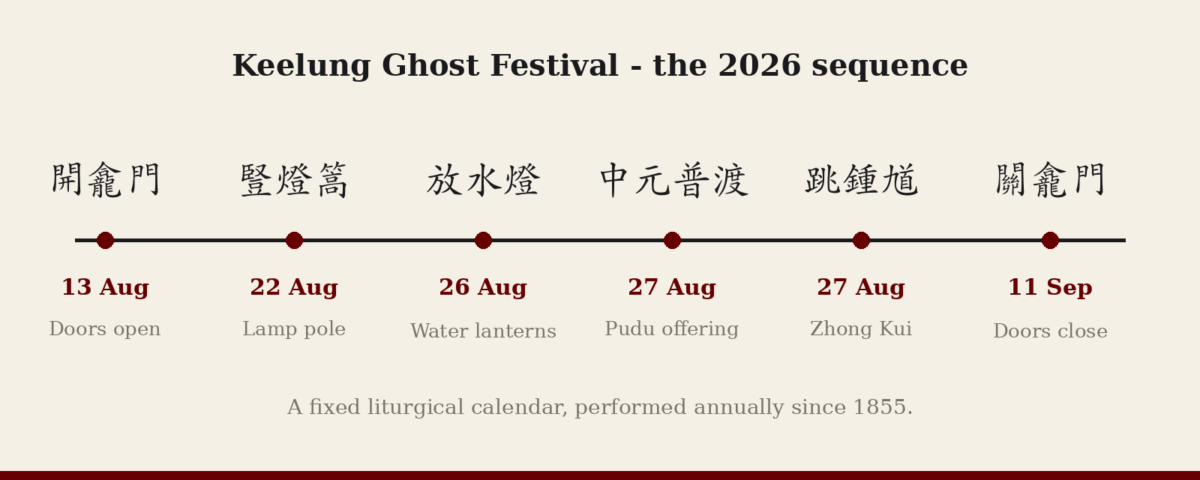
Nothing in that sequence is improvised or optional. It is a fixed liturgical calendar with a designated host, and it has been performed annually for a century and a half.
What pudu means
The offering at the centre of the month is pudu. The National Center for Traditional Arts, under the Ministry of Culture, publishes an account by the folk-religion researcher Hsieh Tsung-jung that frames it through two ideas.
The first is Daoist: the fifteenth of the seventh month is the festival of the Earth Official, whose office is the pardon of offences. The second is the older impulse the ritual actually serves — relief for the dead who have no one to feed them. Ancestors are fed by their own descendants throughout the year. The seventh month is for the dead who have nobody: the drowned, the unclaimed, the unremembered.
That is the part English coverage tends to miss. The month is usually described as a period when spirits are dangerous and one takes precautions. In the sources, it reads as a public obligation to feed the abandoned. The offering tables are elaborate — dough sculptures, whole displays of food, in some places a competitive scramble for the offerings — because the point is generosity at scale.
A note on the writing: the same article observes that the correct written form is 普度, and that 普渡, the form almost everyone now uses, is a popular conflation. Both are read the same. We use 普渡 here because it is what appears on the signage.
The taboos, and what is actually behind them
English articles about Ghost Month are mostly lists: do not whistle at night, do not hang laundry out, do not wear red, do not take the last bus, do not swim, do not step on offerings, do not say the word for ghost.
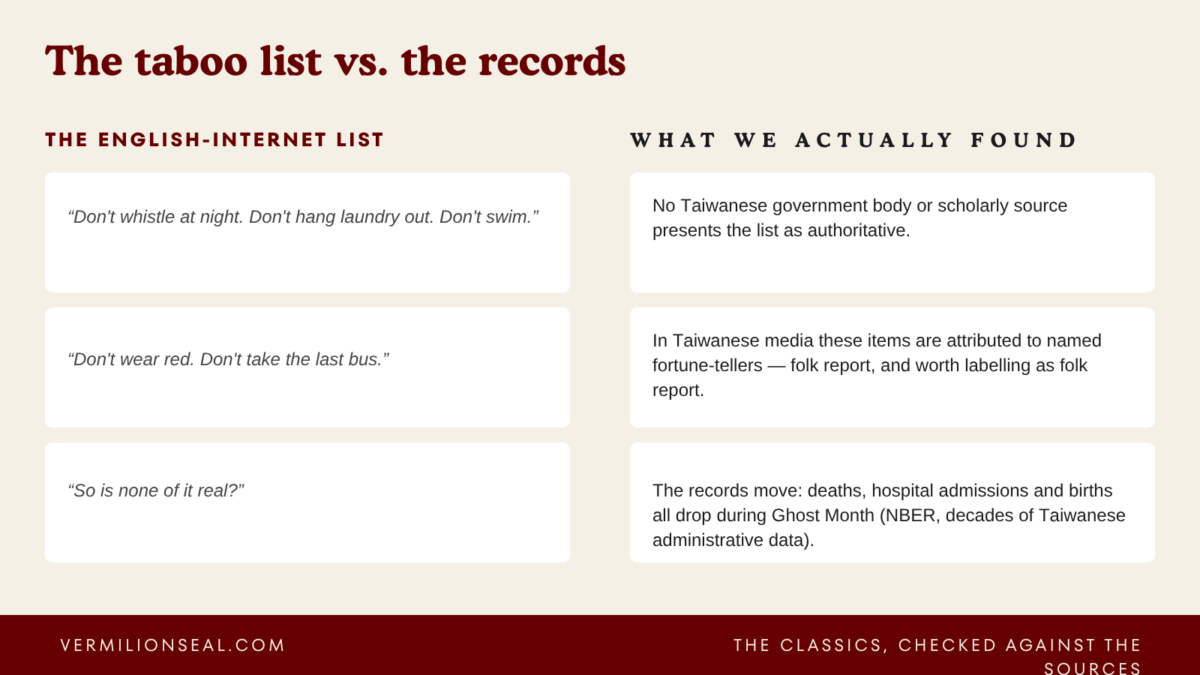
We went looking for the source of that list and did not find one. No Taiwanese government body and no scholarly publication we could reach presents it as authoritative. Where the items appear in Taiwanese media, they are attributed to named fortune-tellers and folk-custom commentators — for instance a Liberty Times piece of exactly that kind — or they appear on commercial sites. That does not make them false. It makes them folk report, and worth labelling as folk report.
What is documented is something narrower and much more interesting: not a list of rules, but a measurable change in what people do.
Economists at the National Bureau of Economic Research examined Taiwanese administrative records — death certificates, inpatient records and birth certificates spanning several decades — using the fact that Ghost Month moves around the Gregorian calendar to separate its effect from ordinary seasonal patterns. Their working paper reports reductions in mortality, hospital admissions and births during Ghost Months, with the admissions and births effects reflecting retiming — deferring an operation, adjusting a delivery date — rather than anything prevented.
Read that carefully, because it is not a finding about ghosts. It is a finding about scheduling. A society in which enough people postpone elective surgery, weddings and major purchases for four weeks produces a visible dip in the statistics, and then a corresponding bump afterwards.
You can watch the same thing in the commercial press each year. In 2026, Taipei Times reported Hotai Motor’s forecast that August car sales would fall around five per cent year-on-year, attributing the drop to Ghost Month. That is a company projection rather than an outturn, but the fact that a listed motor distributor forecasts by the lunar calendar tells you the effect is real enough to plan around.
If you are here during it
Practical, without the folklore:
- Offerings on the pavement are in use. Food set out on a low table outside a shop, with incense burning, is an active offering, not litter and not a display. Walk around it.
- The temple ceremonies are public. The Keelung sequence is open, listed with times and places, and attended by residents in ordinary clothes. It is not a performance staged for visitors and it is not closed to them either.
- Ask before photographing people. The same courtesy that applies at any funeral or religious rite applies here.
- Business slows for some things and not others. If you were planning to sign a lease, buy a car or book a wedding venue in Taiwan in the seventh month, expect the other party to raise it.
- Nobody will be offended if you do not observe any of it. Taiwanese practice varies enormously by family, region and generation, and quietly not participating is the normal position for a large number of people who live here.
Why this is on a site about the classics
Because the tradition this site documents is not only in books. The festival calendar, the temple, and the household altar are where most of it has actually been carried, by people who never read the Analects, for far longer than any text has been in English.
Taiwan is a good place to write this from for an unglamorous reason: here it is ordinary. The offerings on the pavement in August are not heritage being reconstructed. They are just August. We have written about why that matters for sources elsewhere.
The living tradition section covers the festival calendar and temple practice as observed; the concepts library covers the ideas the rituals assume. How every entry is checked is set out on the methodology page, and when we get something wrong the correction is public in the corrections log.
Once the gates close, the next full moon is the Mid-Autumn Festival — which Taiwan spends grilling. How that happened is a story of its own.
Why the seventh month lands in a different Gregorian month each year is a question about the calendar itself: why Chinese New Year never falls on the same day sets out the rule.
Ghost month is the best-known set of Taiwanese prohibitions, but it is not the only one. The rules that govern the lunar new year run on the same logic and are far more widely kept: Chinese New Year taboos traces each of them back to its source and asks what it is protecting.
The seventh month is not the only summer festival that English writing flattens into a single story. For the fifth of the fifth, and why the earliest texts do not credit it to Qu Yuan, see was the Dragon Boat Festival really created for Qu Yuan?; for the small wayside shrines where the unclaimed dead are fed all year round, see what is a Youying Gong?