In every Taiwanese temple there is a basket of red wooden crescents, and all day long you can hear them hitting the floor. They are jiaobei — divination blocks, “moon blocks” in English — and they are the instrument by which Taiwan asks its gods a yes-or-no question. The practice is at least eight centuries old on the textual record, it schedules the largest religious event in the country every year, and almost everything written about it in English cites either nothing or YouTube.
This page describes what the blocks are, how they are actually used, and where the rules come from — from Taiwan’s own government knowledge base, from the temples’ own published instructions, and from the one anthropologist who sat down and did the arithmetic.
What the blocks are
The Ministry of the Interior maintains a religious-knowledge base with signed entries by academic contributors, and its entry on the blocks, written by the folk-religion researcher Hsieh Tsung-jung, gives the physical definition: a pair of crescents, rounded in the middle and pointed at the ends, usually cut from bamboo root or wood. Each block has a flat face and a convex face, and the faces are not decoration — the flat side counts as yang, the convex side as yin. A throw of two blocks is therefore a reading of yin and yang, which connects this pocket-sized ritual to the largest ideas in the tradition.
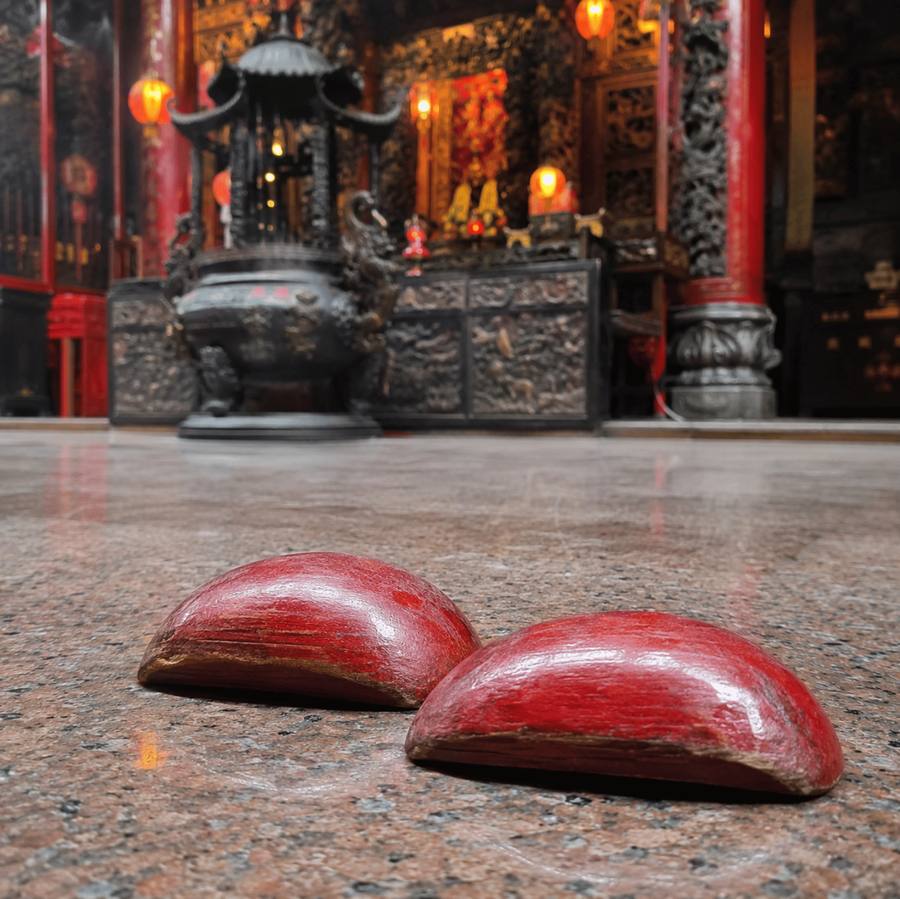
The Mandarin name is written 筊杯 or 杯筊 (the MOI entry prefers the character 筶). In Taiwanese Hokkien the practice is pua̍h-pue — the Ministry of Education’s official Taiwanese dictionary has an entry for it, written 跋桮 with the archaic character for “cup”, defined as throwing two half-moon blocks “to converse with gods and spirits”. A government dictionary that defines how to talk to gods is a very Taiwanese thing to exist, and it is the kind of source this site is built on.
The three ways the blocks can fall
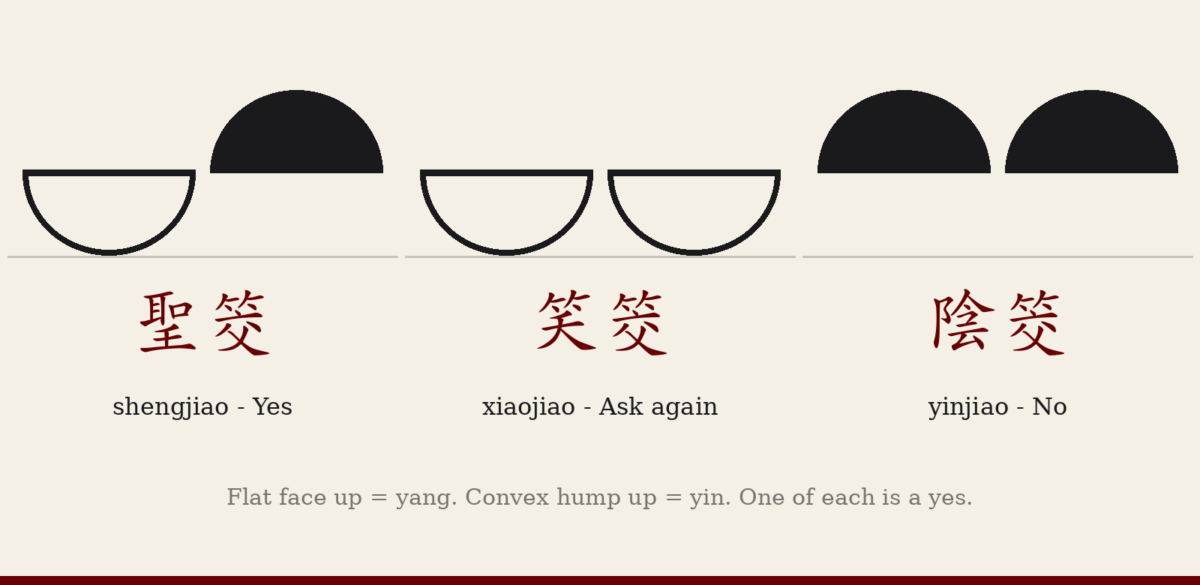
Two blocks, each with two faces, give three readable outcomes:
| Fall | Name | Reading |
|---|---|---|
| One flat up, one convex up | 聖筊 shengjiao — “divine blocks” | Yes. One yin, one yang: the god affirms. |
| Both flat faces up | 笑筊 xiaojiao — “laughing blocks” | Unclear. The god smiles — the question was badly put, or judgment is withheld. Rephrase and ask again. |
| Both convex faces up | 陰筊 yinjiao, also 哭杯 — “weeping blocks” | No. The god declines or disagrees. |
The names and readings above are as the MOI entry gives them — note that where English Wikipedia calls the negative fall “angry blocks” (怒筊), the Taiwanese state knowledge base calls it the weeping cup, 哭杯. Small differences like that are how you tell who has read the sources.
There is a fourth outcome the tables never include because it is not supposed to happen: 立筊, the standing block, when a crescent comes to rest balanced on its edge. It is treated as an extraordinary sign. When Taipei’s Muzha Jiying Temple got standing blocks twice within a single year, it made the national news, and the temple joked that the odds were lower than surviving Squid Game twice.
How a question is asked
The protocol, again from the MOI entry: before divining, you introduce yourself to the deity — name, address, and the matter at hand — then throw once to ask whether the god consents to be consulted at all, and only then put the actual question. The question must be answerable with yes or no. Many worshippers circle the blocks clockwise over the incense burner before the throw.
How many affirmatives you need is where practice divides, and the division is documented on both sides. The anthropologist David K. Jordan, who studied the practice in rural Taiwan, wrote in his 1982 paper Taiwanese Poe Divination that confirmation “normally requires a run of three positive responses in a row”. But Taipei’s Hsing Tian Kong — one of the most-visited temples in the country — teaches the opposite in its own published instructions: hold both blocks flat-side up “like a butterfly”, raise them to the brow, state your name, age, address and your single question, and accept the first answer. One temple’s rule is not another’s, and neither is wrong; there is no central authority, only custom, and the custom is local.
The blocks as a checksum
Jiaobei rarely work alone. Their most common job is to verify another instrument: the fortune sticks. The MOI’s entry on temple lots describes the full loop. You introduce yourself and your question, then throw the blocks to ask permission to draw. Granted, you draw a numbered stick from the cylinder — and then you throw the blocks again to ask, “is this the stick meant for me?” Only a yes sends you to the drawer of printed oracles. A no sends the stick back.
Read as a system, the sticks generate an answer and the blocks confirm it — a checksum on the oracle, run by the questioner. We will take the sticks themselves up separately in the living tradition section, because what is written on them is a literature of its own.
Where the blocks come from
The instrument is old enough that a Tang-dynasty poet could assume his readers knew it: a ninth-century poem by Han Yu on visiting the temple at Mount Heng describes the temple keeper handing him the 杯珓 and guiding his throw. The fuller description is Song-dynasty. The scholar Cheng Dachang, in the twelfth century, wrote — in a passage quoted in the MOI entry — that the diviner’s device called 杯珓 was originally two clam shells thrown in the air and read by how they landed, and that later versions were carved from bamboo or wood “roughly in the shape of a clam”. Turn a jiaobei block over in your hand and the shell is still there: the convex back, the flat mouth, the crescent silhouette. Twelve centuries of use, and the object has barely changed shape.
Not a museum piece
The reason to take jiaobei seriously is not the antiquity. It is that the blocks still make decisions that matter in Taiwan, on the public record.
The Dajia Mazu pilgrimage is the largest annual religious event in the country, a nine-day procession involving millions of participants. Its dates are not set by a committee. The Ministry of the Interior’s own religious-landscape portal records that every year, on the night of the Lantern Festival, the departure and return dates are determined by throwing jiaobei before the goddess at Zhenlan Temple. In pandemic-year 2021, the Central News Agency reported the blocks setting departure for 9 April at 11.05pm; for 2026, the same ceremony fixed 17 April, 11.05pm. And in July 2021, with COVID case numbers climbing, Donggang’s Donglong Temple formally petitioned its god by jiaobei on whether the triennial King Boat festival could proceed as scheduled. The question of whether to hold a festival attended by hundreds of thousands was put to the deity in writing and answered with two pieces of wood.
The practice has also gone online without embarrassment: the MOI entry notes the spread of plastic blocks and internet divination services, and Lukang’s Longshan Temple runs an official online jiaobei page on its own website.
One thing the blocks do not decide
A claim that circulates in English is that tied elections in Taiwan are settled by asking the gods. They are not. Under Article 67 of the Civil Servants Election and Recall Act, a tied vote — which happens in village-chief races — is resolved by drawing lots, administered by the election commission. The lot-drawing is sometimes held in a temple and the photographs look ritual enough, which is presumably where the confusion starts. But the instrument is statutory 抽籤, not jiaobei, and the statute names it. When we find that an earlier version of a claim like this has slipped into our own pages, it goes in the corrections log; this one we caught on the way in.
The arithmetic, since somebody did it
Jordan’s 1982 paper did something almost nobody writing about divination bothers to do: the sums. If a single throw gives a yes half the time, then the three-in-a-row confirmation used in many temples passes any given proposal with probability one in eight. A worshipper who keeps reformulating the question until the blocks agree is, in effect, running proposals against a filter that rejects seven of every eight — which is why, as Jordan observed, the practice pushes people to refine what they are actually asking. The blocks are not a fair coin, either: the convex back means the two faces do not land with equal probability, wear changes the balance, and Taiwanese popular-science writers have measured real blocks departing from the coin model. None of this is a debunking. It is a description of a mechanism that has been tuned, by long use, to make people ask better questions.
Why the English internet gets this wrong
The current English Wikipedia article on jiaobei rests, at the time of writing, on two YouTube videos and a museum catalogue record. The blogs that rank alongside it cite nothing at all, and their claims escalate accordingly — one asserts that major decisions require “seven or even twelve consecutive holy blocks”, a rule we could not find in any temple’s published instructions or any government source. Meanwhile the actually authoritative material — a state knowledge base with signed academic entries, an official dictionary of Taiwanese, the temples’ own printed protocols — sits untranslated. That gap is why this site is written from Taiwan.
The concepts library covers the yin-yang reading of the two faces and the vocabulary of the falls; the living tradition section covers the festival calendar the blocks help schedule, including the Ghost Month just ending as this is published. How every entry here is checked is set out on the methodology page, and when we get something wrong, the correction is public in the corrections log.
New to temples? The building has rules of its own — which door to enter, where to bow first, what you may photograph. They are short, and they are set out in Taiwan temple etiquette: the actual rules.
The blocks also decide larger things than a single question. The dates of the Dajia Mazu pilgrimage are set by throwing them on the night of the Lantern Festival; see why Mazu has to travel.
For the classical book behind Chinese divination — read here as a text, not cast — see hexagram 15, Qian.
Whose answer are you waiting for, when the blocks land? In most of Taiwan, most of the time, hers: Mazu, formally Tianshang Shengmu 天上聖母 — a title the imperial record and the temple plaque do not quite agree on.