Almost every English account of the eight consciousnesses is a translation of a translation. The terms are given in Sanskrit, glossed in English, and arranged into a diagram of layers, with the deepest one labelled something like “the storehouse”. That route skips the century in which this material actually entered the wider world. The eight-fold analysis reached Korea, Japan and Vietnam — and, through them, most of the Buddhism now read in English — in Chinese, in the vocabulary of one translator, 玄奘 Xuanzang (602–664), who spent sixteen years travelling to India and back and then seventeen more turning what he had brought home into Chinese. Read the list in his words and it stops looking like a stack of layers. It looks like what it is: a very precise argument about what “knowing something” is made of.
The list, and what the Chinese names actually say
The eight, in the standard order, with the Chinese Xuanzang settled on:
| # | Chinese | Pinyin | Sanskrit | What the Chinese name says |
|---|---|---|---|---|
| 1–5 | 眼識・耳識・鼻識・舌識・身識 | yǎn / ěr / bí / shé / shēn shí | cakṣur- etc. vijñāna | eye-, ear-, nose-, tongue- and body-discernment |
| 6 | 意識 | yì shí | mano-vijñāna | discernment belonging to the thinking faculty |
| 7 | 末那識 | mò nà shí | manas | — the Sanskrit sound, kept |
| 8 | 阿賴耶識 | ā lài yé shí | ālaya-vijñāna | — the Sanskrit sound, kept |
The word doing the work in six of those names is 識 shí, which English renders “consciousness”. It is a serviceable equivalent and a slightly misleading one, because Xuanzang’s own commentary defines the term by a different Chinese word altogether:
What 識 does
「了」謂了別,即是行相。識以了別為行相故。
“‘Making out’ means discriminating; that is its mode of operation. For discrimination is the mode in which shi operates.”
《成唯識論》卷二・玄奘譯 · Check the original (CBETA T1585)
了別 liǎobié is “to make out and tell apart”. A 識 is not a container of awareness; it is an act of dividing a field into this-rather-than-that. Eye-識 is not “visual consciousness” as a place where sights are stored. It is the cutting of colour and shape out of an undivided field, happening now, and it lasts exactly as long as that act does. Every difficulty English readers have with the eight — are they eight minds? do they run at once? where is the self? — becomes easier once 識 is read as a verb wearing a noun’s clothes.
The same text sorts the eight into three kinds, which is a more useful map than a ladder:
Three kinds of transforming consciousness
能變識類別唯三:一謂異熟,即第八識,多異熟性故;二謂思量,即第七識,恒、審思量故;三謂了境,即前六識,了境相麁故。
“There are only three classes of transforming consciousness: first, ripening — the eighth, since it is largely of the nature of ripened effect; second, deliberating — the seventh, since it deliberates constantly and closely; third, making out objects — the first six, since their making-out of objects is coarse.”
《成唯識論》卷二 · Check the original (CBETA T1585)
Six of the eight, then, are grouped together as the coarse, outward-facing business of registering a world. Only two are singled out, and each gets a Sanskrit name.
The eighth: what 阿賴耶 is a name for
The eighth consciousness is the one everything else in this system hangs on, and the treatise explains its name rather than assuming it:
Why it is called 阿賴耶
初能變識,大小乘教名阿賴耶,此識具有能藏、所藏、執藏義故。謂與雜染互為緣故,有情執為自內我故。
“The first transforming consciousness is called ālaya in the teachings of both vehicles, because this consciousness carries the senses of that which stores, that which is stored, and that which is clung to as a store: it stands in mutual condition with the defiled, and sentient beings cling to it as an inner self.”
《成唯識論》卷二 · Check the original (CBETA T1585)
Three senses of storing, in one Sanskrit word: it stores, it is stored in, and it is grabbed at as a possession. The same passage gives the eighth three further names for its three aspects — 阿賴耶 for what it is in itself, 異熟 “ripened effect” for what it results from, and 一切種 “all the seeds” for what it carries forward, “since it holds the seeds of all things so that they are not lost”. Four names for one thing, each answering a different question. English “storehouse consciousness” translates the first sense of the first name and drops the rest, which is how the eighth ends up sounding like a warehouse — a still room with boxes in it — when the treatise insists on the opposite. Its standing image is water:
猶如瀑流,因果法爾 — “like a torrent; cause and effect are simply so.” The eighth is neither permanent nor cut off, arising and perishing in continuous succession (《成唯識論》卷三).
A torrent has a constant shape and no constant water. That is the point being made, and it is also the reason the eighth cannot be the soul that some readers want it to be. We take that argument apart in is the storehouse consciousness the subconscious?, which is where the modern comparison to Freud and Jung belongs.
The seventh: the one that keeps saying “I”
The seventh is easy to miss, because in English both the sixth and the seventh come out as some kind of “mind”. In Chinese the sixth is 意識, the discernment that runs on the thinking faculty; the seventh is that faculty itself, working continuously in the background, and its whole job is described in four characters:
The seventh, in the verse the treatise comments on
次第二能變,是識名末那,依彼轉緣彼,思量為性相。
“Next, the second transforming consciousness: this consciousness is called manas. It turns in dependence on that one and takes that one as its object; deliberating is its nature and its mode.”
《唯識三十頌》,引於《成唯識論》卷四 · Check the original (CBETA T1585)
“That one” is the eighth. The seventh looks at the eighth — a torrent — and reads it as a self. It does this without pause and it does it carefully, which is what the standard phrase 恆審思量 “constant and close deliberation” means, and it comes with four fixed companions: 我癡、我見、我慢、我愛, self-delusion, self-view, self-conceit, self-love. The seventh is not a hidden reservoir of repressed material. It is the machinery of first-person grammar, always on. Manas has its own entry.
The neatest way to hold all eight apart is a distinction from the Ming commentator 憨山德清 Hanshan Deqing (1546–1623), who crosses two questions: is it constant, and is it close? Only one of the eight is both.
| Constant 恆 | Close 審 | Deqing’s words | |
|---|---|---|---|
| First five | No | No | 前五非恒非審,不執我故 |
| Sixth | No | Yes | 第六審而非恒,以執我有間斷故 |
| Seventh | Yes | Yes | 唯第七識亦恒亦審,以執我無間斷故 |
| Eighth | Yes | No | 第八恒而非審,不執我無間斷故 |
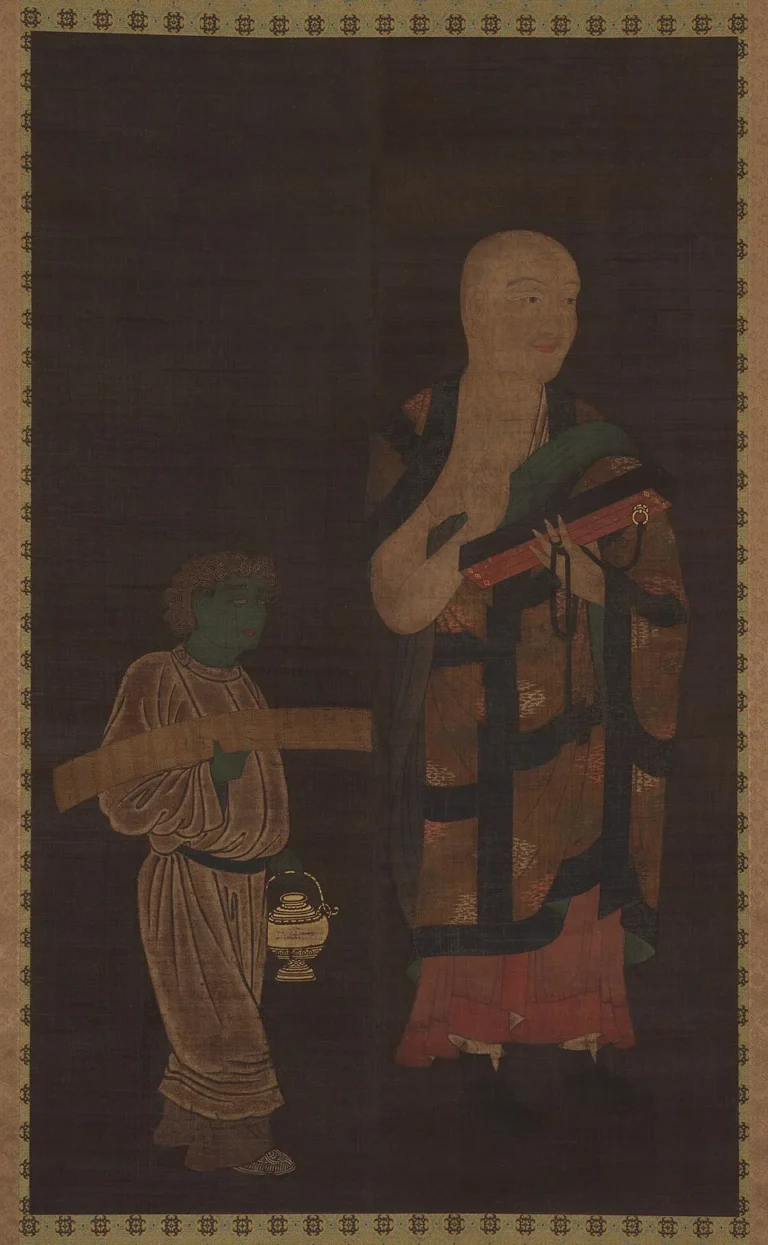
Why two names kept their Sanskrit sound
Xuanzang translated 眼識 and 意識 into plain Chinese and left 末那 and 阿賴耶 in transliteration. That was policy, not fatigue. A Song dynasty handbook of Buddhist terminology preserves his rule of thumb, the “five kinds not translated”:
The five untranslatables
唐.奘法師明五種不翻:一、祕密故不翻,陀羅尼是;二、多含故不翻,如薄伽梵含六義故;三、此無故不翻,如閻浮樹;四、順古故不翻,如阿耨菩提,實可翻之,但摩騰已來,存梵音故;五、生善故不翻,如般若尊重,智慧輕淺,令人生敬,是故不翻。
“Master Xuanzang of the Tang set out five kinds that are not translated. First, the esoteric — dhāraṇī. Second, the multiply-meaning — as bhagavān holds six senses. Third, what we do not have here — the jambu tree. Fourth, following precedent — anuttara-bodhi could well be translated, but the Sanskrit sound has been kept since Kāśyapa Mātaṅga. Fifth, what generates good — prajñā is weighty where ‘wisdom’ is light, and it makes people reverent; so it is not translated.”
法雲《翻譯名義集》,宋 · Check the original (CBETA T2131)
The second rule is the one that applies here. 阿賴耶 holds three senses of storing at once; any single Chinese word would have picked one and thrown away two. 末那 would have had to be 意, which was already spoken for by the sixth. So the two consciousnesses that most needed to be distinguished from ordinary experience are the two that arrive in Chinese wearing a foreign sound — permanently marked as technical terms. Anyone who has argued about whether to write Taipei or Taibei will recognise the trade-off: transliteration keeps the word intact and makes it opaque.
What the eight are for
None of this is descriptive psychology for its own sake. The eight-fold analysis exists to make one claim workable: that what is wrong with ordinary experience is structural rather than moral, and that the structure can be turned. The technical name for the turning is 轉識成智, “turning consciousness into wisdom”, and the treatise assigns each of the eight a specific wisdom it becomes. The mapping is exact, it is frequently reported the wrong way round in English, and it has an article of its own.
One last thing worth saying plainly, because the school’s name causes trouble in English. This is not idealism of the European kind, and the Chinese term 唯識 does not say “mind only”. What it says, and how the English label went astray, is the subject of “Mind-Only” or “Consciousness-Only”?.
Elsewhere in this vocabulary: what “arhat” actually means, why Chinese needed two words for a pratyekabuddha, and the Chan verse on correcting a fault.
FAQ
What are the eight consciousnesses in order?
Eye, ear, nose, tongue and body consciousness; 意識 the sixth, running on the thinking faculty; 末那識 manas, the seventh; 阿賴耶識 ālaya, the eighth. The first six are grouped together in the Chinese sources as the “coarse” making-out of objects; the seventh and eighth are treated separately.
Are the eight consciousnesses eight separate minds?
No. 識 in this system names an activity of discriminating, not a compartment, and the eight are eight modes of that activity rather than eight things. The treatise’s own grouping is threefold — ripening, deliberating, making-out — which cuts across any picture of eight stacked containers.
Is the eighth consciousness a soul?
The texts go out of their way to deny it. The eighth is described as arising and perishing in unbroken succession “like a torrent”, neither permanent nor annihilated; the mistake of taking it for a permanent inner self is precisely the work of the seventh consciousness, and is named as a delusion, not as insight.
Who worked out the eight consciousnesses?
The analysis is Indian — Asaṅga and Vasubandhu, fourth to fifth century — and reached East Asia in Chinese. The synthesis everything here is quoted from is the 《成唯識論》, ten fascicles compiled by Xuanzang in 659 out of Indian commentaries on Vasubandhu’s 《唯識三十頌》, with Dharmapāla’s reading given precedence.
Sources
- 《成唯識論》卷二,玄奘譯(大正藏 T1585) — CBETA:「能變識類別唯三」「識以了別為行相故」「初能變識,大小乘教名阿賴耶,此識具有能藏、所藏、執藏義故」「此能執持諸法種子令不失故,名一切種」(accessed 4 Sep 2026)
- 《成唯識論》卷三 — CBETA:「由攝藏諸法,一切種子識,故名阿賴耶」「猶如瀑流,因果法爾」(accessed 4 Sep 2026)
- 《成唯識論》卷四 — CBETA:「次第二能變,是識名末那,依彼轉緣彼,思量為性相」「四煩惱常俱,謂:我癡、我見,并我慢、我愛」(accessed 4 Sep 2026)
- 憨山德清《八識規矩通說》(卍續藏 X0893) — CBETA:恆審四句「前五非恒非審」「第六審而非恒」「唯第七識亦恒亦審」「第八恒而非審」;題署「唐三藏法師玄奘集,明憨山沙門德清述」(accessed 4 Sep 2026)
- 法雲《翻譯名義集》(大正藏 T2131) — CBETA:「唐.奘法師明五種不翻」全段(accessed 4 Sep 2026)
- 霍韜晦〈唯識五義〉,《華岡佛學學報》第 6 期,臺北:中華學術院佛學研究所,1983 — chibs.edu.tw:論 vijñapti 與 vijñāna 在玄奘譯語中的混同(accessed 4 Sep 2026)