Who is Mazu? The short answer is that she is the most widely worshipped deity in Taiwan: a woman of the Fujian coast, born in 960, who was said to save sailors, was worshipped after her death, and was promoted by successive dynasties until, by the nineteenth century, her official title ran to sixty-four characters and ended in “Empress of Heaven”. The longer answer starts with the fact that almost nobody in Taiwan calls her that. They call her 媽祖, which is not a title at all. It is a kinship term — “mother-ancestor”, something close to “granny” — and the choice of that word over the imperial one tells you most of what is distinctive about the goddess on this island. This entry follows the name, the dates and the titles through the sources, including one place where the popular account and the oldest hagiography disagree.
Mazu: the short answer
Mazu 媽祖 is the sea goddess of the southern Chinese coast and, by adoption, of Taiwan. The tradition — set out with its sources further down this page — names her as a woman who actually lived: Lin Moniang 林默娘, born on the island of Meizhou off the Fujian coast in the tenth century, dead before thirty, and credited afterwards with pulling sailors out of storms. Her formal religious title in Taiwan is Tianshang Shengmu 天上聖母, Holy Mother in Heaven. The name used at the temple door is Mazu, or Mazu-po 媽祖婆.
She is a goddess, not a god. That is worth saying plainly, because the English spelling of her name arrives in search engines attached to both words. The Office of the President of the Republic of China, writing in English, puts it without hedging: Matzu is probably the most revered goddess worshipped in Taiwan’s civil religion.
The grammatical gender is not a translator’s nicety here. It is built into the title itself: 聖母 is a mother, and 婆 is an older woman of the family.
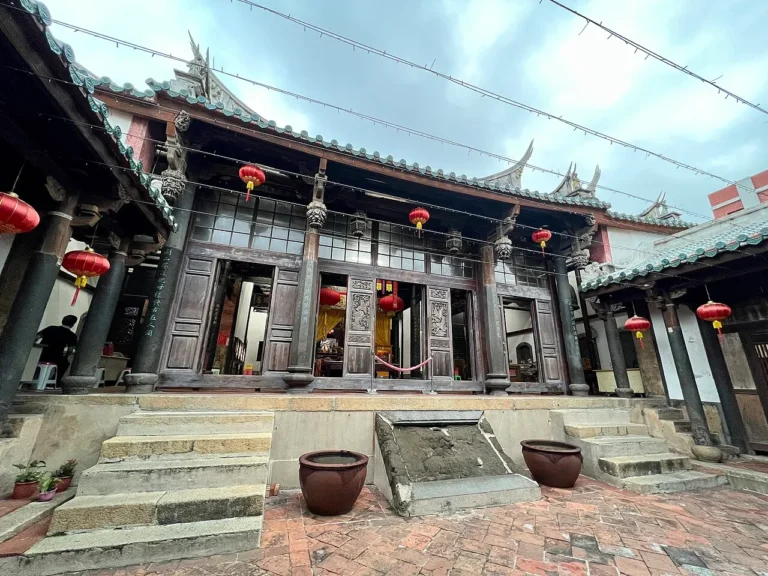
The oldest Mazu temple in Taiwan, on the Ministry of the Interior’s account, is the Tianhou Temple in Magong, Penghu 澎湖天后宮 — 澎湖天后宮為目前文獻考據所知全臺第1座媽祖廟
, the first as far as the documentary record goes. It has been a national monument since December 1983.
What the state does register is the walking. The nine-day Dajia Mazu pilgrimage 大甲媽祖遶境進香 was registered by Taichung City as an important folk practice 重要民俗 on 4 July 2008, and registered again at national level on 18 June 2010, in the category 民俗-重要民俗-儀式、祭典、節慶. Two registrations, two years, which is why you will see both dates quoted as though one of them had to be wrong. The record now credits the Ministry of Culture, though in June 2010 the designating body was still the Council for Cultural Affairs; the ministry replaced it in 2012. The Baishatun pilgrimage 白沙屯媽祖進香, which has no fixed route at all and goes where the palanquin goes, was registered on that same day in 2010 — but at the plain folk-practice tier, 民俗-民俗, not the important one. The two are often described as equivalent. On the register they are not. If you want the shape of Mazu in Taiwan rather than her titles, the pilgrimages are where to look.
How many Mazu temples are there in Taiwan? I cannot give you a figure I am able to stand behind. The Ministry of the Interior’s statistical bulletin on temples breaks its counts down by religion, by county, by the type of building, by form of organisation and by registration status — but not by which deity sits on the main altar. The ministry’s own open dataset of registered temples does carry a 主祀神祇 field, principal deity, which means the information exists row by row; I have not found a published total drawn from that column. So the round numbers in circulation — five hundred, eight hundred, a thousand and more — are estimates whose working I cannot check. If a reader can point me to an official total, I will print it and say where it came from.
The word in the dictionary
Start with what the word means to the people who use it. The Ministry of Education’s dictionary of Taiwanese has two relevant entries, and the second is the one to read:
媽祖婆, in the Ministry of Education’s Taiwanese dictionary
媽祖婆 Má-tsóo-pô:媽祖。臺灣民間對媽祖的暱稱。現今有用來稱呼像母親、祖母,婆婆般親切慈祥待人的年長女子。
“Má-tsóo-pô: Mazu. The affectionate name used for Mazu among the Taiwanese people. Today also used of an older woman who treats people with the warmth and kindness of a mother, a grandmother or a mother-in-law.”
教育部《臺灣台語常用詞辭典》「媽祖婆」條 · sutian.moe.edu.tw
Every character in the name is a relative. 媽 is a mother; 祖 is an ancestor or grandparent; 婆 is an old woman, a grandmother, a husband’s mother. The dictionary’s second sense — that a kindly old woman can herself be called a Má-tsóo-pô — shows the word has come full circle: the goddess is named after a grandmother, and grandmothers are now named after the goddess. Compare the entry for the bare 媽祖, which the dictionary defines as “the Holy Mother in Heaven, Mazu-po; in legend, the goddess who guides ships on their course”. The formal title and the kinship term are given as synonyms. In practice they are not used by the same people in the same rooms.
Only two places call her by kin terms
Chang Hsun, of the Institute of Ethnology at Academia Sinica, has studied Mazu for over twenty years and has walked with the great pilgrimages more than half a dozen times. Interviewed by the Academy’s Research Insights in 2020, she began with the name:
媽祖信仰普遍流傳在中國、港澳、東南亞各地,但唯獨臺灣與福建會以媽、祖、婆等「親屬」稱謂稱呼媽祖,如同親暱地呼喚祖輩。相較其他地方多以天上聖母稱呼,臺灣信徒多用「媽祖」、「媽祖婆」、「姑婆」等稱號。
“Belief in Mazu is widespread across China, Hong Kong and Macau and South-East Asia, but only in Taiwan and Fujian is she addressed by ‘kinship’ terms — ma, zu, po — as if one were calling affectionately to a grandparent. Where other places mostly say ‘Holy Mother in Heaven’, Taiwanese believers mostly say ‘Mazu’, ‘Mazu-po’ or ‘Great-aunt’.”
The last of those, 姑婆, is the key to the others. A gupo is a father’s father’s sister — a great-aunt. Mazu was a woman of the Lin family who died unmarried and childless, so to the Lins of Putian and their descendants she is not an ancestress but a great-aunt of the lineage. Chang reports hearing women in Putian, at the busy season, set a baby down and say “Great-aunt, watch the child for me”, and hearing pilgrims in Taiwan call her simply 婆啊, “Granny”. The Ministry of the Interior’s entry on the goddess records the Lin-family forms too: 祖姑婆 and 姑婆祖, “ancestral great-aunt”. What happened in Taiwan, on Chang’s account, is that a family’s way of speaking to a dead aunt was adopted by everyone: the Fujianese settlers, most of them not Lins, took over the Lins’ intimacy with her, and 媽祖 — the kin term stripped of the lineage — became the island’s word.
Matsu, Matzu, Mazu: three spellings, all of them official
If you arrived here having typed matsu goddess, or ma zhu, or mazu god, the confusion is not yours. It belongs to the Republic of China’s own English-language publishing, which spells this one name three different ways on three different government sites, and goes on doing so even though the romanisation rule itself was settled years ago.
The Office of the President writes Matzu. The Tourism Administration writes Mazu and Matsu — in the same sentence, for the same goddess. Here is that sentence, from the ministry’s English page on Lienchiang County, in full:
Named after the goddess “Mazu”, Matsu Archipelago is located northwestward by west in Taiwan Strait, which is the very water Matsu had saved many sailors’ lives.
Read it twice. The goddess is Mazu in the first clause. The islands are Matsu. Then the goddess is Matsu again by the end of the sentence. One government page, one sentence, two spellings for one woman and a third job for one of them. This is the whole problem in twenty-six words, and it is why a search for matsu goddess lands half on a deity and half on a group of islands.
There is nothing improper about Matsu. It is the older romanisation, and the county paper of the islands said so in 2003, when the switch to Tongyong Pinyin was being argued out: 馬祖的英文除了傳統的「Mat-su」外,現在又多一個「Mazu」,到底哪個才是對的?
— besides the traditional Mat-su, there is now also Mazu; which one is right? The paper filed it under the headline 馬祖英文名一地兩譯, one place, two translations.
The archive has since taken its revenge on that article. As the 馬祖日報 website renders the page today, the English half of its own headline reads “Mazu or Mazu”. The distinction the piece was written to explain has been normalised out of the title above it. I have left the link in the sources so you can check that for yourself; it is the most economical illustration of the problem I have found anywhere.
What is wrong with ma zhu
Two things, and neither is the spacing alone. In Hanyu Pinyin, which the Executive Yuan’s 中文譯音使用原則 makes the default for Chinese romanisation in Taiwan — 我國中文譯音除另有規定外,以漢語拼音為準
— the name is written Māzǔ: one word, and the second syllable begins with z, not zh. The zh of Pinyin is a retroflex, a different consonant entirely. Dropping the tone marks is forgivable, and almost universal in English text; swapping z for zh changes the sound.
The tones also record what happened to the island name. The goddess is 媽, mā, first tone, the character for mother. The islands are 馬, mǎ, third tone, the character for horse. Writing both as a flat ma hides the fact that the name was altered, not merely transliterated. The Fuzhou-dialect account preserved by the county paper has the body of Lin Moniang washing ashore on Nangan, a shrine raised to her, and the name shifting by homophony: 後據福州話諧音,轉稱「馬祖」
. The paper marks that account as tradition, 相傳, and so do I.
The naming itself, as distinct from the story of how it happened, is stated flatly rather than hedged. An Executive Yuan news release puts it in a single clause — 馬祖列島因媽祖而得名
, the Matsu archipelago is named after Mazu — and the Tourism Administration’s Chinese page says the same: 馬祖列島以「媽祖」而得名
. The National Cultural Memory Bank goes one step more local and credits the temple rather than the goddess directly: 馬祖列島因為馬祖澳的天后宮而得名
, named after the Tianhou temple at Matsu Bay.
Taiwan has a standing argument of this kind about almost every proper noun it exports; the reason Taipei is not spelled Taibei is the same argument with a different winner, and the choice between dao and tao is the same argument again with no winner at all. The script her name is written in has its own version of the quarrel, which is not the same question as whether Taiwan speaks Mandarin.
The woman, according to the oldest account
The story everyone in Taiwan knows comes, as Chang notes, mostly from the 《天妃顯聖錄》, the Record of the Manifest Sanctity of the Heavenly Consort, a Qing dynasty compilation from the Meizhou temple that gathered the legends into their standard form. Its chapter on her birth is precise about the date:
The birth, from the Record of Manifest Sanctity
越次年,宋太祖建隆元年庚申,三月二十三日方夕,見一道紅光從西北射室中,晶輝奪目,異香氤氳不散。俄而王氏腹震,即誕妃於寢室。……自始生至彌月,不聞啼聲,因命名曰「默」。
“The following year, the first year of Jianlong under Song Taizu, a gengshen year, on the twenty-third day of the third month towards evening, a shaft of red light was seen striking into the room from the north-west, dazzlingly bright, and a strange fragrance hung in the air and would not disperse. Presently Lady Wang’s womb stirred, and the Consort was born in the bedchamber. … From her birth until her first month was complete no cry was heard from her, and so she was named ‘Silent’.”
《天妃顯聖錄》「誕降」 · ctext.org
That is 960, the year the Song dynasty was founded, and the twenty-third of the third lunar month is still her birthday and the reason “the whole of Taiwan goes mad for Mazu in the third month”. The name 默, “Silent”, gives her personal name Lin Mo; the Ministry adds that 默娘, “Miss Silent”, is just the feminine form. The Record goes on: at sixteen she looked into a well and received a talisman; she flew over the sea on clouds; the villagers called her 通賢靈女, “the Numinous Maiden of Penetrating Wisdom”; and then, 越十三載,道成,白日飛升;時宋雍熙四年丁亥秋九月重九日也 — “after thirteen more years her Way was complete and she ascended in broad daylight; it was the ninth day of the ninth month of autumn, in the fourth year of Yongxi under the Song, a dinghai year.” That is 987.
Here is the discrepancy I promised. The Research Insights article summarising Chang’s interview says she ascended “at twenty-six”. The Record‘s own dates, 960 to 987, make her twenty-seven by Western reckoning and twenty-eight by the traditional count, and Lien Heng’s General History of Taiwan (1920), summarising the same hagiography, says so outright: 雍熙四年九月初九日昇化……年二十有八, “on the ninth day of the ninth month of the fourth year of Yongxi she was transformed and ascended … aged twenty-eight.” I take the twenty-six to be a slip in the write-up rather than a variant tradition, but I note it because the number is repeated a good deal in English, and the primary text does not support it.
From village maiden to Empress of Heaven
The Record says the villagers “feared and revered her, and together built a shrine and sacrificed to her” under the maiden title. What followed was nine centuries of promotion, and Chang’s reading of the ladder is the clearest I know. The earliest titles — 靈女 and 神女, numinous maiden, divine maiden — are the vocabulary of southern Fujian’s folk religion. Then come the imperial grades, 夫人, 妃, 后 — Lady, Consort, Empress — awarded by successive courts on the pattern of the Book of Rites. Alongside these, 天妃, Heavenly Consort, is a Daoist title. The Ministry’s entry gives the outer numbers: enfeoffed by the court no fewer than thirty times from 1123 onwards, with the last and longest title conferred in 1857 — the sixty-four-character formula beginning “Protector of the State and Shelterer of the People” and ending 天后之神, “the Spirit who is Empress of Heaven”.
Chang’s point about all this is that Mazu is unusual among Chinese goddesses in having been, from the Song onward, a state goddess, and that the titles are not neutral. Fujian’s folk maiden, the court’s Lady-Consort-Empress and the Daoists’ Heavenly Consort are three constituencies stacked in one name, which is why so many different kinds of people could accept her. She adds, with a smile one can hear in the transcript, that titles like Lady and Holy Mother, conferred on an unmarried woman of twenty-eight, carry a heavy load of “good wife, good mother” — the Confucian ideal of the woman who follows husband and son — and that the goddess embodies a contradiction the patriarchal state found useful: chaste, and maternal.
Tianfei, Tianhou, Tianshang Shengmu: the records disagree about the dates
The promotion from village girl to Empress of Heaven is usually told as a tidy ladder with a date on each rung. It is not tidy. I went looking for the two dates that matter — when she was made Tianfei 天妃, Heavenly Consort, and when she was raised to Tianhou 天后, Empress of Heaven — and came back with four, plus two more I could not trace to anything.
For Tianfei, the register of imperial honours in the 《天妃顯聖錄》 gives 1281, under Kublai Khan, and gives the reason as grain-convoy protection rather than anything to do with fishermen:
《天妃顯聖錄》・歷朝顯聖褒封, the Yuan entry and the last two Qing entries
至元十八年(一二八一),以庇護漕運封「護國、明著天妃」。
康熙十九年(一六八○),將軍萬以征剿廈門得神陰助取捷,並使遠遁,具本奏上,敕封「護國、庇民、妙靈、昭應、弘仁、普濟、天妃」。
二十三年(一六八四),琉球冊使汪以水道危險荷神護佑複命,奏請春秋祀典;又將軍侯施以澎湖得捷默叨神助,奏請加封;俱差官賷香帛詔誥到湄褒嘉致祭。
“In the eighteenth year of Zhiyuan (1281), for safeguarding the grain transport, she was granted the title Protector of the State, Manifestly Illustrious Heavenly Consort.”
“In the nineteenth year of Kangxi (1680), General Wan, having routed the enemy at Xiamen with the goddess’s hidden help and driven them far off, submitted a memorial; she was granted by edict the title Protector of the State, Shelter of the People, Wondrously Numinous, Brightly Responsive, Greatly Benevolent, Universally Succouring Heavenly Consort.”
“In the twenty-third year (1684), Wang, envoy to the Ryukyus, having returned safely from a dangerous passage under her protection, petitioned for spring and autumn sacrifices; and Marquis Shi, the general, having won at Penghu with her silent aid, petitioned for an additional title. Officials were in both cases dispatched with incense, silk and the imperial edict to Meizhou, to commend her and offer sacrifice.”
《天妃顯聖錄》排印本,歷朝顯聖褒封條 · Project Gutenberg #54777, checked character by character on 5 October 2026
D. K. Jordan’s table of her titles, following Tu Jung-che, instead dates the Tianfei grant to 1278. The Ministry of the Interior, writing for a general audience, skips the Yuan detail and says she held Tianfei through the Song, Yuan and Ming before the Qing raised her: 清康熙22年(公元1683年)…加封媽祖為「護國庇民妙靈昭應仁慈天后」
. Jordan’s table puts an elevation to Tianhou at 1681 — but the title he records for it, 昭靈顯應仁慈天后, is not the string the ministry gives for 1683, 護國庇民妙靈昭應仁慈天后. They may be two accounts of one event, or two events. So: 1278 or 1281 for the consort, 1681 or 1683 for the empress, and not even agreement on what she was called when it happened. The two dates repeated most often in English writing on Mazu, 1684 and 1720, I could not trace to any source I am willing to cite. They may well be right. I have not found who says so.
Where the paper trail stops
Here is the part I did not expect, and it is the reason the dates will not line up. The register carries its own tally in its heading — 歷朝顯聖褒封共二十四命, twenty-four imperial commands across the dynasties — and then simply stops, at 1684. Its last entry is not an elevation at all. It is two petitions: the Ryukyu envoy asking for seasonal sacrifices, and Marquis Shi — Shi Lang, the admiral who had just taken Penghu and ended the Ming loyalist state in Taiwan — 奏請加封, petitioning for a further title. Incense and edicts went to Meizhou. The register records the asking. It does not record the granting.
And in all nine hundred characters of that register the word 天后 does not occur once. 天妃 occurs five times, including both Kangxi entries. Across the whole book the ratio is seventy-five to nine, and those nine are not in the edicts: the appended genealogy is headed 天后本支世系考, the temple survey opens 天后於宋雍熙四年, and the sailors in the miracle stories burn their incense before 天后.
I want to be careful about what that shows. This is one printed transcription, not the Qing archives, and a compilation assembled in layers will carry each layer’s vocabulary. But the pattern inside the one book is consistent, and legible: by the time the editors were titling their own chapters and retelling the miracles, she was already Tianhou in ordinary speech, while the document list they had copied out still said Tianfei and had run out of documents. The honorific had gone ahead of the paperwork. That is usually how these things happen, and it is exactly why a date is hard to pin — a title people are already using cannot be dated to the edict that catches up with it.
None of this, in Taiwan, is what you will see carved above the door. The plaque says 天上聖母, and the ministry’s own prose reaches for it as the ordinary name when it describes a family carrying an incense flame home from Meizhou to its own front room. Empress of Heaven is the rank. Holy Mother in Heaven is the relationship, and Taiwan kept the one it could speak to. If you go and stand in front of her, what to do with your hands and your shoes will matter more than which of her titles you use, and the answer she gives back comes off the floor from a pair of wooden blocks, not out of any of them.
Why Taiwan took the maiden and left the empress
Which brings the name back. The official name is Empress of Heaven, and the official temples bore it: the Ministry’s entry notes that a temple called 天后宮, Palace of the Empress of Heaven, was in the old days usually a government foundation, and that after the Japanese took the island these became people’s temples but kept the name. The people, meanwhile, went on saying “Granny”.
Chang’s explanation is that the Taiwanese chose which face of a many-faced goddess to look at. Elsewhere — in Hong Kong especially, and among the Fujianese diaspora in America, Penang or Shanghai — Mazu is the goddess who subdued the sea-demons Thousand-Mile Eye and Following-Wind Ear, who helped beat the Jin armies in the Song and Zheng Chenggong and Shi Lang in the seventeenth century: a martial goddess of justice, or simply the god from home. Taiwan, where the great majority of the settlers were southern Fujianese who treated her as their own old ancestress, took the merciful face instead. Its images show it. Mainland Mazu statues, Chang observes, tend to be young and slender; Taiwanese ones are matronly, heavy-set, seated with lowered eyes — a middle-aged woman, an elder, which some in the tradition justify by arguing that a goddess who has been cultivating for a thousand years should not still look like the girl who ascended.
Two further things drew the island to her. She was the one god the settlers had in common: the Zhangzhou people had their Sacred King, the Anxi people their Patriarch of the Clear Stream, the Tong’an people their City God of Xiahai, but everyone had crossed the strait, and everyone had prayed to Mazu to survive it — so, Chang says, when the feuding settler groups of the Qing reached deadlock, it was Mazu they asked to arbitrate. And she grew with the land. The Ministry’s entry describes her turning from a harbour goddess into an inland one, credited with “sweeping the stream’s path” in floods and driving off the insects from the rice, so that Taiwan has “harbour Mazus” and “mountain Mazus” alike; Chang records a “native Mazu” at the Cirén Temple in Gongliao, built jointly by Ketagalan and Han settlers, and asks — without answering — whether Taiwan’s taste for black-faced images, smoke-darkened and held to be the most powerful, has absorbed something of older local goddesses in the way the Black Madonnas of Europe are thought to have.
Who is Mazu, then? A Fujian woman of the tenth century, a court-enfeoffed empress, a Daoist consort, a martial protector of fleets — and in Taiwan, before any of those, somebody’s great-aunt, whom a whole island decided to address the way her own family did. The imperial title is on the temple gate. The kinship term is what people say when they walk through it. For what they do once inside, see Taiwan temple etiquette; for why she leaves the temple once a year and where she goes, see why Mazu has to travel. And if you have seen her name spelled Matsu, Ma-tsu and Mazu on the same street, the reason is the same one that keeps Taipei from being spelled Taibei — see that entry.
FAQ
Who is Mazu?
A woman of the Lin family from Meizhou island in Fujian, born, according to the oldest hagiography, on the twenty-third of the third lunar month of 960 and named “Silent” because she did not cry for a month. Credited with saving sailors, she was worshipped after her death and promoted by the Song, Yuan, Ming and Qing courts to “Empress of Heaven”. She is the most widely worshipped deity in Taiwan.
What does the name Mazu mean?
It is a kinship term, not a title: 媽 mother, 祖 ancestor. The Ministry of Education’s Taiwanese dictionary defines 媽祖婆 as the affectionate popular name for the goddess, now also used of any kindly old woman. Only Taiwan and Fujian address her this way; elsewhere she is “Holy Mother in Heaven” or “Empress of Heaven”.
How old was Mazu when she died?
The Record of Manifest Sanctity dates her birth to 960 and her ascent to the ninth day of the ninth month of 987, which Lien Heng’s General History of Taiwan gives as “aged twenty-eight” by traditional count. The figure “twenty-six” that appears in some summaries is not supported by the primary text.
Why is Mazu so important in Taiwan specifically?
Because she was the one god all the Fujianese settlers shared, having prayed to her to survive the crossing, so she became the arbiter between feuding settler groups and then the common goddess of the island; because Taiwan emphasised her merciful, grandmotherly face rather than her martial one; and because she adapted from a sea goddess into a goddess of floods and crops as settlement moved inland.
Is Matsu the same as Mazu?
Yes — the same goddess, spelled two ways, and the older spelling also happens to be the official English name of a group of islands. Matsu is the traditional romanisation; Mazu is Hanyu Pinyin, the system the Executive Yuan made the default. The Republic of China’s own English publishing uses both, and the Office of the President adds a third, Matzu. The Matsu Archipelago in the Taiwan Strait is named after her, which is why a search for Matsu goddess returns a deity and a ferry timetable in the same breath.
Is Mazu a god or a goddess?
A goddess. Her formal title, 天上聖母, Holy Mother in Heaven, is a feminine one, as is the familiar 媽祖婆. The Office of the President, writing in English, calls her the most revered goddess worshipped in Taiwan’s civil religion
. The tradition identifies her as a particular woman who lived and died, which is part of why the word god sits so badly on her.
How do you spell and pronounce Mazu in pinyin?
In Hanyu Pinyin she is Māzǔ — one word, first tone then third. The common misspelling ma zhu gets two things wrong: it splits the name, and it puts the retroflex zh where Pinyin has a plain z. Tone marks are routinely dropped in English text and that is no great loss; the zh changes the consonant.
Taiwanese official sources disagreeing with themselves is not a one-off. The Ministry of Education’s dictionary entry for 送窮 dates the New Year sweeping-out to the third day, the sixth or the twenty-ninth, and the holiday statute makes the Spring Festival one day while granting five — see Chinese New Year taboos: what the rules protect.
Attaching a name to a practice is how a good deal of Taiwanese religious life acquired its labels. The best-documented case is the dragon boat race at Erlong in Yilan, whose heritage registration traces the race to the Kavalan and files Qu Yuan among the legends Han settlers brought with them: was the Dragon Boat Festival really created for Qu Yuan?
Sources
- 教育部《臺灣台語常用詞辭典》「媽祖婆」「媽祖」條 — sutian.moe.edu.tw (accessed 5 Sep 2026)
- 《天妃顯聖錄》(臺灣文獻叢刊第 77 種):「誕降」「窺井得符」及雍熙四年重九飛升一則;「里人畏之敬之,相率立祠祀焉,號曰『通賢靈女』」 — ctext.org (accessed 5 Sep 2026)
- 連橫《臺灣通史》卷二十二・宗教志:「宋太祖建隆元年三月二十有三日,誕后……雍熙四年九月初九日昇化,或言二月十有九日也,年二十有八。」 — 維基文庫 (accessed 5 Sep 2026)
- 內政部全國宗教資訊網「宗教知識+」〈天上聖母(Matzu)〉 — religion.moi.gov.tw:林默、默娘;1123 年以來敕封三十餘次;1857 年六十四字封號;澎湖天后宮明萬曆創建;天后宮多為官廟;媽祖婆、祖姑婆、姑婆祖;港口媽與內山媽、掃溪路、趕稻蟲 (accessed 5 Sep 2026)
- 〈保平安、反核四、選總統都請託夢!媽祖如何成為臺灣最強天后?〉專訪張珣(中央研究院民族學研究所),研之有物,2020-04-16(CC BY-NC-ND 4.0) — research.sinica.edu.tw:親屬稱謂唯臺灣與福建;「姑婆,幫我看一下孩子」;封號階梯(靈女/神女、夫人/妃/后、天妃);國家級女神;施琅與天后;械鬥仲裁;慈悲媽祖 vs 香港正義天后;黑面媽、番仔媽;神像造型比較;「26 歲」之說(本站依原典校正為 28) (accessed 5 Sep 2026)
- 《天妃顯聖錄》排印本・「歷朝顯聖褒封共二十四命」全條: the register of twenty-four imperial honours, ending at 康熙二十三年(一六八四) with Marquis Shi’s petition 奏請加封 and no grant recorded; 天后 occurs nowhere in the register and nine times in the book against seventy-five for 天妃 — gutenberg.org (read 5 Oct 2026)
- Office of the President, Republic of China (Taiwan), “President Chen Prays to Goddess Matzu to Bless Taiwan”, 17 Feb 2006:
Matzu is probably the most revered goddess worshipped in Taiwan’s civil religion.
— english.president.gov.tw (accessed 5 Oct 2026) - Tourism Administration, MOTC, “Lienchiang County (Matsu)”:
Named after the goddess “Mazu”, Matsu Archipelago is located northwestward by west in Taiwan Strait, which is the very water Matsu had saved many sailors’ lives.
— eng.taiwan.net.tw; Chinese page 「馬祖列島以『媽祖』而得名」 — taiwan.net.tw (accessed 5 Oct 2026) - 馬祖日報〈馬祖英文名一地兩譯〉,2003-10-29:「馬祖的英文除了傳統的「Mat-su」外,現在又多一個「Mazu」」; the archive page now renders its own English headline as “Mazu Or Mazu” — matsu-news.gov.tw (accessed 5 Oct 2026)
- 馬祖日報〈馬祖地名故事〉/林國清:「相傳宋孝女林默娘殉身投海救父,身負父屍被海水漂至島上……後據福州話諧音,轉稱『馬祖』」(原文標為「相傳」) — matsu-news.gov.tw (accessed 5 Oct 2026)
- 行政院新聞稿:「馬祖列島因媽祖而得名」 — ey.gov.tw (accessed 5 Oct 2026)
- 文化部國家文化記憶庫〈南竿馬祖境天后宮〉:「馬祖列島因為馬祖澳的天后宮而得名」 — tcmb.culture.tw (accessed 5 Oct 2026)
- 行政院《中文譯音使用原則》(97-12-18 修正)第二點:「我國中文譯音除另有規定外,以漢語拼音為準」;教育部《中文譯音使用原則》手冊:「聲調符號標示在音節的主要母音上,輕聲不標」 — crptransfer.moe.gov.tw (accessed 5 Oct 2026)
- 內政部臺灣宗教文化地圖〈澎湖天后宮〉:「澎湖天后宮為目前文獻考據所知全臺第1座媽祖廟」;國定古蹟公告 1983-12-28;「清康熙22年(公元1683年)…加封媽祖為「護國庇民妙靈昭應仁慈天后」」 — taiwangods.moi.gov.tw (accessed 5 Oct 2026)
- 內政部全國宗教資訊網「宗教知識+・媽祖」條 — religion.moi.gov.tw; 內政部統計通報(寺廟概況,僅按宗教別與縣市別分類,無主祀神統計) — moi.gov.tw; 民政司開放資料「全國宗教資訊系統資料-寺廟」(含主祀神祇欄位,未發布彙總) — data.gov.tw (accessed 5 Oct 2026)
- D. K. Jordan, “Titles of Mha-Tzuu” (after Tu Jung-che, 1984), dating the Tianfei grant to 1278 and the Tianhou elevation to 1681 — pages.ucsd.edu (accessed 5 Oct 2026)
- 臺中市文化資產處「重要民俗-大甲媽祖遶境進香」,公告 2008-07-04,府授資字第0970004811號 — tchac.taichung.gov.tw; 內政部臺灣宗教文化地圖〈大甲媽祖遶境進香〉:文化部公告 2010-06-18,類別「民俗-重要民俗-儀式、祭典、節慶」 — taiwangods.moi.gov.tw; 〈白沙屯媽祖進香〉:文化部公告 2010-06-18 — taiwangods.moi.gov.tw (accessed 5 Oct 2026)