The usual version of this comparison is a list of adjectives. Chinese dragons are benevolent, wise, associated with water; Western dragons are evil, greedy, associated with fire. It is roughly true and almost useless, because it explains nothing about why two traditions arrived at such different animals. The more interesting answer is in what each dragon is for — what job it does in the stories, the law and the religion around it. Once you look at that, the appearance follows, and so does the awkward fact that the Chinese dragon is not nearly as friendly as the adjective list suggests.
What follows is built from the Chinese sources themselves, quoted in the original, because most English writing on this topic recycles other English writing.
What the Chinese sources say a dragon is
The oldest working definition is in the 說文解字, Xu Shen’s character dictionary of about 100 CE. It is worth reading closely, because it does not describe a monster. It describes a species.
What the text actually says
龍:鱗蟲之長。能幽,能明,能細,能巨,能短,能長;春分而登天,秋分而潛淵。
“Dragon: chief of the scaled creatures. It can be hidden, it can be manifest; it can be fine, it can be huge; it can be short, it can be long. At the spring equinox it ascends into the sky; at the autumn equinox it sinks into the deep.”
《說文解字・龍部》 · Check the original at ctext.org
Three things are being asserted. First, taxonomy: the dragon is the head of the 鱗蟲, the scaled class of animals — a category that also holds fish and snakes. It is filed with the fauna, not with the demons. Second, its defining property is not strength or malice but variability: hidden or visible, tiny or vast, short or long, at will. Third, its motion is calendrical. It rises at one equinox and submerges at the other, which puts it in charge of the two things a farming society watches most anxiously, the sky and the water.
That last point is the whole thing in miniature. A creature whose schedule is the agricultural year is a creature you petition, not one you kill.
Assembled from nine other animals
The Chinese dragon is explicitly a composite, and the tradition says so in as many words. Li Shizhen’s 本草綱目 (1596) — a pharmacopoeia, which is itself telling, since the dragon appears there as an animal with parts — quotes an earlier list of nine resemblances attributed to the Han scholar Wang Fu.
What the text actually says
龍者鱗蟲之長。王符言其形有九似:頭似駝,角似鹿,眼似兔,耳似牛,項似蛇,腹似蜃,鱗似鯉,爪似鷹,掌似虎,是也。其背有八十一鱗,具九九陽數。……喉下有逆鱗。頭上有博山,又名尺木,龍無尺木不能升天。
“The dragon is chief of the scaled creatures. Wang Fu says its form has nine resemblances: head like a camel, horns like a deer, eyes like a hare, ears like an ox, neck like a snake, belly like a shen clam, scales like a carp, claws like an eagle, paws like a tiger. Its back has eighty-one scales, the full yang number nine times nine. … Beneath its throat is a reversed scale. On its head is the boshan, also called the chimu; without the chimu a dragon cannot ascend.”
《本草綱目・鱗之一・龍》 · Check the original at 維基文庫
Nothing on that list is a wing. The Chinese dragon flies without wings, which is why it is drawn as a long body in motion rather than a body in a pose: the movement is the flight. When wings do appear they mark a specific variety, not the default. The 廣雅, a third-century glossary, sorts the family out:
What the text actually says
有鱗曰蛟龍,有翼曰應龍,有角曰虯龍,無角曰螭龍,未升天曰蟠龍。
“Scaled, it is called a jiaolong; winged, a yinglong; horned, a qiulong; hornless, a chilong; not yet ascended to heaven, a panlong.”
《廣雅》,引於 ctext.org 字典・龍
Five named kinds, differing by scales, wings, horns and by whether the creature has managed to get airborne yet. This is the vocabulary of a bestiary, not of a symbol. It is the same instinct that produced the 尺木 in the passage above: a specific bump on the head, without which flight is mechanically impossible. Someone cared how the thing worked.
The scale you must not touch
The single most useful passage for understanding the Chinese dragon is not in a book about dragons at all. It is the closing image of 說難, “The Difficulties of Persuasion”, in the 韓非子 — a third-century BCE essay on how to give advice to a ruler without being executed for it.
What the text actually says
夫龍之為蟲也,柔可狎而騎也,然其喉下有逆鱗徑尺,若人有嬰之者則必殺人。人主亦有逆鱗,說者能無嬰人主之逆鱗,則幾矣。
“The dragon, as a creature, is docile enough that it can be tamed and ridden. But beneath its throat there are reversed scales a foot across, and anyone who touches them it will certainly kill. A ruler also has reversed scales. A persuader who can avoid touching his ruler’s reversed scales is close to succeeding.”
《韓非子・說難》 · Check the original at ctext.org
Note what Han Fei takes for granted, because he needs his reader to accept it instantly for the analogy to land: a dragon is an animal you can approach, gentle it, and sit on. That is the baseline assumption. The danger is local and specific — one patch of scales that grow the wrong way — and it is the rider’s business to know where it is. The dragon is not the enemy. The dragon is the relationship.
The image never left the language. 逆鱗 is still in the Ministry of Education’s standard dictionary, glossed exactly as “the scales growing in reverse beneath a dragon’s throat” and cited to this passage, and 批逆鱗 — “to strike the reversed scale” — is still what you say in Taiwan about someone who has told a boss the one thing that could not be said. Nobody involved is thinking about a monster.
Where the Western dragon comes from
The English word arrives from Greek drakōn through Latin draco, and in its earliest use it means, plainly, a large serpent; lexicographers usually connect the Greek to a verb of sharp seeing, which fits a creature whose oldest recorded job is to keep watch over something. That job is the constant. The serpent of the Hesperides guards apples; Fáfnir guards gold; the dragon in Beowulf sits on a barrow full of treasure for three hundred years and burns the countryside when a cup is taken from it. The Western dragon begins as a custodian of a hoard, which means it begins as an obstacle between a hero and something the hero wants.
Christianity then supplied a second layer. Revelation identifies the great dragon with the ancient serpent, the devil — and once the dragon is Satan, killing it stops being theft and becomes virtue. The military saints inherit the animal: Saint George, Saint Margaret, Saint Michael, all pictured standing over it with a spear. By the late Middle Ages the dragon’s narrative function is fixed. It exists in order to be defeated, and the picture is always the same picture.
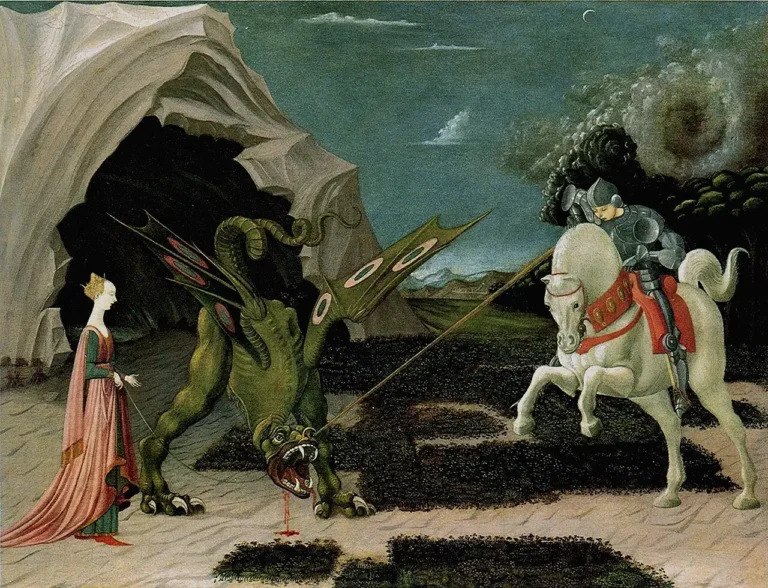
The body follows the job. A hoard-guarding adversary needs a lair, so it gets four legs and a cave; it needs to be defeatable by one man with a spear, so it gets a compact body with a vulnerable spot; it needs to threaten a village from a distance, so it gets wings and fire. The Chinese dragon has none of those requirements and consequently none of those parts.
The differences that actually hold
| 龍 — the Chinese dragon | Dragon — the Western dragon | |
|---|---|---|
| What it governs | Water: rivers, seas, rain, floods | A hoard: gold, treasure, a captive |
| Body plan | Long serpentine body, four short legs, no wings; nine borrowed features | Bulky quadruped, bat wings, tail; broadly reptilian |
| How it flies | By motion and by the 尺木 on its head; wings mark one variety only | By wings |
| Element | Water; sometimes clouds and mist | Fire |
| Relation to humans | Petitioned, ridden, invoked; also blamed and scolded | Fought and killed |
| Whose emblem | The emperor, and by extension the state | The enemy; later, a heraldic charge for a house or nation |
| Story it belongs to | Weather, legitimacy, ascent | Combat, treasure, salvation |
The part the adjective lists get wrong
“Benevolent” is too generous. A creature that controls rain in an agrarian society is a creature that can also withhold it, and Chinese popular religion treated the 龍王, the Dragon King, accordingly. In drought years his statue was carried out into the sun to feel what the fields were feeling; there are well-documented cases of dragon-king images being beaten, fined, exiled or stripped of rank by imperial decree for failing to deliver rain. The historian Nick Kapur has pointed out, in the middle of the recent argument about what to call these animals in English, that Chinese dragons were closely associated with natural disaster and were sometimes attacked in effigy by furious peasants.
That is not the behaviour of people dealing with a benevolent being. It is the behaviour of people dealing with an official. Which, in the imperial system, is more or less what the dragon was: a functionary with a portfolio, entitled to reverence while performing and liable to sanction when not. The emperor wore the same animal on his robe for exactly this reason — 龍袍, the dragon robe — and the Ministry of Education’s dictionary still lists “symbol of the sovereign” among the ordinary senses of the word, alongside 人中之龍, “a dragon among men”, for an outstanding person.
So the honest contrast is not benevolent versus evil. It is accountable power versus hostile power. The Chinese dragon can be petitioned and it can be blamed, because it is inside the social order. The Western dragon can only be killed, because it is outside it.
Dragon, long, or loong
Because the two creatures differ this much, there is a long-running argument about whether the English word should be used at all. It flared up publicly in early 2024, before the Year of the Dragon, when mainland Chinese state outlets — China Daily, CGTN, Xinhua — began writing “loong” instead of “dragon” in their English coverage, and Hong Kong’s chief executive John Lee used the word at a tourism event. The spelling is not new: it goes back to the British missionary Joshua Marshman (1768–1837), who used loong to render the sound while keeping it visibly distinct from the European animal.
The case for “loong” is straightforward and reasonable: the referents are different, English readers arrive with the wrong picture, and other languages happily keep loanwords for culturally specific creatures. The case against is that it is a solution imposed on the wrong end of the problem — English speakers who read “loong” learn a spelling, not a meaning — and that the sharpest version of the argument, in which the Chinese dragon is auspicious and the Western one demonic, flattens the Chinese tradition in order to flatter it. Kapur’s point about drought and effigies is a direct response to that flattening. There is also a plain political dimension: the campaign was pushed hardest by state media, which makes some readers outside the mainland reluctant to adopt it on those grounds alone.
In Taiwan the ordinary English word remains “dragon”. Nobody here says “Year of the Loong”. This site follows that usage, writes 龍 where precision matters, and explains the difference rather than legislating a spelling — the same approach we take to Dao and Tao, where two romanisations of one word have been quietly doing different jobs for a century, and to the choice between traditional and simplified characters, where the useful answer is a number rather than an adjective.
Where you will actually meet one
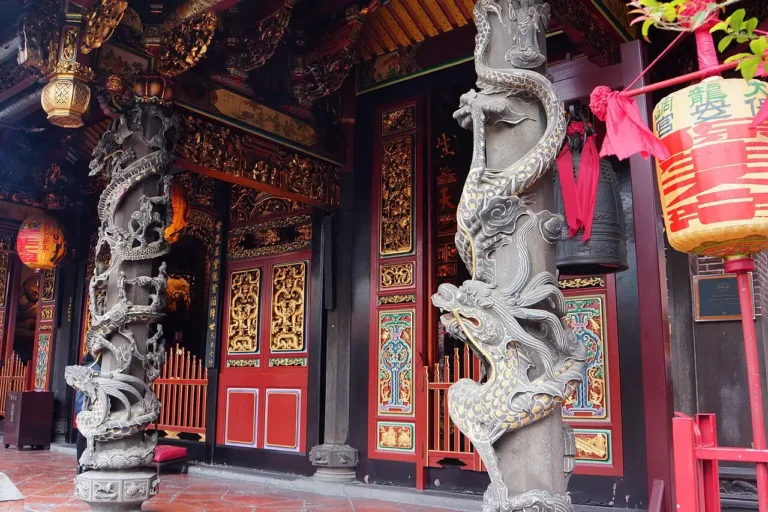
Not in a story. In Taiwan the dragon is a building material. It winds up the stone columns at the front of almost every large temple, it runs along the ridge of the roof in cut porcelain, and it appears in pairs flanking a flaming pearl above the main hall. The pillars in the photograph above are at Baoan Temple in Taipei, and they are load-bearing; the dragon is holding the roof over the people inside. Those people are there to ask for something — health, a birth, an exam result, rain in a dry summer — which returns the creature to the job the 說文 gave it two thousand years ago. If you are visiting one of these buildings, our guide to temple etiquette covers what to do once you are past the columns.
The Western dragon, by contrast, you will meet in a museum, on a flag, or in a fantasy novel — never in a place of worship, and never as something anybody expects to bargain with.
FAQ
Are Chinese dragons and Western dragons the same creature?
No. They share a serpentine ancestry and little else. The Chinese 龍 is a water spirit and a member of the scaled class of animals, wingless, associated with rain and with the sovereign; the Western dragon is a winged, fire-breathing hoard-guardian whose role in every story is to be fought. The English word covers both only because early translators reached for the nearest available animal.
Why don’t Chinese dragons have wings?
Most do not need them: the Chinese dragon flies by movement, and by the 尺木 protuberance on its head, which the 本草綱目 says a dragon cannot ascend without. Winged dragons do exist as a named variety — the 應龍 in the 廣雅 — but they are one of five kinds, not the standard form.
Is the Chinese dragon always a good omen?
No, and the tradition is clear about it. The creature that brings rain also brings drought and flood, and the Dragon King’s statue was carried into the sun, beaten or demoted when the rain failed. It is better understood as power that can be appealed to and held to account than as a benevolent being.
Should I write “loong” instead of “dragon”?
You do not have to. “Loong” was promoted by mainland state media from 2024 and has a real argument behind it, but it is not standard usage in Taiwan or in most English writing, and a new spelling does not by itself teach a reader what the creature is. Writing “dragon” and adding one sentence of explanation does more work.
What does 逆鱗 mean?
Literally the reversed scales beneath a dragon’s throat, from the 韓非子. Figuratively, the one subject a powerful person cannot bear to have raised. 批逆鱗, to strike the reversed scale, is still current Chinese for saying the unsayable thing to a superior.
Sources
- 《說文解字・龍部》 — 中國哲學書電子化計劃:「龍:鱗蟲之長。能幽,能明,能細,能巨,能短,能長;春分而登天,秋分而潛淵。」(accessed 2 Sep 2026)
- 《廣雅》,引於同上:「有鱗曰蛟龍,有翼曰應龍,有角曰虯龍,無角曰螭龍,未升天曰蟠龍。」(accessed 2 Sep 2026)
- 李時珍《本草綱目・鱗之一・龍》 — 維基文庫:引王符「九似」說、八十一鱗、逆鱗、尺木(accessed 2 Sep 2026)
- 《韓非子・說難》 — 中國哲學書電子化計劃:「夫龍之為蟲也,柔可狎而騎也,然其喉下有逆鱗徑尺,若人有嬰之者則必殺人。」(accessed 2 Sep 2026)
- 教育部《重編國語辭典修訂本》「龍」 — dict.revised.moe.edu.tw:「傳說中一種極具靈性的動物。頭生角、鬚,身長,有鱗、爪。」;並收帝王象徵、人中之龍等義項(accessed 2 Sep 2026)
- 教育部《重編國語辭典修訂本》「逆鱗」 — dict.revised.moe.edu.tw:「指龍喉下倒生的鱗片。《韓非子.說難》:『喉下有逆鱗徑尺,若人有嬰之者,則必殺人。』」;另收「批逆鱗」(accessed 2 Sep 2026)
- Global Voices, “China’s state media wants you to call the Chinese dragon ‘loong’” (22 April 2024) — the 2024 switch by China Daily, CGTN and Xinhua; John Lee’s use of the word; the Marshman romanisation; and Nick Kapur’s counter-argument about dragons, natural disaster and effigies
- Paolo Uccello, Saint George and the Dragon, about 1470, National Gallery, London — Wikimedia Commons (public domain)