Taipei is not a different name from Táiběi. It is the same two syllables, 臺北, written down in two different alphabets. The spelling on your boarding pass comes from a nineteenth-century British system called Wade–Giles, with its apostrophe quietly dropped; the spelling in a Mandarin textbook comes from Hanyu Pinyin, the system Taiwan itself adopted for most purposes in 2009. The reason the city did not become “Taibei” when the rules changed is that the government wrote an exception for it — on purpose, in a published regulation, for reasons that have more to do with airports than with linguistics. Here is the whole story, with the rule quoted rather than paraphrased.
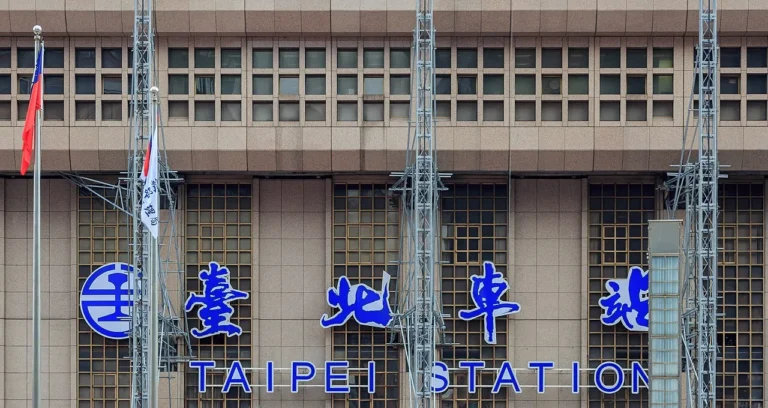
Same sounds, two alphabets
Start with the sound. The second character, 北 “north”, is pronounced with an unaspirated stop — the lips close and release without a puff of air. English has that sound: it is the p in “spin”, not the p in “pin”. The Ministry of Education’s dictionary gives it as ㄅㄟˇ, běi.
The two romanisation systems simply chose different letters for the same sound. Hanyu Pinyin borrowed b, on the grounds that English speakers hear an unaspirated p as something close to b. Wade–Giles kept p for the unaspirated sound and marked the aspirated one with an apostrophe: p’. So in Wade–Giles the city is T’ai-pei — the first syllable aspirated, the second not — and in pinyin it is Táiběi. Neither letter is “more correct”. Both are conventions for a sound that the Latin alphabet was never designed to write.
What the world’s maps show is Wade–Giles with the punctuation removed: Taipei. Drop the apostrophe from T’ai, drop the hyphen, and you have the airport code’s spelling. The same thing happened to most of Taiwan’s county and city names, which is why they look nothing like the pinyin a student learns.
| City | Characters | Wade–Giles | Hanyu Pinyin | Official spelling today |
|---|---|---|---|---|
| Taipei | 臺北 | T’ai-pei | Táiběi | Taipei |
| Taichung | 臺中 | T’ai-chung | Táizhōng | Taichung |
| Kaohsiung | 高雄 | Kao-hsiung | Gāoxióng | Kaohsiung |
| Hsinchu | 新竹 | Hsin-chu | Xīnzhú | Hsinchu |
| Chiayi | 嘉義 | Chia-i | Jiāyì | Chiayi |
| Pingtung | 屏東 | P’ing-tung | Píngdōng | Pingtung |
| Keelung | 基隆 | Chi-lung | Jīlóng | Keelung |
| Kinmen | 金門 | Chin-men | Jīnmén | Kinmen |
Where “Taipei” came from
Thomas Wade, a British diplomat, published his Mandarin course in 1867; Herbert Giles, another British consular official, tidied the system into the dictionary he brought out in 1892. Wade–Giles was the working romanisation of the English-speaking world for the next century — the spelling behind Mao Tse-tung, Peking, Tao Te Ching, and the reason the same word can be spelled Dao and Tao.
Its apostrophes and umlauts did not survive contact with telegraph clerks. In 1906 the Imperial Postal Joint-Session Conference in Shanghai (帝國郵電聯席會議) fixed a set of spellings for Chinese place names that were Wade–Giles in skeleton but stripped of every diacritic, and that kept older, locally pronounced spellings where the West already used them: Peking rather than Pei-ching, Amoy rather than Hsia-men. That habit — Wade–Giles letters, no apostrophes, older forms grandfathered in — is the habit Taiwan’s place names still follow.
Taiwan itself was not on the 1906 map. It had been ceded to Japan in 1895, and for fifty years the city was Taihoku, the Japanese reading of the same two characters; the university founded in 1928 was Taihoku Imperial University, as its successor, National Taiwan University, still records. When the Republic of China took over the island in 1945, the Wade–Giles-derived spellings of the postal tradition came with it, and Taipei went onto the letterhead. It has been there ever since.
The rule, as written
Taiwan does have a national standard for romanising Chinese, and since 2009 that standard is Hanyu Pinyin. The regulation is the Ministry of Education’s 《中文譯音使用原則》, the Principles for the Use of Chinese Transliteration. Its second article is one sentence long.
What the regulation actually says
我國中文譯音除另有規定外,以漢語拼音為準。
“Except where otherwise provided, the transliteration of Chinese in this country shall follow Hanyu Pinyin.”
其他中文譯音,除國際通用或特定詞、約定俗成者外,以漢語拼音為準。
“Other Chinese transliterations shall follow Hanyu Pinyin, except for terms in international use, specific terms, and established conventions.”
《中文譯音使用原則》第二條、第七條 · Ministry of Education, promulgated 18 September 2002, last amended 21 March 2011 · Read the regulation
“Except where otherwise provided” is doing the work. The third article hands place names to a separate rulebook, the Ministry of the Interior’s 《標準地名譯寫準則》 (Guidelines for the Romanisation of Standard Place Names), and that rulebook’s fourth article allows a name to escape phonetic transliteration on grounds of history, language, custom, religion or international usage, once the Ministry has signed off. The Ministry’s own tables of administrative names carry two columns for exactly this reason: one headed 國際慣用名, “internationally customary name”, and one headed 漢語拼音譯寫, the pinyin rendering. Taipei sits in the first column. Taibei sits in the second, as a reference, not as a name.
The clearest demonstration came in 2011, when Taipei County became a special municipality and needed an English name. The Ministry of the Interior announced on 12 January that it would be New Taipei City — not Xinbei, the pinyin — citing that same fourth article and the county’s own public consultation. The press release even offered Sun Moon Lake as the model: some names are translated, some transliterated, and some simply kept.
Taiwan’s own pinyin wars
The exception was not a foregone conclusion, because Taiwan spent a decade arguing about which romanisation to use at all. The Republic of China had its own scholarly system, 國語羅馬字 (Gwoyeu Romatzyh), from 1928, and a simpler official one, 注音符號第二式 (MPS II), from 1986; neither was ever used consistently on street signs. In 2002 the government adopted Tongyong Pinyin (通用拼音), a home-grown variant designed to differ from the mainland’s Hanyu Pinyin in a handful of spellings. On 16 September 2008 a new administration reversed that decision at an inter-ministerial meeting, the Principles were amended on 18 December, and Hanyu Pinyin became the national standard from 1 January 2009.
For our purposes the interesting point is that “Taibei” would have been the answer under both systems. Tongyong and Hanyu agree on bei; they differ on syllables like zhi/jhih and xin/sin. So the county- and city-name exception was not a way of ducking the mainland’s system in particular. It was a decision that the names of places already known abroad — on maps, in treaties, in airline timetables, in the address of every business in the country — should not change every time the language policy did. Street names could be re-signed; the name of the capital could not.
What changed and what did not
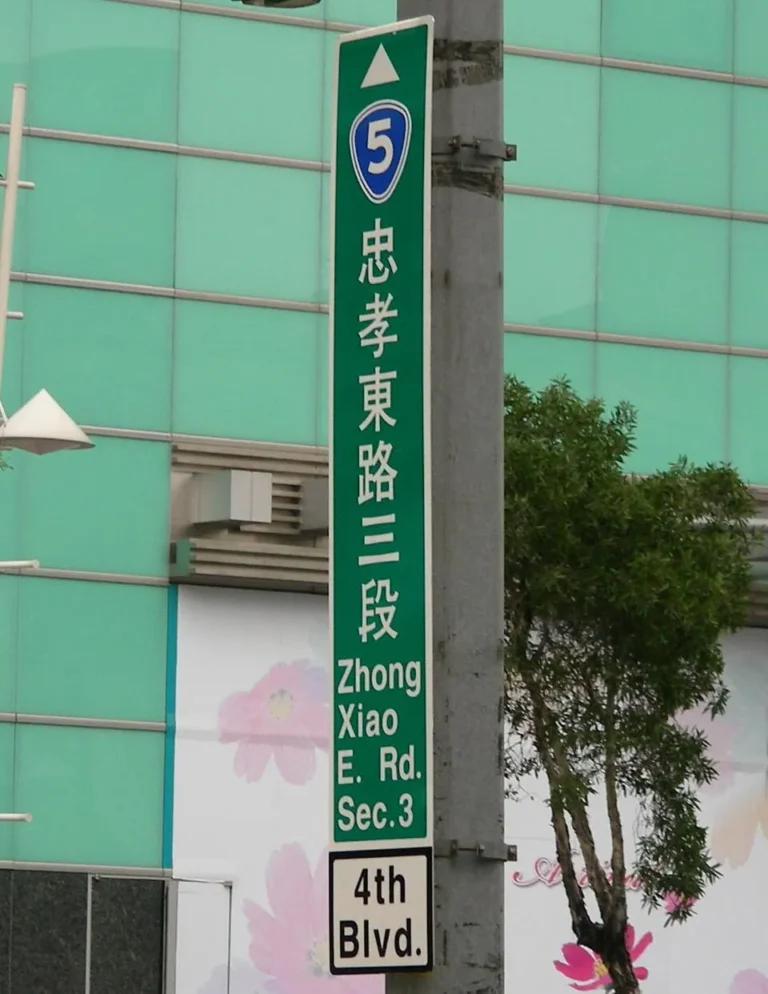
Walk through Taipei today and you see the compromise on the walls. Street signs and metro stations use Hanyu Pinyin: Zhongxiao Fuxing, Xinyi Road, Songshan. The city those streets are in remains Taipei, and the main station is Taipei Main Station. Cross into the next county and the same logic gives you Taoyuan (a pinyin spelling that happens to coincide with the old one) and, further south, Kaohsiung and Chiayi, both Wade–Giles fossils.
Personal names went a third way. The Principles say that the transliteration of a person’s name “may respect the wishes of the person concerned”, which is why Taiwanese surnames on passports overwhelmingly keep Wade–Giles forms — Tsai, Hsieh, Chang, Kuo — while the same characters on a mainland passport read Cai, Xie, Zhang, Guo. A Taiwanese name is often the quickest way to tell where a document was issued.
Is it 臺北 or 台北?
The Chinese is not entirely settled either. The formal character is 臺; 台 is a simpler form that has been written in its place for centuries. In December 2010 the Ministry of Education ruled that 臺 is the standard character and 台 a variant, and that official documents and school textbooks should use 臺灣 and 臺北. The same announcement said that nobody would lose marks in an exam for writing 台, and that road signs would be left alone. This site follows the Ministry and writes 臺; the shop down the road writes 台, and both are right. For why the fuller forms matter to a site about classical texts, see why this library uses traditional characters.
How to read a Wade–Giles name
Because so much of Taiwan’s public face is still written in Wade–Giles, it is worth being able to convert on sight. The correspondences that trip people up are the stops and the sibilants; the Library of Congress publishes a full table, but these six rows cover most place and personal names you will meet.
| Wade–Giles | Hanyu Pinyin | Example |
|---|---|---|
| p / p’ | b / p | Taipei → Táiběi |
| t / t’ | d / t | Pingtung → Píngdōng |
| k / k’ | g / k | Kaohsiung → Gāoxióng |
| hs | x | Hsinchu → Xīnzhú |
| ch / ch’ | zh or j / ch or q | Taichung → Táizhōng |
| ts / ts’ | z / c | Tsai → Cài |
The conversion is mechanical, and the pronunciation underneath does not move. A traveller who says “Tai-bay” for Taipei is closer to the Mandarin than one who says “Tai-pay”, whichever way the word is spelled — which is the whole point. The spelling records a history of who wrote the name down, and when. It does not record a different city.
Romanisation is one choice a learner has to make; the script itself is the other. Traditional or simplified works out how much the two actually differ.
Transliteration is a translator’s decision, not a default. Xuanzang made it deliberately for two of the eight consciousnesses, and wrote down his reasons — see the eight consciousnesses in his own Chinese.
The same history explains why the island’s most worshipped goddess appears as Matsu, Ma-tsu and Mazu on the same street. What she is called in Taiwanese, and why it is not her title, is the subject of why Taiwan calls her Mazu.
The spelling is only one layer. Taiwan also writes its Mandarin in traditional characters and teaches the sounds with Zhuyin rather than pinyin; the script side of the story is in does Taiwan use traditional Chinese?, and the difference between a script and a language in traditional Chinese vs Mandarin.
FAQ
Is “Taibei” wrong?
Not as a transliteration — it is the correct Hanyu Pinyin for 臺北, and the Ministry of Education’s dictionary gives it as tái běi. As the name of the city in English, though, the official form is Taipei, fixed by the Ministry of the Interior under the exception for internationally customary names. Use Taibei when you are writing pinyin; use Taipei when you are naming the place.
Why is it Kaohsiung and not Gaoxiong?
Same reason. Kaohsiung is the Wade–Giles spelling Kao-hsiung without the hyphen, and it was already the city’s name in international use when Taiwan adopted Hanyu Pinyin in 2009. County- and city-level names were kept as they were; the pinyin form appears in official tables only as a reference.
Does Taipei’s metro use pinyin or Wade–Giles?
Hanyu Pinyin, for station and street names — Zhongxiao Fuxing, Xindian — with the city’s own name left as Taipei. That is the rule in miniature: streets follow the current standard, the names of counties and cities follow custom.
Will Taipei ever be respelled?
There is no proposal to, and the 2011 decision to name New Taipei City rather than Xinbei suggests the direction of travel is the other way: the customary spelling is treated as a brand worth extending, not a legacy to be corrected.
The same split runs through Buddhist vocabulary: Sanskrit arhat, Chinese 羅漢, and the museum spellings lohan and luohan are one word wearing four coats — see what arhat means.
The same quarrel between zhuyin and pinyin reaches any parent deciding how a child should learn to read. For what Taiwan’s curriculum actually requires of them, see should kids learn traditional or simplified Chinese?
Sources
- 教育部《中文譯音使用原則》— 教育部主管法規共用系統:公發布 2002-09-18,修正 2011-03-21;第二、三、四、七條全文(accessed 2 Sep 2026)
- 內政部〈尊重新北市政府的意見,新北市譯寫為「New Taipei City」〉— 內政部新聞稿,2011-01-12:引《標準地名譯寫準則》第四條「得於報經內政部核定後,不受音譯規定之限制」(accessed 2 Sep 2026)
- 內政部《標準地名譯寫準則》— 全國法規資料庫(accessed 2 Sep 2026)
- 教育部《重編國語辭典修訂本》「臺北市」— dict.revised.moe.edu.tw:ㄊㄞˊ ㄅㄟˇ ㄕˋ/tái běi shì(accessed 2 Sep 2026)
- 自由時報〈臺灣非台灣?教部要用正字〉— news.ltn.com.tw,2010-12-13:教育部以「臺」為正體、「台」為異體,公文與教科書統一用「臺」(accessed 2 Sep 2026)
- 華樂絲學術英文〈常見的中譯英拼音系統〉— editing.tw:通用拼音 2002–2008;2008-09-16 行政院跨部會決議、2008-12-18 修正、2009-01-01 實施(accessed 2 Sep 2026)
- National Taiwan University, “History” — ntu.edu.tw: Taihoku Imperial University, founded 1928; renamed 1945 (accessed 2 Sep 2026)
- Library of Congress, “Wade-Giles to Pinyin Conversion Table” — loc.gov: pei → bei, t’ai → tai (accessed 2 Sep 2026)