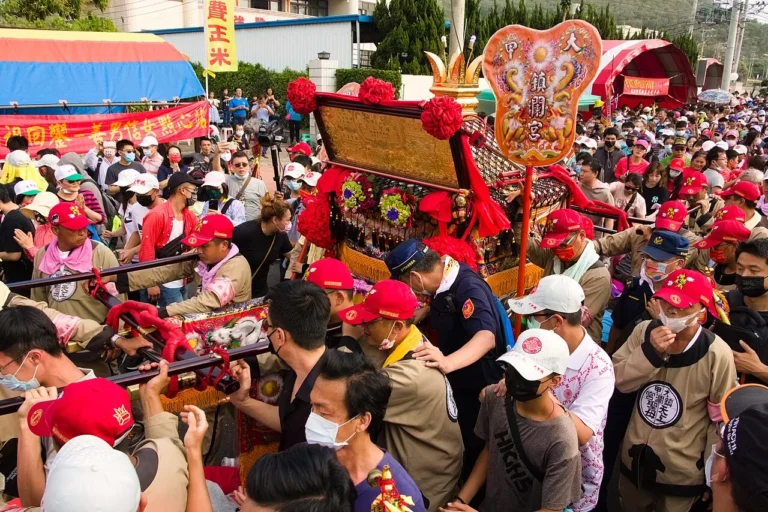
Every spring, for nine days and eight nights, something like a hundred thousand people walk behind a sedan chair from the Zhenlan Temple at Dajia to the Fengtian Temple at Xingang and back — three hundred kilometres or so, through four counties, with the goddess Mazu inside the chair. English coverage of the Mazu pilgrimage tends to file it under festivals: a parade, a spectacle, one of the world’s great religious gatherings. All true, and all beside the point. The walk is the visible part of a system with its own logic — a system in which a god’s power runs down and has to be topped up from a source, and in which the topped-up god is then carried round a defined territory to clean it. Once you have the system, the route, the timing, the quarrels over destinations and even the renaming of rituals all make sense. This entry lays it out from the Ministry of the Interior’s own reference entries and from the Academia Sinica anthropologist who has walked it for forty years.
Three words that English collapses into “pilgrimage”
The first is 分香 or 分靈, “dividing the incense” or “dividing the spirit”. When Fujianese settlers crossed to Taiwan they brought their gods with them — as a statue if they could, and if not, as a pinch of ash from the home temple’s censer, which was enough. The new temple was a branch; the old one was the 祖廟, ancestor temple, or 母廟, mother temple. The Interior Ministry’s Religion Knowledge+ entry on the subject notes that Taiwanese usage keeps both metaphors side by side — “ancestor temple and descendant temple”, which borrows the patrilineal line, and “mother temple and child temple”, which marks the relationship as female — and that the two reflect the same idea of descent seen from two angles.
The second is 進香, “presenting incense”, with its blunter synonym 刈火 (also written 割火), “cutting fire”. This is the journey of the branch back to the source. The Ministry’s entry distinguishes two kinds: the proper sense, in which a temple with a documented incense lineage returns to its mother temple to renew the link; and a looser sense, in which any temple or group of believers travels to an older or more efficacious temple simply because it is efficacious, with no lineage at all. Taiwanese speech, it adds, does not police the difference.
The third is 遶境, “circling the territory”. This is what happens after the incense comes home, and the Ministry’s definition of the key word is worth setting out in full, because “territory” is doing a lot of work:
What a “territory” is
所謂「境」即指一定的轄區範圍,並非完全以政治上的行政區域來畫分,而是民眾依據社區的共同體制,借此標誌群體開發的共同記憶,在生活圈內建立廟宇以崇奉共同祭祀的神明。
“The so-called ‘territory’ means a definite area of jurisdiction, not one drawn entirely along political administrative boundaries, but one that the people themselves, on the basis of their community’s shared institutions, use to mark the collective memory of the group’s settlement — building a temple within their living area to worship a god they sacrifice to in common.”
內政部全國宗教資訊網「宗教知識+」〈遶境〉,李豐楙、劉怡君撰 · religion.moi.gov.tw
The entry goes on: the circuit both confirms the boundary of where the residents live and drives out and purifies everything unclean inside it. A god’s territory is a map of who settled where, drawn by the people who live on it, and the yearly circuit redraws it.
Why the god has to travel: power runs down
Put the three words together and the pilgrimage stops being a parade. Chang Hsun, of the Institute of Ethnology at Academia Sinica, first walked with the Dajia procession in 1984 and has been studying it since; interviewed by the Academy’s Research Insights in 2020, she gave the mechanism in two sentences:
民間相信,神像的靈力會隨著時間慢慢消退,需要透過「謁祖割火」的儀式,重回祖廟拜見祖先、分取香火,重新帶回靈力。
“Popular belief holds that the spiritual power of a god’s statue slowly fades with time, and must be renewed through the rite of ‘paying respects to the ancestor and cutting fire’: returning to the ancestor temple, presenting oneself to the ancestor, taking a share of the incense fire, and bringing the power back.”
Her example is the classic one. When the Zhenlan Temple at Dajia used to go to the Chaotian Temple at Beigang, it carried its censer with it, and Chaotian ladled out three scoops of incense ash for Dajia to take home. 香灰即是神明的靈力: “the incense ash is the god’s spiritual power.” Everything else on the road — the crowds, the troupes, the fireworks — is arranged around the safe conveyance of a small quantity of ash. Chang points out that the sedan chair is routinely delayed by crowds and even fought over on the way through Changhua, but the 香擔, the carrying-pole with the censer, is guarded by the temple and never lets an outsider near it, and is never late.
The Ministry’s entry describes the rite itself. At the mother temple the officiant takes fire from the everlasting lamp, burns paper money and a written petition in the censer, ladles ash into the visitors’ censer three times, and seals it; the visitors may instead ask for incense fire directly. A softer variant is 交香 or 會香, “meeting incense”: the two censers are set side by side, incense is lit in both, and the smoke intertwines. Temples without a known mother temple — because the link was lost, or because politics closed the strait — go to the seashore or face the sky and “cut heaven’s incense”. Around Kaohsiung, some temples “cut mountain fire” or “cut water fire”, taking a flame from a natural source, or running the chair into a river to gather up stray spirits as reinforcements for the god’s army. Once home, the ash is divided into the temple’s own censers and a little is given to the year’s lay leaders to take to their houses.
And then, with the god recharged, the circuit. In Chang’s words, 進香回來後則要遶境,藉由神明的力量將居所周圍淨化,讓神明掌管的「境內」成為安全之地 — “after returning from presenting incense, the god goes round the territory, using its power to purify the surroundings of the people’s homes, so that the ‘territory’ under its charge becomes a safe place.” Charge at the source; discharge at home. That is the whole design.
Why the destination changed — and why the ritual was renamed
Because the system is about lineage and power, its history is a history of arguments about where the source is. Chang lays out the sequence for Dajia. In the Qing, Taiwanese Mazu temples went back to Meizhou in Fujian, the island where Mazu is said to have ascended. Under Japanese rule the crossing was cut off — the Ministry adds that the ports had silted too — and the colonial government, for its own reasons, encouraged temples to take incense from Beigang instead. Dajia went to Beigang for seventy or eighty years; both towns, Chang notes, were settled largely by Quanzhou people. Then Dajia and Beigang fell out over rank, and in 1988 Dajia moved its destination to the Fengtian Temple at Xingang.
The Ministry’s entry explains what the quarrel was about, and it is precisely the logic of the first section. To “cut fire” at Beigang and “pay respects to the ancestor” there was being read as an admission that Dajia was a mere branch — a daughter “returning to her mother’s house”. Dajia would not have it. So when the destination moved, the ritual was renamed. The event became 遶境進香, “territory-circuit incense-presenting” — the Ministry glosses this as a declaration of autonomy: the point is the circuit, not homage to a greater temple. The “rite of paying respects to the ancestor” once held in Beigang’s hall of Mazu’s parents became a “birthday rite” in the square in front of Fengtian; and the cutting of fire was dropped in favour of 會香, the meeting of incense between equals. A change of a few characters in the programme, and Dajia’s Mazu went from daughter to peer.
This is also why a second faction exists. Chang describes the Taiwan Mazu Fellowship led by Dajia, which favours pilgrimage to Meizhou and helped rebuild the ancestor temple there, and the southern-based Taiwan Temple Golden Orchid Association, which holds that Taiwanese Mazu images, after two or three centuries of worship here, are more powerful than the Meizhou statue and need not go back for fire at all. Underneath the theological question — where does the power come from? — she notes a difference of political colour. In this system, that is not a contamination of religion by politics; the source of incense has always been a statement about where one comes from.
How a hundred thousand people organise themselves
Two further details from the sources explain how the thing runs. The first is the route. The Baishatun Mazu of Gongtian Temple in Miaoli, whose pilgrimage to Beigang was designated a national intangible heritage in 2008 and covers some four hundred kilometres on foot, has no fixed route at all: only the departure day, the fire-cutting day and the return day are announced, and the rest is decided on the road by the movements of the chair, which the bearers read as the goddess’s will — taking side lanes rather than main roads, resting in factories and schools as well as temples, and on one occasion fording the Zhuoshui river rather than crossing the bridge. Dajia’s route is fixed but its dates are not: Chang describes the divination blocks being thrown on the night of the Lantern Festival to set them, after which the mobilisation begins through village networks and trades. (For how the blocks are read, see jiaobei, the moon blocks.)
The second is Chang’s answer to the old charge that Chinese popular religion is “a heap of loose sand” with no organisation. If it were, she asks, how could it move a hundred thousand people? Her answer is that the organisation is invisible: the pilgrims are ordinary people in ordinary jobs who assemble, as a task force, only for the walk and dissolve when it is over. She reads this as a survival strategy learned over centuries of official suppression — an organisation that cannot be banned because, most of the year, it does not exist. The same invisibility keeps old things safe. The Dajia route, she notes, still passes through places under their Qing dynasty names, and the arrangement of temples receiving the goddess at the Xiluo bridge replicates, to her eye, a Qing county’s reception of an imperial commissioner: the god was enfeoffed by the court and is met as an official.
What to hold onto
If you watch a Mazu procession, what you are seeing is the outer layer of an incense economy. A branch temple goes to its source to renew a link and take back power; the power is then spent on a circuit whose boundary is a memory of who settled where. Where the source is, and whether the visit is homage or a meeting of equals, are live questions that have changed the route within living memory and changed the names of the rites. None of it is decorative. For why Taiwanese call this particular goddess by a kinship term rather than her imperial title, see why Taiwan calls her Mazu; for how to behave if you find yourself inside a temple on the route, see Taiwan temple etiquette.
FAQ
What is the purpose of the Mazu pilgrimage?
To renew the god’s power. A branch temple returns to its mother or ancestor temple and takes a share of incense ash — “cutting fire” — which is believed to carry the god’s spiritual power; it then carries the recharged god round its own territory to purify it. The walk is the transport between those two acts.
What is the difference between 進香 and 遶境?
進香, presenting incense, is the outward journey to a source temple to take fire. 遶境, circling the territory, is the homeward circuit of the temple’s own area. Dajia’s event is officially called both, “遶境進香“, a wording adopted in 1988 to assert that it was not paying homage to a superior temple.
Why did the Dajia pilgrimage stop going to Beigang?
Because “cutting fire” at Beigang implied that Dajia’s Mazu was a subordinate branch. After a dispute over rank, Dajia moved its destination to Xingang in 1988, replaced the ancestor rite with a birthday rite, and replaced fire-cutting with “meeting incense” between equals.
Who decides the route and dates?
The goddess, by divination. Dajia’s dates are set by throwing divination blocks on the night of the Lantern Festival. Baishatun’s route is not fixed at all; the bearers read the movements of the sedan chair on the road.
Sources
- 內政部全國宗教資訊網「宗教知識+」〈進香(刈香、刈火)〉,李豐楙、劉怡君撰 — religion.moi.gov.tw:祖廟/子孫廟與子母廟兩種說法;分靈回祖與信仰進香;刈火程序、交香、添火、刈天香、刈山火/刈水火;白沙屯民國 97 年指定、約四百公里、無固定路線;大甲民國 77 年改往新港、「遶境進香」名義與會香 (accessed 5 Sep 2026)
- 同上〈遶境〉,李豐楙、劉怡君撰 — religion.moi.gov.tw:「境」之定義;祭祀圈;大甲媽祖遶境民國 97 年 7 月 4 日指定民俗類文化資產 (accessed 5 Sep 2026)
- 〈為何媽祖每年要進香遶境?靈力回充、淨化管區!〉專訪張珣(中央研究院民族學研究所),研之有物,2020-04-18(CC BY-NC-ND 4.0) — research.sinica.edu.tw:靈力消退與謁祖割火;北港三瓢香灰;香擔;輻射與系譜兩種傳播;日治改北港、1988 改新港;元宵擲筊定路線;「隱形的組織」;清代古地名;兩派聯誼會 (accessed 5 Sep 2026)
- 張珣〈香之為物:進香儀式中香火觀念的物質基礎〉,《臺灣人類學刊》4(2):37–73,2006;張珣《文化媽祖:臺灣媽祖信仰研究論文集》,中研院民族所,2003(研之有物與宗教知識+ 所引)