A politician accused of vote-buying announces that he will go to the City God temple and behead a chicken. A woman whose husband denies an affair takes a number at a temple in Xinzhuang and dictates a petition to the underworld. A suspect who will not confess is left to sit through the night in a hall lined with instruments of torture, under the painted eyes of the Seventh and Eighth Lords. None of these is folklore in the sense of a thing people used to do. All of them are documented in Taiwan within living memory, and the last two are current. An oath before the gods in a Chinese temple is not a colourful custom; it belongs to a working legal culture that ran alongside the official courts and, in some situations, still does. This entry describes how that culture works, using the Interior Ministry’s reference entry on the City God and the fieldwork of Paul Katz, the Academia Sinica historian who has spent thirty years on it.
A god whose job is the law
The City God — 城隍, literally “wall and moat” — sounds, from the name, like a guardian of fortifications. The Ministry’s Religion Knowledge+ entry corrects that in its first lines: whatever the name, the god’s function is judicial; he “governs human moral conduct and the rights and wrongs of disputes”. To show what that meant on the ground in Taiwan, the entry quotes the Kangxi-era gazetteer of Taiwan Prefecture, in a passage that reads like a charge to a court:
The City God’s writ, from the Qing gazetteer
凡我一縣境內人民,倘有忤逆不孝、不敬六親者,有奸盜詐偽、不畏公法者,有拗曲作直、欺壓良善者,有逃避差役、靠損貧戶者,似此頑惡、奸邪不良之徒,神必告於城隍,發露其事。
“Among all the people within the bounds of this county, should there be any who are rebellious and unfilial or disrespectful to their kin; any who rob, cheat and deceive and do not fear the public law; any who twist the crooked into the straight and oppress the good; any who evade corvée and shift the burden onto poor households — obstinate, wicked, treacherous and worthless people of this sort — the spirits shall report them to the City God, who shall bring the matter to light.”
康熙《重修臺灣府志》,轉引自內政部「宗教知識+」〈城隍爺〉 · religion.moi.gov.tw
The list is a legal list: unfiliality, fraud, perversion of justice, tax evasion. And the City God does not sit alone. The entry describes a whole bureaucracy under him — civil and military judges, six departments, the two tall constables known as the Seventh and Eighth Lords, ox-headed and horse-headed runners, soul-summoners — organised, as its English text puts it, like a police and judicial system: inspection, detection, arrest, trial, punishment. The system was made official under the Ming: in 1379 the founding emperor ordered every prefecture and county to build a City God temple so that the god could “examine the people’s good and evil and dispense fortune and misfortune”. Taiwan’s oldest, the entry notes, is the Prefectural City God temple at Tainan, from the Zheng period in the seventeenth century; today there are somewhere between fifty and ninety temples with the City God as principal deity across Taiwan, Penghu and Kinmen.
Then comes the sentence that this whole entry is about. Because the City God is a judicial god, the Ministry writes, “when people had disputes that were hard to resolve, or when an individual’s integrity was in doubt, or when someone wished to repent, in the past there was often a rite of swearing an oath before the City God temple, or of submitting to the god’s judgement” — 過去也常有在城隍廟前立誓的儀式,或是接受神判裁決. It adds that when a serious criminal case stalls, police and prosecutors are said to go and pray to the City God for a break.
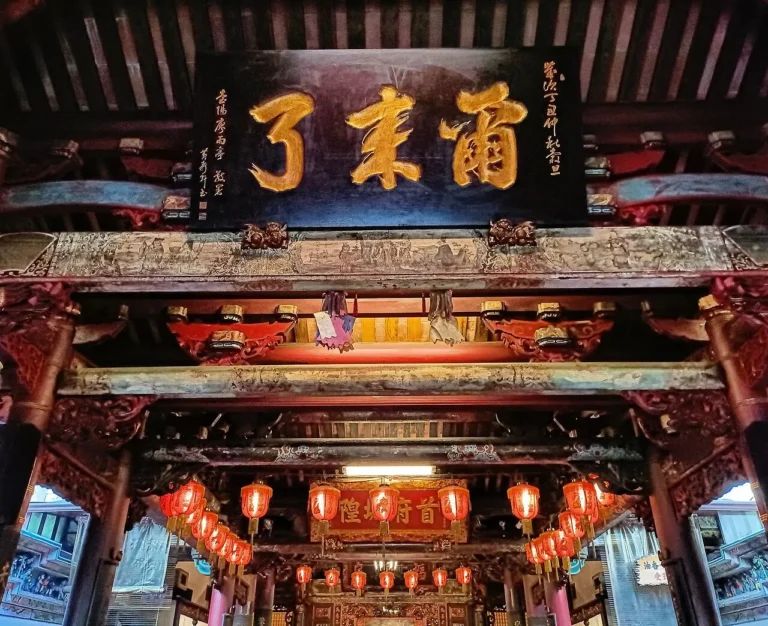
Hell as a courthouse
Paul Katz — 康豹, a Jewish-American historian at the Institute of Modern History who speaks Mandarin and Taiwanese and has been known to get dengue fever in the course of fieldwork — was interviewed by Academia Sinica’s Research Insights in 2017 on exactly this question. Many religions, he says, have a last judgement and many call for repentance; what is distinctive about the temples of the underworld’s judicial gods — the City God, the Emperor of the Eastern Peak, Dizang, the Lords of the Multitude — is that they run a rite of judgement, here, now:
神判儀式:把地獄當成「衙門」,神明會審判善惡是非,讓做錯事的人懺悔。
“The rite of divine judgement: hell is treated as a yamen, a magistrate’s court; the gods try good and evil, right and wrong, and bring those who have done wrong to repent.”
His first example is the one that startles. Under the Qing, under the Japanese, and now, when the police have a suspect who will not confess, they have sometimes brought him to one of these temples and left him to sit there and think. The halls are dark at night; the walls carry the instruments of a magistrate’s court; the judges’ faces are ferocious; the Seventh and Eighth Lords stare down. Katz calls it, without euphemism, 精神刑求 — psychological torture — and reports that suspects do confess. Nothing about it is a secret; the temples are built to do it.
The chicken
The oath proper is the other side of the same coin: not a suspect being made to fear the god, but an accused person volunteering to. The form Taiwan knows best is 斬雞頭, “beheading the chicken”. Katz gives the formula a politician uses when a vote-buying accusation will not go away:
若我有錯,就像這隻雞一樣遭到天譴、身首異處。
“If I am guilty, may I suffer Heaven’s punishment like this chicken, and my head be parted from my body.”
The chicken is then killed in front of the god and the crowd. Katz notes drily that a candidate’s policy speech draws nobody, but the announcement that he will go to a temple to curse himself or behead a chicken draws a crowd every time — and that many temples have now banned the practice as too bloody. He also explains why it is done before the City God and never before Mazu: the underworld’s judges are fierce and exact, and to lie in front of one carries a real psychological cost, whereas to swear before Mazu, who is merciful and forgiving, is a sign that one knows one is in the wrong and lacks the nerve. The choice of god is part of the oath’s evidential weight. (The Ministry of Education’s Taiwanese dictionary, incidentally, has no entry for 斬雞頭; the term lives in newspapers and temples rather than in the standard lexicon.)
Suing in the underworld
The third practice is the most alive, and the least known abroad. Katz sets it inside a plain description of how disputes get settled in Taiwan. There are three routes. You can ask the village or borough chief, or the residents’ committee, to mediate — the upstairs neighbour’s leak, that sort of thing. You can go to the courthouse, ring the bell and file suit, which is fine if you can afford a lawyer to see it through. Or, if you are an ordinary person with a grievance the courts cannot easily handle, you can go to a temple and 告陰狀 — “file a suit in the shadow”, lodge a complaint with the gods. He calls this, deliberately, a form of legal culture in the broad sense.
The Prefectural City God temple in Tainan hangs two characters over the proceedings: 放告, “complaints may be lodged” — the phrase a magistrate’s office posted on the days it accepted petitions. At the Dizang Temple in Xinzhuang, outside Taipei, the work is done by 筆生, “pen clerks”, who know the civil code and write the petition — a 牒文, in the format of an official document, a mix of literary and plain Chinese with legal terms and the gods’ names — asking Dizang or the Lords of the Multitude to investigate. Katz’s rough count was over three thousand petitions in a year. Ten years before the interview the temple had one clerk; at the time of it, five, and petitioners were taking numbers.
Two details show how seriously the clerks take it. First, they screen. Before writing, a clerk will typically require that the petitioner has already filed a complaint at the courthouse, or can show receipts for the debt, or has obtained the god’s consent by throwing the divination blocks — all, Katz says, to avoid becoming an instrument of somebody’s malice. (For how the blocks are read, see jiaobei, the moon blocks.) Second, the process changes the petitioner. People arrive angry and in pain; they may not rant at the clerk; they must tell the story in order. Katz describes what happens as the grievance moves from speech into writing: emotional language becomes normative language, the person’s anger cools because a god is now listening and the petition is itself a proof of their good faith, and — this is the part that matters — in the waiting period before the god “takes up the case” there is room to renegotiate. Petitioners, he says, always tell the other side what they have done. The other side now knows a god is involved. A debt of a million that could not be recovered is reopened at three hundred thousand; a husband who denied everything goes home. On the wall of the Xinzhuang temple hang letters of thanks from people whose cases were settled.
What kind of thing this is
Katz’s conclusion is the one to take away. The rite of divine judgement, the self-cursing oath and the petition to the underworld look, from outside, like religious activities; in practice each of them is handling a psychological or social problem — clearing a suspect or a reputation, giving a grievance a hearing, creating a pause in which two parties can talk. That is why the practices have not gone away with the arrival of courts, and why the Ministry’s own reference work records oath-taking before the City God as a function of the temple rather than a superstition attached to it.
The underworld’s judiciary has a lower tier, the unnamed dead of the wayside shrines, and it is the tier ordinary people are least willing to lie to; see what is a Youying Gong? For what a visitor should and should not do inside any of these halls, see Taiwan temple etiquette.
FAQ
What is a chicken-beheading oath?
斬雞頭: an accused person swears before the City God or another judicial deity that, if guilty, he will suffer Heaven’s punishment like the chicken, and kills the bird in front of the god and the crowd. It is used most visibly by politicians accused of vote-buying. Many temples have banned it as too bloody.
Why swear before the City God rather than Mazu?
Because the City God is a judge and Mazu is not. The underworld’s judicial gods are believed to be fierce and exact, so lying to them carries a real cost; swearing before the merciful Mazu is read as an admission that one lacks the nerve to face a judge. The choice of god is part of the oath’s credibility.
What is 告陰狀?
“Filing a suit in the shadow”: lodging a written complaint with an underworld god, usually against a person whom the courts cannot easily reach — an unfaithful spouse, a defaulting debtor with no receipts. At Xinzhuang’s Dizang Temple, clerks who know the civil code write over three thousand such petitions a year and screen petitioners first.
Do police really leave suspects in temples?
According to Paul Katz’s fieldwork, yes — under the Qing, under Japanese rule and today, a suspect who will not confess has sometimes been left overnight in a City God, Eastern Peak, Dizang or Lords of the Multitude temple, whose halls are designed to frighten the guilty. The Ministry of the Interior’s entry also records that police and prosecutors pray to the City God when a case stalls.
Sources
- 內政部全國宗教資訊網「宗教知識+」〈城隍爺(Cheng huang ye)〉 — religion.moi.gov.tw:城隍為司法神;引康熙《重修臺灣府志》「凡我一縣境內人民……神必告於城隍,發露其事」;洪武十二年普設;臺灣最早為臺南府城隍廟;全臺約五十至九十座;「過去也常有在城隍廟前立誓的儀式,或是接受神判裁決」;參考增田福太郎《臺灣漢民族的司法神》 (accessed 5 Sep 2026)
- 〈人們為何在神明面前發誓?專訪康豹〉(中央研究院近代史研究所),研之有物,2017-08-21(CC BY-NC-ND 4.0) — research.sinica.edu.tw:神判儀式定義;嫌犯留廟;斬雞頭誓詞與禁絕;媽祖前發誓之解讀;三種糾紛途徑與告陰狀;臺南「放告」;新莊地藏庵筆生、牒文年約三千份、篩選程序、情緒轉化與重啟談判 (accessed 5 Sep 2026)
- 康豹〈漢人社會的神判儀式初探——從斬雞頭說起〉,《中央研究院民族學研究所集刊》第 88 期,2000,頁 173–202;康豹〈新莊地藏庵的大眾爺崇拜〉,《人文學報》16,1998,頁 123–159(研之有物所列延伸閱讀)
- 教育部《臺灣台語常用詞辭典》:「斬雞頭」查無詞條(完全符合 0 筆) — sutian.moe.edu.tw (accessed 5 Sep 2026)