Walk past the incense burner in any Taiwanese temple and you will hear two sounds: the clack of the moon blocks hitting the floor, and a dry rattle, like a maraca played slowly — someone shaking a cylinder of numbered bamboo sticks until one works its way loose. The sticks are 籤 (qian), “fortune sticks” or kau chim in English, and when we wrote about the moon blocks we promised to come back for them, because the two instruments are halves of one machine: the sticks generate an answer, and the blocks confirm it.
This page describes what the sticks are, how a stick becomes an answer, what is actually printed on the slip of paper you end up holding — and why the number on your stick means nothing at all until you know which temple you are standing in.
What the sticks are
The Ministry of the Interior’s religious knowledge base carries an entry on the sticks, written by the religious-studies researcher Chen Pin-jing, and its physical description matches what you will see in the cylinder: long thin slats of bamboo or wood, the top end cut to a point or a gourd shape, painted red. Each stick carries a number and nothing else. The number points to a verse — the 籤詩 (qianshi), the oracle poem — kept separately, usually in a wall of small labelled drawers or a printed rack near the altar.
How many sticks are in the cylinder depends on the temple. The MOI entry lists sets of thirty-six, sixty, one hundred and one hundred twenty, with the sixty-stick set numbered not “1 to 60” but by the sexagenary cycle — the sixty two-character combinations of heavenly stems and earthly branches that traditional China also used to count years. Each verse carries a grade, from 上上 (“great good fortune”, sometimes marked 王, “king”) down to 下下, the worst reading in the set.
How a stick becomes an answer
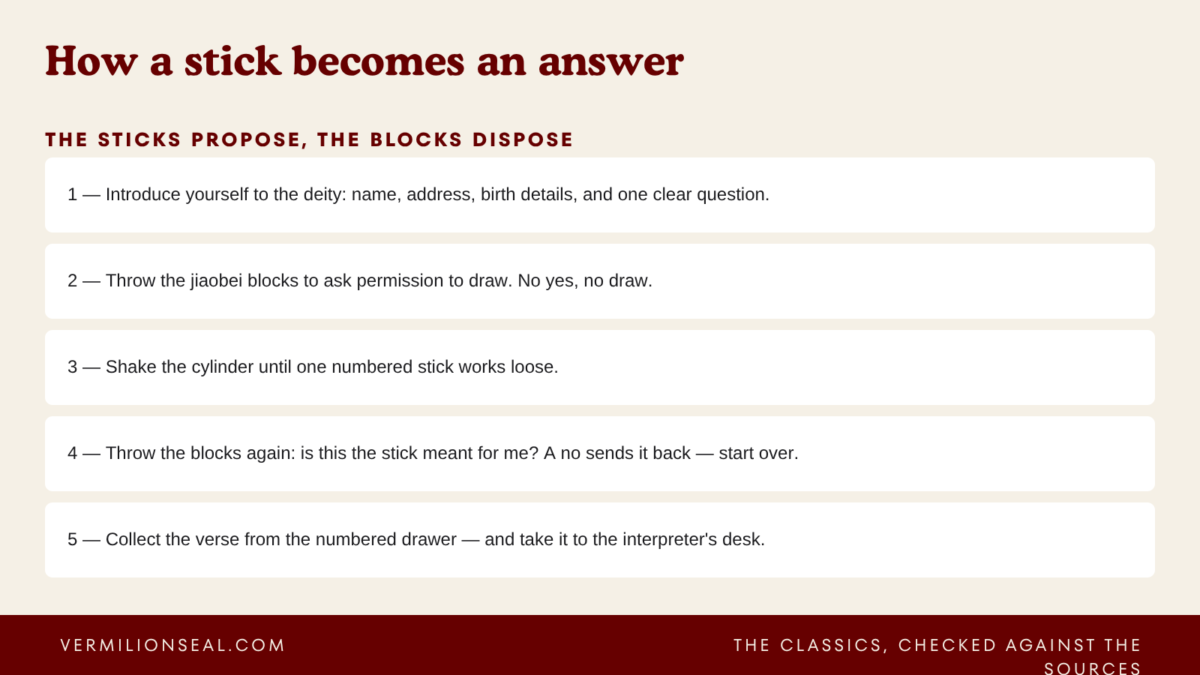
Nobody simply shakes out a stick and reads it. The protocol, as the MOI entry gives it, wraps the sticks inside the moon-block ritual we described separately: you introduce yourself to the deity — name, address, birth details, and the question — then throw the blocks to ask permission to draw at all. Only after a yes do you shake the cylinder. And the stick you draw is not yet your answer: you carry it back to the altar and throw the blocks again to ask, is this the stick meant for me? A no sends the stick back into the cylinder and you start over. A yes sends you to the drawers.
Read as a system, it is the same loop every time: the sticks propose, the blocks dispose. Some temples want one confirming throw; others want two or three in a row before a stick is settled. Hold that thought, because at the end of this page a temple will need ten attempts to seat a single stick — with the whole country watching.
What is printed on the slip
The verse you finally collect is a short poem — typically four lines of seven characters — under a title that names a story. Not an abstract omen: a specific episode from history or opera. 蘇秦拜相, “Su Qin is made chancellor”, names the Warring States strategist who failed, went home to be sneered at by his own family, studied until he had to jab his thigh with an awl to stay awake, and ended up wearing the chancellor’s seals of six states. If your stick points to that verse, the story is the reading: the grade may say “fortune”, but the allusion says earned late, after humiliation. The MOI entry credits the verses to literati — these are compositions, at latest from the Song dynasty, written by people who expected their readers to know the stories.
Most large temples station volunteers — 解籤, verse interpreters — at a desk near the drawers, because mapping a twelfth-century allusion onto a question about a job offer in Taoyuan is a skill. The interpretation traditions differ temple to temple, which is a feature to notice, not a flaw to fix: there is no head office of the oracle.
Stick 13 means nothing (until you know the temple)
Here is the thing the English internet most wants and cannot have. Search for these sticks in English and the suggestions fill with “fortune sticks number meanings”, “reading of 100 chinese fortune sticks”, “meanings PDF” — the hope that stick 13 has a meaning the way the eight of spades has a meaning. It does not. The number is a filing index into one temple’s verse set, and the sets differ: a sixty-stick temple and a hundred-stick temple are not even numbering the same universe, and two sixty-stick temples may bind different poems under the same slot. When we say below that a famous temple drew “stick 13”, that means one specific poem in that temple’s set of sixty; in the temple down the road, 13 is a different verse with a different story and possibly the opposite grade. A universal number-meanings chart is not a simplification of the system. It is a misunderstanding of what the number is. If you have drawn a stick and want to know what it said, the question to ask is not “what does 13 mean” but “which temple, which set” — and the temple’s own drawer, or its interpreter’s desk, is the only authoritative answer. When an earlier version of one of our own pages gets something like this wrong, it goes in the corrections log; this one we are flagging before anyone has to.
The sticks that prescribed medicine
One variant deserves its own paragraph. Alongside the ordinary 運籤 — fortune sticks for luck, career, marriage, health — the MOI entry documents 藥籤, medicine sticks, whose verses were not omens but prescriptions, sorted by department: internal medicine, surgery, ophthalmology, gynaecology, paediatrics. In the centuries before Taiwan had clinics in every town, you could ask the god for a diagnosis and walk out with a formula to take to the herbalist. We would not romanticise this — it existed because doctors were scarce — but as a record of what temples actually did for their communities, the five-department pharmacy in a bamboo cylinder says more than any slogan about tradition.
The stick that grades the nation’s year
As with the moon blocks, the reason to take the sticks seriously is not their age; it is that they are still in service, publicly, at scale. Every Lunar New Year, Nankunshen Daitian Temple in Tainan — one of the island’s great Wang Ye temples — draws a 國運籤, a stick for the fortune of the country itself, in a ceremony it has now run for sixteen years with the general manager as drawing officer and a temple monitor as block-throwing officer. The national press covers it the way other countries cover a budget address.
In February 2026, as UDN reported, the temple needed ten draws before a stick survived three consecutive confirming throws of the blocks. The stick that seated was 庚寅, number 13 of the sixty — the Su Qin verse. China Times printed the poem in full: 名顯有意在中間,不須祈禱心自安,看看早晚日過後,即時得意在中間 — roughly, “the name will be known in due course; no need for prayer, the heart may rest; watch the days pass, morning and evening; satisfaction arrives in their midst.” The temple graded it upper-middle-high and drew 旺 — “thriving” — as the character of the year, a relief it did not hide, since several recent years had produced bottom-grade sticks. And the same holiday, Yonglian Temple in New Taipei drew a 下下 stick, the worst grade, while Fuxing Temple in Xiluo settled on a middle-low stick warning of storms and quakes — three temples, three verdicts for the same nation and the same year, and no contradiction — because, again, there is no head office. Each god was asked; each god answered through that temple’s own cylinder.
Where the sticks come from
The honest answer is: earlier than the paper trail. The MOI entry places the verse tradition no later than the Song dynasty, composed by literati, with the drawing of lots as a divination practice reaching back much further. English Wikipedia’s article ties the practice to the Jin dynasty through a text called the Lingqijing; we went looking for the basis of that claim and found the article resting mainly on newspaper features and dead links, so we will say only what we can stand behind: by the Song, people were drawing numbered lots and reading poems, and the poems they wrote are, in many cylinders, still the poems.
About the name “kau chim”
One more piece of translation housekeeping. The term English sources use, kau chim, is the Cantonese for 求籤, “requesting a stick” — it entered English through Hong Kong, where the practice at Wong Tai Sin Temple meets millions of visitors a year. In Taiwan the language around the cylinder is Mandarin and Taiwanese, and the everyday verb is simply 抽籤, drawing lots. The same instrument, under other names, runs from Thailand’s seam si to the o-mikuji drawers of Japanese shrines — East Asia is full of gods who answer in numbered paper. What an English reader mostly meets, though, is none of these: it is Amazon. The first page of English search results for the sticks is shopping listings — decorative sets sold as gifts, cylinders without a temple, numbers without a verse set behind them. A stick without its temple’s drawers is a chopstick with a number on it; the object was never the oracle. That gap between what is sold and what is practised is why this site is written from Taiwan.
The concepts library holds the vocabulary this page leans on, and the living tradition section covers the ritual calendar around it, including the Ghost Month and the moon blocks that gatekeep every draw. How we check what we publish is set out on the methodology page; what we have had to fix is public in the corrections log.
Drawing a stick is only half the visit. For the doors, the order of the censers and the photography rules, see Taiwan temple etiquette: the actual rules.
Divination is one thing the temples do; adjudication is another. For the City God’s courts, the chicken-beheading oath and the petitions filed against the living, see why people swore oaths before Chinese gods.
For the Yijing itself, read as a text rather than consulted, see hexagram 15, Qian.