Every June the English-language explanation of the Dragon Boat Festival arrives on schedule: the poet Qu Yuan drowned himself in the Miluo river in 278 BC; the villagers raced out in boats to save him and threw rice into the water so the fish would leave his body alone; and that is why, on the fifth day of the fifth month, people race dragon boats and eat zongzi. The Dragon Boat Festival origin, in this telling, is a single event with a single hero. The earliest sources do not tell it that way. They describe a day that was already dangerous, already full of herbs and races and coloured threads, before anyone thought to attach a poet to it — and Taiwan’s own official heritage writing says so plainly.
The short answer
If you have come for the story rather than the argument, here it is by date. A rite on the fifth day of the fifth month is already dated to the second century AD, and the person honoured in it is not Qu Yuan. The oldest surviving description of the whole day — herbs over the door, medicated wine, a boat race — is sixth-century, and the poet does not appear in it. The first text to put Qu Yuan, the date and the rice-parcels in one place is also sixth-century, and it offers itself as an explanation of something people were already doing. The earliest commentary on the race lists three rival founders and then declines to pick one.
| AD 143 | A fifth-century dynastic history dates to the fifth of the fifth a river rite at Shangyu in which Cao E’s father drowns while going out on the tidal bore to meet a deity on the water. No Qu Yuan. |
|---|---|
| AD 151 | The stele for Cao E is raised. As quoted in the commentary to the 《荊楚歲時記》, its line on the day honours 伍君 — Wu Zixu, not Qu Yuan. |
| 6th century | The 《荊楚歲時記》 describes the day as the Orchid-Bath Festival: mugwort figures on the door, sweet-flag in the wine, a boat race, herb-gathering, all against 毒氣, poisonous vapours. The poet is absent from the entry itself. |
| 6th century | The 《續齊諧記》 tells the Qu Yuan rice story for the first time — and ends by calling the practice 遺風也, “the surviving custom”. |
| 6th–7th century | The commentary to the 《荊楚歲時記》 reports the Qu Yuan explanation as 俗為, “popularly held to be”, offers Wu Zixu and King Goujian of Yue instead, and concludes 不可詳矣, “it cannot be determined”. |
| Tang dynasty | 端午 becomes the proper name of this one date; before that it meant the fifth day of any month (Taiwan Historica). |
| 2006 | Taiwan registers its only protected dragon-boat custom, at Erlong in Yilan. The registration traces the race to the Kavalan and records the Qu Yuan legend as a later Han addition. |
| Current law | 《紀念日及節日實施條例》, the Act that sets the festival calendar, lists 端午節 among the 民俗節日 — folk festivals — with one day’s holiday. The Act contains neither the poet’s name nor the words 詩人節. |
The rest of this piece is the evidence for each of those lines, in the order the texts were written.
What the Han historian does not say
Qu Yuan’s death is recorded by Sima Qian in the 《史記》, in the biography he shares with Jia Yi. The sentence is short:
Sima Qian on the death
於是懷石遂自沈汨羅以死。
“Thereupon, clasping a stone, he drowned himself in the Miluo and died.”
司馬遷《史記・屈原賈生列傳》 · ctext.org
There is no date. Not the fifth of the fifth, not any day. There are no villagers, no boats and no rice. The historian who is our only early source for the poet’s life gives us the river and the stone and nothing else. Everything that makes the festival story a festival story comes later, and it comes from a different kind of book.
Why did Qu Yuan drown himself?
This is the question people actually type, and the biography answers it — not with a date, but with a reason. Qu Yuan was a nobleman of Chu who had the king’s ear, lost it to rivals, was slandered and was sent away from court. Sima Qian stages the end as a conversation on a riverbank: a fisherman recognises the exile and asks what has brought him to this. The reply is the most quoted sentence Qu Yuan has.
Qu Yuan answers the fisherman
舉世混濁而我獨清,眾人皆醉而我獨醒,是以見放。
“The whole world is muddied and I alone am clean; everyone is drunk and I alone am sober. That is why I have been cast out.”
司馬遷《史記・屈原賈生列傳》 · ctext.org
The fisherman tells him to bend with the times, as a sage would. Qu Yuan refuses, says he would sooner go into the belly of the river fish than let his whiteness be soiled by the grime of the age, composes the lament called 〈懷沙〉, “Embracing the Sand”, and walks into the water with a stone in his arms. The motive, in the only early source we have, is political disgrace and a refusal to compromise. It is not a death staged on a particular day, and no day is given.
One detail of that exchange is worth keeping. The fisherman addresses him as 三閭大夫, Minister of the Three Wards. That is the title the ghost uses, eight hundred years later, in the story that first attaches him to the festival — whoever wrote that story had read this one.
You will often see the death dated to 278 BC, the year the Qin general Bai Qi took the Chu capital. That date is a modern reconstruction. The biography gives no year; the fall of the capital is recorded in a different chapter of the same history, and the two are not joined there. The inference is a reasonable one and I am not disputing it, but it is an inference, and on a page about what the sources say it matters which is which.
Where the fifth of the fifth comes from
The first text to put Qu Yuan, the date and the rice in one place is the 《續齊諧記》, a collection of marvels by Wu Jun (469–520), written some eight hundred years after the drowning. It is worth reading whole, because it explains a custom rather than founding one:
The earliest Qu Yuan–zongzi story
屈原五月五日投汨羅水,楚人哀之,至此日,以竹筒子貯米投水以祭之。漢建武中,長沙區曲忽見一士人,自云「三閭大夫」,謂曲曰:「聞君當見祭,甚善。常年為蛟龍所竊,今若有惠,當以楝葉塞其上,以彩絲纏之。此二物,蛟龍所憚。」曲依其言。今五月五日作椶,並帶楝葉、五花絲,遺風也。
“Qu Yuan threw himself into the Miluo on the fifth day of the fifth month. The people of Chu grieved for him, and on that day each year they filled bamboo tubes with rice and cast them into the water as an offering. In the Jianwu era of the Han, a man of Changsha named Ou Qu suddenly saw a gentleman who called himself the Minister of the Three Wards. He said to Qu: ‘I hear you are about to make me an offering — very good. But every year it is stolen by the flood-dragons. If you would do me a kindness, stop the tube with chinaberry leaves and bind it with coloured silk. Those two things the dragons fear.’ Qu did as he said. So today, on the fifth of the fifth, people make zong and tie on chinaberry leaves and five-coloured thread — it is the surviving custom.”
吳均《續齊諧記》 · 維基文庫
Notice what the passage is doing. It is not a record of an event; it is an aetiology, a story told to account for something people were already doing — wrapping rice in leaves and tying it with five-coloured thread on the fifth of the fifth. The narrator says so in the last three characters: 遺風也, “this is the surviving custom.” The custom came first. The ghost of the poet was recruited to explain it.
Two details the English retelling gets wrong
Set that passage beside the version in circulation and two of the most repeated details come apart in your hands.
The first is the fish. In English, the rice goes into the river to distract the fish so they will leave the poet’s body alone. The text does not say that. The rice is an offering to him, and the thief is not a fish but 蛟龍, the flood-dragons, who have been taking it every year. The chinaberry leaves and the coloured silk are not a courtesy to the dead and not simply a wrapper; they are a repellent, named in the text as the two things the dragons fear. The story is about a sealed parcel that works as a charm — which is, conveniently, what a zongzi is.
The second is the boats. In English they put out to search for the body, or to beat the water and frighten the creatures off. The commentary to the 《荊楚歲時記》 does report that explanation; it also, in the same breath, gives a flatter one for why there were boats at all: 蓋越人以舟為車,以楫為馬也, “for the people of Yue used boats as carts and oars as horses.” Racing was what a river people did on a river. The rescue is the story told about the race, not the reason there was a race.
Neither correction makes the festival less interesting. They move the interest to where the evidence is: a dangerous month, a protective parcel, a boat-owning people, and a poet who arrives late and gets the credit.
The same day, without the poet
A near-contemporary book describes the fifth of the fifth from the other direction — as a day in the calendar, with its own rites — and gets through the whole entry without mentioning Qu Yuan at all. The 《荊楚歲時記》 of Zong Lin, a record of the festival year in the middle Yangtze, has this:
The fifth of the fifth, as a calendar entry
五月五日,謂之浴蘭節。四民並蹋百草之戲,採艾以為人,懸門戶上,以禳毒氣。以菖蒲或鏤或屑以泛酒。……是日競渡,採雜藥。
“The fifth day of the fifth month is called the Orchid-Bath Festival. People of all four classes play at treading the hundred grasses; they gather mugwort and make it into a figure, hang it over the door, and so ward off poisonous vapours. Sweet-flag is carved or ground and floated in wine. … On this day there are boat races, and mixed medicinal herbs are gathered.”
宗懍《荊楚歲時記》 · 維基文庫
Mugwort on the door, sweet-flag in the wine, poisonous vapours, medicinal herbs, and a boat race — all the furniture of the modern festival is here, and the organising idea is not mourning but protection. The same entry adds that five-coloured silk is tied on the arm under the name 辟兵, “warding off weapons”, so that one does not fall ill of plague: the thread that Wu Jun’s ghost asks for is already a charm in its own right.
Qu Yuan does appear on the page — but in the commentary, the notes marked 按 that were added to the text and later printed with it. And the commentator, having reported the popular view, immediately undercuts it. The race, he writes, 俗為屈原投汨羅日, “is popularly held to be the day Qu Yuan threw himself into the Miluo”, and the boats are said to be racing to save him. Then he cites the Cao E stele, which puts a boat rite on the same day in the state of Wu in honour of Wu Zixu, and concludes: 斯又東吳之俗,事在子胥,不關屈平也 — “this again is a custom of eastern Wu; it concerns Zixu and has nothing to do with Qu Ping.” He adds a third claim, that the race began with King Goujian of Yue, and gives up: 不可詳矣, “it cannot be determined.” Fourteen hundred years ago, the people closest to the sources already had three competing founders for the boat race and declined to pick one.
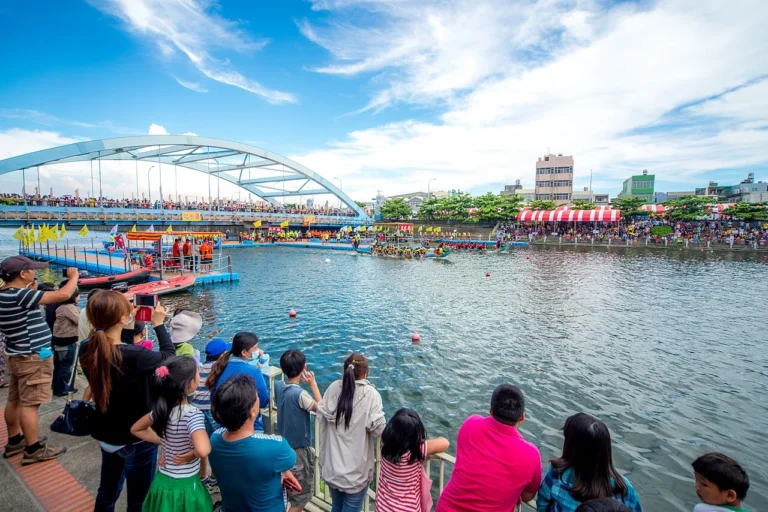
The earliest dated drowning on the fifth of the fifth is not his
If the festival were built on the memory of a drowned man, you would expect the earliest firm record of a fifth-of-the-fifth water rite to be about Qu Yuan. It is not. It is about a girl of fourteen from Shangyu, in what is now Zhejiang, and it sits in a standard dynastic history — compiled in the fifth century, describing the second — rather than in a collection of marvels.
The Cao E entry, dated to AD 143
孝女曹娥者,會稽上虞人也。父盱,能絃歌,為巫祝。漢安二年五月五日,於縣江泝濤迎婆娑神,溺死,不得屍骸。
“Cao E the filial daughter was a native of Shangyu in Kuaiji. Her father, Xu, could sing to the strings and served as a shaman. On the fifth day of the fifth month in the second year of Han’an, going up against the tidal bore on the county river to meet the Posuo god, he drowned, and his body was not recovered.”
范曄《後漢書・列女傳》 · ctext.org
The second year of Han’an is AD 143. The entry continues: the girl walked the bank crying for seventeen days and then went into the water herself, and in the first year of Yuanjia — AD 151 — the county magistrate reburied her by the road south of the river and set up a stele for her. That stele is the document the sixth-century commentator reaches for when he wants to show that the day already had another owner. In his quotation of it the rite is for 伍君 — Wu Zixu, the loyal minister of Wu who was driven to his death by his own king, and who was as famous in early China as Qu Yuan.
Two things follow, and they are not equally firm, so I will separate them. The firm one is the date: a documented river rite on the fifth of the fifth in AD 143, three and a half centuries before any surviving text ties the day to Qu Yuan, in which people go out onto the water to meet a god and a man drowns. The looser one is which god. The history says 婆娑神, the Posuo deity; the stele, as quoted in the commentary, says Wu Zixu. I cannot reconcile those two readings from the texts I can check, and I am not going to tidy the discrepancy away. What neither of them says is Qu Yuan.
What Taiwan’s official heritage writing says
None of this is obscure, and it is not a foreign scholar’s revisionism. The Taiwan Historica, the national archive’s heritage institute in Nantou, published a short piece on the festival for the general public in 2020 — the year everyone was thinking about epidemics — under the title 〈由防疫而生的節日——端午節〉, “A festival born of epidemic prevention”. Its opening paragraph makes the point I have been building towards:
多數人普遍認為端午節吃粽子和划龍舟的習俗皆源起於屈原投江,但其實端午還有許多習俗……部分習俗起源比屈原還早,辟邪也與在汨羅江尋找屈原沒有什麼關聯性,因此現在的端午節習俗,應是由多個相異的習俗融合而成。
“Most people generally believe that the customs of eating zongzi and racing dragon boats at the Duanwu Festival originate in Qu Yuan’s drowning, but Duanwu has many other customs … some of them older than Qu Yuan, and warding off evil has no real connection with searching the Miluo for him. Today’s Duanwu customs should therefore be understood as a fusion of several distinct practices.”
Two further points from the same piece are worth carrying into English. First, the name. 端午 originally meant the fifth day of any month — 端 is “beginning”, so “the first fifth” — and it only became the proper name of the fifth of the fifth in the Tang dynasty, citing the Historica’s own Glossary of Taiwanese Folk Artefacts. Second, the two rival theories of origin that the piece lays side by side: the “evil month” theory, in which the fifth month is the height of summer pestilence and the fifth day its worst, so that every custom is a form of quarantine; and the theory of the poet-scholar Wen Yiduo, in his essay on the festival, that the race and the rice-parcels both belong to a dragon cult of the Wu and Yue peoples of the lower Yangtze, older than Chu and older than Qu Yuan. The Historica does not choose between them. Neither will I. What both have in common is that the poet is not at the start of the story.
What Taiwan’s own paperwork calls the day
There is a tidier way to test whether a festival is a memorial: look at what the state writes down when it is obliged to be precise. Taiwan’s festival calendar is set by statute, and the statute sorts the year into two kinds of day. 紀念日, commemorative days, are the ones with a person or an event behind them, and a later article of the Act tells agencies to fly the flag on them, with formal ceremonies prescribed for several. 節日, festivals, are listed separately, and the first category under that heading is 民俗節日, folk festivals. The fifth of the fifth is in the second list.
Where the statute puts the day
第五條 節日之名稱及日期如下:一、民俗節日:……(四)端午節:農曆五月五日。
第六條 前條所列節日之放假依下列規定辦理:……二、兒童節、清明節、勞動節、端午節、教師節及中秋節:均放假一日。
“Article 5. The names and dates of the festivals are as follows: 1. Folk festivals: … (4) Duanwu Festival: the fifth day of the fifth lunar month. Article 6. Holidays for the festivals listed in the preceding article shall be granted as follows: … 2. Children’s Day, Qingming, Labour Day, Duanwu, Teachers’ Day and Mid-Autumn: one day’s holiday each.”
《紀念日及節日實施條例》 · law.moj.gov.tw
I searched the full text of the Act for the poet. His name is not in it, and neither is 詩人節, Poets’ Day. In the one document that has to be exact about what each day is for, the fifth of the fifth is a folk festival on a lunar date, and nothing else.
The Ministry of Education’s dictionaries are the next place to look, and they are more interesting than they sound, because two adjacent entries disagree by a hair. The headword 端午 is defined as a date, and the book-citation the editors chose to explain the name is about the calendar, not about a man: 五月午時,正陰陽衝會之時 — the fifth month at the hour of the horse, when yin and yang meet head-on. No poet. The next entry along, 端午節 — the festival rather than the date — does give the Qu Yuan account, and prefaces it with 相傳, “it is handed down that”. It then adds the sweet-flag and mugwort at the door, the realgar wine and the image of Zhong Kui as a separate layer, introduced by 再加上, “and on top of that”. The dictionary has quietly performed the same analysis this article is performing: a date, a story attached to it, and a body of protective custom that arrived by another road.
Two further entries repay a look. 惡月, “evil month”, is given as the vernacular name of the fifth lunar month, with the sixth-century line 五月俗稱惡月,多禁, “the fifth month is commonly called the evil month; there are many prohibitions”. And 競渡, boat-racing, quotes the sceptical line about Qu Yuan from that same sixth-century book — but prints it as the book’s own text rather than as the commentary attached to it, and in a wording that differs slightly from the edition on Wikisource. Both wordings keep the operative word: 俗為. Even where an official dictionary passes the Qu Yuan explanation straight through, it passes through the word that marks it as popular belief rather than record.
And then there is the tourism bureau. Its page on traditional festivals, written to sell the island to visitors, says that the festival’s origins and customs 幾乎都和紀念戰國時期楚國詩人-屈原有關,故民間又稱「詩人節」 — “are almost all connected with commemorating Qu Yuan, the Warring States poet of Chu, which is why it is also popularly called Poets’ Day”. That is the same government whose statute omits him and whose heritage registry, as we are about to see, files him under later additions. I do not think this is a scandal. It is what happens when a story is good enough to use as publicity and a registry has to be accurate.
The one dragon-boat race Taiwan has actually protected
Taiwan keeps a register of intangible heritage, and exactly one dragon-boat custom is on it as a folk practice: the race at Erlong, two villages on a narrow river in Jiaoxi, Yilan. It was registered by the Yilan county government on 27 December 2006, under document number 府文資字第0950007040號. The registry’s account of where the race came from is the most useful paragraph I have found on this subject in Chinese, and it is useful precisely because it is not an essay. It is a government file explaining why a thing is worth keeping.
From the heritage registration for the Erlong race
二龍競渡,根據考証是由以前當地平埔族(噶瑪蘭人)所遺留的農暇娛樂活動演進而來,而噶瑪蘭人聚居淇武蘭港的考古紀錄,至少有300年以上,在漢人不斷移入的過程中,二龍競渡也加入漢人的傳說和信仰,如屈原給皇帝吃鹽的傳說與龍船公鎮壓水域等。
“Research indicates that the Erlong race evolved from a slack-season recreation left behind by the local Pingpu people, the Kavalan; the archaeological record of Kavalan settlement at Qiwulan harbour goes back at least three hundred years. In the course of continuous Han settlement, the Erlong race also took on Han legends and beliefs — such as the story of Qu Yuan feeding salt to the emperor, and the Dragon Boat Lord who holds down the waters.”
文化部文化資產局・國家文化資產網〈礁溪二龍競渡〉 · nchdb.boch.gov.tw
Three things in that paragraph. The race is older than the Han presence on that river and belonged to an indigenous community. Qu Yuan arrives with the settlers, as one borrowed legend among several, standing alongside a local river deity called the Dragon Boat Lord. And the Qu Yuan legend these villages took up is not even the famous one: salt, and an emperor, and no drowning that the file thinks worth mentioning. I have not been able to trace that story to a text, and I am leaving it exactly where the registry leaves it — as a thing the villages say.
The stated reason for protecting the race is as unlike a memorial as the history is. It is not run for the result. The file commends a contest 不以勝負、輸贏為目的,並以兩岸的觀眾為裁判 — “not aimed at winning or losing, with the spectators on both banks as the judges” — and calls it 為臺灣唯獨僅有的民俗活動, the one and only folk activity in Taiwan.
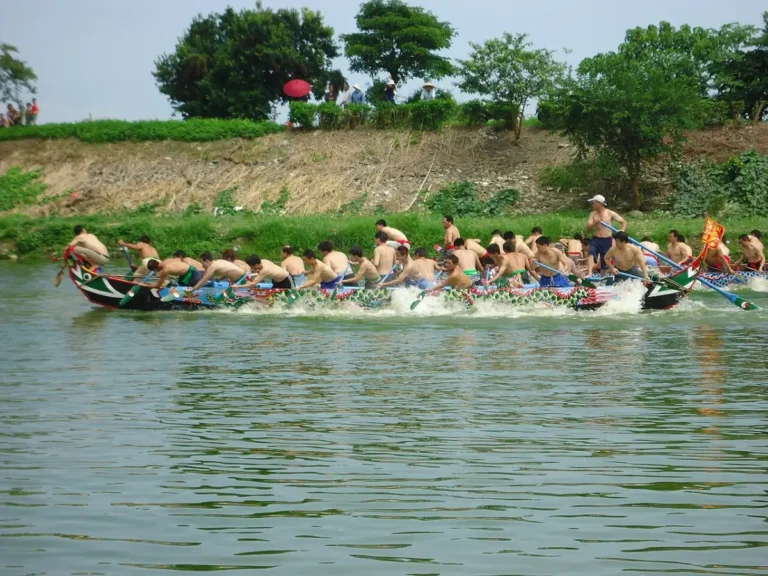
It is worth saying plainly what this does and does not prove. Erlong is one river in one county, and its Kavalan descent is a claim about that race, not about dragon-boat racing in general. The bigger, better-known events — the races at Lukang, on the Tainan canal, at Bitan — are run as municipal festivals; I have not found any of them on the heritage register, and none of them should be described as protected heritage on the strength of its size. What Erlong shows is narrower and sharper than a general theory. When a Taiwanese authority had to write down, for the record, where a dragon-boat custom came from, it did not write Qu Yuan. It wrote him in as something that arrived later, with the boats already on the water.
What the day looks like in Taiwan
The reason the Historica frames the festival as epidemic prevention is that this is how it was practised when the customs came across the strait. Taiwan is hot and damp; the fifth month is when the five poisonous creatures — the snake, the centipede or spider, the scorpion, the lizard and the toad — are said to multiply. So households pasted printed 五毒符, five-poisons charms, or paper-cuts of a cockerel eating the five poisons; tied five-coloured thread on children; drank realgar wine and sprinkled the dregs under the bed and in the corners; scattered lime around the house; and hung sweet-flag, mugwort and banyan sprigs — the Historica adds that a flower called dragon-boat flower used to go up with them — over the door. Sweet-flag stands for a sword, mugwort for a banner: 艾旗招百福,蒲劍斬千邪, “the mugwort banner summons a hundred blessings; the sweet-flag sword cuts down a thousand evils.” The same herbs went into a bath. Children wore scented sachets, and by the old rule the sachet was thrown away once the festival passed, taking the sickness with it — a detail, the Historica notes, that has almost disappeared.
And there are the races, at Tainan’s canal, at Bitan in Xindian, on the Fulu river at Lukang, and the newer game of standing an egg on its end at noon. Zongzi divide the island: northern ones steamed so the rice stays in separate grains, southern ones boiled until rice and filling cling together. None of this needs Qu Yuan. It needs a hot month and a healthy fear of it.
There is also the question of what the day is called by the people keeping it. In Taiwanese the usual name is not 端午節 at all but 五日節, Gōo-ji̍t-tseh, the fifth-day festival, with 五月節 and 肉粽節 — the fifth-month festival, the rice-dumpling festival — given as alternatives. The Ministry of Education’s Taiwanese dictionary defines 五日節 as the date, names it one of the three great folk festivals alongside Lunar New Year and Mid-Autumn, and lists the zongzi, the races, the sweet-flag and mugwort, the realgar wine and the image of Zhong Kui. Qu Yuan is not in the entry. A festival that the local language will also happily call “the rice-dumpling festival” is telling you what it is organised around.
The proverb in the same dictionary is better still.
A Taiwanese proverb about the day
未食五日節粽,破裘毋甘放。
“Until you have eaten the fifth-day festival zongzi, you cannot bring yourself to put the worn padded coat away.”
教育部《臺灣台語常用詞辭典》 · sutian.moe.edu.tw
The dictionary glosses it itself: the weather in Taiwan can still turn cold before the festival, so the winter clothes are not put away until it has passed — an observation of the weather handed down from earlier generations. That is the festival doing the work it has always done. It is a marker in the agricultural year — the point after which the heat is reliable and the cold is finished — and the customs hung on it are about getting through the dangerous stretch. A memorial does not tell you when to pack away your coat.
One last Taiwanese habit shows that the attaching of heroes never stopped. At Tiezhen Hill in Dajia, Taichung, people queue at noon on the fifth of the fifth to draw 午時水, noon water, from the Sword Well; the city tourism bureau runs the event and hands out commemorative bottles. The water is said to drive off misfortune and sickness, and the well has a founder of its own: 鄭成功拔劍刺向地面,跪求湧泉 — Koxinga, Zheng Chenggong, his troops exhausted and out of water, drove his sword into the ground and knelt to beg for a spring. A different hero, a different century, the same hour of the same day. Nobody had to remove Qu Yuan to make room for him; the date simply took one more story, as it has been doing since at least the second century. The festivals I have looked at on this site behave the same way whenever the paperwork survives — see the taboos of Chinese New Year, where two entries of the same official dictionary set out two incompatible lengths for the holiday, or why Taiwan calls her Mazu, where the name a community uses and the name on the plaque are not the same name.
So is the Qu Yuan story false?
Not false — late, and partial. Qu Yuan was real, the drowning is recorded, and by the sixth century people in Chu had for some time been throwing rice into the river for him on the fifth of the fifth. What the sources will not support is the claim that the festival was created for him: that the boats, the rice and the date exist because of the poet. The date and the boats and the herbs were there first, as a day of protection at the turn of high summer. Qu Yuan was added to the fifth of the fifth in the same way — and for the same reasons — that a beast was later added to New Year: a single memorable figure is easier to teach than a calendar of fears. We look at that other case in the Nian monster did not invent Chinese New Year.
The Taiwanese folklorist Wen Zong-han, writing about New Year, makes the comparison himself: the beast and the poet both came into Taiwanese classrooms as the single origin of their festivals, and both displaced older, messier local understandings. If you want the honest short version of the Dragon Boat Festival’s origin, it is this: a poison-month day of herbs, thread and racing, to which the memory of a drowned poet was attached in the centuries after his death. For the other summer festival that English writing tends to flatten, see Ghost Month in Taiwan: what is documented and what is just repeated; for why the fifth of the fifth lands on a different Gregorian date every year, see why Chinese New Year changes dates, which explains the calendar.
FAQ
Did the Dragon Boat Festival start with Qu Yuan?
No text earlier than the sixth century connects him to the fifth of the fifth, and the historian who records his death gives no date. The first text that does connect them, Wu Jun’s Xu Qi Xie Ji, presents the story as an explanation of an existing custom (“this is the surviving custom”). Taiwan’s national heritage institute states that some Duanwu customs predate Qu Yuan and that the festival is a fusion of distinct practices.
What is the oldest description of the festival?
The sixth-century Record of the Seasons in Jing-Chu, which calls the fifth of the fifth the Orchid-Bath Festival and lists mugwort figures on the door, sweet-flag wine, boat races and herb-gathering, all to ward off poisonous vapours. Qu Yuan is not in the entry itself; he appears in the attached commentary, which also names Wu Zixu and King Goujian of Yue as rival founders of the race and concludes that the question cannot be settled.
What does 端午 mean?
“The first fifth”. Originally it meant the fifth day of any month; according to the Taiwan Historica, citing its glossary of folk artefacts, it became the proper name of the fifth of the fifth only in the Tang dynasty.
Why is the festival called a “poison month” festival in Taiwan?
Because the fifth lunar month is the onset of summer pestilence, and the customs — five-poisons charms, realgar wine, lime, sweet-flag and mugwort over the door, scented sachets on children — are all forms of protection. The Taiwan Historica’s own title for its account of the festival is “a festival born of epidemic prevention”.
What reason does Sima Qian give for Qu Yuan’s death?
Because he had been exiled and would not compromise. In Sima Qian’s biography a fisherman asks him how he has come to this, and he answers 舉世混濁而我獨清 — “the whole world is muddied and I alone am clean … that is why I have been cast out.” He then composes a lament, takes up a stone and walks into the Miluo. The history gives no date and no year; the familiar 278 BC is a modern reconstruction from the fall of the Chu capital, recorded in a different chapter.
Did people throw rice into the river so the fish would not eat his body?
Not in the earliest version. In the sixth-century 《續齊諧記》 the rice is an offering to Qu Yuan, and the thieves stealing it are 蛟龍, flood-dragons, not fish. The chinaberry leaves and five-coloured silk are added as a repellent against the dragons, which is how the story accounts for the shape of a zongzi. The fish, and the idea that the rice was a decoy, belong to later retelling.
Is the Dragon Boat Festival a public holiday in Taiwan, and is it really called Poets’ Day?
It is a one-day public holiday. 《紀念日及節日實施條例》 lists 端午節 under 民俗節日, folk festivals, on the fifth day of the fifth lunar month, with one day’s holiday; commemorative days for people and events are a separate category in the same Act. The Act does not mention Qu Yuan and does not use the term 詩人節, Poets’ Day, although the tourism bureau’s own pages do.
Which dragon-boat race is protected heritage in Taiwan?
The race at Erlong in Jiaoxi, Yilan, registered as a folk practice by the Yilan county government on 27 December 2006. Its registration traces the race to the Kavalan, an indigenous Pingpu people, and records Han legends — Qu Yuan among them — as later additions. The larger races at Lukang, Tainan and Bitan are run as municipal events; none of them appears on the heritage register.
Another festival whose origin story is a later attachment: the Double Ninth’s plague legend comes from a sixth-century collection of marvels, and the plant at the centre of it has been mistranslated into English for a century. See the Double Ninth in Taiwan.
Sources
- 國史館臺灣文獻館,民俗文物小常識〈由防疫而生的節日——端午節〉,2020 — th.gov.tw:「部分習俗起源比屈原還早」;「端午」唐代才成專稱(引江韶瑩等《臺灣民俗文物辭彙類編》2009 頁 368);惡月說與聞一多〈端午考〉(引楊玉君撰、王秋桂主編《端午》,文建會 1995,頁 8–16);臺灣五毒符、五色線、雄黃酒、菖蒲艾草榕枝、香包舊俗 (accessed 5 Sep 2026)
- 司馬遷《史記・屈原賈生列傳》:「於是懷石遂自沈汨羅以死。」 — ctext.org (accessed 5 Sep 2026)
- 吳均《續齊諧記》「屈原五月五日投汨羅水」條 — 維基文庫 (accessed 5 Sep 2026)
- 宗懍《荊楚歲時記》「五月五日,謂之浴蘭節」條,及按語「俗為屈原投汨羅日……事在子胥,不關屈平也……不可詳矣」、「以五綵絲繫臂,名曰辟兵」 — 維基文庫 (accessed 5 Sep 2026)
- 溫宗翰〈過年的由來:追溯一段臺灣人神相挺的古老故事〉,故事 StoryStudio,2016 — storystudio.tw:年獸與屈原同為教科書單一起源說之判斷 (accessed 5 Sep 2026)
- 《紀念日及節日實施條例》第五條(民俗節日・端午節:農曆五月五日)、第六條(均放假一日) — law.moj.gov.tw:全文檢索無「屈原」、無「詩人節」;紀念日與節日分列兩條;第七條「紀念日,各機關應懸掛國旗」,並僅對開國紀念日、孔子誕辰紀念日、國慶日規定「舉行紀念活動」 (accessed 7 Oct 2026)
- 文化部文化資產局・國家文化資產網〈礁溪二龍競渡〉,登錄案號 20061227000003,宜蘭縣政府 2006-12-27 府文資字第0950007040號 — nchdb.boch.gov.tw:歷史源流「由以前當地平埔族(噶瑪蘭人)所遺留的農暇娛樂活動演進而來」;登錄理由「不以勝負、輸贏為目的」 (accessed 7 Oct 2026)
- 教育部《重編國語辭典修訂本》「端午」條(ID 48288) — dict.revised.moe.edu.tw:釋義「農曆五月五日。參見「端五」條。」;書證《談徵》「五月午時,正陰陽衝會之時」 (accessed 7 Oct 2026)
- 教育部《重編國語辭典修訂本》「端午節」條(ID 48289) — dict.revised.moe.edu.tw:「相傳戰國時楚國三閭大夫屈原……」;蒲艾、雄黃酒、鍾馗以「再加上」另起一層 (accessed 7 Oct 2026)
- 教育部《重編國語辭典修訂本》「競渡」條(ID 96463) — dict.revised.moe.edu.tw:引《荊楚歲時記.五月》「五月五日競渡,俗為屈原沒汨羅日,傷其死,故並命舟楫以拯之。」,未標為注文 (accessed 7 Oct 2026)
- 教育部《重編國語辭典修訂本》「惡月」條(ID 146979) — dict.revised.moe.edu.tw:「俗稱陰曆五月為惡月」;引《荊楚歲時記.五月》「五月俗稱惡月,多禁」 (accessed 7 Oct 2026)
- 教育部《臺灣台語常用詞辭典》「五日節」條(ID 625) — sutian.moe.edu.tw:台語主詞條釋義不提屈原;近義詞「五月節」、「肉粽節」 (accessed 7 Oct 2026)
- 教育部《臺灣台語常用詞辭典》「未食五日節粽,破裘毋甘放。」條(ID 26971) — sutian.moe.edu.tw:釋義「臺灣的氣候在端午節之前,都還可能有轉冷」 (accessed 7 Oct 2026)
- 交通部觀光署〈傳統節慶〉端午節段 — taiwan.net.tw:「幾乎都和紀念戰國時期楚國詩人-屈原有關,故民間又稱「詩人節」」 (accessed 7 Oct 2026)
- 臺中市政府觀光旅遊局〈鐵砧山慶端午:取劍井午時水,消災解厄、保平安!〉 — tourism.taichung.gov.tw:劍井午時水;「鄭成功拔劍刺向地面,跪求湧泉」 (accessed 7 Oct 2026)
- 范曄《後漢書・列女傳》曹娥條:「漢安二年五月五日,於縣江泝濤迎婆娑神,溺死,不得屍骸。」及「至元嘉元年……為立碑焉」 — ctext.org:漢安二年=西元 143 年;元嘉元年=西元 151 年 (accessed 7 Oct 2026)
- 司馬遷《史記・屈原賈生列傳》漁父問答:「舉世混濁而我獨清,眾人皆醉而我獨醒,是以見放。」 — ctext.org:全篇查無「五月五日」字樣 (accessed 7 Oct 2026)
- 宗懍《荊楚歲時記》五月條按語引邯鄲淳《曹娥碑》「五月五日,時迎伍君,逆濤而上,為水所淹。」與《越地傳》「起於越王勾踐。」 — 維基文庫:按語又作「蓋越人以舟為車,以楫為馬也」;按語作「俗為屈原投汨羅日,傷其死所」,與教育部辭典所引「俗為屈原沒汨羅日,傷其死」有兩處字句差異 (accessed 7 Oct 2026)
- Photograph: File:二龍村龍舟競渡.jpg, frank_ou, CC BY-SA 2.0, via Wikimedia Commons (accessed 7 Oct 2026)