Every January the lists come round again: don’t sweep, don’t wash your hair, don’t say the word for four, don’t break anything, don’t visit your parents on the first day. They are usually presented as a flat inventory of superstitions, which is why they feel arbitrary and why nobody can remember them. They are not arbitrary. Nearly every rule in the list is protecting one of four things, and once you can see which, the whole set becomes legible — including the rules that are quietly protecting something a modern reader may not want protected.
This is an account of where the taboos come from, what each is guarding, and which ones people in Taiwan still actually keep.
Chinese New Year taboos: the short answer
Almost every rule on the list is one rule wearing different clothes: on the first morning of the lunar year, nothing of value leaves the house. Dust leaves the house, so you do not sweep. Rubbish leaves the house, so you do not put it out. A cut or a breakage divides something that should stay whole, so the knife, the scissors and the needle stay in the drawer. An unlucky word lets loss into the room, so you do not say it. Learn the single idea and the inventory stops being arbitrary.
- Do not sweep, and do not take the rubbish out. The household’s prosperity is treated as a physical thing sitting in the house that can be carried out with the dust.
- Do not cut, and do not break. Knives, scissors and needles divide; if something breaks anyway, the breakage is repaired with a pun rather than an apology.
- Do not say the wrong word. Anything that sounds like death, loss or finishing is out for the day.
- Do not let anything run empty. The rice jar, the water, the till: full before midnight, full afterwards.
- Do not send the married daughter home on the first day. The one rule here that is protecting something other than the household’s luck.
And how long does all this last? That is the question with no answer, and it is worth more than the list. Taiwan’s holiday statute makes the festival one day and the holiday five; the Executive Yuan actually granted seven for 2027; the Ministry of Education’s dictionaries give one night, a day, a season, the first five days and a whole lunar month across separate entries; and in the cities whose timetables I checked the rubbish lorry stops for three, four or five days, or in one case does not stop. Many English-language guides run the prohibitions on to the Lantern Festival on the fifteenth day. Searching the statute, the two Ministry of Education dictionaries and the Ministry of Environment’s collection timetable, I did not find a Taiwanese official source that sets the period at fifteen.
Why there are rules at all
The framing comes before the content. In the Chinese festival calendar a festival is not primarily a celebration; it is a passage between two states of time, and the rituals and prohibitions are what get you across intact. The Executive Yuan’s own cultural overview puts it in four characters that are hard to improve on.
What the source actually says
傳統節慶的「節」,都選在節氣轉換的時間或是一個月的特殊時間……所以「過節」就是「過關」,在通過儀式中大多配合有祭祀的儀式、習俗禁忌,使人能從這個節序過渡到另一個節序。
“The ‘jie’ in a traditional festival always falls at the turn of a solar term or at a special point in the month. … So to ‘pass the festival’ is to ‘pass the gate’: the rite of passage is generally accompanied by sacrificial ritual and by customary prohibitions, so that a person can cross from one segment of the calendar into the next.”
行政院《國情簡介・文教與休閒・傳統節慶》 · ey.gov.tw
The pun is the argument. 過節, to keep a festival, and 過關, to get through a mountain pass or a checkpoint, are the same verb. A gate is a narrow place where things can go wrong, so you carry what you need through it and leave nothing valuable behind. Read the taboo list as instructions for crossing a checkpoint and it stops being a list of things that annoy ghosts.
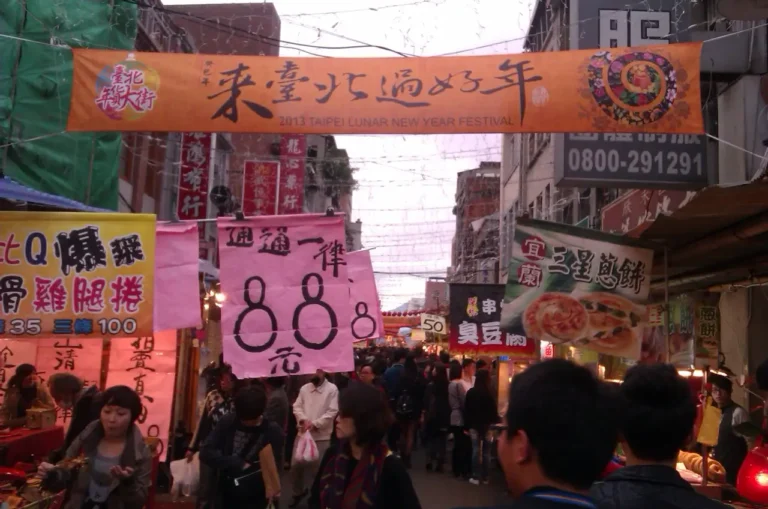
Protecting the stock: don’t sweep, don’t throw anything out
The best-known rule is that on the first day of the year you do not sweep the floor and do not carry the rubbish out of the house. The stated reason is that you would be sweeping out the year’s wealth, which sounds like a metaphor until you find the story behind it. It is preserved in the 荊楚歲時記, a sixth-century almanac of the customs of the Jing and Chu region, quoting an older collection of strange tales.
What the text actually says
《錄異記》云:「有商人區明者,過彭澤湖,有車馬出,自稱青湖君,要明過家,厚禮之,問何所須。有人教明,但乞如願。……青湖君語明曰:『君領取至家,如要物,但就如願,所須皆得。』自爾商人或有所求,如願並為即得,數年遂大富。後至正旦,如願起晚,商人以杖打之,如願以頭鑽入糞中,漸沒失所,後商人家漸漸貧。」
“A merchant named Ou Ming was passing Lake Pengze when a carriage came out and its rider announced himself as the Lord of the Blue Lake. He invited Ming home, treated him lavishly, and asked what he wanted. Someone had told Ming to ask only for Ruyuan — ‘As-You-Wish’. … The Lord said: ‘Take her home. Whenever you want a thing, go to Ruyuan and you shall have it.’ From then on whatever the merchant asked for, Ruyuan produced, and in a few years he was very rich. Then one New Year’s morning Ruyuan overslept. The merchant beat her with a stick; she burrowed head-first into the rubbish heap and vanished, and afterwards the merchant’s household grew poor.”
《荊楚歲時記》引《錄異記》 · 維基文庫
The prosperity of the house is a person, and she is hiding in the bin. That is the whole logic of the rule: at new year the household’s luck is treated as a physical stock, present on the premises, portable, and losable through the door. Dust, sweepings, dirty water and rubbish are all things that leave the house, so on the first day none of them leaves. If you must sweep, you sweep inwards, towards the centre of the room, and the pile waits until the third or fifth day.
The same logic covers a set of rules that otherwise look unrelated. You do not lend money or settle accounts on the first day, because money going out at the gate sets the pattern for the year — which is also why debts are supposed to be cleared before the new year’s eve dinner, not after. You do not let your rice jar, your wallet or your bowl be empty on the first morning. The Taiwanese habit of leaving a whole fish on the table uneaten belongs here too: 年年有餘, may there be a surplus every year, works only if the surplus is visibly left over.
Protecting the words: say nothing that sounds wrong
The second class of rule governs speech. During the new year you avoid the words for death, illness, breaking, losing, poverty and finishing; you avoid 四, four, because it sounds like 死, to die; you do not say a thing is 沒有了, all gone. The premise is that at the threshold of the year, what is said is taken as a description of the year, so a chance phrase can set a precedent.
The most useful thing about this rule is that it comes with a documented escape hatch. If you break a plate, you say 歲歲平安. The Ministry of Education’s standard dictionary explains it without embarrassment: 歲, “year”, is a homophone of 碎, “shattered”, so the phrase turns “smash, smash” into “peace year after year”. It defines the expression, in as many words, as the auspicious thing you say when you break ceramics or glass during the spring festival.
That is a rule and its repair kit issued together, and it tells you how the whole speech taboo is meant to work. The danger is not the accident; it is letting the accident stand as the year’s first statement. So you overwrite it immediately with a better one. The same instinct produces the substitutions that fill a Taiwanese new year: 發糕, the steamed cake whose split top means 發, to prosper, and which must crack open or the year will not; oranges for 大吉; pineapple, 旺來 in Taiwanese, “prosperity comes”.
Protecting the fabric: don’t cut, don’t break, don’t drain
A third group forbids anything that severs, empties or damages. No scissors, knives or needles, because cutting on the first day cuts the year’s connections and the household’s wealth. No hair-washing or laundry on the first two days, the reason usually given being that the water god’s birthday falls then and that washing pours the year’s fortune down the drain. No haircut for the whole first lunar month. No breaking of dishes, no smashing, no tearing.
This class has the deepest textual root of any of them, and it is not about wealth at all. The 荊楚歲時記 records that the first seven days of the year each belong to a creature — chicken, dog, sheep, pig, ox, horse, and on the seventh day the human being — and that the animal of the day is spared.
What the text actually says
正月一日為雞,二日為狗,三日為羊,四日為豬,五日為牛,六日為馬,七日為人……今一日不殺雞,二日不殺狗,三日不殺羊,四日不殺豬,五日不殺牛,六日不殺馬,七日不行刑,亦此義也。
“The first day of the first month belongs to the chicken, the second to the dog, the third to the sheep, the fourth to the pig, the fifth to the ox, the sixth to the horse, and the seventh to the human being. … Today no chicken is killed on the first day, no dog on the second, no sheep on the third, no pig on the fourth, no ox on the fifth, no horse on the sixth, and on the seventh no sentence is carried out. This is the same principle.”
《荊楚歲時記》引董勛《問禮俗》 · 維基文庫
On the seventh day, the day of humans, executions stop. A calendar in which the state suspends the death penalty for a day because the day belongs to people is a calendar with a moral argument inside it, and the domestic version of that argument is the rule against knives and scissors: at the turn of the year, nothing in this house cuts anything.
Protecting the rest: the first five days have jobs
The fourth class is the one nobody calls a taboo, though it functions as one. The days of the new year are allocated, and doing the wrong thing on the wrong day is the transgression. Taiwan has a children’s rhyme, quoted in the government’s own cultural overview, that runs from the first day to the fifteenth; the first five lines are the ones people still recite.
| Day | The rhyme | What it means |
|---|---|---|
| 初一 | 初一早 | Up early, open the door at an auspicious hour; worship gods first, then ancestors |
| 初二 | 初二巧 | The married daughter and her husband come to her parents’ house as honoured guests |
| 初三 | 初三無通巧 | The “red dog day”: unlucky for going out; or, in the other version, sleep in — and the mice are marrying |
| 初四 | 初四神落天 | The gods return from heaven; you welcome them in the afternoon, because “see them off early, greet them late” |
| 初五 | 初五隔開 | The partition: shops reopen, ordinary work resumes |
Read as a block, this is a labour rule. The household has just been through weeks of cleaning, shopping, cooking and debt-clearing; the taboos on sweeping, cutting, washing and working are a five-day moratorium enforced by supernatural sanction rather than by anyone’s goodwill. 初三睏較飽 — “on the third, sleep your fill” — is an instruction to rest, dressed as an unlucky day. If you want to know what a society could not otherwise get people to do, look at what it made sacred.
How long do they last? Six different spans, none of them fifteen
The span is the part the lists get wrong, and they get it wrong because there is nothing to get right. I went looking for the authority that fixes the period and found six Taiwanese official answers that do not agree with one another, which is a more interesting result than a single clean number would have been.
Start with the law. The 《紀念日及節日實施條例》, excerpted on the Directorate-General of Personnel Administration’s own page for the 2027 working calendar, lists the festival in Article 5 among the folk holidays as a single date: 「(一)春節:農曆一月一日。」 One day, the first of the first lunar month. New Year’s Eve is not part of it; 除夕 gets its own line in the same list, as 「農曆十二月之末日」. The article immediately following — it opens 「前條所列節日之放假依下列規定辦理」, the holidays for the days listed in the preceding article — then reaches the clause that decides when anyone actually stops work, and the arithmetic changes:
一、除夕及春節:自農曆十二月末日之前一日至翌年一月三日,放假五日。
One. New Year’s Eve and the Spring Festival: from the day before the last day of the twelfth lunar month to the third day of the first lunar month of the following year, five days’ holiday.
《紀念日及節日實施條例》, the article following Article 5, as excerpted on the Directorate-General of Personnel Administration’s 2027 working-calendar page (accessed 6 October 2026)
So the name covers one day and the holiday it generates covers five, in the same statute. For 2027 the number changes again. The Directorate-General’s press release announcing the Executive Yuan’s approval of the 2027 calendar counts the Lunar New Year break as 「農曆春節假期(7日)」 — seven days — because, as the same release explains, 「2月6日至7日(農曆初一、初二)適逢星期六、日」, so the first and second days of the year fall on a Saturday and a Sunday and are made up on the Tuesday and Wednesday following. That release is also the one Taiwanese government document I found that pins the date: the first day of the lunar year 2027 is 6 February. Note what it is — a press release reporting an approved schedule, not the statute itself, and quoted here for the figure rather than as a source of law.
Now the dictionaries, compiled by a different arm of government and answering the question differently again. The Ministry of Education’s 《重編國語辭典修訂本》 glosses 春節 as 「傳統節慶之一。舊時指立春,今指農曆正月初一。」 — formerly the solar term 立春, now the first day of the first lunar month. One day, or a point on the solar calendar, depending on which century the reader has in mind. The entry’s second sense then widens the word to 「春天」, spring itself: a whole season.
Elsewhere in the same dictionary, 過年 opens with something far shorter: 「度過除夕。」 To get through New Year’s Eve. One night. Its second sense is then open-ended — 「在新年裡慶祝、作樂的活動。」, the celebrating and merrymaking done during the new year, with no length given at all. The dictionary is not being careless. It is recording that the word does not carry a span.
And elsewhere again the same dictionary produces a five-day prohibition window. Under 破五 — the fifth day, when shops properly reopen — it quotes the Qing-dynasty Beijing almanac 《燕京歲時記》: 「初五日謂之破五,破五之內不得以生米為炊,婦女不得出門。」 Within the first five days you may not cook with raw rice and women may not go out of doors. That is a real taboo period with a stated length, carried in a Taiwanese official reference work, and it is five days rather than fifteen — and it is a record of practice in one city, not a national rule.
The vocabulary will not settle it either. 開正 (khui-tsiann), the word for the turn of the year as the island actually says it, is glossed in the Ministry’s Taiwanese dictionary as 「初春、新春。農曆正月,為新年的開始。相當於春季的第一個月。」 — the whole first lunar month. The entry says nothing about prohibitions; what it shows is that the word Taiwan reaches for names a month rather than a moment.
One night, one day, five days, seven days, a season, a month. And the fifth-day release that I have heard used in Taiwan, 初五隔開, is not in that dictionary as a unit: search it for 初五 and the result reads 「完全符合「初五」有0筆」, zero exact matches, while 隔開 (keh–khui) appears on its own with the plain verbal sense 「分開。」, to separate, carrying no New Year gloss. An expression I can hear and cannot cite is a pattern this site keeps meeting, most recently in what Taiwan actually does on the Double Ninth, where the documented customs and the observed ones only partly overlap.
The rules that protect something else
Which brings us to the group that does not fit the pattern, and that this site is not going to launder. A married daughter may not return to her parents’ house on the first day of the year. She goes on the second, as a guest, bringing gifts, and she must leave before dark. Taiwan’s National Museum of Taiwan History, in its 臺灣女人 project on the history of women in Taiwan, sets the rule out and its stated reasons plainly: if a daughter came home on the first day it would mean her marriage had failed and she had run home for help; if she arrives without gifts her parents’ house will be poor for a year; if she stays to see the smoke of the evening meal, her parents’ house will fall into poverty.
The museum also records the proverb that shows what the rule costs: 有父有母初二、三,無父無母斗擔擔 — a wife whose parents are alive will be fetched home to visit on the second or third day; a wife whose parents are dead has nobody to fetch her, and stays at her mother-in-law’s house helping to receive the guests. And it notes that traditionally the second-day visit was for married daughters only: a divorced woman, having no husband’s family, was not welcome at her parents’ either, and spent the reunion alone. The museum’s own conclusion is that these are among the taboos that display society’s unreasonable treatment of women, and that equality between the sexes still has some way to go.
That is a Taiwanese state museum writing about Taiwanese custom, and it is a better guide than any foreign commentary could be. The first four classes of taboo protect the household’s stock, its speech, its fabric and its rest — things every member of the house shares. This fifth class protects a claim: the principle that a married woman belongs to her husband’s line, which the rest of the phrase makes explicit — 嫁出去的女兒,潑出去的水, “a married-out daughter is spilled-out water”. Plenty of families in Taiwan now ignore it, some split the reunion dinner between two houses, and the rule is weakening. It is worth knowing precisely because it is the one taboo where the honest answer to “what is this protecting?” is not something you would want to keep.
The ritual the rules forgot: 送窮, where sweeping is the whole point
Here is the part that unsettles the first-morning prohibition, and it comes from the same Ministry of Education dictionary rather than from any sceptic. Look up 送窮, seeing off poverty, and the entry describes a New Year observance whose central action is sweeping — sweeping deliberately, and sweeping the dirt out of the house and into the road or the river:
正月三日,人多掃積塵於箕,并加敝帚,委諸歧路以送窮。
On the third day of the first month, people mostly sweep the accumulated dust into a dustpan, add a worn-out broom to it, and abandon it at the fork in the road, to see off poverty.
Qing dynasty, 顧祿《清嘉錄.小年朝》 — an almanac of Suzhou customs — quoted in Ministry of Education, 《重編國語辭典修訂本》, entry 送窮 (ID 146390) (accessed 6 October 2026)
That is New Year dust being treated as something to get rid of rather than something to protect. And the entry does not present this as the version it has chosen; it offers three dates and declines to choose. One puts the sweeping on the twenty-ninth of the first month, quoting the 《圖經》 by way of the Song-dynasty 《歲時廣記》 — and the quotation names its locality in its first four characters, 「池陽風俗,以正月二十九日為窮九日,掃除屋室塵穢,投之水中,謂之『送窮』。」, the customs of Chiyang. Another puts it on the sixth, the day before 人日, quoting 呂原明《歲時雜記》: 「人日前一日,掃聚糞帚,人未行時,以煎餅七枚覆其上,棄之通衢以送窮。」 The third is the Suzhou version above, on the third day. The entry prefaces all of it with 「日期各地有不同說法」 — the dates differ by locality — and then simply prints the disagreement.
That preface is the honest part, and it is what the modern taboo list leaves out. These are not three competing claims about one tradition. They are three dates from three different records: the customs of Chiyang on the twenty-ninth, a Song-dynasty note on the sixth, and Suzhou on the third. The 破五 entry quoted earlier is Beijing. Four local calendars, flattened in English into a single thing called Chinese New Year, which is how a reader ends up believing there is a correct answer about sweeping that somebody is failing to tell them.
Set the sweeping beside that Beijing prohibition and the windows collide. If the 送窮 sweep falls on the third day, it falls inside the first five days during which 《燕京歲時記》 says a household should not even be cooking with raw rice or letting its women out of the house. Two entries in one official reference work, describing the same few weeks, and they do not fit together.
I do not read this as an error, and nothing in the entries says so either. What I think it looks like is a calendar assembled out of several centuries of local practice and then written down once: the prohibition and the ritual are both real, they belong to different towns and different days, and the list we have inherited kept the prohibition and dropped the ritual. The sweeping that survives in Taiwan is the pre-New-Year clean, 年終大掃除, which happens before the eve and is therefore safely outside the argument. The 送窮 sweep, the one that happens inside the new year and whose whole purpose is to carry something out of the door, has gone.
The attributions wander too. The story behind the first-morning prohibition, the one about the servant girl 如願 who was beaten with a stick and burrowed into the rubbish heap, is quoted on this page from 《錄異記》. The Ministry’s dictionary entry for 如願 sends the same name somewhere else in each of two consecutive senses: 「傳說中彭澤湖神的女婢。見晉.干寶《搜神記》卷四。」 and then 「相傳為財神爺最早的稱謂。見南朝梁.宗懍《荊楚歲時記》。」 Two books in one entry, roughly two centuries apart, and a third in the quotation this page already carries. Anyone who tells you firmly which collection the no-sweeping rule comes from is tidier than the record is.
What actually gets observed in Taiwan
Foreign guests usually over-worry about this. In practice, in a Taipei household in the 2020s, the rules that hold are: no sweeping or taking out rubbish on the first day; no inauspicious words, with 歲歲平安 ready for accidents; the day-two visit to the wife’s family; and red envelopes given in even-numbered amounts, never in fours. The hair-washing prohibition is largely gone. The scissors rule survives mostly as “don’t get a haircut in the first month”. Almost nobody keeps the animal days.
If you are a guest: bring something, and not a clock (送鐘 sounds like 送終, attending a funeral), not an umbrella (傘 sounds like 散, to break up), not sharp objects, not white or black wrapping. Put cash in a red envelope, never a white one. Say 新年快樂 or 恭喜發財. If you break something, say the four characters and everyone will laugh and mean it. And if you are wondering why the whole thing lands on a different date each year, that is a separate and much more interesting question, answered in our piece on why the date moves. If your visit takes in a temple, the temple etiquette guide covers the other set of rules you will meet, and the creature on the pillars outside is explained in Chinese dragon vs Western dragon.
Where the festival itself is said to come from is a separate question, and the usual answer — the Nian beast — is not in any early text. Taiwan’s own version of the origin, first written down in 1936, explains the vigil and the reunion dinner rather better; see the Nian monster did not invent Chinese New Year.
The rubbish really does stop — and not for the same number of days
English-language guides file “do not take the rubbish out” under superstition. In Taiwan it is also a timetable. The Ministry of Environment publishes a page collating what each of the twenty-two counties and cities does with refuse collection over the New Year, and the most recently published edition is titled, flatly, 「2026 春節期間垃圾清運時間表」 — it covers the 2026 new year, which began on 17 February; at the time of writing no 2027 edition has appeared on the board. For much of the island, on the first morning of the lunar year, the lorry is not coming. The rule and the logistics have fused, and arguing about whether anyone still believes in it slightly misses the point.
What the table shows, though, is that the fused version has no fixed length either. Six entries, taken as they are printed:
- Taipei: 「2月17日(初一)至2月19日(初三)及 2月22日(初六)停收垃圾。」 Days one to three, and again on day six. Four days.
- New Taipei: 「2月17日(二)至2月19日(四)農曆初一至初三則停止收運」, with normal collection resuming on day four. Three days.
- Hsinchu City: 「115年2月17日至2月20日(初一至初四)停止收運垃圾。」 Four days.
- Miaoli County: 17 to 21 February. Five days.
- Nantou County: days one to four in Nantou City, days one to five in Caotun and Puli — the span changes between townships inside one county.
- Taichung: 「115年春節垃圾收運不打烊」 — New Year collection, the city says, does not shut up shop. Its own breakdown then gives day one fixed-point collection, day two marked 「例假日不收運」 and skipped as a scheduled day off, day three fixed-point again, day four normal. Not shutting, with a day off in it.
Three days, four days, five days, or effectively none, depending on which municipality you wake up in. If the taboo were really a belief about the first morning, Taichung would be the outlier that proves Taiwan has stopped caring. I suspect it is the reverse: collection continues in Taichung because the city decided it could, the other cities stop because closing the depots over the family holiday is reasonable, and the belief is what the arrangement gets explained with afterwards. Nothing in the table says so; it is simply the reading the timetable is consistent with.
The detail that persuades me is what the two biggest cities do next. Taipei notes that during the suspension residents can use 「本市30處限時收受點」, thirty timed drop-off points; New Taipei set up 「70處定點收運站」, seventy fixed stations, saying explicitly that from the evening of the eve through to the third day 「民眾仍有倒垃圾需求」 — people still need to put the rubbish out. The municipal position, in other words, is that the household will generate rubbish on the first morning of the year and should have somewhere to take it. The taboo is given official exceptions by the dozen, and it is not treated as a scandal.
The hair rule rests on a pun that needs a character Taiwan does not write
Of all the rules on the list, the one about not washing your hair is the one most confidently explained, and the explanation is the one piece of the whole inventory that can be checked and found wanting. The claim is that 髮, hair, sounds like the 發 of 發財, getting rich, so washing your hair washes the money away.
The two words do not sound the same. The Ministry of Education’s 《重編國語辭典修訂本》 gives 髮 the reading ㄈㄚˇ, third tone, and 發 the reading ㄈㄚ, first tone. Chinese New Year is full of puns that work, and plenty of them are near rather than exact — the broken plate answered with 歲歲平安 is the obvious one on this page. But a near pun is a different thing from the claim normally made, which is that the two words are pronounced identically. In the readings the Ministry records, they are not.
There is a script in which they are. The simplification that produced 发 merged 髮 and 發 into one character, so that hair and wealth became the same shape on the page as well as nearly the same sound — and once two words share a character, the wordplay is sitting there waiting to be noticed. Written in the characters Taiwan uses, it has to be pointed out; written the other way, it is unavoidable. Which script a reader grew up with turns out to decide how obvious this piece of folklore feels, which makes the reasoning behind the simplifications unexpectedly load-bearing here.
The clearest illustration I found is from a public broadcaster rather than a content farm. SBS Chinese, in a listicle on Lunar New Year taboos, writes that “‘hair’ (髮) is pronounced the same as ‘making money’ (發財)” — and prints both words in traditional characters, the script in which the two are written differently and read with different tones.
What makes the passage genuinely useful, though, is that it does not stop there. The next sentence offers a completely different reason for the same prohibition: that the first two days of the lunar year are the birthday of the Water God, who would be offended by washing. Two unrelated explanations for one rule, in consecutive sentences, with no sign that either is in tension with the other. And a few lines earlier, discussing sweeping, the same page says that after New Year’s Day “cleaning and washing can resume as normal” — one day — while the hair rule is given as two. One article, two reasons, two spans.
So where does the hair prohibition come from? On the evidence I can reach, nowhere citable. I searched the Ministry of Education’s 《重編國語辭典修訂本》 entries for 春節, 過年, 破五 and 送窮, and the Ministry’s Taiwanese dictionary under 開正, and found no hair-washing rule in any of them. The National Museum of Taiwan History’s page on traditional New Year prohibitions records the married-daughter rule in detail and does not mention hair. The explanations in circulation — the 發財 pun, the Water God, and the quite separate prohibition on cutting hair across the whole first lunar month, which is a rule about a different act — are mutually independent, and that is at least consistent with reasons supplied after the rule rather than before it.
None of which is a reason to wash your hair at a relative’s house on the first morning if it would upset someone. It is a reason to stop repeating the pun, which is the part of the story that can be tested and the part that fails. This site has run into the same shape with the spellings of Taiwan’s own sea goddess, where the confident explanation and the official record turned out to be pulling in different directions.
FAQ
Why can’t you sweep the floor on Chinese New Year?
Because the household’s prosperity is treated as a physical thing that is present in the house and can be carried out of the door with the dust. The oldest version of the story, quoted in the sixth-century 荊楚歲時記, has a wish-granting servant called Ruyuan who hides in the rubbish heap on New Year’s morning and takes the merchant’s fortune with her. If you must clean, sweep inwards and keep the pile until the third or fifth day.
What do you say if you break something during Chinese New Year?
歲歲平安 (suì suì píng ān), “peace year after year”. It works because 歲, year, sounds like 碎, shattered. Taiwan’s Ministry of Education dictionary defines it exactly this way — the auspicious phrase said when ceramics or glass are broken during the spring festival.
Why can’t a married daughter visit her parents on the first day?
The custom holds that she belongs to her husband’s family and that returning on the first day would signal a failed marriage. The National Museum of Taiwan History records the rule, its stated reasons and its costs, and treats it as one of the new year taboos that reflect the unequal treatment of women. Many families in Taiwan no longer keep it.
How long do the taboos last?
Most of them lift on the fifth day, 初五隔開, “the partition”, when businesses reopen and ordinary work resumes. A few run longer — the haircut prohibition traditionally covers the whole first lunar month — and the festival period proper does not close until the Lantern Festival on the fifteenth.
Do people in Taiwan actually follow these rules?
Selectively. The no-sweeping rule, the speech taboos, the day-two visit and the red-envelope conventions are widely kept; the washing and animal-day rules are mostly gone. Few hosts will mind if a foreign guest gets one wrong, as long as the gift is not a clock.
What should you not do on Chinese New Year?
On the first morning: do not sweep, do not put the rubbish out, do not use knives, scissors or needles, do not break anything, do not let the rice jar or the water run empty, and do not say a word that sounds like death, loss or finishing. Traditionally a married daughter does not visit her parents until the second day. Each of these follows from the same instruction — nothing of value leaves the house on day one — which is easier to hold on to than the list.
Can you wash your hair on Chinese New Year?
Nothing I can cite forbids it. The usual explanation, that 髮 (hair) is pronounced the same as the 發 of 發財 (getting rich), does not hold in the readings the Ministry of Education records: 髮 is ㄈㄚˇ and 發 is ㄈㄚ, different tones, and so not the identical sound the claim needs. The two share a single character, 发, only in the simplified script. Searching the Ministry’s dictionary entries for 春節, 過年, 破五 and 送窮, and the National Museum of Taiwan History’s account of New Year prohibitions, I found no hair-washing rule. If your host keeps it, keep it with them; the reasoning is the part that does not stand up.
When is Chinese New Year 2027, and how many days does Taiwan actually get off?
The first day of the lunar year falls on 6 February 2027. Taiwan’s holiday statute grants five days for New Year’s Eve and the Spring Festival together, running from the day before the eve to the third day of the first month. Because the first and second days land on a Saturday and Sunday in 2027, the Directorate-General of Personnel Administration’s press release announcing the approved calendar counts the break as seven days, with substitute days off on Tuesday 9 and Wednesday 10 February. Seven is the figure that release reports for the approved schedule, not a length set by the statute.
The same gap between what an official source records and what it merely hands down opens at the other end of the year. Taiwan’s statute book lists the Dragon Boat Festival among the folk festivals and never names the poet it is supposed to commemorate, while the tourism bureau calls the day Poets’ Day: was the Dragon Boat Festival really created for Qu Yuan?
Sources
- 《荊楚歲時記》(南朝梁・宗懍) — 維基文庫:引《錄異記》如願故事「後至正旦,如願起晚,商人以杖打之,如願以頭鑽入糞中……後商人家漸漸貧」;引董勛《問禮俗》「正月一日為雞……七日為人」「今一日不殺雞……七日不行刑」(accessed 2 Sep 2026)
- 行政院《國情簡介・文教與休閒・文化・傳統節慶》(資料來源:文化部、原住民族委員會,114/04/17) — ey.gov.tw:「所以『過節』就是『過關』」;〈過年謠〉「初一早、初二巧、初三無通巧、初四神落天、初五隔開」及其註解(accessed 2 Sep 2026)
- 國立臺灣歷史博物館《臺灣女人》〈臺灣傳統的年節禁忌〉 — women.nmth.gov.tw:初一禁回娘家、初二歸寧作客、須於傍晚前離去;俗諺「有父有母初二、三,無父無母斗擔擔」;離婚婦女之處境;「這種種不符合時代潮流的年節禁忌,彰顯了社會對婦女的不合理待遇」(accessed 2 Sep 2026)
- 教育部《重編國語辭典修訂本》「歲歲平安」 — dict.revised.moe.edu.tw:「歲,音諧『碎』。歲歲平安為春節期間打破陶瓷、玻璃等器物時所說的吉祥話。」(accessed 2 Sep 2026)
- 《紀念日及節日實施條例》 (Act on the Implementation of Memorial Days and Holidays), excerpted on the working-calendar page — Directorate-General of Personnel Administration, Executive Yuan, 〈中華民國一百一十六年政府行政機關辦公日曆表〉: Article 5, 「(一)春節:農曆一月一日。」 and 「(八)除夕:農曆十二月之末日。」; the following article, 「一、除夕及春節:自農曆十二月末日之前一日至翌年一月三日,放假五日。」 (accessed 6 October 2026)
- Directorate-General of Personnel Administration press release — 〈行政院核定116年(西元2027年)政府行政機關辦公日曆表〉: 「農曆春節假期(7日)」; 「2月6日至7日(農曆初一、初二)適逢星期六、日,依上開規定,於2月9日至10日(星期二、三)補假」. Cited for the figures it reports, not as a source of law. (accessed 6 October 2026)
- Ministry of Environment — 〈2026 春節期間垃圾清運時間表〉, refuse-collection suspensions by county and city. Taipei: 「2月17日(初一)至2月19日(初三)及 2月22日(初六)停收垃圾」, 「本市30處限時收受點」. New Taipei: 「2月17日(二)至2月19日(四)農曆初一至初三則停止收運」, 「70處定點收運站」, 「民眾仍有倒垃圾需求」. Hsinchu City: 「115年2月17日至2月20日(初一至初四)停止收運垃圾。」 Taichung: 「115年春節垃圾收運不打烊」. This is a rotating notice board rather than a permanent link; the edition read was titled 「2026 春節期間垃圾清運時間表」 (accessed 6 October 2026)
- Ministry of Education, 《重編國語辭典修訂本》 — entry 送窮 (ID 146390): 「日期各地有不同說法」, with three dates quoting 《歲時廣記》引《圖經》, 呂原明《歲時雜記》 and 顧祿《清嘉錄.小年朝》 (accessed 6 October 2026)
- Ministry of Education, 《重編國語辭典修訂本》 — entry 破五 (ID 22761), quoting 富察敦崇《燕京歲時記.破五》: 「破五之內不得以生米為炊,婦女不得出門。」 (accessed 6 October 2026)
- Ministry of Education, 《重編國語辭典修訂本》 — entry 春節 (ID 126191): 「舊時指立春,今指農曆正月初一。」, second sense 「春天」 (accessed 6 October 2026)
- Ministry of Education, 《重編國語辭典修訂本》 — entry 過年 (ID 72593): 「度過除夕。」, second sense 「在新年裡慶祝、作樂的活動。」 (accessed 6 October 2026)
- Ministry of Education, 《重編國語辭典修訂本》 — entry 如願 (ID 136466), the same name attributed to 晉.干寶《搜神記》卷四 and to 南朝梁.宗懍《荊楚歲時記》 in consecutive senses (accessed 6 October 2026)
- Ministry of Education, 《重編國語辭典修訂本》 — readings of 髮 (ID 1545), ㄈㄚˇ and 發 (ID 1532), ㄈㄚ (accessed 6 October 2026)
- Ministry of Education, 《臺灣台語常用詞辭典》 — 開正 khui-tsiann: 「初春、新春。農曆正月,為新年的開始。相當於春季的第一個月。」; 隔開 keh–khui: 「分開。」; a dictionary search for 初五 returns 「完全符合「初五」有0筆」 (accessed 6 October 2026)
- National Museum of Taiwan History, 臺灣女人 — 〈臺灣傳統的年節禁忌〉, which records the married-daughter prohibition and does not mention hair-washing (accessed 6 October 2026)
- SBS Chinese — “6 taboos that you need to avoid during Lunar New Year”. Cited as an instance of the 發財 homophone claim printed in traditional characters, and of two incompatible reasons given in consecutive sentences — not as an authority. (accessed 6 October 2026)