The question usually starts in a drop-down menu. A translation app offers “Chinese (Traditional)” and “Chinese (Simplified)”, a streaming service offers “Mandarin”, a form asks which you speak, and it is reasonable to conclude that traditional Chinese and Mandarin are two kinds of the same thing. They are not. Traditional Chinese is a script — a way of writing characters. Mandarin is a spoken language. Asking which is better is like asking whether Latin script is better than French. The two meet constantly, but they are answers to different questions.
This page separates them, shows one word written once and spoken four ways, and ends with what to call things when you need to be precise.
Is traditional Chinese the same as Mandarin?
No. Traditional Chinese is one of two standard forms of the Chinese script; simplified Chinese is the other. Mandarin is the most widely spoken Chinese language, and it can be written in either script. In Taiwan, Mandarin is written in traditional characters. In mainland China and Singapore it is written in simplified ones. In Hong Kong the everyday spoken language is Cantonese, not Mandarin, and it is written in traditional characters too.
So “traditional or simplified?” is a question about writing, and “Mandarin or Cantonese?” is a question about speech. Every combination except simplified-written Cantonese is part of ordinary life somewhere, and even that one turns up in mainland Guangdong.
Script, speech, and the labels in between
Most of the confusion here comes from one habit: software menus put scripts and languages in the same dropdown, so people reasonably assume they are the same kind of thing. They are not. The table below separates the labels you are likely to meet, and says what each one actually governs.
| Label | What it is | What it governs | Standard code |
|---|---|---|---|
| Traditional Chinese | A script variant | Which character forms are standard in writing | Hant (ISO 15924 no. 502) |
| Simplified Chinese | A script variant | Which character forms are standard in writing | Hans (ISO 15924 no. 501) |
| Mandarin | A spoken language | Pronunciation, vocabulary, grammar | cmn |
| Cantonese | A spoken language | Pronunciation, vocabulary, grammar | yue |
| Taiwanese | A spoken language | Pronunciation, vocabulary, grammar | nan (Min Nan; nan-TW to be exact) |
| Hakka | A spoken language | Pronunciation, vocabulary, grammar | hak |
zh-TW, zh-HK |
A language tag with a region subtag | Where the text is for, which is not the same as which script | BCP 47 |
Read down the second column and the shape of the problem is plain. Two of these labels describe which forms the characters take. Four describe sounds in a mouth. One describes a place. The nearest European parallel is Fraktur against Antiqua, or British against American spelling conventions: a standard for how the writing looks on the page, which several different kinds of reader can share.
Why the labels keep blurring
Software is largely to blame. Menus built for a handful of choices collapse three separate facts — the language, the script and the place — into one label. “Chinese (Traditional)” in a translation tool almost always means written Mandarin in traditional characters, with Taiwanese vocabulary. It does not mean Cantonese, and it is not a language of its own.
The people who write the internet’s standards keep the three apart. Language tags combine a language code, a script code and a region code. The script codes come from the international standard ISO 15924, in which Hant means “Han (Traditional variant)” and Hans means “Han (Simplified variant)”. The specification for language tags uses exactly this case as its worked example: zh-Hant is “Traditional Chinese”, built from zh for the language and Hant for the script. It also notes that yue-Hant-HK — Cantonese, traditional script, Hong Kong — is a perfectly good tag. That one string is the whole argument of this page: a language, a script and a place, three separate things.
Tags such as zh-TW and zh-HK are different again: they name a place, not a script. They are useful for vocabulary and conventions, because written usage in Taipei and Hong Kong differs, but they say nothing directly about which characters are used.
One word, written once, spoken four ways
The easiest way to see that the script is not the language is to take a single written word and ask four speech communities to read it. 食飯, “to eat a meal”, is a good test because it is ordinary and because it shows a second effect: different languages sometimes prefer different words for the same thing.
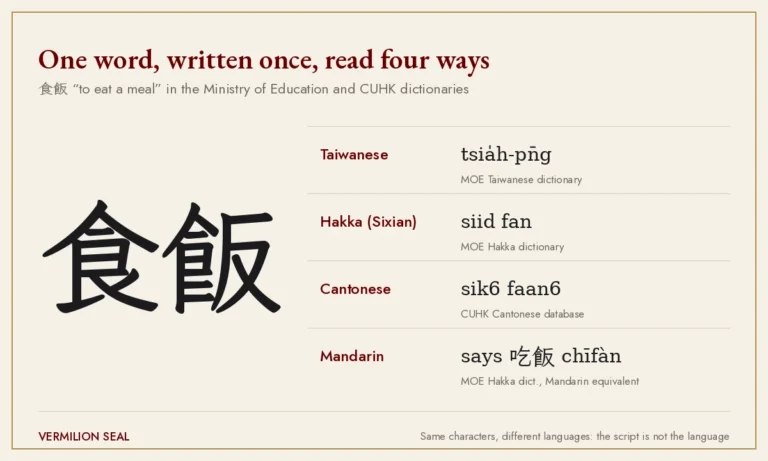
| Language | How 食飯 is read | Source |
|---|---|---|
| Taiwanese (Taiwanese Hokkien) | tsia̍h-pn̄g | Ministry of Education, 臺灣台語常用詞辭典 |
| Hakka (Sixian accent) | siid fan | Ministry of Education, 臺灣客語辭典 |
| Cantonese | sik6 faan6 | Chinese University of Hong Kong, 粵語審音配詞字庫 |
| Mandarin | Understood, but the everyday word is 吃飯, chīfàn | The Hakka dictionary gives 吃飯 as the Mandarin equivalent |
Nothing in those two characters tells you how to pronounce them, and nothing about traditional script ties them to one language. Taiwan’s own Ministry of Education publishes dictionaries of Taiwanese and Hakka that write every headword in Han characters, the same traditional characters used for Mandarin, with a romanisation alongside to give the sound. That is the normal relationship between Chinese characters and Chinese languages: shared writing, separate speech.
How one script can serve several languages
An alphabet records sounds, so a French word spelt in the Latin alphabet is still French and an English reader cannot pronounce it correctly without knowing French. Chinese characters work differently. Each one stands for a unit of meaning that is also a syllable, and the meaning travels more easily than the sound. 飯 means cooked rice, or a meal, whichever language you read it in; only the syllable you attach to it changes.
That is why the same writing system has served speakers of languages that cannot understand each other in speech. For centuries, educated readers across East Asia read and wrote Classical Chinese and pronounced it in their own ways, and the characters still sit at the heart of written Japanese. Within the Chinese languages the sharing is closer still. It is also why the question “is traditional Chinese a language?” never quite makes sense: the script was designed, in effect, to be indifferent to how it is pronounced.
There are limits. Where languages have words with no common written form, writers borrow or invent characters, which is what happened with Cantonese and with Taiwanese; and a text written in one language’s vocabulary and grammar can be hard going for a reader of another, even when every character is familiar. Shared script gives you a head start, not fluency.
Taiwan: traditional characters, and more than one language
In Taiwan, standard Mandarin is called 國語 or 華語, and it is written in traditional characters, which Taiwan officially calls 正體字. Children learn its sounds through Zhuyin (注音符號, often called bopomofo), a set of phonetic symbols the Ministry of Education first announced in November 1918 under the name 注音字母 and renamed in 1930. Pinyin is used on many road signs and in romanised names; Zhuyin is what schoolchildren actually learn to read with.
Mandarin is not the only language in the picture. Since 2019 Taiwan’s law has defined its national languages broadly:
Taiwan’s legal definition of a national language
本法所稱國家語言,指臺灣各固有族群使用之自然語言及臺灣手語。
“In this Act, ‘national languages’ means the natural languages used by each of Taiwan’s native ethnic groups, and Taiwan Sign Language.”
《國家語言發展法》第 3 條(2019 年 1 月 9 日公布) · Read the article on the national law database
In practice that means Mandarin, Taiwanese, Hakka, the Indigenous languages and Taiwan Sign Language. The first three share the traditional script; the Indigenous languages are written in the Latin alphabet under the government’s own orthographies. When someone says “traditional Chinese” in Taiwan, then, they are describing the writing on the page. Which language you read it in depends on who is reading.
Hong Kong: traditional characters, Cantonese speech
Hong Kong is where the confusion does the most damage, because it is traditional-script territory where Mandarin is not the everyday language. People speak Cantonese. Formal writing — newspapers, government notices, school essays — follows standard written Chinese, which is close to written Mandarin, and a Cantonese speaker reads it aloud in Cantonese pronunciation. Informal writing, advertising, chat and a good deal of popular fiction are in written Cantonese, which uses characters standard Chinese does not need.
Two of the commonest show the idea. 佢, read keoi5, is the everyday Cantonese “he, she, it”; the Chinese University of Hong Kong’s Cantonese pronunciation database describes it simply as a character of Cantonese usage for the third-person pronoun. 冇, read mou5, means “not have”. A Mandarin writer would put 他 or 她 for the first and 沒有 for the second. All four are traditional characters. What separates them is the language they belong to.
Those extra characters are catered for officially. The Hong Kong government maintains the Hong Kong Supplementary Character Set, which it describes as containing the special Chinese characters that the government and the public need in electronic communication; its 2016 edition has 5,033 characters, and one of its categories is characters used in Cantonese. Hong Kong’s education bureau is equally clear about which script schools use: in its words, the status of traditional characters is beyond doubt.
So a learner who says “I want to learn traditional Chinese for Hong Kong” needs to decide something else first. If the aim is to talk to people in Hong Kong, the language is Cantonese. If the aim is to read Hong Kong newspapers, standard written Chinese in traditional characters will get you most of the way, whether you pronounce it in Mandarin or Cantonese.
Mainland China and Singapore: simplified characters, Mandarin
On the mainland the standard language is 普通話 (Putonghua), which is Mandarin, written in simplified characters and taught with Hanyu Pinyin. Singapore teaches Mandarin with simplified characters and pinyin as well. Differences between mainland and Taiwanese Mandarin are real but modest — some vocabulary, some pronunciation habits, some grammar at the edges — and speakers understand each other without difficulty. The script difference is the more visible one, and it is covered in traditional vs simplified Chinese.
What to call things when it matters
Most of the time “Chinese” does the job. When it does not — ordering a translation, setting up a website, choosing a course — three decisions are hiding inside the word.
Which language? Mandarin, Cantonese, Taiwanese, Hakka or another. For a spoken course or subtitles, this is the only question that matters.
Which script? Traditional or simplified. For anything written, this decides what the characters look like. It is independent of the language.
Which place? Taiwan and Hong Kong both use traditional characters, but they are not interchangeable for professional work: vocabulary differs, and a few standard character forms differ too — Taiwan writes 衛 and 裡 where Hong Kong’s school lists give 衞 and 裏. The details are in does Taiwan use traditional Chinese?
Put together, the precise phrases are things like “Mandarin in traditional characters, Taiwan usage” or “Cantonese in traditional characters, Hong Kong usage”. They are clumsy, which is why menus shorten them, and why the shortened versions mislead. Romanisation adds one more layer of confusion — the same Mandarin word can be spelt differently in English depending on the system, which is why you see both Dao and Tao and both Taipei and Taibei.
What the standards actually say
The bodies that maintain the relevant standards settled this decades ago, and their paperwork is unusually clear about it.
ISO 15924 is a standard whose title is Codes for the representation of names of scripts, and whose registration authority is the Unicode Consortium. In that register, Hant is number 502 and its English name is “Han (Traditional variant)”; Hans is 501, “Han (Simplified variant)”. Both carry the date 29 May 2004. Neither is a language code, because the register does not contain language codes at all.
The word doing the work in both names is “variant”, and the register makes clear what that means in practice. Hani, number 500, is plain “Han (Hanzi, Kanji, Hanja)”, and it carries the property value alias “Han” — the name Unicode uses for the script as a character property. The alias column for Hant and Hans is empty, although both are recorded as encoded since Unicode 1.1. So at the level of character properties there is one Han script; traditional and simplified are registered as variants of it. They sit in the register alongside Latf (Fraktur), Latg (Gaelic), Aran (Nastaliq) and Cyrs (Old Church Slavonic Cyrillic) — variant registrations of a parent script, useful for saying how text is written without claiming a separate writing system.
Two layers, then, and it pays to keep them apart: ISO 15924 and BCP 47 give traditional and simplified their own codes, which is why zh-Hant is a real and useful tag, while Unicode’s character properties recognise a single Han script underneath both.
For language tags the governing document is BCP 47, currently RFC 5646. Its grammar puts the pieces in a fixed order, language then script then region, and its account of what a script subtag is for could hardly be plainer: they mark “the script or writing system variations that distinguish the written forms of a language or its dialects”. The same document works through our exact case as an example, noting that the tag zh-Hant “can now be composed from the subtags ‘zh’ (Chinese) and ‘Hant’ (Han script traditional variant)”. So zh-Hant is not a language code either. It is a language code with a script code attached.
The registry has a field called Suppress-Script, for languages customarily written in one script only, where naming it adds nothing. The RFC’s own example is Icelandic: “virtually all Icelandic documents are written in the Latin script, making the subtag ‘Latn’ redundant”. The registry record for zh has no such field. I should be careful about what that proves, because the RFC lists three reasons a record might lack one — the language is written in more than one script, or is not customarily written at all, or there was not enough information when the record was created.
What makes the absence meaningful for Chinese is the company it keeps. Japanese suppresses Jpan; Korean suppresses Kore. Both are written with Han characters among others, and for both the registry names a default — in each case a composite code minted for the purpose, Jpan covering Han with the two Japanese syllabaries and Kore covering Hangul with Han. No aggregate code was ever minted to cover traditional and simplified together, which sharpens the asymmetry rather than softening it. For zh it is not, and zh is additionally marked with a scope of “macrolanguage”. Of the three reasons the RFC offers, the first plainly applies: Chinese is written, abundantly, and it is written two ways.
There is one more entry worth knowing about. RFC 5645 tidied up the older Chinese tags, deprecating them in favour of the modern language subtags: zh-yue gives way to yue, zh-hakka to hak, zh-min-nan to nan. The tag zh-guoyu — 國語, the name Taiwan uses for Mandarin — had its preferred value flattened from zh-cmn to cmn. The mechanism is mundane, and a bare script code could not have appeared in that field anyway. The point is simply where the registry files things: 國語 is catalogued as a language, and has never been catalogued as a script.
Two governments, and both keep speech and script apart
If the standards feel abstract, the statutes are not. The two laws that govern language on either side of this script divide both keep the spoken standard and the written standard apart. Other jurisdictions using these characters — Hong Kong, Macao, Singapore — maintain character standards of their own, so this is not a two-way world.
The law on language in the People’s Republic of China does it in a single sentence:
PRC law on the national common language and script, article 2
本法所稱的國家通用語言文字是普通話和規範漢字,是國家法定全國通用的語言文字。
“The national common spoken and written language referred to in this Act is Putonghua and the standardised Chinese characters, which are the nationwide common spoken and written language established by law.”
《中華人民共和國國家通用語言文字法》第 2 條(2025 年 12 月 27 日修訂,2026 年 1 月 1 日施行) · 新華網受權發布
原文為簡化字,此處依本站體例轉寫為正體。2000 年制定版本條止於「規範漢字」,見國務院公報。
One sentence, two standards: 普通話 for the mouth, 規範漢字 for the page. They are joined by “and”, not by “that is to say”. The clause added in the 2025 revision does the same thing a second time, calling the two of them together the language established by law; the pair itself is untouched. A single sentence defining a national standard still has to name two objects.
Taiwan’s statute approaches language from a different direction and lands in the same place. It defines national languages in the plural, as quoted above, and the article immediately following declares them all equal, with no speaker of any of them to be discriminated against or restricted. What the law does not do, anywhere, is name a script among those national languages. And the clearest illustration sits inside the definition itself: Taiwan Sign Language is a national language by statute, and it is not written in characters at all. A framework that counts a sign language among its national languages is plainly not using “traditional characters” as the name of one.
Taiwan: four languages over the loudspeaker, one script on the sign
Here is what that pluralism sounds like. Ride the Taipei metro and every station is announced four times. The operator’s own FAQ explains why, and it is not a courtesy:
Taipei Rapid Transit Corporation, on why station names are announced in four languages
依據「大眾運輸工具播音語言平等保障法」第六條之規定,以及臺北市政府為考量臺北都會區之國際化發展趨勢,依此捷運系統廣播提供國語、閩南語、客家語及英語四種播音語言。
“Under article 6 of the Act for Broadcasting Language Equality in Public Transport, and in view of the Taipei metropolitan area’s international development, metro announcements are provided in four languages: Mandarin, Taiwanese [the source says Minnan], Hakka and English.”
臺北大眾捷運股份有限公司・常見問答
我未能在全國法規資料庫核對該法條原文,此處引的是北捷官方頁對第六條的引述。
Three of those four are languages of Taiwan, and the first three are mutually unintelligible to a degree that surprises visitors. The signage you read while you listen is in traditional characters throughout. One script, three Chinese languages, simultaneously, on a Tuesday morning.
The census puts numbers to it. Taiwan’s 2020 population and housing census asked residents aged six and over which languages they use. Mandarin was the main language for 66.4 per cent and Taiwanese for 31.7 per cent; as a secondary language the order reverses, Taiwanese at 54.3 per cent and Mandarin at 30.4 per cent. Combining main and secondary use gives Mandarin 96.8 per cent, Taiwanese 86.0 per cent, Hakka 5.5 per cent and indigenous languages 1.1 per cent. Those figures do not describe a monolingual society, and they are not a survey of scripts: every one of those respondents reads traditional characters.
The state does not merely tolerate this. It legislates the orthography. Taiwan’s Ministry of Education has published a list of recommended characters for writing Taiwanese — 700 entries, issued in 2009 and revised in 2010, with columns for the recommended character, its reading, alternative readings, the corresponding Mandarin word, examples of use and other forms in use. There is a parallel set of principles for Hakka, which ranks candidate characters by preference: the etymologically correct character first, then serviceable ones, then popular forms, then borrowings. A government that publishes an official list of traditional characters for writing a language that is not Mandarin has conceded the whole argument in advance.
The naming has moved too. Since August 2024 the ministry’s dictionary of the language is officially the 臺灣台語 dictionary rather than the 臺灣閩南語 one, renamed under the written-usage rules of the national languages development programme. The language Taiwan’s own government now calls Taiwanese Taigi is written in traditional characters.
One character, five Hakka accents, printed in a row by the ministry
If you want the distinction in a single line of evidence, the Ministry of Education’s Dictionary of Chinese Character Variants carries an appendix of reference characters for writing Hakka. Each row gives a character, its radical and stroke count, and then its reading in every major accent:
《異體字字典》附錄〈臺灣客語用字參考表〉
柏 木-05-09 四縣bag2;海陸bag5;大埔bag21;饒平bag2;詔安ba24
“Cypress — radical ‘wood’, five strokes beyond the radical, nine in total — Sixian bag2; Hailu bag5; Dabu bag21; Raoping bag2; Zhao’an ba24.”
One character, five accents, four distinct readings — Sixian and Raoping agree here, the other three do not — and none of them Mandarin. The character is doing exactly what characters do: holding still while the speech around it varies.
The ministry’s Hakka dictionary goes further and gives whole words. Look up 食飯 and you get the reading siid fan in the Sixian accent, glossed into Mandarin as 吃飯、進食、用餐、用膳 — to eat a meal, or by extension to make a living. Both halves of that entry are written in the same traditional characters. The difference between the headword and its gloss is not a difference of script. It is a difference of language, and the dictionary has to translate across it.
Set that beside the Mandarin reading of the same first character. In the ministry’s concise Mandarin dictionary, 食 is shí, an open syllable. In Hakka the same character is siid, with a final consonant Mandarin does not have. Same glyph, two languages, two sounds — and the glyph is the part that does not change.
Hong Kong had to encode characters for Cantonese
The other half of the traditional-character world makes the point from the opposite direction. Hong Kong writes traditional characters and speaks Cantonese, and when that combination met computers, the standard character sets of the day did not cover everything people there actually wrote.
The Hong Kong government has maintained a Supplementary Character Set ever since. The 2016 edition contains 5,033 items, being 4,602 characters and 431 symbols, and the official document is matter-of-fact about why they were needed: “Some characters were used in the names of persons and places while some in the Cantonese dialect.” Note what this is and is not. The characters were not invented; they existed in traditional writing already. What had to be extended was the encoding. But the reason a traditional-character jurisdiction needed its own supplement at all is that the inherited encodings had not covered everything written locally, including characters used in Cantonese.
The education side is as clear. Hong Kong’s curriculum guide for Putonghua treats it as a subject to be taught within the Chinese language education area, and states plainly that 香港屬於粵方言區 — Hong Kong belongs to the Cantonese-speaking region. The guide names pronunciation, vocabulary and grammar as the areas where the two differ, and directs teaching at the difficulties Cantonese speakers meet. Two languages, taught separately, written in the same characters.
So the two largest traditional-character societies pair that script with different spoken languages: Taiwan with Mandarin, Taiwanese and Hakka; Hong Kong with Cantonese. Any sentence of the form “traditional Chinese is X” has to be false in one of those places.
Where this goes wrong in public
I had assumed the confusion lived mostly in blog posts. It does not. It is in the interfaces and reference pages people trust.
MedlinePlus, the consumer health site of the United States National Library of Medicine, indexes its material by language. Its Chinese entries are labelled “Chinese, Simplified (Mandarin dialect)” and “Chinese, Traditional (Cantonese dialect)”. Those two labels are wrong in opposite directions, and each is refuted by the other’s territory: Taiwan reads traditional characters and speaks Mandarin, which kills the second, and Hong Kong reads traditional characters and speaks Cantonese, which kills the first. A reader in Taipei looking for health information in her own written language is directed to a page labelled Cantonese.
Microsoft’s Azure translation documentation lists supported languages in a table whose first column is headed “Language” and whose second gives a “Language code”. The codes offered for Chinese are zh-Hans and zh-Hant, which are script codes, sitting beside yue, which is a language code. The same table offers “Cantonese (Traditional)”, a label fusing a spoken language and a script into one name as though the pairing were fixed.
Apple’s specification pages are the most instructive case, because they get it right and wrong on the same sheet of paper. The iPhone 15 specifications list, under “Language support”, “Chinese (Simplified, Traditional, Traditional – Hong Kong)”: two scripts and a region. Scroll to the Siri languages and the list reads “Mandarin Chinese (China mainland, Taiwan)” and “Cantonese (China mainland, Hong Kong)”. When the machine has to listen, Apple names languages and then regions. When it has to render glyphs, Apple names scripts. The distinction is already in the document; it is simply never stated.
Google Translate’s own list of languages, for Chinese, offers 中文 (简体中文), 中文 (繁體) and 中文 (香港) — two scripts and a territory. Mandarin and Cantonese do not appear on it at all.
It would be unfair to present this as an industry that does not know. Much of it does, and says so more crisply than I have. The American Translators Association published a piece putting it in one line: when we talk about traditional or simplified Chinese, “we are only talking about the writing system”. The author goes on to name the belief that simplified is for Mandarin and traditional for Cantonese as a misconception to be corrected. The professional consensus is not the problem. The dropdown is.
Three claims worth checking
Three beliefs travel with this confusion. Two of them fail; the third I could not settle either way, and I would rather say so.
“Traditional characters are the older language.” This mistakes conservative character forms for conservative speech, and then points at the wrong language. Traditional characters do preserve older character structure. But the varieties that kept features of Middle Chinese which Mandarin has lost — the entering tone and the stop consonants that close its syllables among them — are Taiwanese and Hakka, as the ministry’s own materials show, along with Cantonese. The Ministry of Education’s handbook for the Taiwanese romanisation system has to provide for syllables closing in p, t and k, for a glottal stop written h, and for a tone inventory that keeps both the upper and the lower entering tone; modern Mandarin lost the entering tone and has no such final consonants. I am claiming no more than that: not that these varieties preserve the Middle Chinese sound system entire, which none of them does, but that they kept distinctions Mandarin dropped. The confusion in the original claim is therefore double. It attributes age to a script rather than to a language, and the languages that did keep the older distinctions are written in that very script.
“Simplified characters were invented by the Communist Party in the 1950s.” The dates are real: the State Council approved the simplification scheme in January 1956, with 515 simplified characters and 54 simplified components, and a consolidated table followed in 1964 — I have written separately about why that happened when it did. But the framing is contradicted by the Chinese education ministry’s own website, which hosts scholarly articles saying so in terms. One states that the history of simplified characters is as long as the history of traditional ones. Another says simplification runs right through the development of the script, that examples of simplified forms appear in documents of the Wei, Jin, Yuan, Ming and Qing periods, that the official and literary classes of the day dismissed them as 俗字 — vulgar or popular characters — and that the 1956 scheme was a consolidation and formal recognition of simplified regular-script forms already in use.
Two further facts make the single-government story untenable. The Republic of China got there first: its education ministry published a first list of simplified characters in August 1935, with 324 characters, and retreated from it within months, one of the two ministry articles saying it was withdrawn after opposition and the other that a February 1936 order suspended it. And Taiwan’s own authorities file these forms as what they are:
《異體字字典》常見問題:簡體字與異體字有何不同?
異體字的涵義較廣,簡體字是異體字的一種。
“‘Variant character’ is the broader term; simplified characters are one kind of variant character.”
That is Taiwan’s standard-setting dictionary, in the jurisdiction most invested in traditional forms, classifying simplified characters as a species of variant. Its entry for 万 as a variant of 萬 cites 《漢隸字源》, a Song compilation of Han clerical-script forms, which in turn cites a stele. I have not independently dated that stele and will not pretend otherwise, but the point survives without the date: a character form recorded from a stone inscription was not devised in 1956.
“Readers of one script cannot read the other.” In practice many literate adults manage the crossing with some friction, helped by the fact that a great many characters are untouched by simplification and that the systematic component substitutions are learnable. But I went looking for published experimental work with figures I could cite, and found none I could read in full. So I will say only that I could not substantiate the strong version of the claim, and leave the number out rather than invent one.
FAQ
Is Mandarin traditional or simplified?
Neither; Mandarin is a spoken language and can be written in either script. Taiwan writes Mandarin in traditional characters, while mainland China and Singapore write it in simplified characters.
Is Cantonese the same as traditional Chinese?
No. Cantonese is a spoken language; traditional Chinese is a script. Hong Kong and Macau write Cantonese in traditional characters, with some extra characters for Cantonese words, but traditional characters are also used for Mandarin in Taiwan.
Can a Mandarin speaker read traditional Chinese?
A literate Mandarin speaker from Taiwan reads it natively. One who learnt simplified characters can usually work out most traditional text with some practice, because many characters are identical and most others differ in regular ways; the hard cases are the few simplified characters that stand for more than one traditional one.
What does “Chinese (Traditional)” mean in Google Translate?
In practice it means written Mandarin in traditional characters, generally following Taiwanese usage. It is a script setting, not a separate language, and it is not Cantonese.
Romanisation makes the same trouble for names as script choice makes for text. The goddess 媽祖 appears in official Republic of China English as Matzu, Mazu and Matsu, the last of these shared with the archipelago named after her: three official spellings of one goddess.
The distinction has practical consequences beyond reading. The New Year rule against washing your hair is usually explained as a pun on 髮 and 發財, which only reads as a pun where simplification merged both into 发 — see Chinese New Year taboos.
Is “traditional Chinese” a language I can learn to speak?
No. You can learn to read and write traditional characters, and you can learn a language that uses them — Mandarin, Taiwanese, Hakka or Cantonese. But traditional Chinese is a written standard, not something anyone speaks, in roughly the way that Fraktur was a way of writing German down rather than a way of talking. If a course or a job advert offers “traditional Chinese” as a spoken skill, the person who wrote it has not thought it through, and it is worth asking which language they mean.
Does zh-TW mean the same as zh-Hant?
Not quite, and the difference matters if you are tagging content. zh-Hant says the text uses traditional characters, and nothing more. zh-TW says the text is for Taiwan, which implies traditional characters but also carries Taiwanese vocabulary and conventions that differ from Hong Kong’s. The W3C’s guidance describes how people historically “had to bend” region tags such as zh-CN to mean a script, because that was all they had. If you mean the script, write zh-Hant or zh-Hans; if you mean the locale, use the region tag and accept that it says more than you asked.
Do Taiwanese and Hakka use traditional characters?
Yes, and officially so. Taiwan’s Ministry of Education publishes recommended character lists for writing Taiwanese and principles for selecting characters for Hakka, and its dictionaries of both languages are written in traditional characters throughout. Both languages also have romanisation systems used alongside the characters, which is why a dictionary entry shows Hakka as siid fan next to the characters 食飯. The characters are shared; the readings are not. Which of the two scripts a child should start with is a separate question, and one I have looked at on its own.
Were simplified characters invented in the 1950s?
The official scheme dates from 1956, but many of its forms are older. The Chinese education ministry’s own site hosts articles stating that simplified forms run through the whole history of the script and that the 1956 scheme consolidated and formally recognised ones already in use. Taiwan’s Ministry of Education classifies simplified characters as a kind of variant character and cites pre-modern attestations for some of them. The Republic of China also published, and then abandoned, its own list of 324 simplified characters in 1935. What 1956 did was standardise and mandate, not invent.
Sources
- 《國家語言發展法》第 3 條、第 4 條 — 全國法規資料庫:第 3 條「本法所稱國家語言,指臺灣各固有族群使用之自然語言及臺灣手語。」;第 4 條「國家語言一律平等,國民使用國家語言應不受歧視或限制。」;2019 年 1 月 9 日公布。
- ISO 15924 script codes — Unicode Consortium:
Hantno. 502 “Han (Traditional variant)” andHansno. 501 “Han (Simplified variant)”, both dated 29 May 2004 and recorded as encoded since Unicode 1.1;Hanino. 500 carries the property value alias “Han” whileHantandHanscarry none. Compare the variant registrationsLatf,Latg,AranandCyrs. - RFC 5646 (BCP 47), Tags for Identifying Languages — RFC Editor: §2.2.3 on script subtags marking “the written forms of a language or its dialects”; §2.2.8 on composing
zh-Hant; §3.1.9 on Suppress-Script, including the Icelandic example and the three reasons a record may lack the field; §3.1.11 onzhas a macrolanguage. - RFC 5645, Update to the Language Subtag Registry — RFC Editor: deprecates
zh-yue,zh-hakkaandzh-min-nanin favour ofyue,hakandnan, and changes the preferred value ofzh-guoyufromzh-cmntocmn. - IANA Language Subtag Registry — IANA: the record for
zhgives Scope “macrolanguage” and has no Suppress-Script field, whilejasuppressesJpanandkosuppressesKore. - Language tags in HTML and XML — W3C: on region tags such as
zh-CNandzh-TWhaving been bent to mean the two scripts, and onzh-Hansandzh-Hantapplying regardless of the reader’s spoken variety. - 《中華人民共和國國家通用語言文字法》第 2 條 — 國務院公報:「本法所稱的國家通用語言文字是普通話和規範漢字。」所引為 2000 年制定、2001 年施行版。
- 中華人民共和國主席令第六十六號 — 中國政府網:該法經第十四屆全國人民代表大會常務委員會第十九次會議於 2025 年 12 月 27 日修訂通過,自 2026 年 1 月 1 日起施行。修訂版第 2 條文字本站尚未核實。
- 到站站名廣播為何須用四種語言播報? — 臺北大眾捷運股份有限公司・常見問答:引《大眾運輸工具播音語言平等保障法》第六條,提供國語、閩南語、客家語及英語四種播音語言。
- 《109 年人口及住宅普查初步統計結果》 — 行政院主計總處:6 歲以上本國籍常住人口主要使用語言為國語者占 66.4%、閩南語占 31.7%;次要使用語言為閩南語者占 54.3%、國語占 30.4%。普查標準日 2020 年 11 月 8 日。
- 《臺灣閩南語推薦用字 700 字表》 — 教育部:98 年 10 月公布、99 年 9 月修正;欄位為編號、建議用字、音讀、又音、對應華語、用例、異用字,共 700 條(部分條目為多字詞)。
- 《臺灣台語漢字之選用原則》 — 教育部:載明《臺灣閩南語常用詞辭典》於 113 年 8 月更名為《臺灣台語常用詞辭典》。
- 《臺灣客語書寫推薦用字漢字選用原則》 — 教育部:用字順位為本字、堪用字、俗用字、借用字。
- 《異體字字典》附錄〈臺灣客語用字參考表〉 — 教育部:「柏 木-05-09 四縣bag2;海陸bag5;大埔bag21;饒平bag2;詔安ba24」;欄位為字形、部首筆畫、音讀。
- 《異體字字典》常見問題 — 教育部:「異體字的涵義較廣,簡體字是異體字的一種。」
- 《異體字字典》「万」(「萬」之異體,字號 A02909-011) — 教育部:關鍵文獻引《漢隸字源・去聲・願韻・萬字》所錄〈建平郫縣碑〉。《漢隸字源》為宋代婁機所編漢隸字書;該碑年代本站未自行考定。
- 《臺灣客語辭典》「食飯」條 — 教育部:四縣腔音讀 siid fan,對應國語「吃飯、進食、用餐、用膳」。
- 《國語辭典簡編本》「食」條 — 教育部:音讀 ㄕˊ、漢語拼音 shí;食部-0畫、共9畫。
- 《臺灣閩南語羅馬字拼音方案使用手冊》 — 教育部:普通入聲韻以一般塞音 p、t、k 收尾,入聲韻以喉塞音 h 收尾;聲調含陰入、陽入。
- 王立軍〈談漢字簡化的優化原則〉 — 中華人民共和國教育部:「簡化是貫穿整個漢字發展歷史的一條重要規律」;魏晉元明清歷代文獻可見簡體用例,當時稱之為「俗字」;1956 年方案為「對此前楷書簡體字的集中整理和正式認可」;1935 年《第一批簡體字表》為政府首次公布,半年後收回。
- 蘇培成〈近百年來漢字的簡化與規範〉 — 中華人民共和國教育部:「簡體字的歷史和繁體字的歷史一樣長久」;1956 年《漢字簡化方案》收 515 個簡化字、54 個簡化偏旁;1935 年 8 月表內 324 字,1936 年 2 月令「簡體字應暫緩推行」;1964 年《簡化字總表》。
- Hong Kong Supplementary Character Set – 2016 — Hong Kong SAR Government: “The HKSCS-2016 consists of 5 033 characters, including 4 602 Chinese characters and 431 symbols”; on the need for it, “Some characters were used in the names of persons and places while some in the Cantonese dialect.”
- 《普通話科課程指引(小一至中三)》 — 香港課程發展議會(2017):普通話科為中國語文教育學習領域下的一門學科;「香港屬於粵方言區」。
- Languages index — MedlinePlus, US National Library of Medicine: Chinese entries labelled “Chinese, Simplified (Mandarin dialect)” and “Chinese, Traditional (Cantonese dialect)”.
- Azure Translator language support — Microsoft Learn: a table with columns headed “Language” and “Language code”, giving
zh-Hansandzh-Hantbesideyue, and the label “Cantonese (Traditional)”. - iPhone 15 technical specifications — Apple: under “Language support”, “Chinese (Simplified, Traditional, Traditional – Hong Kong)”; under Siri languages, “Mandarin Chinese (China mainland, Taiwan)” and “Cantonese (China mainland, Hong Kong)”.
- Languages — Google Translate: the Chinese entries are two scripts and a territory; Mandarin and Cantonese are absent.
- Fang Sheng, Demystifying the difference between simplified and traditional Chinese — American Translators Association: “When we talk about Traditional or Simplified Chinese, we are only talking about the writing system”, with the simplified-equals-Mandarin pairing named as a misconception.
- 《國家語言發展法》第3條 — 全國法規資料庫:「本法所稱國家語言,指臺灣各固有族群使用之自然語言及臺灣手語。」;公布日期見 文化部(2019年1月9日;accessed 10 Sep 2026)
- 教育部《臺灣台語常用詞辭典》「飯」:食飯 tsia̍h-pn̄g(吃飯);「食」:tsia̍h — sutian.moe.edu.tw(經 教育百科 查閱;accessed 10 Sep 2026)
- 教育部《臺灣客語辭典》「食飯」:四縣腔 siid fan;對應國語「吃飯、進食、用餐、用膳」 — hakkadict.moe.edu.tw(accessed 10 Sep 2026)
- 香港中文大學《粵語審音配詞字庫》:「食」 sik6、「飯」 faan6;「佢」 keoi5「粵語用字,第三人稱代名詞」;「冇」 mou5「沒有」 — humanum.arts.cuhk.edu.hk(accessed 10 Sep 2026)
- 教育部《國語注音符號手冊》:「自民國二年創制,民國七年公布」;《教育大辭書》「注音字母」條:民國七年十一月二十三日公布〈注音字母表〉 — language.moe.gov.tw;教育百科(accessed 10 Sep 2026)
- 香港特區政府〈香港增補字符集〉:「《香港增補字符集-2016》共收錄 5,033 個字符」;字符類別含「粵方言用字」 — ccli.gov.hk;gov.hk(accessed 10 Sep 2026)
- 香港教育局〈政策正面睇〉(2016年2月13日):「繁體字的地位毋庸置疑。」 — edb.gov.hk(accessed 10 Sep 2026)
- ISO 15924 code list: “Hant — Han (Traditional variant)”, “Hans — Han (Simplified variant)” — unicode.org; RFC 5646, Tags for Identifying Languages, §2.2.8 and §3.1.7 — rfc-editor.org (accessed 10 Sep 2026)