
Zhuangzi’s happiness of fish is about a hundred characters long, and it ends in a pun. Whether that pun reaches you depends entirely on which English version you happen to be holding. In several of them what survives is a tidy little parable about not being able to feel what someone else feels. What the Chinese actually records is an argument that Zhuangzi wins by rereading a single word of his opponent’s question — and by pointing at the ground under his own feet.
The passage closes chapter 17 of the 《莊子》, the chapter called 〈秋水〉, Autumn Floods. Two friends are out walking. One of them is Huizi (惠施), the logician, the man Zhuangzi spends the book teasing and clearly cannot do without. Here is the whole of it.
Zhuangzi, Autumn Floods
莊子與惠子遊於濠梁之上。莊子曰:「儵魚出遊從容,是魚樂也。」惠子曰:「子非魚,安知魚之樂?」莊子曰:「子非我,安知我不知魚之樂?」惠子曰:「我非子,固不知子矣;子固非魚也,子之不知魚之樂全矣。」莊子曰:「請循其本。子曰『汝安知魚樂』云者,既已知吾知之而問我,我知之濠上也。」
Zhuangzi and Huizi were walking out on the weir above the Hao. Zhuangzi said: “The white minnows come out and swim about unhurried — that is what fish enjoy.” Huizi said: “You are not a fish. Whence do you know what fish enjoy?” Zhuangzi said: “You are not I. Whence do you know that I do not know what fish enjoy?” Huizi said: “I am not you, so of course I do not know you. You are certainly not a fish, and that you do not know what fish enjoy is settled.” Zhuangzi said: “Let us trace it back to the root. When you said, whence do you know the fish enjoy it — you put that question to me already knowing that I knew. I knew it here, up on the Hao.”
《莊子・外篇・秋水》 · ctext.org. The received text of 《莊子集釋》 reads 「是魚之樂也」 where the Chinese Text Project base text reads 「是魚樂也」; nothing in the argument turns on it.
Everything turns on one word
Huizi’s challenge is four characters: 安知魚之樂. The word doing the work is 安, an. In classical Chinese it is an interrogative that can be read two ways. It asks how, and it asks where from. Huizi plainly means the first: on what basis can you claim to know this? He is a logician; he is testing a warrant.
Zhuangzi lets the exchange run to the point where Huizi thinks he has closed it — 全矣, the case is complete — and then goes back to the wording. 請循其本. Trace it back to the root. And having gone back, he answers the other 安: not on what basis but from where. From here. From up on the Hao, standing next to you, watching.
That is why the last five characters are 我知之濠上也 and not something about feelings. The sentence gives a location because the question, reread, asked for one.
What the old commentators did with it
This is not a modern reading imposed on a Daoist text. Guo Xiang (郭象, died 312), who edited the thirty-three-chapter recension that survives — the fuller early versions are lost — glosses the ending as a place and says so with some impatience.
Guo Xiang’s commentary on the last line
苟知我之非魚,則凡相知者,果可以此知彼,不待是魚然後知魚也。故循子安知之云,已知吾之所知矣。而方復問我,我正知之於濠上耳,豈待入水哉!
If you can know that I am not a fish, then knowers in general really can know that from this — one need not be a fish before one can know fish. So trace back your “whence do you know”, and you already knew what I know. And yet you put the question to me again. I know it right here, up on the Hao — why would I have to get into the water?
郭象注,見郭慶藩《莊子集釋・外篇秋水第十七》 · ctext.org
Cheng Xuanying (成玄英), writing his sub-commentary in the seventh century, is equally plain about the turn: 「循,猶尋也」 — 循 here means to trace, to follow something back to its source. Huizi, he says, 「棄初逐末」, abandoned the beginning and chased the end of the thread, so Zhuangzi asks to go back and look at the source. Cheng also records something the English versions quietly drop. Glossing the setting he writes 「石絕水為梁,亦言是濠水之橋梁」 — a 梁 is stone laid across water to block it, though it may also mean a bridge over the Hao. Lu Deming’s 《經典釋文》, printed with the commentaries in the same edition, cites Sima Biao to the same effect: 「濠,水名也。石絕水曰梁。」 A weir, then, at least as readily as a bridge.
Five English versions, and what each does with the last line
Set five endings side by side and the drift is easy to see. Three of the five give Huizi’s question as “how”, which closes off the reread before the last line arrives.
| Version | Huizi’s question | Zhuangzi’s last line |
|---|---|---|
| Legge, 1891 (transcribed at ctext) | “how do you know what constitutes the enjoyment of fishes?” | “I know it (from our enjoying ourselves together) over the Hao.” |
| Giles, Musings of a Chinese Mystic, 1906 | “how can you possibly know in what consists the pleasure of fishes?” | “I knew it from my own feelings on this bridge.” |
| Burton Watson, 1968 | “how do you know what fish enjoy?” | “I know it by standing here beside the Hao.” |
| A. C. Graham | “Whence do you know that the fish are happy?” | “I knew it from up above the Hao.” |
| Brook Ziporyn | also uses “whence” | glossed in his note as “a friendly metajoke” |
Legge keeps the river but supplies a motive the Chinese does not contain. The round brackets are his own convention for words he has supplied, which is scrupulous of him; what sits inside them, to my reading, is already the sentimental interpretation. Watson keeps the place but reads 安 as “how” throughout, so the reread is simply not available in his English. Graham is the one who takes 安 at both values and gets an ending that actually answers the question — though in a footnote he warns against treating the move as no more than a trick with the idiom. The Graham and Ziporyn wordings above are quoted from Lucas Klein’s essay on the passage rather than from the printed editions, and are marked as such in the sources below.
And then there is Giles, who does something different in kind. The effect, whatever the intention, is not a lost pun but a substituted answer. The Chinese points outward at a river; this English points inward at a feeling. Once the last line is “from my own feelings on this bridge”, the debate stops being a debate: Huizi’s objection stands, and Zhuangzi appears to concede it by retreating into his own head.
How a Victorian sentence became an unanswerable riddle
In 2014 the anthropologist David Graeber ended an essay with this story and a confession. He used to set it for his students at Yale, he wrote, and offered an automatic A to anyone who could explain why the last line made sense. Nobody ever collected.
The text he quoted ends: “as I did know, from my own feelings on this bridge.” That is the Giles wording, lightly modernised, and it carries no translator’s name. The translator and critic Lucas Klein made the point at the time: the sentence Graeber’s students could not explain had had its logic translated out of it before it reached them. They were being asked to find the sense in a line that had been rewritten into nonsense — not by Zhuangzi, and not by Graeber, but by a translation published when Queen Victoria was on the throne.
The same sentence is still circulating. BrainyQuote runs “I know the joy of fishes in the river through my own joy, as I go walking along the same river” over Zhuangzi’s name, with no translator, no book, no chapter. There is no river-walking in the Chinese and no “own joy”: the last five characters say where the speaker is standing. That is one common route by which a misquotation forms: a nineteenth-century interpretive choice comes loose from its translator and ends up quoted as the thing itself. We have watched the same thing happen to Laozi on cooking a small fish and to heaven and earth are not benevolent.
What Taiwan’s dictionaries do with it
Here is the part of the story that never reaches English. In the Ministry of Education’s dictionaries — the reference works every school in Taiwan uses — this passage is not filed under scepticism at all.
Ministry of Education, Dictionary of Chinese Idioms
知魚之樂:莊子與惠施於濠梁之上,辯論水中游魚是否快樂之事。典出《莊子.秋水》。比喻能體會物情。
To know the joy of fish: Zhuangzi and Hui Shi, up on the weir above the Hao, debating whether the fish in the water are happy. From Zhuangzi, “Autumn Floods”. A figure for being able to enter into the feeling of things.
教育部《成語典》 · dict.idioms.moe.edu.tw
比喻能體會物情. The official gloss is about the capacity to feel one’s way into things — and the things in question are the fish, not the other person. The companion entry for 濠梁 in the 《重編國語辭典修訂本》 goes further in the same direction: after the story, it says, 濠梁 came to stand for the recluse’s unhurried ease, his detachment from the world, and it cites the sixth-century 《水經注》 phrase 「可謂濠梁之性,物我無違矣」 — the Hao-weir temperament, in which self and things are not at odds.
The two bodies of material we have sampled here shelve the same hundred characters differently. The English secondary quotations above reach for the problem of other minds. The Taiwanese dictionary entries reach for a mood: a landscape, a man with nowhere he has to be. Neither shelf is wrong, and specialists writing in English — Graham, Ziporyn, Klein — know the second one perfectly well. But a reader who meets the passage through quotation sites alone is far less likely to run into it.
One small honesty about the Taiwanese source. 知魚之樂 does not have a full entry in the idiom dictionary: it sits in the appendix, carried over as a cross-reference from the older revised dictionary, with a definition and no source note or worked example. That is an observation rather than a complaint, but for a phrase this well known it is a curious place to end up: the state’s own reference work has recorded it without quite adopting it.
Does Zhuangzi actually win?
Readers have been arguing about this for seventeen centuries, and it would be dishonest to pretend there is a settled answer. Guo Xiang thinks the reply is sound and says why: if Huizi can know across the gap between himself and Zhuangzi, he has already conceded that knowers can know across a gap, and the fish are no worse a case. Others read the ending as a piece of footwork — a man who has lost on the merits changing the meaning of the question. Graham, who gave us the reading that makes the joke work, is careful to say it is more than a trick with an idiom, which is a sentence you only write if you can hear someone objecting that it is exactly that.
What can be said flatly is narrower, and it is the thing English readers are usually not given: the last line is an answer, it is aimed at Huizi’s own wording, and the wording it is aimed at is 安. Whatever you conclude about who won, you cannot even start on the question from a version that ends in feelings on a bridge.
If you want another passage where the English tradition has quietly added a moral that is not in the Chinese, the empty boat from chapter 20 is the clearest case in the book. For how we compare editions when the translations disagree, see our note on choosing a Daodejing translation.
FAQ
Is “you are not a fish, how do you know fish are happy” a saying of Confucius?
No. It is Huizi’s line, from chapter 17 of the Zhuangzi, and it is an objection rather than a maxim — the point of the passage is the reply to it. Confucius appears often in the Zhuangzi, usually as a character being gently corrected, but he has nothing to do with this exchange.
Which English translation of the happiness of fish should I read?
If you only read one, read a version that renders 安 as “whence”, because otherwise the ending cannot mean anything. Graham’s is the standard reference for that choice and Ziporyn follows him. Watson reads beautifully and keeps the river but not the pun. Where a version is circulating without a translator’s name attached, treat it as a quotation of unknown provenance until you can trace it.
What does 請循其本 mean?
Literally, “please trace it back to the root”. Cheng Xuanying glosses 循 as 尋, to seek out or follow back, and reads the sentence as a request to return to the source of the dispute — which in practice means returning to the exact words Huizi used.
Where is the Hao, and was it a bridge?
Cheng Xuanying places the Hao in Zhongli commandery in the Huainan region and notes that Zhuangzi’s grave was said to be nearby. On 梁 he gives two readings: a stone barrier across the water, and a bridge over the Hao. Taiwan’s 《重編國語辭典修訂本》 gives “bridge over a river” as the first sense of 濠梁. English versions have almost all chosen the bridge.
The fish debate is not the only passage in the Zhuangzi whose point survives translation badly. Cook Ding and the Ox looks at what happens when a chapter called 養生主 is retold as a lesson in mastery.
Huizi asks the awkward question here, and he asks it again at the death of Zhuangzi’s wife — where the reply is the reverse of what the Chinese idiom built out of it.
Herbert Giles adds to the text elsewhere in the Zhuangzi too. In the monkey-keeper parable of chapter two he turns a bare self-question into a dialogue between two named speakers who are not there in the Chinese. See Zhuangzi’s three in the morning.
Zhuangzi’s other famous fish are the ones left on dry land when the spring dries up, wetting each other with spit: Zhuangzi: Forget Each Other in the Rivers and Lakes.
Sources
- 《莊子・外篇・秋水》 — Chinese Text Project, Zhuangzi, “The Floods of Autumn”, section 13 (checked 18 September 2026, verified character by character in-browser). James Legge’s 1891 English is transcribed alongside on the same page; the Legge wording quoted above is that transcription, not a printed copy of the Sacred Books of the East.
- 郭象注、成玄英疏、陸德明釋文,見郭慶藩《莊子集釋・外篇秋水第十七》 — Chinese Text Project, Zhuangzi jishi (checked 18 September 2026, read in-browser).
- 教育部《成語典》「知魚之樂」條 — Ministry of Education, Dictionary of Chinese Idioms, entry 14839.
- 教育部《重編國語辭典修訂本》「濠梁」條 — Ministry of Education, Revised Mandarin Chinese Dictionary, entry 80826.
- Musings of a Chinese Mystic: Selections from the Philosophy of Chuang Tzu, Wisdom of the East series, 1906 — “Personal Anecdotes”, Internet Sacred Text Archive, where the volume is credited to Lionel Giles. The renderings in it are generally attributed to Herbert A. Giles’s 1889 translation; we have not checked that against a printed copy, and call the version simply “Giles” above for that reason.
- Burton Watson, trans., The Complete Works of Chuang Tzu, 1968, chapter 17 — text at Terebess Asia Online.
- Lucas Klein, “Anarchist Anthropology, Happy Fish, and Translation: Where do you get that?”, 12 February 2014 — Paper Republic. Source for the Graham wording quoted above, for Graeber’s quoted text, and (in the comment thread) for the Ziporyn note. We have not inspected the printed Graham or Ziporyn editions.
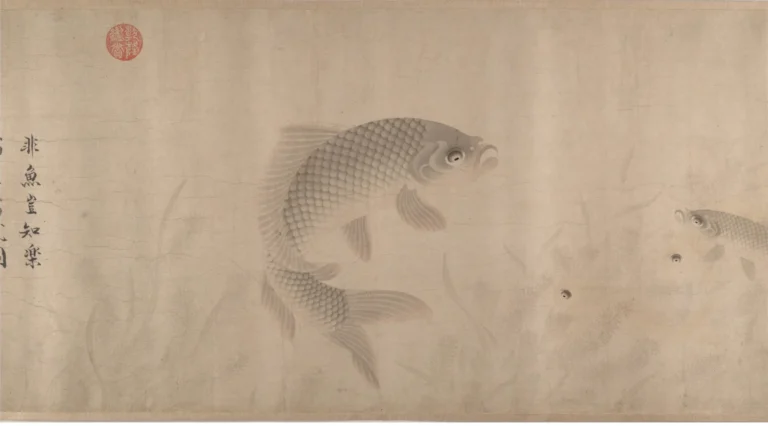
- Zhou Dongqing, The Pleasures of Fishes, 1291 — The Metropolitan Museum of Art, accession 47.18.10.
- Unattributed quotation checked 18 September 2026 — BrainyQuote, “Zhuangzi”.



