
Ask what the Zhuangzi says about death and someone will tell you the story of the tub: the philosopher’s wife dies, his friend arrives to offer condolences, and finds him sitting on the ground drumming on a pot and singing. It is usually told as a lesson in detachment. But the passage on Zhuangzi mourning his wife contains a sentence that makes detachment the wrong word, and the afterlife of the phrase in Chinese is stranger still — because 鼓盆而歌, the act of drumming and singing, is listed in Taiwan’s official dictionary today as an expression meaning grief at the death of one’s wife. The phrase now means the thing the man in the story had just stopped doing.
What the passage actually says
The anecdote sits in the 至樂 (Perfect Enjoyment) chapter of the outer chapters. It is short — four exchanges, no commentary, no moral tacked on the end.
莊子妻死,惠子弔之,莊子則方箕踞鼓盆而歌。
Zhuangzi’s wife died. Huizi came to offer condolences, and found Zhuangzi squatting with his legs splayed, drumming on a tub and singing.
Chinese Text Project, Zhuangzi, ‘Perfect Enjoyment’ · my translation
Huizi is scandalised, and says so. The reply is the part that matters, and it is the part that gets compressed out of every short retelling — not because translators drop it, but because a summary has no room for a man contradicting himself.
不然。是其始死也,我獨何能無概然!
Not so. When she first died, how could I alone not have been stricken?
Chinese Text Project, Zhuangzi, ‘Perfect Enjoyment’ · my translation
He grieved. He says so in the second sentence, before any argument about the cosmos. What follows is the reasoning that brought him out of it: that before she was born she had no life, before that no form, before that no breath; that the change from breath to form to life and now to death runs like the passing of the four seasons; and that she is now 偃然寢於巨室 — lying down peacefully in the great chamber — so that to keep sobbing after her would be to show he had understood nothing about how things go. The word he uses for his own wailing, 噭噭, is an onomatopoeia: the noise of it, not the feeling.
So the sequence is grief, then reasoning, then singing. The singing is not an alternative to mourning. It is what he does after mourning has been thought through — which is a different and much less comfortable proposition than the one that gets quoted.
What the dictionary did to it
Here the story stops being about translation into English and starts being about Chinese. Taiwan’s 《重編國語辭典修訂本》, the Ministry of Education’s scholarly reference dictionary, carries three related entries. Read them in order.
鼓盆而歌:比喻遭喪妻之痛。
‘Drumming on a tub and singing’: a figure for suffering the pain of a wife’s death.
That is the whole reversal in one line. In the source, drumming on the tub is the moment the weeping stops. In the dictionary, it is the weeping. And the entry proves its definition by quoting the very passage it has inverted — the headword’s gloss and the headword’s evidence point in opposite directions, inside the same box.
The neighbouring entries confirm it is not a slip. Entry 71286, for the bare compound 鼓盆, retells the anecdote accurately, cites 《莊子.至樂》 as its source, and then adds four characters: 後比喻妻死 — ‘later, a figure for a wife’s death’. The dictionary is recording the drift itself, with the joint visible. Its supporting quotation is a line of Ming drama in which a man 鼓盆已久,未有夫人 — has ‘drummed the tub’ for a long while and has no wife — where the phrase carries no philosophy at all and simply means widowed. Entry 71288, 鼓盆之戚, glosses it flatly as the grief of losing a wife, and quotes the Qing story collection 《聊齋志異》, where a character is poor, hot, living under a few beams of thatch, and has 鼓盆之戚. He is a widower. That is all it means by then.
The Ministry’s Dictionary of Chinese Idioms logs 鼓盆之戚 in its editorial database with a frequency count of six — listed there alongside six idiom reference works. The reversed sense is not a curiosity of one dictionary.
A Ming bestseller got there first
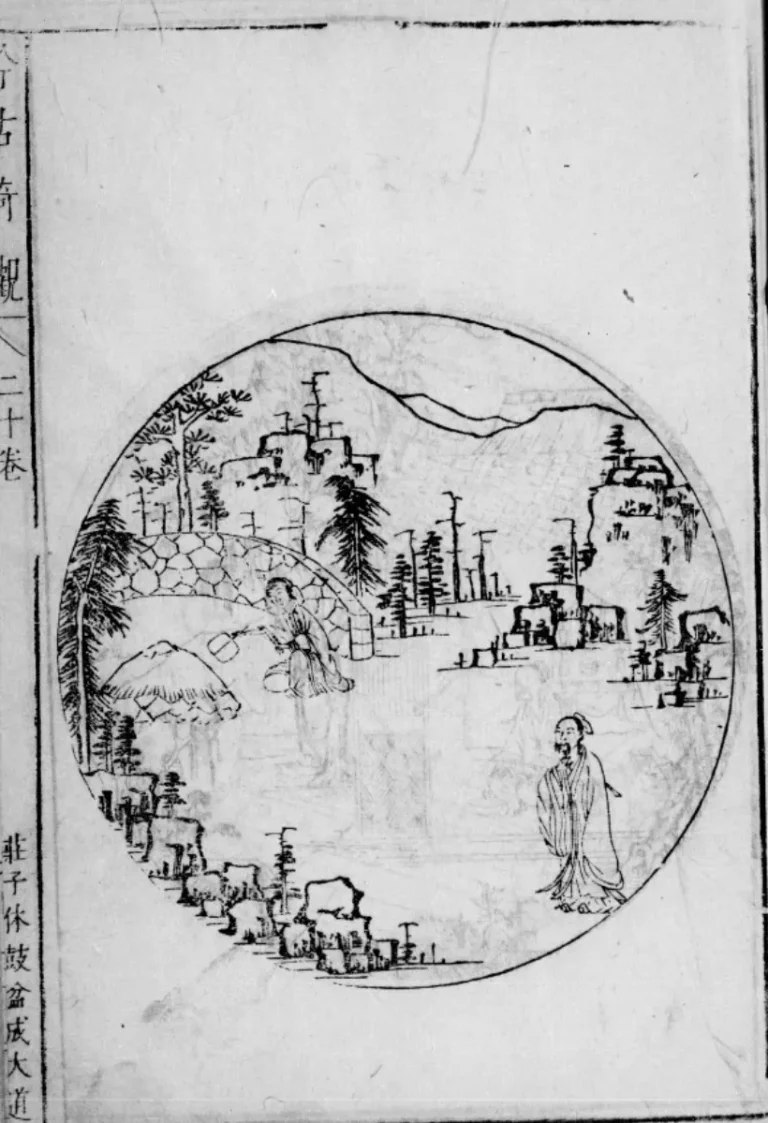
If you want to know when the tub changed meaning, the most legible evidence is a vernacular story that sold extremely well. Feng Menglong’s collection 《警世通言》 (1624) opens its second chapter with 〈莊子休鼓盆成大道〉 — ‘Zhuangzi Drums on the Tub and Attains the Great Way’. It was reprinted in the anthology 《今古奇觀》, which is where the illustration above comes from.
The tale opens with the scene in the illustration above. Walking in the hills, Zhuangzi comes across a young widow fanning a grave mound: she has promised her husband she will not remarry until the earth on his tomb is dry, and she is helping the earth along. That image sets the terms for everything after it, and the tale keeps returning to it.
The plot has nothing to do with the Zhuangzi. Zhuangzi fakes his own death to test his wife, Tian. She takes up with a young visitor almost at once, and when he falls ill and needs a fresh human brain as medicine, she goes to the coffin with an axe. The text is precise about why she manages it: 那莊周是達生之人,不肯厚斂,桐棺三寸,一斧就劈去了一塊木頭,再一斧去,棺蓋便裂開了 — Zhuangzi, a man who understood life, refused a heavy burial, so the paulownia coffin was three inches thick; one axe-blow took out a piece of wood, and a second split the lid. He sits up. She hangs herself. And only then:
莊生見田氏已死,解將下來,就將劈破棺木盛放了他,把瓦盆為樂器,鼓之成韻,倚棺而作歌。
Seeing that Tian was dead, Zhuangzi cut her down, laid her in the split coffin, took the earthenware basin for an instrument, drummed it into rhythm, and leaned on the coffin and sang.
Wikisource, 《警世通言》 chapter 2 · my translation
Same gesture, opposite meaning. In the Zhuangzi the drumming settles a grief that was real. In the Ming story it is a verdict delivered over a woman who has been caught. Once that version is the one people know — which two bestselling anthologies made likely — a reader meeting 鼓盆 in a later text has no reason to hear anything in it except a dead wife.
I want to be careful about the causal claim. The dictionary does not cite Feng Menglong, and the drift is attested earlier than he is: the Ming drama quoted at entry 71286 already uses 鼓盆 to mean nothing but widowed. What the story shows is not the origin of the shift but how thoroughly it had won by the seventeenth century — enough that the most popular retelling of the anecdote could invert its point and keep its title.
What the English translators did
The English record is better than its reputation, and it is worth saying so plainly, because the easy version of this article would claim that Western translators sentimentalised the passage. Mostly they did not.
Burton Watson’s 1968 version keeps the grief where the Chinese puts it, rendering Zhuangzi’s retort as a question — do you think I didn’t grieve like anyone else?
— and giving the gesture as pounding on a tub and singing
. The reader cannot miss the admission.
James Legge’s 1891 translation is the one that softens. Where the Chinese has 我獨何能無概然, a verb of being struck or stricken, Legge writes: was it possible for me to be singular and not affected by the event?
Nothing in that sentence sounds like a man who has been weeping. Affected by the event is the language of a condolence card. Legge also renders the tub as a basin, which is defensible for 盆 but loses the domestic bluntness of the object.
The gap between the two is the whole argument in miniature. Legge is not wrong about the grammar; he is flat about the temperature. And because Legge is out of copyright, his is the version that circulates free on the open web, gets scraped, and is the rendering a reader is most likely to meet first online.
Where the phrase stands in Taiwan now
I looked for living use of 鼓盆之戚 in Taiwan — obituaries, funeral couplets, recent news — and did not find it. I found it only in dictionaries: recorded, glossed, cross-referenced. That is worth stating as a finding rather than filling the space with an example I could not source.
What is alive is the argument underneath the anecdote, about whether grief has to be performed. Taiwanese funerals long employed professional mourners: the 孝女白琴, a hired woman who wept and sang at the farewell ceremony, and the 五子哭墓 troupe, neither of them relatives. The Liberty Times reported in July 2025 that the role has nearly vanished as funerals simplify, and that a recruitment post for hired mourners in Taichung was novel enough to become news. The paper describes the old practice as 表演式哀悼 — performed grief — staged to move the family and fill the hall with sound.
Set that beside Huizi standing in the doorway. His objection is not that Zhuangzi feels too little; it is that he is doing the wrong thing in public at a moment when a particular noise is expected. Two and a half thousand years later the expectation was solid enough in Taiwan that families paid someone to supply the noise. The anecdote is not an argument for detachment. It is an argument about what we owe the room.
Three ways the passage gets misread
That Zhuangzi celebrated. Popular retellings frame it that way, sometimes in the headline. The text forecloses it in the second sentence of his reply, and the better translations keep that sentence intact. The framing does the damage, not the translation.
That the phrase means acceptance in Chinese. It does not, and has not for centuries. Anyone writing 鼓盆而歌 into a condolence message on the strength of an English summary would be writing, in the dictionary’s own words, the pain of losing a wife. The idiom kept the gesture and discarded the reasoning.
That Huizi is a fool. He is the one who asks the question the chapter needs, here as in the debate on the bridge over the Hao. Zhuangzi’s answers exist because Huizi refuses to let a gesture pass as an argument.
Reading the anecdote with the rest of the book
The move here — feel the thing, then think about where it came from, then stop — is the same one the Zhuangzi makes elsewhere. The parable of the empty boat works by removing the person you were angry at and watching the anger go with them. Cook Ding and the ox is usually read as a lesson in skill and is not about skill either. And the flat cosmological claim behind the tub passage — that the process has no preferences about you — is stated outright in the Daodejing line about heaven and earth not being benevolent.
If you are choosing an English Zhuangzi, the same considerations apply as with the Daodejing, where the choice of translation decides what the book appears to say. For this chapter, read Watson before Legge.
FAQ
Did Zhuangzi grieve for his wife?
Yes, by his own statement. His reply to Huizi begins by conceding that when she first died he was stricken. The singing comes after that, and the passage presents it as the result of thinking the loss through, not as evidence that he never felt it.
What does 鼓盆而歌 mean in Chinese today?
Taiwan’s Ministry of Education dictionary defines it as suffering the pain of a wife’s death, and the related forms 鼓盆 and 鼓盆之戚 carry the same sense. It is a mourning expression, the reverse of what the gesture means in the original passage, and it is now largely confined to dictionaries.
Was he drumming on a tub or a basin?
The Chinese is 盆, an open earthenware vessel — a basin or a tub, depending on the translator. Watson uses tub, Legge basin. Legge adds a note taking it for a vessel of ice placed under the bier; the text itself says nothing about ice, and the Ming retelling calls it a plain 瓦盆, an earthenware pot.
Is the Ming story about Zhuangzi testing his wife part of the Zhuangzi?
No. It is a seventeenth-century vernacular tale by Feng Menglong, collected in 《警世通言》 and reprinted in 《今古奇觀》. The Zhuangzi contains no test, no axe and no adultery — only the death, the condolence visit, the singing and the explanation.
For another entry where the Ministry of Education’s dictionary keeps the Zhuangzi citation and reverses the sense of the passage it cites, see Zhuangzi’s useless tree.
The Ministry’s entry for 每下愈況 performs the same trick in a different register: it explains Zhuangzi’s pig at length, then records that the phrase now means the opposite, and supplies only the later sense in its example sentences. See Mei Xia Yu Kuang: Zhuangzi’s Phrase Now Means the Opposite.
The same preference — for the state where the strain has gone rather than the state where it is bravely borne — drives the passage on the fish in the drying spring: Zhuangzi: Forget Each Other in the Rivers and Lakes.
Sources
- Chinese Text Project, Zhuangzi, 〈至樂〉 (Perfect Enjoyment) — Chinese text of the passage, checked character by character.
- James Legge’s translation of the same chapter (1891), on the Chinese Text Project.
- MOE 《重編國語辭典修訂本》, 鼓盆而歌, entry 71289.
- MOE 《重編國語辭典修訂本》, 鼓盆, entry 71286.
- MOE 《重編國語辭典修訂本》, 鼓盆之戚, entry 71288.
- MOE 《成語典》 editorial database, 鼓盆之戚, entry 36260.
- Feng Menglong, 《警世通言》 chapter 2, 〈莊子休鼓盆成大道〉, Chinese Wikisource.
- Burton Watson, The Complete Works of Chuang Tzu (Columbia University Press, 1968), chapter 18, in an online reproduction.
- Liberty Times, 2 July 2025, on 孝女白琴, 五子哭墓 and hired mourners in Taiwan.
- Bibliothèque nationale de France, Chinois 4259, 《今古奇觀》, folio 34 — the illustration above.



