China simplified Chinese characters to make reading and writing quicker to learn, at a time when most of the population could not read. That is the official reason, and it is broadly the true one. But it is only half the story. The idea of simplifying the script is older than the People’s Republic by half a century; the first government to issue an official list of simplified characters was not the one in Beijing but the Republic of China, in 1935, which withdrew it within six months. Much of what became simplified Chinese had also been sitting in ordinary people’s handwriting for centuries. This page follows the reform from those beginnings to the list that governs mainland writing today, with the documents that record each step.
The short answer
The People’s Republic introduced simplified characters in stages from 1956, as part of a wider programme of script reform aimed at mass literacy. Official PRC figures put illiteracy at around 80 per cent when the state was founded in 1949, and the government’s case was that characters with fewer strokes would be easier for workers, peasants and schoolchildren to learn and to write. Zhou Enlai made the argument directly in his January 1958 report on the current tasks of script reform: simplified characters, he said, are easier to learn and to write than the complex ones, and that was why workers, peasants, pupils and teachers welcomed them.
Most of the simplified forms were not invented for the purpose. The reformers gathered short forms that already existed — cursive shapes, abbreviations used by clerks and shopkeepers, older forms that had fallen out of print — and made them standard. Some were new. A few merged characters that had been separate, and those are the ones people still argue about.
An idea older than the People’s Republic
The argument for simplification was being made in print before the Qing dynasty fell. In 1909 the educator and publisher Lufei Kui (陸費逵) wrote an article for the first issue of 《教育雜誌》, the Educational Review, arguing that general education should adopt the popular short forms of characters, the 俗體字. In 1922 the linguist Qian Xuantong (錢玄同), with colleagues, put a formal proposal to reduce the strokes of current characters to the government’s preparatory committee for a unified national language.
These reformers were not starting from nothing. Chinese has always had two registers of writing: the careful forms of print and examination, and the faster forms of the hand. A shopkeeper’s ledger or a personal letter in 1900 was full of shapes a printer would never set. The reformers’ case was that the second register should be allowed into the first, so that a child learning to read would not have to master a form nobody used for daily writing.
1935: the Republic of China’s own simplified list
The first official list of simplified characters came from Nanjing. It is recorded, among other places, in an article published by Taiwan’s National Taiwan Library:
The first government list, 1935
1935年8月21日,我國教育部根據文字學家錢玄同整理之「簡體字譜」,公布《第一批簡體字表》(共收錄324個字),並強制推行於小學課本、民眾學校課本。然而,時任教育部部長王世杰礙於各界責難,遂於1936年2月收回成命。
“On 21 August 1935 our Ministry of Education, on the basis of the philologist Qian Xuantong’s ‘Register of Simplified Characters’, promulgated the First List of Simplified Characters (324 characters in all) and made it compulsory in primary school and adult school textbooks. However, the then Minister of Education, Wang Shijie, bowing to criticism from all sides, rescinded the order in February 1936.”
李浩銘〈1950年代臺灣的漢字簡化問題〉,《臺灣學研究》第 22 期,國立臺灣圖書館,2018 · Read the article (PDF)
The same article quotes Wang Shijie’s own diary putting the failure down to opposition from Dai Jitao (戴季陶), then president of the Examination Yuan. The episode matters for two reasons. It shows that simplification was not, in origin, a project of one political camp: it was a common goal of Chinese educational reformers across the spectrum. And it shows how divisive the idea already was. The list was withdrawn not because it failed in the classroom — it hardly had time to — but because of the argument it started.
Taiwan’s own debate in the 1950s
The argument did not stay on the mainland. The same Taiwanese study records that in 1953 Lo Chia-lun (羅家倫), then vice-president of the Examination Yuan, publicly proposed simplifying characters in Taiwan, and that the proposal met organised opposition, including a 1954 draft bill put forward by Liao Wei-fan (廖維藩), a 《文字制定程序法草案》, which would have made any change to the script a matter for formal legislative procedure. Simplification never became policy in Taiwan. The traditional forms stayed, and in the decades that followed the Ministry of Education turned instead to standardising them, beginning with the 1982 list of 4,808 common characters described in does Taiwan use traditional Chinese?
1956: the scheme that stuck
In the People’s Republic the reform went ahead. In January 1956 the State Council adopted the 《漢字簡化方案》, the Chinese Character Simplification Scheme. Its resolution divided the work into parts: a first table of 230 simplified characters to be used in all printed and written documents nationally from 1 February 1956, a second table of 285 characters, and a table of 54 simplified components. That is 515 characters and 54 components in the first wave.
The scheme was introduced in batches and then consolidated in 1964 into the 《簡化字總表》, the Complete List of Simplified Characters. Its structure is the key to how simplified Chinese works: a short table of standalone simplifications, a table of simplified characters and components that can be reused, and a long third table of characters derived automatically by applying them. The mechanics, and what they mean for a learner today, are laid out in traditional vs simplified Chinese.
How the characters were simplified
Scholars classify the methods of the 1956 scheme in slightly different ways. The Taiwanese scholar Chi Ting-ting (亓婷婷), writing in the journal of National Taiwan Normal University, lists eight, and her list is a useful map because almost every simplified character falls under one of them.
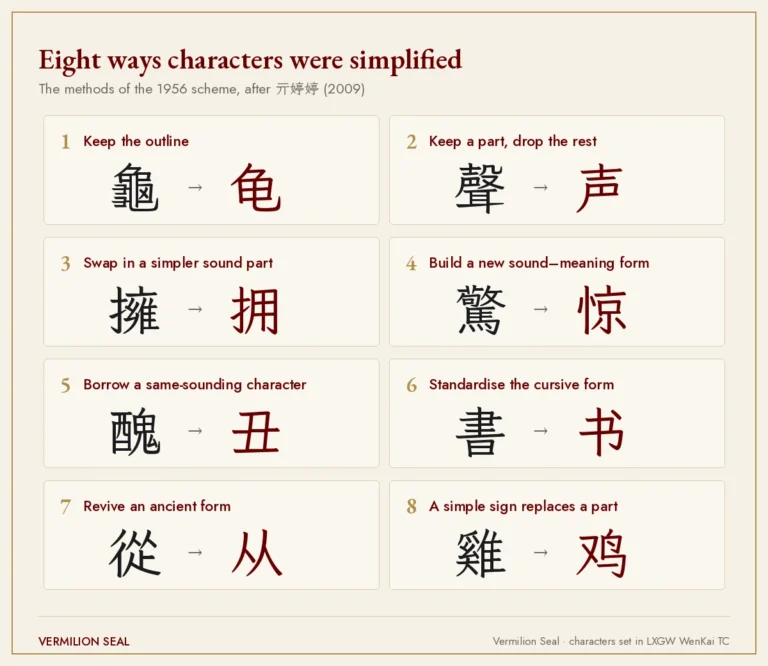
| Method | Example | What happened |
|---|---|---|
| 1. Keep the outline of the old form | 龜 → 龟 | The turtle keeps its silhouette, with fewer strokes inside |
| 2. Keep a distinctive part, drop the rest | 聲 → 声, 醫 → 医 | Only the top left of “sound” and the enclosure of “medicine” survive |
| 3. Swap in a simpler sound component | 擁 → 拥 | The hand radical stays; 用 replaces the old phonetic |
| 4. Build a new sound-meaning character | 驚 → 惊 | Heart radical plus 京 for the sound |
| 5. Borrow a same-sounding character | 醜 → 丑, 裏 → 里, 麵 → 面 | Two words now share one character |
| 6. Standardise the cursive form | 書 → 书, 東 → 东 | The quick brush shape becomes the printed one |
| 7. Revive an ancient form | 從 → 从 | Two people walking, the character’s early shape |
| 8. Replace a component with a simple sign | 雞 → 鸡 | The sign 又 stands in for a complicated part |
Seen this way the reform looks less like a demolition and more like an editorial decision about which of the existing shapes to print. Methods 1, 2, 6 and 7 mostly took forms that were already in use somewhere. Methods 3, 4 and 8 created new characters on familiar principles. Method 5 is the controversial one, because it removed distinctions: a reader of simplified text can no longer see whether 面 means “face” or “noodles” without the context.
The second round that failed
On 20 December 1977 a second, far more radical scheme was published in draft, the 《第二次漢字簡化方案(草案)》. It went well beyond collecting existing short forms, and it was unpopular from the start. On 24 June 1986 the State Council ordered that it cease to be used, and in the same notice set a new tone for the whole enterprise: the simplification of characters should be approached with caution, so that their forms stay relatively stable for a period and serve society’s needs. The 1964 list was reissued with small corrections the same year.
That notice effectively closed the era of reform. The mainland’s current standard, the 《通用規範漢字表》 issued by the State Council in 2013, lists 8,105 characters in three tiers and replaces the earlier lists, but it did not start a new round of simplification. Its appendices pair standard forms with their traditional and variant equivalents, a quiet recognition that the older forms remain part of the written language — needed for names, for classical texts and for anything printed before the 1950s.
Singapore, Hong Kong and the rest of the Chinese-speaking world
Singapore followed the mainland in stages. Its Ministry of Education issued its own list of 502 simplified characters in 1969 — including a few forms found nowhere else — expanded it to more than 2,200 in 1974, and in 1976 revised it to remove the Singapore-only forms, after which its simplified characters were essentially the same as the mainland’s. Malaysian Chinese-language education and publishing largely moved the same way. Hong Kong and Macau, outside the People’s Republic when the reforms were made, kept traditional characters, as did Taiwan. That is why the Chinese-reading world is divided roughly along the lines of 1950s political geography rather than along any line of language.
Did simplification work?
Literacy on the mainland rose dramatically after the 1950s, and simplified characters were part of the campaign that achieved it. But it is not possible to credit the script for the result. Schooling expanded enormously in the same decades, and literacy campaigns did not depend on the shape of characters alone. The clearest counter-example is next door: Taiwan and Hong Kong reached high rates of literacy with traditional characters. What simplification certainly did was make handwriting faster and the printed forms closer to how many people already wrote. What it cost was a set of merged characters and a wider gap between modern print and the classical texts, which remain in the older forms. Both sides of that ledger are real; neither makes one script the property of one side of an argument.
FAQ
When did China switch to simplified characters?
In stages from 1956, when the State Council adopted the Chinese Character Simplification Scheme and brought the first 230 simplified characters into national use from 1 February. The full list was consolidated in 1964 and reissued in 1986; the current standard dates from 2013.
Did Taiwan ever use simplified characters?
Not as policy. The Republic of China’s Ministry of Education issued a list of 324 simplified characters in 1935, before the government moved to Taiwan, and withdrew it in February 1936. A proposal to simplify characters in Taiwan was debated in the 1950s but never adopted.
Why do Taiwan and Hong Kong use traditional characters?
Because the simplification of the 1950s was a reform of the People’s Republic, and neither Taiwan nor Hong Kong was under its government at the time. Taiwan debated simplification and rejected it; Hong Kong, then under British administration, was never subject to it.
Is simplified Chinese still being simplified?
No. In 1986 the State Council abandoned the second simplification scheme and called for character forms to be kept relatively stable. The 2013 standard list regularises forms but does not introduce a new round of simplification.
One small consequence of merging 髮 and 發 into a single 发: the popular reason given for the New Year rule against washing your hair, that hair sounds like getting rich, is only obvious once the two words share a character. In the readings the Ministry of Education sets down they differ in tone — see Chinese New Year taboos.
A related confusion is worth clearing up separately: the choice between the two character sets is often mistaken for a choice between spoken languages. It is not, and traditional Chinese is a script rather than a language — which is why Taiwan writes Mandarin, Taiwanese and Hakka with the same characters.
Taiwan’s own Ministry of Education dictionary files several of the simplified shapes as long-attested variants rather than as inventions of the 1950s. What that evidence means for a child who is learning to write is set out in should kids learn traditional or simplified Chinese?
Sources
- 李浩銘〈1950年代臺灣的漢字簡化問題〉,《臺灣學研究》第22期,頁77–108,國立臺灣圖書館,2018:1935年《第一批簡體字表》;羅家倫1953年倡議、廖維藩1954年《文字制定程序法草案》 — ntl.edu.tw (PDF)(accessed 10 Sep 2026)
- 亓婷婷〈從中共文字改革歷史看簡化字〉,《師大學報:語言與文學類》54卷2期,頁107–133,2009:陸費逵1909年〈普通教育應當采用俗體字〉;「依〈漢字簡化方案〉,有下列方法」八類 — jntnu.ord.ntnu.edu.tw (PDF)(accessed 10 Sep 2026)
- 北京大學新聞網〈錢玄同:引領風氣的一代宗師〉:「1922年,在國語統一籌備會第4次大會上,他提出了《減省現行漢字的筆畫案》」 — news.pku.edu.cn(accessed 10 Sep 2026)
- 國務院〈關於公布漢字簡化方案的決議〉(1956):第一表230字自1956年2月1日起通用;第二表285字;偏旁簡化表54個 — 法規資料庫轉錄(accessed 10 Sep 2026)
- 國務院批轉國家語委關於廢止《第二次漢字簡化方案(草案)》……的請示的通知(國發〔1986〕64號,1986年6月24日):「對漢字的簡化應持謹慎態度,使漢字的形體在一個時期內保持相對穩定」 — beijing.gov.cn(accessed 10 Sep 2026)
- 國務院〈關於印發通用規範漢字表的通知〉(國發〔2013〕23號) — gov.cn;收字8,105(chinanews.com.cn;accessed 10 Sep 2026)
- 周恩來〈當前文字改革的任務〉(1958年1月10日),《周恩來選集》下卷,頁293:「簡體字是要比繁體字好學好寫」 — theorychina.org.cn(accessed 10 Sep 2026)
- Liu Fuxing, “Leapfrog Progress in China’s Education”, China Today, 19 June 2019 — “the illiteracy rate as high as 80 percent” in 1949 — chinatoday.com.cn (accessed 10 Sep 2026)
- 林夏〈新加坡是如何推行華語和簡體字的?〉,澎湃新聞,2015年3月13日:1969年《簡體字表》502字;1976年修訂本刪除新加坡本土簡體字 — thepaper.cn(accessed 10 Sep 2026)