Parents usually meet this question at the worst possible moment: signing up for a class, standing in a bookshop, or reading an online course’s comparison page that happens to recommend whatever it sells. So here is the answer without anything to sell. For most families the right script is the one the child’s Chinese-speaking world already uses — the grandparents’ letters, the weekend school down the road, the place the child will visit in the summer. When there is no such world, choose the best teacher you can find and use their script. Either way, teach one script at a time; the other can come later, and it comes more easily than parents fear.
The rest of this page explains how to apply that, with the facts that actually bear on it: what the exams accept, what the schools in Taiwan and Hong Kong do, and why the phonetic system matters nearly as much as the characters.
Start with the language, not the script
Before traditional or simplified comes a more basic question: which Chinese language? Mandarin is what most classes teach and what Taiwan, mainland China and Singapore use in school. Cantonese is the everyday language of Hong Kong and of many older overseas communities. A family whose grandparents speak Cantonese and write traditional characters has a different decision from one whose relatives are in Taipei, even though both “use traditional”. The difference between a script and a language is explained in traditional Chinese vs Mandarin. Settle the language first; the script usually follows from it.
The paperwork, in one table
Parents arrive at this question wanting a verdict. What follows is not a verdict but the paperwork — the actual documents, curriculum codes and exam rules that each choice commits a child to. Every cell is sourced at the foot of this article, and where I could not find an official answer I have said so rather than filled the gap.
| What you are actually choosing | Traditional, as taught in Taiwan | Simplified, as taught in mainland China |
|---|---|---|
| Who fixes the character forms | A Ministry of Education standard, promulgated on 1 September 1982 as the Table of Standard Forms of Common National Characters | 规范汉字 under the Law on the Standard Spoken and Written Chinese Language, revised 27 December 2025 |
| The phonetic system a child learns first | Zhuyin, ㄅㄆㄇㄈ — strand 3 of the curriculum, “phonetic symbols and their use”, taught in a ten-week block at the start of Year 1 | Hanyu Pinyin, written in Latin letters |
| Characters expected by the end of primary school | Recognise at least 2,700, write 2,200 — curriculum code 4-Ⅲ-1 | Not stated as a single comparable figure in any document I was able to open; treat round numbers you meet online as unsourced |
| Children’s proficiency certificate for non-native speakers | CCCC, for ages seven to twelve, three bands with suggested vocabularies of about 400, 700 and 1,100 words | Outside the scope of this article — I have not verified the current junior HSK bands and will not repeat them second-hand |
| AP Chinese Language and Culture | Accepted. The screen can be switched between both character sets, with no effect on the score | Accepted, on the same screen, under the same rule |
| Typing on AP Chinese | Bopomofo, or Pinyin Traditional | Pinyin Simplified |
| Where schools’ script use is set down | In the curriculum, which fixes how many characters and how they are written, and in the 1982 table of standard forms | Article 11 of the revised law, in force since 1 January 2026, which requires schools to teach in the standard language and script |
Read down the first column and the shape of the decision changes. Almost nothing in it is about which script is prettier or harder. It is about which set of institutions your child’s schooling will be measured against.
Five questions that decide it
1. What does the family read and write? A child’s most important Chinese readers are often relatives. If the grandparents write traditional characters, a birthday card from them is a reading lesson; if they write simplified, the same is true the other way. Children notice what the adults around them actually use.
2. What teaching is really available? A good teacher in either script beats a mediocre one in the “right” script. Look at the weekend schools, tutors and school programmes within reach, and ask which script they teach. Schools linked to Taiwanese communities tend to teach traditional characters; many others teach simplified.
3. Where will the child use it? Summers in Taipei or Hong Kong point to traditional; family in Shanghai or Singapore points to simplified. For a child who will mostly use Chinese on video calls, the spoken language matters more than either script in the early years.
4. Which exams, if any? This matters less than people think, because the major tests for school-age learners are either script-neutral or offered in both. Details below.
5. Who helps with homework? If a parent will be sitting beside the child, the parent’s own script is a practical advantage for the first years. That is not a small point: a lot of early literacy happens at the kitchen table.
What the exams and schools actually do
AP Chinese. In the United States, the College Board’s AP Chinese Language and Culture exam lets students display the text in either simplified or traditional characters and switch between them, and offers typing by pinyin in either script or by Zhuyin (bopomofo). The College Board states that the choice has no effect on the score.
TOCFL and CCCC. Taiwan’s national proficiency tests are run by a committee under the Ministry of Education. Its adult test, the TOCFL, is offered only in traditional characters in Taiwan, but candidates abroad can choose traditional or simplified. For children it has a separate test, the 兒童華語文能力測驗 (Children’s Chinese Competency Certification, CCCC), designed for learners aged seven to twelve whose first language is not Chinese; its published practice papers come in both traditional and simplified versions, and the beginner level adds Zhuyin and pinyin to the reading questions.
YCT and HSK. The mainland’s youth test, the YCT, is aimed at primary and secondary pupils and prints pinyin on the questions at the lower levels. The HSK, the adult test, is set in simplified characters.
Taiwanese materials abroad. Taiwan’s Overseas Community Affairs Council publishes a free textbook series for children overseas, 《學華語向前走》 (Let’s Learn Mandarin), written for children learning abroad. Its own description says the phonetic notation is given in both Zhuyin and pinyin, with simplified characters annotated alongside.
The upshot is that no mainstream exam locks a child out for choosing the “wrong” script. Pick for the child’s life; the certificates will follow.
One script at a time
The most useful practical advice on this subject comes from an unexpected place: Hong Kong’s education bureau, which has to think about children who live surrounded by traditional characters but meet simplified ones constantly. In 2016 it put its policy on record. Reading simplified characters, it said, must not start too early, especially at primary level, because learning both forms at once interferes with learning to read and write and makes children confuse the shapes; pupils should first master traditional characters, and only once that foundation is in place should they learn to read simplified ones, in secondary school, as needed.
That is one education system’s judgment about its own children, not a universal law, and the same logic works in the other direction for a child learning simplified first. But the core of it — build one solid set of characters before adding the other — matches the experience of most teachers and parents. The second script is much easier to acquire once the first is secure, because most of the differences follow a small number of regular patterns, set out with examples in traditional vs simplified Chinese.
Parents often worry that starting with one script means the child is “behind” in the other. It helps to remember how old this worry is. A sixth-century father writing instructions for his sons put the case for early study as strongly as anyone has — and then immediately refused to let it become a reason for giving up later:
On learning early, and learning late
人生小幼,精神專利,長成已後,思慮散逸,固須早教,勿失機也。……然人有坎壈,失於盛年,猶當晚學,不可自棄。
“In early childhood the mind is focused and sharp; once grown, one’s thoughts scatter. So teaching must begin early and the moment must not be lost. … Yet if hardship has made someone miss their best years, they should still learn late, and not give up on themselves.”
顏之推《顏氏家訓.勉學》 · Check the original at ctext.org
Yan Zhitui goes on, in the same passage, to say that texts he memorised at seven were still with him decades later, while what he read after twenty was gone within a month of neglect. Parents of young learners will recognise both halves. Start with whichever script fits the child’s life, start early if you can, and do not treat the other script as a door that closes.
Is traditional harder for a child?
Harder to write, somewhat; not obviously harder to read. Traditional characters have more strokes on average, and a young child copying 龍 takes longer than one copying 龙. But children in Taiwan and Hong Kong learn traditional characters as a matter of course, and readers recognise characters as whole shapes rather than counting strokes. The extra detail can even help: 說 (speak), 語 (language) and 讀 (read) all visibly carry the component for speech, 言, which simplified writes as a small stroke-group.
There is also the asymmetry. A child who learns traditional first can usually read simplified later with modest effort, because simplification mostly removes information. A child who learns simplified first has a little more to learn when turning to traditional, because a handful of simplified characters stand for two or more traditional ones. Neither direction is a reason to override the five questions above, but it is a reasonable tie-breaker for families with no other reason to choose.
Zhuyin or pinyin?
The phonetic system arrives with the script, and parents should know what they are signing up for. Children in Taiwan learn to read through Zhuyin, the phonetic symbols known as bopomofo: first-grade Mandarin starts with a primer, used for the first ten weeks of school, that contains no characters at all and teaches only Zhuyin. Children’s books keep Zhuyin beside the characters for years. On the mainland and in Singapore, children learn Hanyu Pinyin, which uses the Latin alphabet.
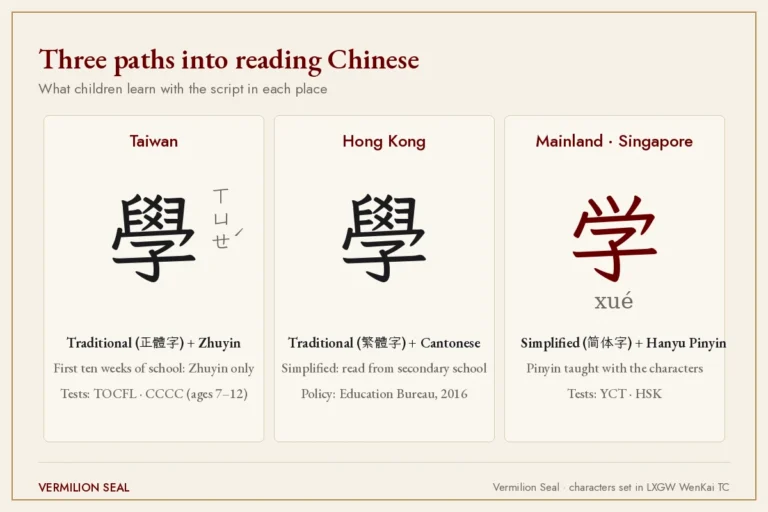
For a family abroad, pinyin has one obvious advantage: the child already knows the letters. Zhuyin has another: it keeps Chinese sounds separate from English spelling, so a child is less tempted to read q or x the English way. Both are learnt in weeks, not years. The deciding factor is the same as for the characters — use the system your teacher and books use. Many Taiwanese materials for overseas children, including the Overseas Community Affairs Council series, print both.
Three common situations
A family with roots in Taiwan. Traditional characters with Zhuyin, using Taiwanese materials such as the free Overseas Community Affairs Council textbooks, and the CCCC if a certificate is wanted. Visits to Taiwan will reinforce everything, because every sign, menu and picture book is in the same script. Background on how Taiwan standardises its characters is in does Taiwan use traditional Chinese?
A family with roots in mainland China or Singapore. Simplified characters with pinyin, which is what relatives, most children’s apps and the YCT use. Traditional can be added in the teenage years, particularly if the child becomes interested in calligraphy, classical poetry or Taiwanese and Hong Kong popular culture.
A family with no Chinese-speaking relatives. Follow the best available teacher and programme. If there is a genuine choice between two equally good classes, the tie-breakers are where the family is likeliest to travel and the asymmetry described above. Whichever you choose, the history of how the two scripts came apart is worth knowing, and it is in why did China simplify Chinese characters?
What Taiwan’s curriculum actually asks of a child
If your child will sit in a Taiwanese classroom, the demands are written down and countable. The current national curriculum for Chinese language — issued in January 2018 and still in force — sets recognition and writing targets by learning stage, each with its own code:
Character targets by learning stage
4-Ⅰ-1 認識常用國字至少1,000字,使用700字。
4-Ⅱ-1 認識常用國字至少1,800字,使用1,200字。
4-Ⅲ-1 認識常用國字至少2,700字,使用2,200字。
“4-Ⅰ-1 Recognise at least 1,000 common characters; use 700. 4-Ⅱ-1 Recognise at least 1,800; use 1,200. 4-Ⅲ-1 Recognise at least 2,700; use 2,200.”
《十二年國民基本教育課程綱要.語文領域-國語文》 · Ministry of Education, January 2018, full text
Two things in that box are worth more than the numbers. The first is that recognising always runs ahead of writing — 1,000 against 700, then 1,800 against 1,200. The curriculum states the principle outright in its guidance on handwriting: 「寫字教學:應先認讀再書寫,並配合單元教材習寫生字。」 — read first, write second. Parents who panic at 龍 and its sixteen strokes are panicking one step ahead of the syllabus.
The second is that stroke work is specified as technique rather than as a test of endurance. Code 4-Ⅰ-5 asks a child to learn the basic strokes and stroke order and write characters that are 「正確及工整」, correct and neat; by the second stage 4-Ⅱ-6 asks a child to grasp the variation of components and the proportions of a character, written correctly and neatly with a hard-tipped implement — a pencil or pen rather than a brush, which the curriculum makes the primary tool with the brush in support. Learning content item Ab-Ⅱ-12 names the method of executing the basic strokes of regular script.
None of that is abstract. The national student art competition, run by the National Taiwan Arts Education Centre, has calligraphy categories for primary pupils split into middle and upper years. In the 2022 edition, primary entries were written on half-sheet paper of roughly 34 by 135 centimetres and were to be submitted unmounted, forwarded by the county or city education bureau rather than by a school or pupil directly. Those guidelines also require anyone who wins a place in the calligraphy final to attend a live writing session when notified, though they set no time limit for the primary categories; the two-hour limit they do specify, with leave to depart after forty minutes, is written for the university-level calligraphy categories. Writing by hand, at length, is still part of a Taiwanese childhood.
The ten weeks, and the method inside them
You will often read that Taiwanese first-graders spend the first ten weeks of Year 1 on zhuyin before meeting a single character. This one is true, and it is written into the curriculum rather than being folklore: appendix three, the explanatory notes on teaching the strand, states it directly.
On the first ten weeks of school
注音符號教學實施於第一學年前十週,採綜合教學法教學。
“Instruction in the phonetic symbols is carried out in the first ten weeks of the first school year, using the synthetic method.”
《十二年國民基本教育課程綱要.語文領域-國語文》附錄三〈語文領域-國語文學習表現之教材編選與教學實施說明〉,【3.標音符號與運用】教學實施說明 · Ministry of Education, January 2018
What has changed is not the ten weeks but the teaching inside them. A paper hosted on the Ministry’s own teacher-development platform records that from 1968, when nine-year compulsory education began under the provisional primary curriculum standards, those same ten weeks were taught by an intensive, direct method. The block has outlived two curricula and at least one pedagogy. If you are choosing Taiwan for your child, this is the first thing that will happen to them in a classroom, and it has been happening to children here for well over half a century.
Zhuyin is also a strand in its own right rather than a footnote to characters. Code 3-Ⅰ-1 asks a child to 「正確認念、拼讀及書寫注音符號」 — read, blend and write the symbols correctly — and strand 3 carries on into the second stage, where 3-Ⅱ-2 has children 「運用注音符號,檢索資訊,吸收新知」, using zhuyin to look things up and take in new knowledge. Pinyin does not appear in the strand at all. If you want to see what the rival romanisations do to a single word, a place name is the cleanest test case: why isn’t Taipei spelled Taibei?
It survives into adult examinations, too. The guidelines for Taiwan’s TOCFL writing test require candidates to be able to type Chinese and let them do it with either zhuyin or pinyin input; they say nothing at all about which character set to write in. Which is worth knowing in both directions: a keyboard layout is not a script policy, and sites that present one as evidence of the other are guessing.
Where the thousand-year story breaks down
Search for this question in English and you will be told, within two or three results, that traditional characters are the original set used unchanged for over a thousand years, and that simplified characters were invented in the 1950s. Both halves are wrong, and the documents that show why are published by Taiwan’s own Ministry of Education.
Start with the dictionary. The Ministry’s 《異體字字典》, its standard reference on variant character forms, files the simplified 写 as a variant of 寫 under character number A01054. Among the key references for that entry it lists both a Taiwanese dictionary and the mainland’s own table of simplified forms, and it explains where the shape came from:
Taiwan’s official verdict on a simplified form
當係取草書之筆法楷化而致
“It would appear to have arisen from taking the brushwork of the cursive hand and regularising it.”
教育部《異體字字典》正字「寫」,條目 A01054-001,研訂者王初慶 · Ministry of Education, Dictionary of Chinese Character Variants
A sibling entry under the same character, A01054-019, gives the form a dated attestation: its key reference is 《宋元以來俗字譜》, the tables of popular character forms from the Song and Yuan onwards, citing 《古今雜劇》 — a Yuan-dynasty collection of variety plays. The clipped form of this character was being cut into popular editions centuries before any committee sat down in the 1950s, and it is a Taipei ministry that says so in print. The same dictionary’s FAQ states the general case in a single line: 「異體字的涵義較廣,簡體字是異體字的一種。」 — variant characters are the broader category, and simplified characters are one kind of variant.
Then there is drift of a second sort. Entry A01054-002 quotes the 《說文解字》 gloss on 寫 and gives its original sense as 「置物也」, to set a thing down. The character that now means to write once meant to place. Forms move and meanings move. A script is a working tool, not a museum case — which is true of the traditional set as much as of the simplified one, and is why the Taiwanese standard needed promulgating in 1982 at all.
Three things parents are currently told
I went looking for what a parent actually meets on the first page of results. These are quoted as found, in October 2026.
A children’s Chinese tutoring platform offers a worked example of stroke counts: “Significantly fewer strokes per character (e.g., ‘Learn’ is 7 strokes vs 15).” Both numbers are wrong, and I checked them against two Ministry sources rather than from memory. 学 has eight strokes and 學 has sixteen. The same page claims that “A child can often learn to recognize 100 Simplified characters in the time it takes to master 60 Traditional ones”, with no study attached, and describes simplified characters as “now the global standard for 1.4 billion people” — a figure which is the population of China, not a count of anybody’s reading habits.
A second tutoring site tells parents that “Pronunciation (pinyin) is identical in both systems; only the way characters are written changes.” Pinyin is a spelling convention, not a pronunciation, and a child in a Taiwanese classroom is not taught it; they are taught zhuyin, which has its own curriculum strand, as above. The same page calls traditional Chinese a set “used continuously for over a thousand years” — twice, in two different sections — which the 1982 promulgation quietly contradicts.
A translation company’s explainer is the most instructive, because it sets out to correct exactly the confusion this article is about and then commits a worse one in the same breath: “These writing systems must not be confused with Mandarin or Cantonese, which are dialects of the Chinese language.” Mandarin and Cantonese are not mutually intelligible. Demoting them to dialects inside a sentence warning you not to confuse scripts with languages is the whole problem in miniature — the same muddle that leaves readers unsure whether to write dao or tao — and it is why I keep insisting you settle the language before the script.
What each side’s institutions actually count
Somewhere in this decision sits an anxiety about which script carries more weight in the world. The honest answer is that nobody can tell you, and the way the two sides publish their numbers is itself worth a parent’s attention.
Taiwan’s Overseas Community Affairs Council puts its figures in an annual statistical yearbook. The 2025 edition counts 2,321 schools and classes in contact with the Council — 1,578 Chinese-language schools, 739 Chinese classes and four Taiwanese schools — of which 1,737, or 74.8 per cent, are in Asia and 453, or 19.5 per cent, in the Americas. That is a register of institutions the Council deals with, not a census of overseas Chinese schooling. The Council is also unembarrassed about its position on the script: 「臺灣所使用的正體文字,保留了傳統中華文化的精華與美學」.
The mainland’s network is counted differently. The figures in general circulation — 499 Confucius Institutes and 764 Confucius Classrooms across 161 countries, as of the end of October 2024 — are counts of institutions established or jointly run, with Institutes mostly attached to universities and Classrooms mostly to schools. They reach a reader through Chinese state media rather than through the organisation: checking on 12 October 2026, I found no current global total anywhere on the Confucius Institute’s own site at ci.cn, whose global-network page offers browsing by continent and no count at all. Nor is the media figure maintained in one place: higher Institute counts for later years circulate in the state press without a named issuing body and without a matching figure for the Classrooms, which is why the 2024 pair is the most recent I am willing to quote.
The two sets of figures should not be put side by side, and I am not going to put them there. The populations differ, the counting units differ, and the coverage differs — one is a contact register spanning three kinds of body, the other a tally of foundings at two different levels of schooling. Neither side publishes pupil numbers, so there is no way to calibrate either figure against actual children. Which means that when a tutoring site tells you how many children are learning which script, it is not drawing on either of these sources, because the number is not in them. Ask where it came from.
One legal change from this year
The mainland’s language law was revised on 27 December 2025 and came into force on 1 January 2026. Two points are relevant to a family choosing a script. Article 2 names language and script separately and joins them with “and” rather than treating them as one thing: 「本法所称的国家通用语言文字是普通话和规范汉字,是国家法定全国通用的语言文字。」 That is the distinction this article opened with, written into statute by the government whose script is at issue.
Article 11 then requires schools and other educational institutions to use the standard language and script as the basic medium of instruction. In the previous version of the law that requirement sat in article 10 and carried a rider allowing for exceptions provided by other legislation; in the revised law the education provision has moved to article 11 and that rider is gone, while the same phrase survives in the new article 10, which governs the language of official business in state organs. The revised provision also adds that teaching materials must conform to the national standard and that pupils should have a basic command of it by the end of compulsory education. What the drafters intended by the change, and how it will be applied, the text does not say and I will not guess. It is a narrowing, it is dated, and for a parent weighing where a child’s schooling will sit, it belongs in the file.
FAQ
Is traditional or simplified Chinese easier for kids?
Simplified characters are quicker to write; traditional characters are learnt by every schoolchild in Taiwan and Hong Kong without special difficulty, and reading depends on recognising shapes rather than counting strokes. For most families the script the child will actually use matters more than the difference in difficulty.
Can a child learn both traditional and simplified?
Yes, but one after the other is the usual advice. Hong Kong’s Education Bureau, for example, recommends that pupils first master traditional characters and only learn to read simplified ones in secondary school, because learning both at once in the early years tends to confuse the shapes.
Does AP Chinese use traditional or simplified characters?
Both. Students can display the exam in simplified or traditional characters and switch between them, and can type using pinyin or Zhuyin; the College Board says these choices do not affect the score.
Is there a Chinese test for children from Taiwan?
Yes. Taiwan’s Steering Committee for the Test of Proficiency–Huayu runs the Children’s Chinese Competency Certification (CCCC) for learners aged seven to twelve whose first language is not Chinese, with practice papers in both traditional and simplified characters.
How many characters does Taiwan’s curriculum expect a child to know?
It is set by learning stage, and recognition always runs ahead of writing: at least 1,000 recognised and 700 written in the first stage, 1,800 and 1,200 in the second, 2,700 and 2,200 by the end of the third. The codes are 4-Ⅰ-1, 4-Ⅱ-1 and 4-Ⅲ-1 in the national Chinese-language curriculum.
Do Taiwanese first-graders really spend ten weeks on zhuyin before seeing a character?
Yes, and it is in the curriculum rather than being staffroom lore. Appendix three of the Chinese-language curriculum states that instruction in the phonetic symbols runs through the first ten weeks of the first school year, using the synthetic method. The ten-week block is old: a paper on the Ministry’s teacher-development platform traces it to 1968, when the same weeks were taught by an intensive, direct method instead.
Were simplified characters invented in the 1950s?
Many of the forms were not. Taiwan’s own Ministry of Education dictionary of variant characters files the simplified 写 as a variant of 寫, attributes it to the regularising of a cursive hand, and gives it a Yuan-dynasty attestation. The 1950s scheme standardised and promoted such forms; it did not conjure them. Equally, the traditional set a Taiwanese child learns was itself fixed by a Ministry standard promulgated in 1982.
Can my child type Chinese with zhuyin on an American exam?
On AP Chinese Language and Culture, yes. College Board lists three input methods — Pinyin Simplified, Pinyin Traditional and Bopomofo — and states that the display and input options have no effect on the exam score. A child trained in Taiwan is not disadvantaged at the keyboard.
Sources
- 顏之推《顏氏家訓.勉學》:「人生小幼,精神專利,長成已後,思慮散逸,固須早教,勿失機也。吾七歲時,誦靈光殿賦,至於今日,十年一理,猶不遺忘;二十之外,所誦經書,一月廢置,便至荒蕪矣。然人有坎壈,失於盛年,猶當晚學,不可自棄。」 — 中國哲學書電子化計劃(accessed 10 Sep 2026)
- 香港教育局〈政策正面睇〉(2016年2月13日):「學生如果同時學習繁簡二體,反會造成識字和寫字上的干擾,容易混淆字形……建議學生學習漢字,要先充分掌握繁體字;待學生具備繁體字的基礎後,在中學階段,按學習需要和在適當情況下,酌量認讀簡化字。」 — edb.gov.hk(accessed 10 Sep 2026)
- 國家華語測驗推動工作委員會〈常見問題〉:「臺灣考區的TOCFL考試只提供正體字的服務。海外地區的TOCFL有正體字與簡體字可以選擇。」;〈兒童華語文能力測驗〉:「適合七至十二歲母語非華語兒童」;題庫下載提供正體、簡體兩版 — tocfl.edu.tw、CCCC、題庫下載(accessed 10 Sep 2026)
- 僑務委員會全球華文網《學華語向前走》:「每冊計12個單元……標音符號為注音及拼音,並搭配簡化字標註。」 — huayuworld.org(accessed 10 Sep 2026)
- 信誼基金會〈ㄅㄆㄇ初體驗-多元管道學注音〉:一上國語「首冊」「供開學後第一到第十週使用,首冊裡沒有國字,專門教注音符號」 — parents.hsin-yi.org.tw(accessed 10 Sep 2026)
- College Board, “AP Chinese Language and Culture: Assessment” — “Chinese text on the screen can be displayed in simplified characters or in traditional characters… The display and input options will have no effect on your exam score.” — apstudents.collegeboard.org (accessed 10 Sep 2026)
- Chinese Testing International, YCT syllabus, levels 1–3: “试卷上的试题都加拼音” — chinesetest.cn (PDF); YCT overview — chinesetest.cn (accessed 10 Sep 2026)
- 《十二年國民基本教育課程綱要.語文領域-國語文》, January 2018, full text — character targets 4-Ⅰ-1, 4-Ⅱ-1, 4-Ⅲ-1; stroke codes 4-Ⅰ-5, 4-Ⅱ-6 and learning content Ab-Ⅱ-12; zhuyin strand 3-Ⅰ-1 and 3-Ⅱ-2; the instruction 「寫字教學:應先認讀再書寫」; and, at appendix three, under the explanatory notes on the phonetic-symbols strand, 「注音符號教學實施於第一學年前十週,採綜合教學法教學。」 — Ministry of Education (accessed 12 October 2026).
- Teaching paper tracing the ten-week zhuyin block to 1968, when the provisional primary curriculum standards had it taught by an intensive, direct method — Ministry of Education teacher-development platform (accessed 12 October 2026).
- Ministry note on the 4,808 common characters, which records that the Table of Standard Forms of Common National Characters was promulgated on 1 September 1982 — Ministry of Education (accessed 12 October 2026).
- 教育部《異體字字典》 FAQ — 「異體字的涵義較廣,簡體字是異體字的一種。」 and the official definition of a standard form — Dictionary of Chinese Character Variants (accessed 12 October 2026).
- 教育部《異體字字典》, character A01054, entry A01054-001 — 写 as a variant of 寫, 「當係取草書之筆法楷化而致」, with the mainland 《簡化字總表.第二表》 among its key references — Dictionary of Chinese Character Variants (accessed 12 October 2026).
- 教育部《異體字字典》, entry A01054-002 — the 《說文解字》 gloss giving 寫 the original sense 「置物也」 — Dictionary of Chinese Character Variants (accessed 12 October 2026).
- 教育部《異體字字典》, entry A01054-019 — key reference 《宋元以來俗字譜.宀部》, citing the Yuan-dynasty variety-play collection 《古今雜劇》 — Dictionary of Chinese Character Variants (accessed 12 October 2026).
- 教育部《異體字字典》, standard form 學 (A01001), whose stroke note reads 「子-13-16」 — radical 子, thirteen further strokes, sixteen in all — Dictionary of Chinese Character Variants (accessed 12 October 2026).
- 教育部《異體字字典》, variant 学 (A01001-003), whose stroke note reads 「子-05-08」 — eight strokes in all — Dictionary of Chinese Character Variants (accessed 12 October 2026).
- Stroke-count check against a second Ministry source — 學 listed as the 39th of 343 characters in the sixteen-stroke index, and 龍 as the 342nd — Ministry of Education, Stroke Order Learning Site (accessed 12 October 2026).
- National student art competition, implementation guidelines — calligraphy categories for primary middle and upper years. The page now serves the 2026–27 edition — National Taiwan Arts Education Centre (accessed 12 October 2026).
- 2022 edition of the same guidelines — primary entries on half-sheet paper of roughly 34 by 135 centimetres, unmounted, forwarded by the county or city education bureau; finalists in calligraphy attend a live writing session when notified, and the 120-minute limit (with leave to depart after forty) is specified for the university-level calligraphy categories, no limit being given for the primary ones — guidelines as reproduced by National Taiwan Normal University (accessed 12 October 2026).
- 兒童華語文能力測驗 (CCCC) — aimed at children aged seven to twelve whose first language is not Chinese — Steering Committee for the Test of Proficiency-Huayu (accessed 12 October 2026).
- CCCC introduction — the three bands, Sprouting, Seedling and Blossoming, with suggested vocabularies of about 400, 700 and 1,100 words — Steering Committee for the Test of Proficiency-Huayu (accessed 12 October 2026).
- TOCFL test guidelines — candidates for the writing test must be able to type Chinese and may use zhuyin (ㄅㄆㄇㄈ) or pinyin input. The guidelines make no stipulation about character set — Steering Committee for the Test of Proficiency-Huayu (accessed 12 October 2026).
- AP Chinese Language and Culture, exam format — the screen may be displayed in either character set, the three input methods are Pinyin Simplified, Pinyin Traditional and Bopomofo, and these choices have no effect on the score — College Board (accessed 12 October 2026).
- 《中華民國114年僑務統計年報》, published September 2026 — 2,321 schools and classes in contact with the Council, 1,737 of them (74.8 per cent) in Asia and 453 (19.5 per cent) in the Americas, with no pupil numbers given — Overseas Community Affairs Council (accessed 12 October 2026).
- Council statement on the script — 「臺灣所使用的正體文字,保留了傳統中華文化的精華與美學」 — Overseas Community Affairs Council (accessed 12 October 2026).
- Figures for 499 Confucius Institutes and 764 Confucius Classrooms across 161 countries as of the end of October 2024. Checking on 12 October 2026, I found no current global total on the Confucius Institute’s own site at ci.cn — China Daily (accessed 12 October 2026).
- 《中华人民共和国国家通用语言文字法》, as revised on 27 December 2025 and in force from 1 January 2026 — article 2 on language and script, and article 11 on schools, to which the education requirement moved from article 10 and from which the statutory-exception rider was dropped — Xinhua (accessed 12 October 2026).
- Tutoring platform comparison page quoted above for its stroke counts, its 100-to-60 recognition ratio and its 1.4 billion figure — LingoAce (accessed 12 October 2026).
- Tutoring blog quoted above for “Pronunciation (pinyin) is identical in both systems” and, in two separate sections, the thousand-year claim — Prepedu (accessed 12 October 2026).
- Explainer quoted above for calling Mandarin and Cantonese “dialects of the Chinese language” — Trusted Translations (accessed 12 October 2026).