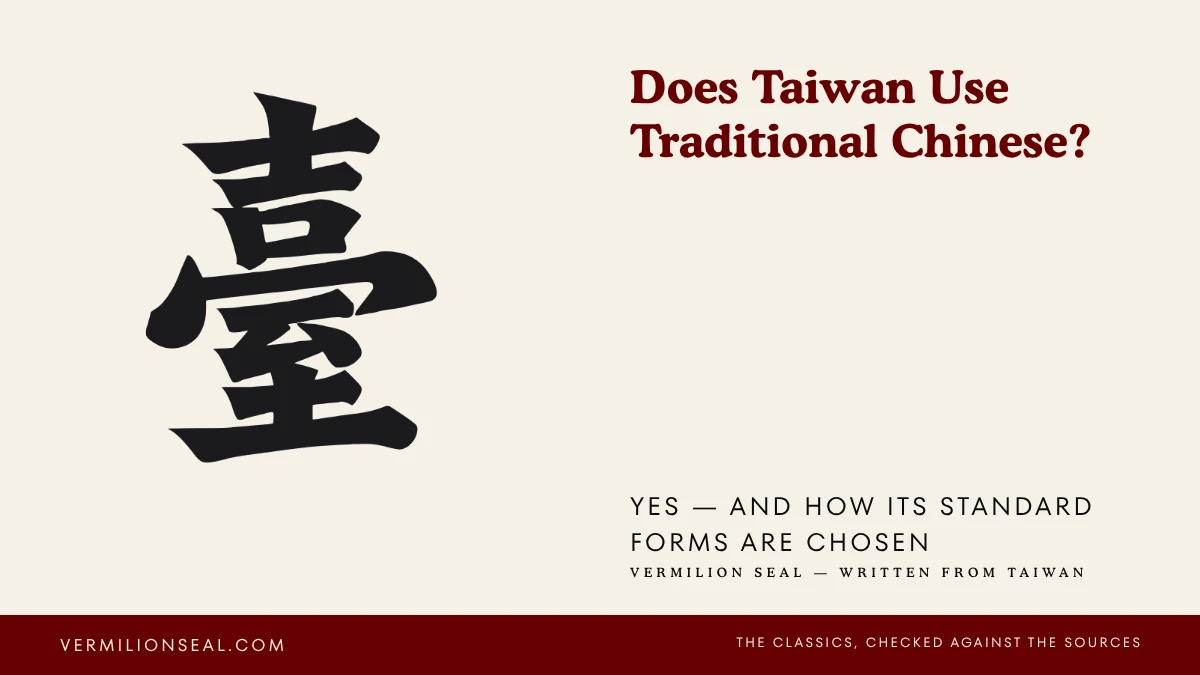
Yes. Taiwan writes in traditional Chinese characters, and has done so without interruption: the government, the schools, the newspapers, the night-market signs and the forms at the post office are all in traditional script. Taiwan does not use simplified Chinese officially, and it does not call its own script “traditional” either. The official term is 正體字, “orthodox characters”. Under that plain yes sit a few things worth knowing before you study, travel or commission a translation: who decides what a correct character looks like, why you see both 臺 and 台, and why Taiwan’s traditional characters are not quite the same as Hong Kong’s.
The short answer, with the details
Taiwan’s written standard is set by the Ministry of Education. The foundation is its list of standard forms for common characters, the 常用國字標準字體表, announced on 1 September 1982 with 4,808 characters, followed by tables of less common and rare characters. For anything outside those lists, the Ministry’s online 《異體字字典》 (Dictionary of Chinese Character Variants) records the variant forms that have existed through history and marks one as the standard, the 正字.
Mandarin in Taiwan is taught with Zhuyin (注音符號), the phonetic symbols usually called bopomofo, rather than with pinyin — more on that below. The national proficiency test for learners, the TOCFL, states the position simply in its own FAQ: in Taiwan the test is offered only in 正體字; overseas candidates may choose traditional or simplified.
None of this is an exotic heritage policy. Traditional characters are simply how Chinese has always been written here, and the job of the standards is housekeeping: deciding, among forms that have circulated for centuries, which one a textbook, an exam or a government form should use.
Zhuyin: the other half of reading in Taiwan
Traditional characters in Taiwan come with a companion script that most foreign learners never meet. Zhuyin is a set of phonetic symbols — ㄅ ㄆ ㄇ ㄈ are the first four, which is why Taiwanese people call it bopomofo — used to spell out the sound of a character. The Ministry of Education’s handbook dates it precisely: devised in 1913 and promulgated in 1918, then revised over the following decades. It also records something that surprises people who think of Taiwan as the home of complicated writing: the symbols were made by simplifying ancient Chinese characters chosen for their sounds.
Zhuyin is how children learn to read. A Taiwanese first-grader spends the first ten weeks of school with a primer that contains no characters at all, only Zhuyin; the characters arrive afterwards, each printed with its Zhuyin beside it. Children’s books keep the symbols running down the side of the text for years. Adults keep using it: plenty of people in Taiwan type Chinese on their phones by Zhuyin. Pinyin is not absent — it appears in romanised street names and on many signs — but it is not what Taiwanese people read with.
For a learner, this is the one practical difference that matters more than any individual character. Materials from Taiwan will often print Zhuyin, dictionaries may sort by it, and a Taiwanese friend spelling a word out for you will use it. Learning the symbols takes a few days, and it is worth it.
How Taiwan decides what the correct form is
Chinese characters have always come in variants. Hand copying, regional habit and dictionary tradition left many characters with two, five or twenty acceptable shapes. A standard does not invent characters; it chooses among existing ones. The principles behind Taiwan’s choices are set out in a paper by the philologist Li Hsien (李鍌) — whose name also stands under the preface of the Ministry of Education’s Zhuyin handbook — published by Taipei City’s education department:
How a standard form is chosen
字形有數體而音義無別的,取一字為正體之標準,其他為異體。其選取原則:(1)取最通用的。(2)取最合於初形本義的。
“Where a character has several forms with no difference in sound or meaning, one is taken as the standard and the others are treated as variants. The principles of selection: (1) take the most commonly used; (2) take the one most faithful to the character’s original form and meaning.”
李鍌〈推行正體字政策補充說明及建議〉,臺北市政府教育局 · Read the source (PDF)
The same paper goes on to say that where several forms are equally faithful to the original structure, the one with the fewest strokes or the widest use wins. That last point surprises people who assume traditional standards always prefer the complicated form. They do not. The rule is fidelity to how the character was built, and after that, ordinary usage.
The same paper makes the argument behind the name: Chinese characters were simply called 正體字 throughout their history, and 繁體字, “complex characters”, only became a term once there was a simplified set to contrast them with. You will hear both words in Taiwan in conversation. In official use it is 正體字.
臺 or 台?
The first character most visitors notice is the tai of Taiwan and Taipei, which appears in two shapes, often on the same street. The Ministry of Education’s dictionaries settle the relationship: the 《重編國語辭典修訂本》 records 台, in this reading, as a variant of 臺, and its dictionary for schoolchildren says 台 is “the same as 臺“. The Variants Dictionary lists 台 among the variant forms of 臺, while also keeping 台 as a standard character in its own right for its older meanings.
In practice the standard form is what you see on official names — the Taipei City Government calls itself 臺北市政府, and the national law database writes 臺灣 — while 台 is everywhere in handwriting, shop signs, brand names and casual print. Neither is simplified. 台 was a common short form long before the 1950s, and the mainland’s simplified list later adopted it.
The same is true of a few other shapes that look simplified to a learner. The Ministry’s dictionary records 体 as a variant of 體 (“body”), and people in Taiwan who would never write simplified Chinese may still jot 体 on a note. Handwriting has always carried short forms. What the standard governs is print, textbooks and exams.
Taiwan and Hong Kong: same script, slightly different standards
Hong Kong also writes traditional characters, and for most purposes a reader moves between the two without noticing. But the two places standardised separately, and for a small number of characters they chose different forms from the same pool of variants. Hong Kong’s education bureau publishes the forms used in its schools; Taiwan’s Ministry of Education publishes its own. Where they differ, each lists the other’s choice as a variant.
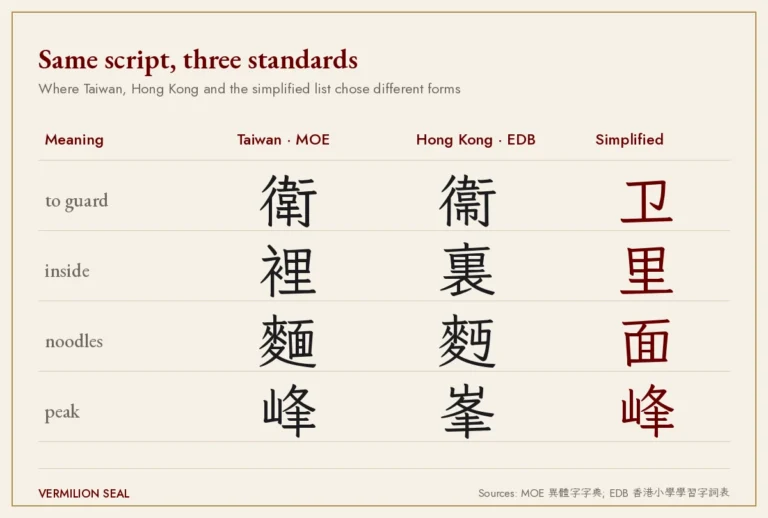
| Meaning | Taiwan standard (Ministry of Education) | Hong Kong school list (Education Bureau) | Simplified |
|---|---|---|---|
| to guard (as in hygiene, 衛生) | 衛 | 衞 | 卫 |
| inside | 裡 | 裏 | 里 |
| noodles | 麵 | 麪 | 面 |
| peak | 峰 | 峯 | 峰 |
The differences are small enough that no reader is confused, and large enough that a careful editor notices. The larger gap between Taiwan and Hong Kong is not in character forms at all but in vocabulary and in the spoken language behind the writing: Hong Kong speaks Cantonese and writes some Cantonese words with characters Taiwan never needs, a point covered in traditional Chinese vs Mandarin. For translation work this is why “traditional Chinese” is not enough of a specification. Ask for Taiwan usage or Hong Kong usage.
Can people in Taiwan read simplified Chinese?
Many can, with some effort, and most who can have picked it up as adults — from books printed on the mainland, from subtitles, from the internet — rather than from school, where the Ministry’s standard forms are what children learn to read and write. Reading from traditional to simplified is the easier direction, because most simplified characters are recognisable reductions of traditional ones; the exceptions are the few simplified characters that stand for two or more traditional ones, which have to be sorted out from context. The mechanics are laid out in traditional vs simplified Chinese.
For a visitor the practical upshot is simple. Menus, timetables, street signs and official forms will be in traditional characters. Some tourist-facing places add English, Japanese and sometimes simplified Chinese. If you have learnt simplified, you will read a great deal but stumble on some common characters; a week of attention to the patterns closes most of the gap.
What this means if you are learning Chinese for Taiwan
Learn traditional characters from Taiwanese material, and treat Zhuyin as optional but useful: children’s books, dictionaries and some signage use it, and it is a quick way to see how Taiwanese speakers think about sounds. If you want a certificate that Taiwanese universities and employers recognise, the TOCFL is the one designed around Taiwanese usage. Expect vocabulary to differ in places from mainland textbooks, and the romanisation of place names to follow older conventions — the reason Taipei is not spelt “Taibei” is its own story, told in why isn’t Taipei spelled Taibei?
If you are curious why the rest of the Chinese-speaking world split from Taiwan’s script in the first place — including the fact that the government in Nanjing tried simplification itself in 1935 — that history is in why did China simplify Chinese characters? And for the broader reasons this site writes in the older forms, see why this library is written from Taiwan.
FAQ
Does Taiwan use simplified Chinese?
Not officially. Government, schools, publishing and signage use traditional characters, officially called 正體字. A few short forms such as 台 and 体 are common in handwriting and casual print, but they are old folk forms recorded as variants in the Ministry of Education’s dictionaries, not a sign of simplified script.
Is Taiwan’s traditional Chinese different from Hong Kong’s?
Slightly. Both use traditional characters, but each standardised separately, so a few characters have different standard forms — Taiwan writes 衛, 裡 and 麵, Hong Kong’s school list gives 衞, 裏 and 麪. Vocabulary differs more, and Hong Kong also writes Cantonese.
Why is it called 正體字 in Taiwan?
Because, on the Taiwanese view, these are simply the standard characters that Chinese has always used; the label “complex characters” only arose after simplification created something to contrast them with. In everyday speech both 正體字 and 繁體字 are heard.
Should I write 臺 or 台?
Either is understood. 臺 is the Ministry of Education’s standard form and is used in official names; 台 is a recorded variant used widely in everyday writing. For formal documents, use 臺.
Families who have to make the same decision for a child, rather than describe it, will want the curriculum codes, the character targets and the exam rules in one place: should kids learn traditional or simplified Chinese?
Sources
- 教育部〈教育部 4808 個常用字說明〉:「民國71年9月1日教育部公告的『常用國字標準字體表』」 — language.moe.gov.tw (PDF)(accessed 10 Sep 2026)
- 李鍌〈推行正體字政策補充說明及建議〉,臺北市政府教育局:「中國文字自古以來即稱為正體字,並無『繁體字』之名。」;「字形有數體而音義無別的,取一字為正體之標準」 — www-ws.gov.taipei (PDF)(accessed 10 Sep 2026)
- 教育部《重編國語辭典修訂本》「台」:「『臺』的異體字。」;《國語小字典》「台」:「同『臺』。」;《重編國語辭典修訂本》「体」:「『體』的異體字。」 — 教育百科「台」、「体」(accessed 10 Sep 2026)
- 教育部《異體字字典》:衞、裏、麪、峯皆列為異體字,正字分別為衛、裡、麵、峰 — dict.variants.moe.edu.tw(經教育百科查閱;accessed 10 Sep 2026)
- 香港教育局《香港小學學習字詞表》:衞(衞生)、裏(《常用字字形表》註「亦作裡」)、麪(異體字:麵)、峯(「亦作峰」) — 衞、裏、麪、峯(accessed 10 Sep 2026)
- 教育部《國語注音符號手冊》序:「注音符號,自民國二年創制,民國七年公布」;「取合於雙聲疊韻的古代漢字簡化而成」(序末署「李鍌謹識」) — language.moe.gov.tw(accessed 10 Sep 2026)
- 國家華語測驗推動工作委員會〈常見問題〉:「臺灣考區的TOCFL考試只提供正體字的服務。海外地區的TOCFL有正體字與簡體字可以選擇。」 — tocfl.edu.tw(accessed 10 Sep 2026)
- 信誼基金會〈ㄅㄆㄇ初體驗-多元管道學注音〉:一上國語課本「首冊」「供開學後第一到第十週使用,首冊裡沒有國字,專門教注音符號」 — parents.hsin-yi.org.tw(accessed 10 Sep 2026)