Search for traditional vs simplified Chinese and almost every answer you find is really answering a different question. “More people use simplified” is about population, not about why you are studying. “Traditional is more beautiful” is about taste. The choice rests on three things beginners are rarely told: how far apart the two scripts actually are, which one makes the other easier to read, and what you personally mean to read. The first can be put as a number, and the number is smaller than you think.
Traditional vs simplified Chinese at a glance
Before the detail, the whole comparison in one table. Everything in it is taken from the official lists and bodies named in the sources at the end of this page.
| Traditional | Simplified | |
|---|---|---|
| What it is called locally | 正體字 (“orthodox characters”) in Taiwan; 繁體字 in Hong Kong and in everyday talk | 簡化字 or 簡體字 |
| Everyday script of | Taiwan, Hong Kong, Macau | Mainland China, Singapore; most Chinese-language publishing in Malaysia |
| The official list | Taiwan: Ministry of Education standard forms, beginning with 4,808 common characters (1982). Hong Kong: its own list of standard forms | 簡化字總表 (1964, revised 1986); now the 通用規範漢字表 (2013, 8,105 characters) |
| Characters that actually differ | About 350 standalone simplifications plus 132 characters and 14 components that simplify everything built from them — roughly 2,235 characters in all. Most characters are written the same way in both | |
| Sound notation taught with it | Zhuyin (注音符號) in Taiwan | Hanyu Pinyin |
| Proficiency test | TOCFL, run for Taiwan’s Ministry of Education (overseas sittings can also be taken in simplified) | HSK (papers in simplified) |
| Spoken language | Neither. A script writes a language; it is not one. Traditional characters write Mandarin in Taiwan and Cantonese in Hong Kong — see traditional Chinese vs Mandarin | |
How different are traditional and simplified Chinese?
The simplification programme in the People’s Republic produced a definitive list, the 簡化字總表 (Complete List of Simplified Characters), first issued in 1964 and revised for the last time in 1986. It is organised into three tables and an appendix, and the arrangement tells you exactly where the learning load sits.
| Table | Contains | Count | What it means for a learner |
|---|---|---|---|
| 第一表 | Simplified characters not used as components in other characters | 350 | Learn these one by one |
| 第二表 | Simplified characters usable as components, plus 14 simplified components | 132 + 14 | Learn these once; they recur everywhere |
| 第三表 | Characters derived mechanically by applying table two | 1,753 | Free, once you know table two |
| 附錄 | Regularised forms conventionally treated as simplifications | 39 | Marginal |
So the real bill is roughly 350 individual characters plus about 150 components and their consequences. Against the 4,808 characters in Taiwan’s standard list of common characters — the 常用國字標準字體表, announced by the Ministry of Education on 1 September 1982 — that is a supplement, not a second language. 人, 山, 水, 日, 月, 中, 大, 小 were never simplified, because there was nothing to simplify.
This matters because the question is usually framed as a fork in the road, as though choosing one closes the other off for good. It does not. Whichever you learn first, the second costs you a few weeks of irritation, not a second course.
24 everyday characters, side by side
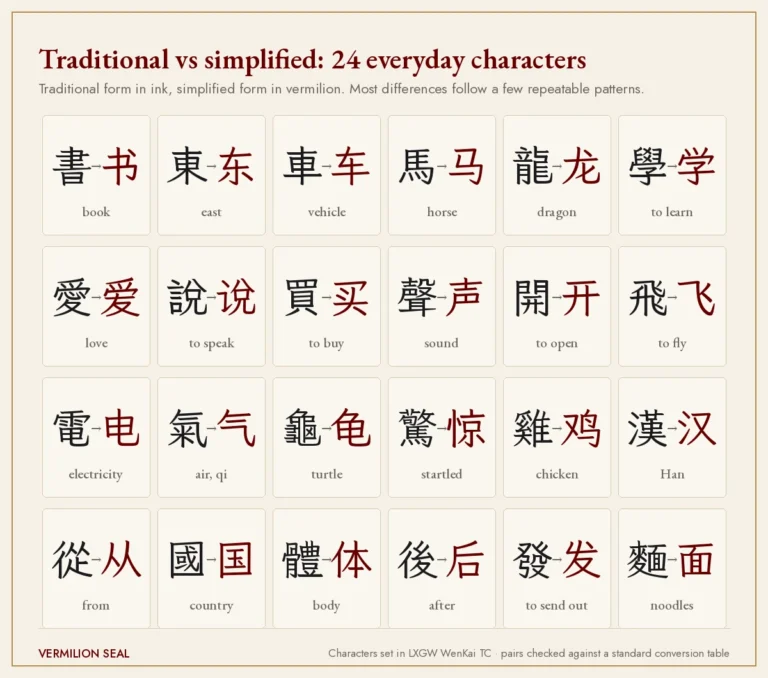
Numbers are abstract, so here is what the difference looks like on the page. These are common characters a learner meets in the first months, with the traditional form on the left of each pair. The last column says how the simplified form was arrived at, using the categories scholars apply to the 1956 scheme; the point of it is that most simplifications follow a handful of repeatable moves, so the second script is learnt in patterns rather than one character at a time.
| Traditional | Simplified | Meaning | How it was simplified |
|---|---|---|---|
| 書 | 书 | book | Handwritten cursive form made standard |
| 東 | 东 | east | Cursive form made standard |
| 車 | 车 | vehicle | Cursive form made standard |
| 馬 | 马 | horse | Cursive form made standard |
| 龍 | 龙 | dragon | Cursive form made standard |
| 學 | 学 | to learn | Top half written in its cursive shape |
| 愛 | 爱 | love | Cursive-derived; the 心 (heart) in the middle is gone |
| 說 | 说 | to speak | Speech component 言 → 讠 (applies to every character built on it) |
| 買 | 买 | to buy | Cursive form made standard |
| 聲 | 声 | sound | One distinctive part kept, the rest dropped |
| 開 | 开 | to open | Part kept; the door 門 removed |
| 飛 | 飞 | to fly | Part kept |
| 電 | 电 | electricity | Part kept; the rain 雨 on top removed |
| 氣 | 气 | air, qi | Part kept; the rice 米 inside removed |
| 龜 | 龟 | turtle | Outline of the old form kept |
| 驚 | 惊 | startled | New character: heart radical plus the sound 京 |
| 雞 | 鸡 | chicken | A simple sign (又) replaces the left side |
| 漢 | 汉 | Han, Chinese | The same sign 又 replaces the right side |
| 從 | 从 | from, to follow | An ancient form brought back: two people walking |
| 國 | 国 | country | A long-standing folk form adopted |
| 體 | 体 | body | A long-standing folk form adopted (also common in Taiwanese handwriting) |
| 後 | 后 | after | Borrowed a same-sounding character (后, “empress”) |
| 發 / 髮 | 发 | to send out / hair | Two characters merged into one |
| 麵 | 面 | noodles | Borrowed a same-sounding character (面, “face”) |
Read down the right-hand column and a pattern appears. Two-thirds of the table is cursive shapes and dropped parts — moves that are easy to learn to see once you know they exist. The awkward rows are the last three, where two different words ended up sharing one character. They are few, and they are the whole reason the next section exists.
Is traditional or simplified easier to read across?
Not symmetrical, and the asymmetry is built into the simplification itself. Most simplifications are one-to-one: 馬 and 马 are the same character in two dresses, and a reader who knows one can learn to see the other. But a minority merged characters that had been distinct, and merges only run one way.
Not symmetrical, and the asymmetry is built into the simplification itself. Most simplifications are one-to-one: 馬 and 马 are the same character in two dresses, and a reader who knows one can learn to see the other. But a minority of simplifications merged characters that had been distinct, and merges only run one way.
| Simplified form | Traditional forms it stands for | Meanings |
|---|---|---|
| 后 | 後 / 后 | after, behind / queen, empress |
| 发 | 髮 / 發 | hair / to send out, to issue |
| 干 | 乾 / 幹 / 干 | dry / trunk, to do / shield, to offend |
| 面 | 麵 / 面 | noodles, flour / face, surface |
| 里 | 裡 / 里 | inside / a unit of distance, a village |
Convert traditional to simplified and a computer gets it right nearly always. Convert simplified to traditional and the computer has to decide, for every 后 in the text, whether the author meant “after” or “empress” — which is why machine-converted traditional text on the web is littered with sentences about the Empress of a meal rather than after a meal. Human readers have the same problem in a milder form.
Convert traditional to simplified and a computer gets it right nearly always. Convert simplified to traditional and the computer has to decide, for every 后 in the text, whether the author meant “after” or “empress” — which is why machine-converted traditional text on the web is littered with sentences about the Empress of a meal rather than after a meal. Human readers have the same problem in a milder form.
The practical consequence: learning traditional first makes simplified almost free later, and learning simplified first leaves a real, if modest, gap when you turn to traditional. That is one argument, not the only one, and it has to be weighed against the fact that most beginner course material in the world is written in simplified.
Where each is actually used
Traditional characters are the everyday script of Taiwan, Hong Kong and Macau. Simplified is the standard in the People’s Republic and, since the 1970s, in Singapore, with Malaysian Chinese-language publishing largely following the same course. Overseas Chinese communities split roughly by when and from where their families emigrated: older Chinatowns in North America and Southeast Asia were traditional-writing places long before simplification existed, and many of their signs still are.
Does Taiwan use simplified at all? Not officially. Government, schools, newspapers, menus and street signs are in traditional characters, and a handful of simplified-looking shapes such as 台 and 体 survive in handwriting because they were folk forms long before 1956. Taiwan’s standard forms also differ in small ways from Hong Kong’s — 衛 against 衞, 裡 against 裏 — which is covered in does Taiwan use traditional Chinese?
Two things complicate the map. First, in Hong Kong and Taiwan the spoken languages differ — Cantonese and Mandarin — so “traditional characters” does not mean one speech community. Second, the Chinese classical corpus, all of it, was written before any simplification; every scholarly edition, every stone inscription, every scroll in a museum, is in the older forms. That is not a preference, it is a date.
The naming problem
Taiwan does not call its script “traditional Chinese”. The official term is 正體字, “orthodox characters”, and there is an argument attached to the choice. A paper by the philologist Li Hsien, published by Taipei City’s education department, puts it plainly: Chinese characters were simply called 正體字 throughout their history, and the word 繁體字 — “complex characters” — did not exist until there was a simplified set to contrast them with. Calling them “complex”, on this view, imports the conclusion that they are hard.
The claim behind the name
中國文字自古以來即稱為正體字,並無「繁體字」之名。
“Chinese characters have from antiquity been called orthodox characters; there was no such name as ‘complex characters’.”
李鍌〈推行正體字政策補充說明及建議〉,臺北市政府教育局 · Read the source (PDF)
You can accept the historical point and still use the English word “traditional”, which is what this site does, because it is the term readers search for. What is worth taking from the naming quarrel is that neither script is neutral ground: both names were chosen by someone making a case. We set out the substance of that case in why this library uses traditional characters.
What the standards actually are
Neither script is a folk convention. Both are administered.
In Taiwan the reference is the Ministry of Education’s standard character forms: the 常用國字標準字體表 of 1982 with its 4,808 common characters, plus the less-common and rare tables that follow it, and the online 《異體字字典》 and 《重編國語辭典修訂本》 for anything unusual. The standard was chosen on stated principles — the most widely used form, the one closest to the character’s original structure and meaning, the simplest stroke count among acceptable candidates — which is why a few Taiwanese standard forms differ slightly from Hong Kong’s or from what a Qing dictionary shows.
In the People’s Republic the current instrument is the 通用規範漢字表, published by the State Council in 2013, which contains 8,105 characters in three tiers — 3,500, 3,000 and 1,605 — and supersedes the earlier lists. It carries appendices pairing regularised forms with their traditional and variant equivalents, which is an official acknowledgement that the older forms have not gone anywhere: they are needed for names, for classical texts and for reading anything printed before the 1950s.
Why any of this was worth standardising
蓋文字者,經藝之本,王政之始。前人所以垂後,後人所以識古。
“Writing is the root of the classics and the beginning of government: the means by which those before us hand things down, and by which those after us know the past.”
許慎《說文解字・敘》,約西元 100 年 · Check the original at ctext.org
Xu Shen wrote that in the first century as an argument for getting the script right, in a period when the older seal forms were becoming illegible to ordinary readers and the classics were being disputed on the basis of misread characters. The complaint recurs. Every script reform in Chinese history, including the one in the 1950s, has been made in the name of the same two goals in that sentence: usability now, and legibility backwards.
Xu Shen wrote that in the first century as an argument for getting the script right, in a period when the older seal forms were becoming illegible to ordinary readers and the classics were being disputed on the basis of misread characters. The complaint recurs. Every script reform in Chinese history, including the one in the 1950s, has been made in the name of the same two goals in that sentence: usability now, and legibility backwards.
Where simplified characters came from, briefly
Simplification was not invented in 1956, and it was not only a mainland project. Reformers had been arguing for adopting handwritten short forms since the last years of the Qing. In August 1935 the Republic of China’s own Ministry of Education issued a first list of 324 simplified characters for school textbooks, and withdrew it in February 1936 after a storm of opposition. The People’s Republic took the idea up again: the State Council’s scheme of January 1956, the consolidated list of 1964, a second, more radical round in 1977 that was formally abandoned in 1986, and the 2013 list that governs today. The whole story, with the documents, is in why did China simplify Chinese characters?
How to choose, by what you want to read
You are studying to work with mainland China, or your course, teacher or textbook is simplified. Learn simplified. The volume of contemporary material — news, business, most Mandarin course design, most graded readers — is on that side, and swimming against your own textbook is a bad use of the first year. Pick up traditional later if you need it.
You are learning because of Taiwan or Hong Kong — family, a partner, a move, a job, a band, a drama habit. Learn traditional, and learn it from material from that place. Taiwan’s proficiency test, the TOCFL, is run by the Ministry of Education’s testing committee and built on Taiwanese usage; the mainland’s HSK is built on simplified. Studying the script of the place you are actually going to is the least surprising advice on this page.
You want to read classical texts, poetry, calligraphy or anything in a museum. Learn traditional. There is no version of the Analects, the Tao Te Ching or the Tang poets in their original characters that is simplified, because they predate simplification by two thousand years and one and a half thousand years respectively. Scholarly editions are traditional; so are the commentaries. If this is your reason, the question does not really arise.
You are choosing for a child. Go with the family and the community before the textbook market: the script the grandparents write, the weekend school within reach, the place the child will visit. One script at a time in the early years is the advice of Hong Kong’s own education bureau, and there are more considerations in should kids learn traditional or simplified Chinese?
You want a character for a tattoo, a name, or a piece of art. Traditional, and check the form in the Ministry of Education’s dictionary before anyone applies ink — the failure modes are documented in our guide to the five ways a Chinese character goes wrong.
You have no particular reason and want to keep options open. Learn traditional first, for the asymmetry described above, and expect to read simplified comfortably within a few months of starting to. This is the minority recommendation and it costs slightly more effort up front.
Two objections worth answering
“Traditional characters have too many strokes to write.” True for a small set of characters, and increasingly beside the point. Almost all writing is now typed, and typing is identical in both systems: you enter sound — pinyin or, in Taiwan, 注音符號 — and choose the character. Stroke count matters for handwriting, which for most learners means exam answers and the occasional card. It does not affect reading speed; fluent readers recognise word shapes, not strokes, which is why Taiwanese readers are not slower than mainland ones.
“Simplified characters destroyed the meaning of the writing system.” Overstated. Many simplifications adopted cursive or vulgar forms that had been written by hand for centuries — 万 for 萬 is centuries old — and those are not innovations at all. The defensible version of the complaint is narrower and concerns the merges in the table above, plus a set of characters where a meaningful component was replaced by a phonetic one. That is a real loss for reading old texts. It is not an argument that the people who write simplified are writing a lesser language, and this site does not make one.
FAQ
Should I learn traditional or simplified Chinese first?
Follow your reason for learning: simplified if your course, work or destination is the mainland or Singapore; traditional if it is Taiwan, Hong Kong, classical texts or calligraphy. With no strong reason, traditional first is the slightly better default, because the character merges in simplification make the traditional-to-simplified direction easier than the reverse.
What is the difference between traditional and simplified Chinese?
Only the written form of some characters. The 1986 簡化字總表 contains 350 standalone simplifications, plus 132 characters and 14 components that generate another 1,753 mechanically. Grammar, vocabulary and pronunciation are not part of the difference; most characters are written the same way in both.
Is traditional Chinese the same as Mandarin?
No. Traditional Chinese is a script and Mandarin is a spoken language. Taiwan writes Mandarin in traditional characters, Hong Kong writes Cantonese in traditional characters, and the mainland writes Mandarin in simplified ones. The full explanation is in traditional Chinese vs Mandarin.
Does Taiwan use traditional or simplified Chinese?
Traditional, which Taiwan officially calls 正體字. Standard forms are set by the Ministry of Education, beginning with its 1982 list of 4,808 common characters. Simplified characters are understood by many readers but are not used in government, schools or everyday print.
Can someone who reads traditional read simplified?
Usually yes, with a little exposure, because simplification mostly discards information rather than adding new forms. The reverse takes more work: a single simplified character sometimes stands for two or three distinct traditional ones, and only context tells you which.
Is speaking affected by which script I learn?
No. Both scripts write Mandarin the same way, and the same characters are read in Cantonese, Hokkien and other languages. What differs alongside the script is vocabulary and pronunciation habits between places — Taiwan and the mainland use different words for some everyday things — but that is a difference of usage, not of writing system.
Sources
- 教育部〈教育部 4808 個常用字說明〉 — language.moe.gov.tw:「民國71年9月1日教育部公告的『常用國字標準字體表』」4,808 字(accessed 2 Sep 2026)
- 李鍌〈推行正體字政策補充說明及建議〉,臺北市政府教育局 — www-ws.gov.taipei (PDF):「中國文字自古以來即稱為正體字,並無『繁體字』之名」;標準字體選取原則(accessed 10 Sep 2026;原網頁版已下架,改連 PDF)
- 教育部《異體字字典》 — dict.variants.moe.edu.tw;教育部《重編國語辭典修訂本》 — dict.revised.moe.edu.tw(accessed 2 Sep 2026)
- 《簡化字總表》1986 年修訂版 — 第一表 350、第二表 132 字及 14 偏旁、第三表 1,753、附錄 39(維基百科條目引總表原文;accessed 2 Sep 2026)
- 國務院〈關於印發通用規範漢字表的通知〉(國發〔2013〕23號) — gov.cn;收字 8,105,三級 3,500/3,000/1,605(chinanews.com.cn;accessed 10 Sep 2026)
- 亓婷婷〈從中共文字改革歷史看簡化字〉,《師大學報:語言與文學類》54卷2期(2009),頁107–133 — jntnu.ord.ntnu.edu.tw (PDF):簡化方法八類(accessed 10 Sep 2026)
- 李浩銘〈1950年代臺灣的漢字簡化問題〉,《臺灣學研究》第22期,國立臺灣圖書館,2018 — ntl.edu.tw (PDF):1935年《第一批簡體字表》324字,1936年2月收回(accessed 10 Sep 2026)
- 許慎《說文解字・敘》 — 中國哲學書電子化計劃:「蓋文字者,經藝之本,王政之始。前人所以垂後,後人所以識古。」(accessed 2 Sep 2026)
- 國家華語測驗推動工作委員會〈常見問題〉:「臺灣考區的TOCFL考試只提供正體字的服務。海外地區的TOCFL有正體字與簡體字可以選擇。」 — tocfl.edu.tw(accessed 10 Sep 2026)
- 香港教育局〈政策正面睇〉(2016年2月13日) — edb.gov.hk(accessed 10 Sep 2026)