
Somewhere in Taiwan this week a newsletter, a graduation speech or a shop sign will quote Zhuangzi’s useless tree. The line runs 無用之用,是為大用 — the use of the useless, that is the great use — and it almost always arrives inside quotation marks with 莊子說 in front of it. The Taiwanese business magazine Global Views Monthly (遠見) ran it as a headline in November 2024 and then repeated it as the opening sentence of the piece: 莊子說:「無用之用,是為大用。」
The second half is not in the Zhuangzi.
What is in the Zhuangzi is stranger and better, and the popular version gets it backwards in a way that is worth spelling out. So this piece does three things: reads the parable of the shrine oak as it actually stands in chapter four, shows what a full-text search of the corpus does and does not turn up, and then looks at what Taiwan’s own dictionaries — and Taiwan’s own old trees — have done with it since.
Two sentences, welded into one
The four characters 無用之用 are genuine. They come from the last line of chapter four, 人間世, “Man in the World, Associated with other Men”. The two characters 大用 are genuine too. But they come from a different sentence, several paragraphs earlier, and they are not Zhuangzi’s words at all — they are spoken by a tree, about itself.
Run the search and you can watch the seam. In the whole of the Zhuangzi, the Chinese Text Project’s full-text index returns exactly one occurrence of 無用之用 and exactly one occurrence of 大用. The joined form 是為大用 returns nothing at all — not in the pre-Qin and Han corpus, and not in the post-Han corpus either. The variant 方為大用 returns nothing as well. I am not aware of any published note making this point, so I am not going to attribute it to anyone; the searches are linked at the foot of this page and take about a minute to repeat.
That is the whole of the claim. Nobody forged anything. Two sentences from one chapter were pressed together by a few centuries of quotation until they became a maxim, and the maxim then went back into circulation with Zhuangzi’s name on it.
The carpenter who would not look up
Chapter four is mostly about surviving other people — how to carry a message to a violent duke, how to tutor a prince who kills his tutors. Then it changes register completely and gives us a road, a carpenter and a tree.
Zhuangzi 4 · 人間世
匠石之齊,至乎曲轅,見櫟社樹。其大蔽數千牛,絜之百圍,其高臨山十仞而後有枝,其可以為舟者旁十數。觀者如市,匠伯不顧,遂行不輟。
Carpenter Shi was on his way to Qi. Reaching Qu-yuan, he saw the oak that served as the altar of the land. It was broad enough to shade several thousand oxen; measured round, a hundred spans; it rose above the hill to a height of ten fathoms before it put out a branch, and a good ten of those branches were big enough to hollow into boats. Sightseers stood about it like a market crowd. Master Shi did not give it a glance and walked on without slowing.
Translation mine. Chinese Text Project, Zhuangzi, “Man in the World”
His apprentice runs after him, baffled: he has never seen timber like it. Shi’s answer is flat, technical and entirely uninterested in mystery.
Zhuangzi 4 · 人間世
散木也,以為舟則沈,以為棺槨則速腐,以為器則速毀,以為門戶則液樠,以為柱則蠹。是不材之木也,無所可用,故能若是之壽。
Scrap wood. Make a boat of it and the boat sinks; make a coffin and it rots at once; make a vessel and it breaks at once; make a door and it weeps sap; make a pillar and the worms get in. This is timber of no quality. There is nothing it can be used for, and that is how it has managed to live so long.
Translation mine. Chinese Text Project, Zhuangzi, “Man in the World”
Note who is speaking. This is a working carpenter running through a list of jobs the wood would fail at, and the survival is offered almost as an afterthought — an accident of commercial worthlessness. Nothing here is uplifting yet.
The tree answers back, and says “for me”
That night the oak comes to Shi in a dream, and it is annoyed. Would he compare it to the fruit trees — the hawthorn, the pear, the orange, the pomelo? Those are stripped as soon as they ripen; stripping is an indignity; big boughs snap and small ones are torn off. Their own ability is what embitters their lives, so they do not see out the years heaven allotted them.
Zhuangzi 4 · 人間世
且予求無所可用久矣,幾死,乃今得之,為予大用。使予也而有用,且得有此大也邪?
And I have been seeking to be good for nothing for a very long time. It nearly killed me, and only now have I got there — and it is a great use, to me. If I had been of use, would I ever have grown to this size?
Translation mine. Chinese Text Project, Zhuangzi, “Man in the World”
There is the 大用, and there is the word the slogan drops: 予, “me”. The oak is not announcing a law about usefulness. It is saying that this particular strategy has worked out for this particular tree, at the cost of a long effort and a near miss. James Legge, whose 1891 version the Chinese Text Project prints alongside the Chinese, keeps the pronoun: “it has been of the greatest use to me”. The four-character maxim removes it, and what was one tree’s account of its own luck becomes a universal principle.
The apprentice then asks the question any reader wants to ask. If the tree is so committed to being of no use, why is it standing there as a shrine — 趣取無用,則為社何邪? Shi tells him to be quiet: the tree simply lodged there, and those who do not understand it use the shrine as a stick to beat it with. Had it not become a shrine tree, he adds, it would very likely have been felled. The sacredness is not the point. It is camouflage, and it is precarious.
The chapter’s closing line — after a crippled man named Shu has been passed over by the recruiting officers and lived on relief grain — is the one everyone half-quotes.
Zhuangzi 4 · 人間世
山木自寇也,膏火自煎也。桂可食,故伐之;漆可用,故割之。人皆知有用之用,而莫知無用之用也。
The mountain’s trees plunder themselves; the fat in the lamp fries itself. Cinnamon can be eaten, so it is cut down; lacquer can be used, so it is cut open. Everyone knows the use of the useful. Nobody knows the use of the useless.
Translation mine. Chinese Text Project, Zhuangzi, “Man in the World”
It ends on 莫知 — nobody knows. It is a complaint, not a slogan, and it does not promise a payoff. The welded version supplies the payoff the original withholds.
Taiwan’s dictionaries went the other way
Here is the part I find hardest to explain and most worth reporting. While the four-character maxim was inflating the parable into a promise, the standard reference works were deflating the same tree into an insult — and they say so with the chapter reference attached.
The Ministry of Education’s Revised Mandarin Chinese Dictionary has an entry for 櫟散, “oak-scrap”. Its definition reads: 櫟木材質鬆散,只能勉強當柴燒,不能用作建材。故以櫟散比喻才能平庸、無用或不為世用的人。見《莊子.人間世》。 Oak is loose-grained, fit only for firewood, no good as building timber; hence 櫟散 stands for a person of mediocre ability, useless, or of no use to the world. See Zhuangzi, “Man in the World”.
The citation is correct. The reading is inverted. In chapter four the whole point of the oak’s uselessness is that it works — the tree is enormous, ancient and alive precisely because no one could think of anything to do with it. The dictionary preserves the address and throws away the argument.
Another entry in the same dictionary, 社櫟, is subtler and, to me, more revealing. It defines the shrine oak as 生長在神社旁的櫟樹,因材質不佳而免受砍伐 — an oak growing beside a shrine, spared the axe because its timber is poor — and then adds that it later came to mean someone the world has no use for, or a modest way of calling yourself talentless. The mechanism survives intact in the first half of the sentence. The verdict flips in the second.
Then there is 樗櫟庸材, in the 辭典附錄・修訂本參考資料 appendix of the Ministry’s Dictionary of Chinese Idioms: 比喻平庸無用之材,或自謙才能低下, a figure for worthless material or a self-deprecating way of describing your own abilities. The two trees in that idiom are Zhuangzi’s trees — 樗, the stinking ailanthus of chapter one, and 櫟, this oak. The supporting citations are from a Tang dynasty epitaph by Yang Jiong and from the Ming novel Romance of the Three Kingdoms. The Zhuangzi is not mentioned at all.
The shape of this will be familiar to anyone who has followed the drumming on the tub, where the Ministry’s dictionary glosses a phrase as grief for a dead wife and cites, as its warrant, the passage in which Zhuangzi stops grieving. So the same two trees, in the same set of official reference works, have become a term of self-abasement with the source erased. This is not an error to be corrected — the idiom really does mean that now, and the dictionaries are recording usage, which is their job. It is simply the clearest record I know of a Chinese phrase reversing polarity inside its own tradition, and it stands in the reference works Taiwanese schoolchildren are pointed at.
The shrine under the tree is still standing
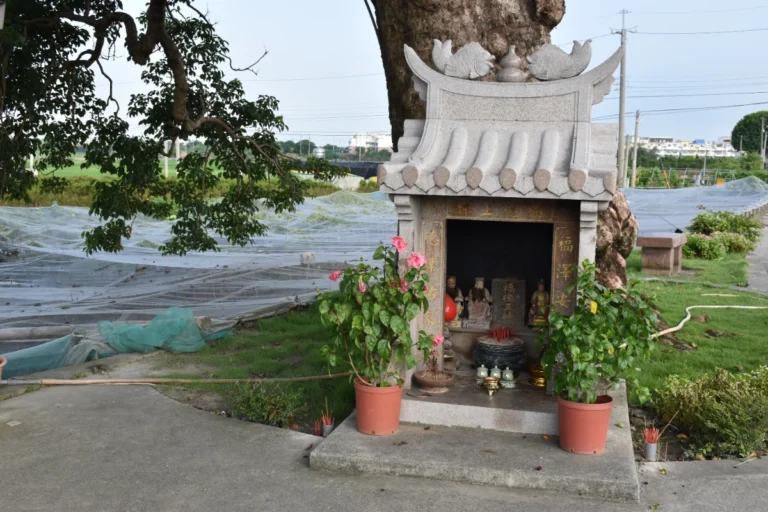
The oak in the parable is a 社 — an altar of the god of the soil. Not a temple in the later sense; the older arrangement, where the local earth deity and a particular tree are the same institution. Reading the chapter from Taiwan, that detail is not antiquarian. It is what you walk past.
A Forestry Bureau account of the national old-tree programme, written by Weng Chia-chun and published in the Ministry of Agriculture’s journal 農政與農情 in November 2011, describes the pattern without any prompting from Zhuangzi: 臺灣的老樹常常與小廟共存,像土地公廟、伯公廟、有應公廟、亦有神格化後的茄苳王公廟、榕王公廟,這種大樹小廟成為臺灣鄉間特殊景色. Taiwan’s old trees usually live alongside a small shrine — to Tudigong, to Bogong in Hakka districts, to the unclaimed dead — and some of the trees have themselves been deified, as King Autumn Maple or King Banyan. A big tree with a small shrine, the report says, is a distinctive feature of the Taiwanese countryside.
The same article records the custom of making a child the tree’s 契子, godchild: the family asks the old tree to adopt the infant, the child wears a charm, and at Mid-Autumn or on the tree spirit’s birthday the family comes back to exchange it. As of that 2011 account, 4,200 trees had been registered in the Forestry Bureau’s management system; the three commonest species under protection were banyan, camphor and autumn maple; and seventeen county and city governments had passed their own old-tree ordinances. The numbers will have moved since. The arrangement has not.
Which means the arrangement Zhuangzi describes — a tree too big and too sacred to cut, standing at a road junction with a shrine at its foot — is not a parable setting in Taiwan. It is a planning category. And the mechanism is the same one Carpenter Shi’s apprentice asked about: the shrine is what keeps the axe away. The article is blunt about what happens when it stops working, noting that as the economy grew a good many old trees were felled for roads and construction and — this is the line that would have made Zhuangzi laugh — for the expansion of the very small shrines they stood beside.
What the tree is not saying
The self-help reading has a second problem, and Zhuangzi supplies it himself, in chapter twenty, 山木. He is walking in the mountains and sees a great tree that the woodcutters will not touch, because it is good for nothing; he points out to his disciples that this is how it has lived out its natural span. That evening he stays with an old friend, who tells the boy to kill a goose for dinner. The boy asks which one — one can honk and one cannot.
Zhuangzi 20 · 山木
主人曰:「殺不能鳴者。」明日,弟子問於莊子曰:「昨日山中之木,以不材得終其天年;今主人之鴈,以不材死。先生將何處?」莊子笑曰:「周將處夫材與不材之間。材與不材之間,似之而非也,故未免乎累。」
“Kill the one that can’t honk,” said the host. Next day a disciple asked: yesterday the tree in the mountains lasted out its years by being no good, and today our host’s goose died for being no good. Where will you place yourself, sir? Zhuangzi laughed. “I would place myself somewhere between good and no good. Though between good and no good only looks right and isn’t, so it too will not escape trouble.”
Translation mine. Chinese Text Project, Zhuangzi, “The Tree on the Mountain”
Within one chapter of setting up the rule, the book kills a goose with it — and then refuses the obvious compromise as well. Uselessness is not a technique. It worked for that oak, in that spot, for those reasons. The goose got nothing.
Which is why the maxim reading is worth resisting even when it is doing no harm. 無用之用,是為大用 is used, kindly and often, to comfort someone who feels unproductive. The chapter it comes from is not comforting. It is about a period in which being noticed by the state got you conscripted, tutored princes got killed, and the safest thing a large living object could be was commercially worthless. Shu the cripple is not an inspirational figure; he is a man who kept his arms because the recruiting officers did not want them. The reading Zhuangzi will not let you have is the one where you deserve to survive.
If you want the version of this idea that does travel well, it is elsewhere in the book: the empty boat, which nobody shouts at because there is nobody aboard, or Cook Ding, who works with the grain rather than against it. Both are about dropping the self that invites collision. Neither promises the collision will not come. And the political cousin of this chapter is the ruler who governs by not acting — another idea that survives translation badly for much the same reason.
Reading it in English
Legge’s 1891 version, the one printed beside the Chinese at the Chinese Text Project, ends the chapter: “All men know the advantage of being useful, but no one knows the advantage of being useless.” It is accurate and it is a little starchy — 莫知 is closer to “nobody has any idea” than to “no one knows the advantage of”. More importantly, “useless” in modern English carries a contempt that 無用 does not. 無所可用, the phrase the carpenter actually uses, is closer to “there is no job this will do” — a statement about the world’s demands, not about the tree’s worth.
That drift is the same one the dictionaries made in Chinese, arriving by a different road. Whether you meet this passage as 櫟散 or as “useless”, the word hands you a verdict the original text has not reached yet. If you read only one sentence of chapter four in the Chinese, make it the oak’s: 為予大用. Two characters of value, one character of “me”, and no maxim anywhere.
FAQ
Is “the use of the useless is the great use” a real quotation from Zhuangzi?
Half of it. 無用之用 is the closing line of chapter four. 大用 appears once in the book, in the shrine oak’s dream speech, as 為予大用 — “a great use, to me”. The joined form 是為大用 returns no results in the Chinese Text Project’s pre-Qin, Han or post-Han corpora, and neither does the common variant 方為大用.
Where in the Zhuangzi is the useless tree?
Chapter four, 人間世, “Man in the World, Associated with other Men”. Carpenter Shi meets the shrine oak at Qu-yuan; the tree answers him in a dream that night. A second, differently-shaped tree appears in chapter one, and a third in chapter twenty, where Zhuangzi uses it to argue against the very rule the chapter-four tree seems to establish.
Does the story mean it is good to be useless?
Not as a general rule, and the text says so. In chapter twenty a goose is killed for being unable to honk, and when a disciple points out the contradiction Zhuangzi declines both positions — he will place himself between usefulness and uselessness, and then adds that the middle position only looks right and will not escape trouble either.
Why do Taiwanese dictionaries define the oak as worthless?
Because the idioms drifted. 櫟散 and 社櫟 in the Ministry of Education’s Revised Mandarin Chinese Dictionary both cite Zhuangzi chapter four and both gloss the tree as a figure for a person of no ability, and 樗櫟庸材 in the Dictionary of Chinese Idioms appendix of revised-dictionary reference material drops the Zhuangzi reference altogether. The dictionaries are recording how the words are used now, which is not how the parable used them.
The same corpus-counting method turns up an equally awkward result in the Laozi: Da Qi Wan Cheng: The Oldest Copies of Laozi Do Not Say ‘Late’.
A second case where a corpus count does most of the work — and where the limits of the corpus have to be stated in the same breath — is 每下愈況, the Zhuangzi phrase whose four characters later changed places. See Mei Xia Yu Kuang: Zhuangzi’s Phrase Now Means the Opposite.
The monkeys in chapter two make the same point from the other side: three in the morning and four at dusk, or four and three, is the same seven, and what changes is only how the total is presented. See Zhuangzi’s three in the morning.
Sources
- Chinese Text Project, Zhuangzi, 人間世 (Chinese) — Carpenter Shi and the shrine oak; the closing line. Checked character by character in a browser.
- Chinese Text Project, Zhuangzi, “Man in the World” (Legge translation alongside)
- Chinese Text Project, Zhuangzi, 山木 — the tree, the goose, and 材與不材之間.
- Chinese Text Project, full-text search for 大用 within the Zhuangzi — one occurrence.
- Chinese Text Project, full-text search for 是為大用, pre-Qin and Han — no results.
- Ministry of Education, Revised Mandarin Chinese Dictionary, 櫟散
- Ministry of Education, Revised Mandarin Chinese Dictionary, 社櫟
- Ministry of Education, Dictionary of Chinese Idioms, appendix entry 樗櫟庸材
- Weng Chia-chun, 臺灣地區老樹保護執行成果 (Results of the old-tree protection programme in Taiwan), Forestry Bureau, in 農政與農情 no. 233, November 2011 — registered trees, commonest species, local ordinances, the shrine-and-tree pattern and the 契子 custom.
- Global Views Monthly (遠見), 15 November 2024 — the maxim attributed to Zhuangzi as a direct quotation, in the headline and the first line.
- Wikimedia Commons, Temple under Sanchung Old Tree — photograph by Bunkichi Chang, CC BY 2.0.



