
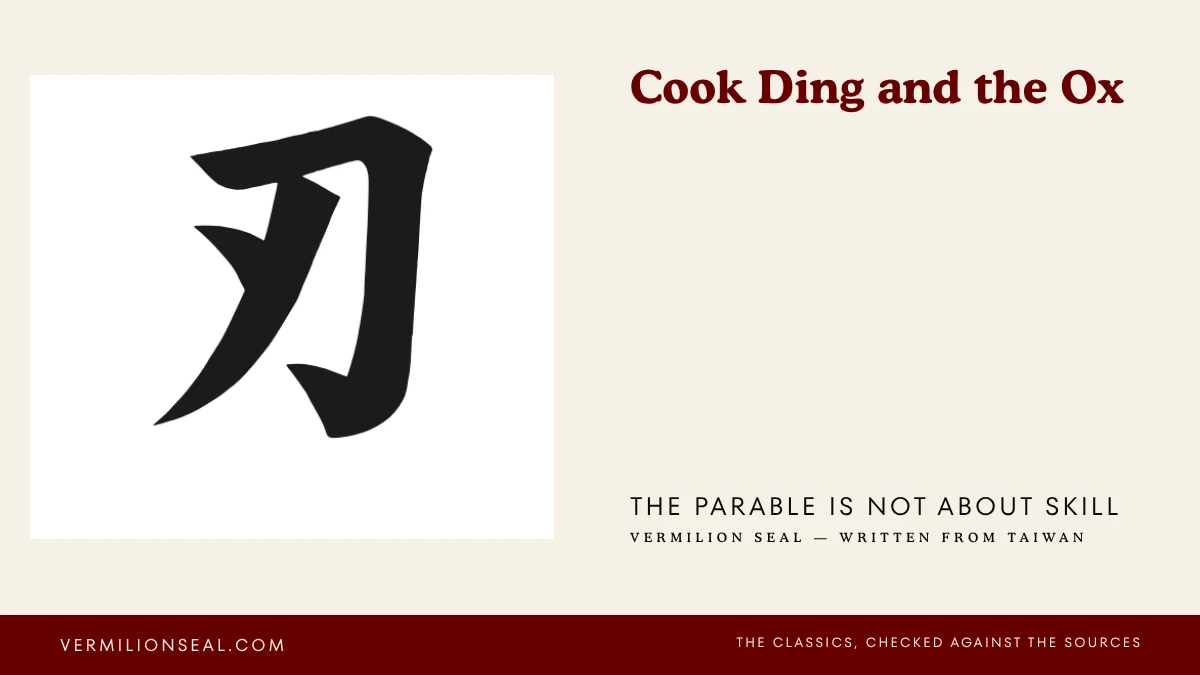
The story of Cook Ding and the ox is the most quoted passage in the Zhuangzi, and in English it has been quietly turned into something it is not. A butcher works his way through a carcass so fluently that the strokes fall into music; a duke watches and says he has learned something. Nine times out of ten the English retelling calls this a parable about mastery — about how practice, repeated long enough, becomes effortless. The chapter it sits in is called 養生主, on nourishing life, and the duke does not say he has learned about knives.
The passage is short enough to check line by line, so this piece checks it. What the cook says about himself, what Taiwan’s official dictionaries record about the two idioms that came out of the story, and where the English versions lose the load-bearing words.
What the cook actually claims
The first thing Ding says, when Duke Wenhui asks how his technique got this good, is that technique is not what he is interested in.
臣之所好者道也,進乎技矣。
What I care about is the way; it has gone past technique.
Text: Chinese Text Project, Zhuangzi – Nourishing the Lord of Life
That is the sentence the skill reading has to get past, and it usually does so by treating it as modesty, or as a flourish. Read plainly it is a correction: the duke has asked a question about 技, and the cook declines the frame. Everything that follows — the three stages of his seeing, the gaps in the joints, the blade that is nineteen years old — is offered as evidence for that claim, not for the claim that he has practised a great deal.
He does mention practice, but only to dismiss two kinds of it. The good cook changes his chopper once a year, because he cuts. The ordinary cook changes it once a month, because he hacks. Both of them are working hard; both are wrecking their blades. The difference Ding describes is not effort and it is not repetition.
“Cook Ding” is probably not a name
English translations settle the question one way or another and move on. James Legge opens with “his cook,” giving the man no name at all. Burton Watson opens with “Cook Ting,” which is where the anglophone habit of treating Ding as a personal name comes from.
Taiwan’s Ministry of Education takes the first line. Its Dictionary of Chinese Idioms glosses 庖丁解牛 as 「梁惠王時有位廚師善宰牛」 — in the time of King Hui of Liang there was a cook who was good at butchering oxen. A cook. Not a man called Ding.
The Zhuangzi also names people this way elsewhere, and the pattern is easy to check. 輪扁, the wheelwright Bian, appears in the “Way of Heaven” chapter. 梓慶, the woodworker Qing, appears in “Mastering Life.” Trade word first, given name second. On that pattern 庖丁 reads as Ding the cook — or, if 丁 is taken in its ordinary sense of a labourer or able-bodied man, simply kitchen hand.
The commentarial tradition is not unanimous on which of those it is. I have seen the relevant glosses quoted in secondary transcriptions but have not been able to check them against a printed critical edition, so I am not going to quote them here and pretend the matter is settled. What can be said safely is narrower and still useful: 庖 is the trade, 丁 is the personal element, and I have not found a Chinese source that treats 庖 as a family name. If you have met the claim that the man’s surname was Pao, treat it as a classroom shortcut until someone produces a commentary for it.
The line these translations let go
When Ding describes what he does instead of cutting, he uses four words that carry the whole argument.
依乎天理,批大郤,導大窾,因其固然。
I go by the patterning of heaven, strike into the large openings, guide the blade through the large hollows, follow what is already so.
Text: Chinese Text Project, Zhuangzi – Nourishing the Lord of Life
Legge renders 依乎天理 as “observing the natural lines.” Watson has “I go along with the natural makeup.” Neither is wrong about the anatomy. In both, 天 settles into the adjective natural, and the suggestion that the ox’s joints and the order of things are the same order is not carried across. Other translators do carry it: Dorothy Kwek, writing in Dao in 2019, has “guided by cosmic patterns (yi hu tian li 依乎天理),” precisely because the flattened version turns a cosmological claim into a tip about butchery.
Nothing here is mistranslated in the sense of being wrong. The words that make the passage part of a Daoist argument are simply rendered into words that make it part of a craft anecdote, and after two or three retellings nobody can see that a choice was made. The same thing happens to 無為, which is why we wrote separately about what wu wei meant before it meant relaxing.
The chapter title that got swapped
The passage ends where the skill reading has no use for it.
文惠君曰:「善哉!吾聞庖丁之言,得養生焉。」
Duke Wenhui said: “Excellent. I have heard the cook’s words, and from them I have got how to nourish life.”
Text: Chinese Text Project, Zhuangzi – Nourishing the Lord of Life
Both major translators keep this. Legge: “I have heard the words of my cook, and learned from them the nourishment of (our) life.” Watson: “I have heard the words of Cook Ting and learned how to care for life!” Watson even titles the chapter “The Secret of Caring for Life.” So the loss is not in the translations.
It tends to happen one step later, in circulation. The passage travels under a title of its own — The Dexterous Butcher — which is how it is headed on the anthology pages anglophone readers actually land on, and it has been used as a title in its own right for a short self-published edition (2018). Swap “caring for life” for “dexterous” and the reader arrives already told what the story is about. The duke’s last line then reads as a polite exit rather than as the point.
Chapter titles are a recurring weak joint. When we compared the main English Daodejing versions, the differences that mattered most were rarely at the level of individual words; they were in framing that the reader never sees as a choice.
Practice makes perfect, and what the scholarship says back
The productivity reading is easy to document because it is stated outright. One idiom site heads its page on 庖丁解牛 with “effortless skill through perfect practice.” A widely shared essay on Medium turns the cook into a case study in deliberate practice, telling readers that mastery “demands patience and deliberate practice… repeating the process again and again.” Even Education About Asia, published by the Association for Asian Studies, leads with skill acquisition and treats nourishing life as the closing note: the mastery of any skill, it says, “brings with it a sense of flow, of spontaneity, of joy in performance.”
Against that, three points from people who work on the text.
John Williams, writing in Early China in 2023, works through the traditional commentaries specifically to ask how the link between 養生 and the Butcher Ding vignette was handled there. His finding is that the connection is not rare in the commentarial literature, and that the suggestion it “might be taken seriously” has textual support behind it. Read modestly, that is enough to block the assumption that the nourishing-life frame is something modern readers bolted onto a skill story.
Eric Schwitzgebel puts the sharper version: “It’s not clear that the cook’s skill is the thing that teaches King Hui how to nourish life. It might be the knife’s passivity instead.” He also notes the self-defeating shape of the productivity reading — “seeking spontaneous wordless skill as the highest goal becomes exactly the sort of driving dogma that Zhuangzi was at pains to resist.”
And Kwek, in the same 2019 article, warns against the broader move of reading the Zhuangzi back into whatever we already believe: we must resist, she writes, “erroneously turning the Zhuangzi’s critique of proto-imperial logics into affirmations of laissez-faire liberalism, or libertarianism.” Swap the ideology and the warning still holds for management literature.
Not everyone in English reads it that way, and it is worth saying so. One popular Daoist blog — not a scholarly source, but a public one — has argued that “what develops over time is not primarily skill but perception,” which is close to what the three-stages passage says about seeing.
What Taiwan’s official dictionary records without comment
Two four-character idioms came out of this passage, and both are in daily use in Taiwan. Neither appears in the Zhuangzi in the form people quote.
目無全牛, the eye no longer sees a whole ox, is a later condensation of the cook’s line 未嘗見全牛也. 遊刃有餘, the roving blade has room to spare, condenses 恢恢乎其於遊刃必有餘地矣. The Ministry of Education marks the distinction in its own vocabulary: the second entry says 語本《莊子.養生主》, derived from, rather than quoted from. If you have seen either phrase presented as a direct quotation of Zhuangzi, it is not one.
The entry for 目無全牛 is more interesting than that, because it records the whole drift in a single definition:
眼中沒有整頭牛的形體,比喻道的修養不受外形限制的境界。典出《莊子.養生主》。後用「目無全牛」比喻技藝純熟高超。
There is no whole ox before the eye: a figure for the state in which cultivation of the way is not bounded by outward form. Originating in the “Nourishing the Lord of Life” chapter of the Zhuangzi. Later used as a figure for consummate skill.
Source: 教育部《成語典》——目無全牛
First sense: cultivation of the way, 道的修養. Second sense, introduced by 後用 — later used as — consummate skill, 技藝純熟高超. The dictionary is not complaining. It is a lexicographical record, and it is recording exactly the slide this article is about, in the same two words the cook uses: from 道 to 技, in the opposite direction from 臣之所好者道也,進乎技矣.
The usage notes make it plainer. Under 目無全牛 the official register is 用在「技藝精湛」的表述上 — used in statements about consummate craft — and the model sentences are about craft: one of them is about the sculptor Ju Ming 朱銘 and his Taichi series. Under 庖丁解牛 in the revised-dictionary appendix, the model sentence has moved into the office: 「這件專案自從由他接手後,便如同庖丁解牛,一切問題皆迎刃而解。」 — since he took over this project it has been like Cook Ding carving the ox; every problem resolves itself. That is a project-management example, in an official dictionary, under a parable about not being worn out by the world.
The living end of it is louder still. 遊刃有餘 has been ordinary Taiwanese speech for decades, and in 2025 it had a year. A phrase from a legislator’s questioning in the Legislative Yuan, 從從容容、游刃有餘 — unhurried, blade roving with room to spare — left the chamber, became a catchphrase, and was still being reported on in December, when United Daily News noted it had been picked up in a widely circulated list of the year’s ten most-used expressions. Nobody using it that way is doing anything wrong. They are using a living idiom in its current sense, which is what idioms are for. The point is only that the current sense and the source text are not the same claim, and the dictionary says so if you read the whole entry.
Misquotation and misattribution: what checks out and what does not
Three things are worth flagging, including one where the honest answer is that the evidence is missing.
The flow attribution. It is widely repeated in English that Mihaly Csikszentmihalyi cites the Cook Ding passage in Flow (1990). I could not verify it. The claim traces to a 2007 blog post by a philosopher who states it in passing without a page reference, and I could not find a chapter, a page number, or a searchable text that confirms it. That does not make it false. It means nobody should be repeating it as a citation. If you want a real academic treatment of the connection, Nathaniel Barrett’s “Wuwei and Flow” in Philosophy East and West 61:4 (2011) exists and can be cited properly.
Invented Zhuangzi quotations. Quotation sites are full of lines attributed to Zhuangzi that have no Chinese original, and we have documented that pattern elsewhere. For this passage specifically, I looked and found none. The English lines circulating under “Cook Ding” are translations of real text, however loosely they are framed. Credit where it is due.
The character you may be reading as a typo. The Chinese Text Project prints the passage with 无 where modern editions print 無 — 刀刃者无厚, 以无厚入有間. That is the older graph, not a simplification and not an error, and it is one reason to quote from a named edition rather than from whatever text a search returns. The same caution applies to 遊 and 游 in the idiom: the Ministry of Education files the entry under 遊刃有餘 and treats 游刃有餘 as a variant of it, with no ruling that either is wrong.
If this way of reading a famous passage against its own circulation is useful to you, the same method is at work in our pieces on the empty boat, on the happiness of fish, and on governing a great state as you cook a small fish — another kitchen metaphor that arrived in English carrying a claim the Chinese does not make.
FAQ
Is Cook Ding a real person?
There is no evidence for one, and the question is probably the wrong shape. 庖 is the job — cook, kitchen — and 丁 is either a given name or the ordinary word for a labourer. The Zhuangzi names skilled workers this way throughout, as with the wheelwright Bian 輪扁 and the woodworker Qing 梓慶. Taiwan’s Ministry of Education simply glosses him as a cook in the time of King Hui of Liang. He is a figure in an argument, not a man in a record.
Does the passage mean practice makes perfect?
The text says the opposite twice. The cook explicitly ranks what he does above 技, technique, and the two cooks he contrasts himself with — the one who replaces his blade yearly, the one who replaces it monthly — are both practising constantly. What he describes instead is following the structure that is already there, 因其固然. The chapter is about not being worn down, and the blade that is still sharp after nineteen years is the image of that.
Which English translation should I read?
Burton Watson’s is the one most anthologies reprint and it keeps both the name and the closing line about nourishing life. James Legge’s is older, freely available, and drops the cook’s name. Neither is a trap. The thing to watch is not the translator but the headnote: if the passage is presented to you as “The Dexterous Butcher” rather than as part of a chapter on caring for life, you are being told what to think before you start.
Do 目無全牛 and 遊刃有餘 appear in the Zhuangzi?
Not in that form. Both are later four-character condensations; what the text has is the longer phrasing they were cut down from, 未嘗見全牛也 and 恢恢乎其於遊刃必有餘地矣. The Ministry of Education’s entry for 遊刃有餘 marks this precisely, with 語本, derived from, rather than the formula it uses for direct quotation.
For another parable whose received meaning inverted the original, see Zhuangzi mourning his wife, where Taiwan’s Ministry of Education dictionary now defines the gesture as the grief it was meant to end.
The chapter after Cook Ding’s is the one about surviving other people, and it ends with a tree no carpenter could use. On what it actually says, and the half-line that is not in it, see Zhuangzi’s useless tree.
The same inversion — a passage about method reread as a passage about outcome — happened to another line in the Zhuangzi: 每下愈況 describes how a market inspector tests a pig, and in modern Chinese it describes decline. See Mei Xia Yu Kuang: Zhuangzi’s Phrase Now Means the Opposite.
Cook Ding is a parable, and so is every encounter between Confucius and Lao Dan in this book: five chapters stage one, and 〈天運〉 even gives Confucius an age when it happens. That age is very nearly the only number anyone has to work with when they try to date Laozi, which is the subject of did Laozi live before Confucius?
Sources
- Chinese Text Project, Zhuangzi, “Nourishing the Lord of Life” 養生主 — Chinese text with James Legge’s translation: ctext.org/zhuangzi/nourishing-the-lord-of-life/zh
- Ministry of Education (Taiwan), Dictionary of Chinese Idioms 《成語典》, entry 目無全牛: dict.idioms.moe.edu.tw (ID 1419)
- Ministry of Education (Taiwan), Dictionary of Chinese Idioms 《成語典》, entry 遊刃有餘: dict.idioms.moe.edu.tw (ID 1731)
- Ministry of Education (Taiwan), 《成語典》 revised-dictionary appendix, entry 庖丁解牛: dict.idioms.moe.edu.tw (ID 10666)
- Burton Watson, trans., Chuang Tzu: Basic Writings, “The Secret of Caring for Life” — full text: terebess.hu/english/chuangtzu.html
- John Williams, “A Note Concerning the Relationship Between ‘Butcher Ding’ and ‘Nourishing Life’ in the Traditional Zhuangzi Commentaries,” Early China 46 (2023), 373–380: Cambridge Core
- Dorothy H. B. Kwek, “Critique of Imperial Reason: Lessons from the Zhuangzi,” Dao 18 (2019), 411–433: open-access PDF
- Eric Schwitzgebel, “The Unskilled Zhuangzi: Big and Useless and Not So Good at Catching Rats”: faculty.ucr.edu
- Nathaniel F. Barrett, “Wuwei and Flow,” Philosophy East and West 61:4 (2011), 679–706 — bibliographic record: PhilPapers
- Charles B. Jones, “The Wheelwright and the Butcher: Master Zhuang’s Recipe for Mindful Living,” Education About Asia (Association for Asian Studies) — cited as an example of the skill-first framing: asianstudies.org
- United Daily News (Taiwan), 2 December 2025, on 「從從容容、游刃有餘」 as a catchphrase of 2025: udn.com
- Cited as examples of the skill-first reading, not as authorities: Chinese Idioms, “Pao Ding Jie Niu”; Álvaro García, “The Lesson of a Chinese Sage to Master Any Skill in Life” (Medium)
- A dissenting English-language reading, cited in the text: Follow the Tao, “Zhuangzi’s Cook”
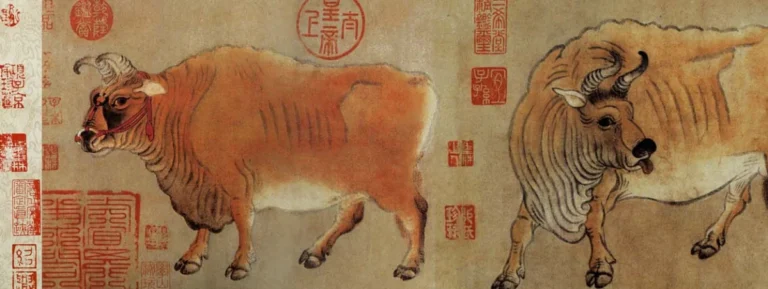
- Wikimedia Commons, Han Huang, Five Oxen 五牛圖 — file and licence: commons.wikimedia.org



