
The Great Learning opens with the sentence Confucian schooling has begun with for eight hundred years: 大學之道,在明明德,在親民,在止於至善. Those are the Great Learning three principles — the 三綱領, “three guiding ropes”, as the tradition calls them — and any Taiwanese adult who went through school can recite them. Fewer can tell you that the middle one is disputed at the level of a single character, that the dispute runs from the Song dynasty to the Ming, and that the most widely read English translation quietly takes one side. This entry sets out what the sentence says, what the three great commentators made of each principle, and which word you are actually reading when you read it in English.
The text
The opening of the Great Learning
大學之道,在明明德,在親民,在止於至善。知止而后有定,定而后能靜,靜而后能安,安而后能慮,慮而后能得。物有本末,事有終始,知所先後,則近道矣。
“The way of the great learning lies in making bright virtue bright, in being close to the people, and in resting in the highest good. Knowing where to rest, one has fixity; with fixity one can be still; being still one can be at ease; at ease one can deliberate; deliberating one can attain. Things have their root and branch; affairs have their end and beginning. Know what comes first and what after, and you are near the way.”
《禮記・大學》 · ctext.org(附理雅各英譯)
The Great Learning (大學) is the forty-second chapter of the Book of Rites, a Han-dynasty compilation of older ritual texts. Nobody knows who wrote it. The Han scholar Zheng Xuan, cataloguing the Rites in the second century, explained the title in a single clause: 名曰大學者,以其記博學可以為政也, “it is called Great Learning because it records how broad learning can be used for government”. For a thousand years it was one chapter among forty-nine. Then Zhu Xi (1130–1200) pulled it out, reordered its paragraphs, supplied a missing one of his own, and placed it first among the Four Books, the core of the examination curriculum in China, Korea and Vietnam, and of Confucian schooling in Japan, until the twentieth century. He also re-read the title: 大學者,大人之學也, “the great learning is the learning of the great person” — not breadth of study but the making of a certain kind of adult. The three principles are what that adult is for.
First principle: make bright virtue bright
明明德 is two words that look like one. The second 明 is an adjective — bright, luminous virtue; the first is a verb — to make bright, to display. James Legge caught the doubling in 1861 with “to illustrate illustrious virtue”, which sounds odd in English precisely because it is faithful.
The commentators differ on where the brightness is. Zheng Xuan’s note is brief: 明明德,謂顯明其至德也, “to make bright virtue bright means to display one’s utmost virtue” — a matter of conduct made visible, in keeping with his view that the book is about government. Zhu Xi turns it inward and makes it a doctrine of human nature:
Zhu Xi on bright virtue
明,明之也。明德者,人之所得乎天,而虛靈不昧,以具眾理而應萬事者也。但為氣稟所拘,人欲所蔽,則有時而昏;然其本體之明,則有未嘗息者。故學者當因其所發而遂明之,以復其初也。
“The first ‘bright’ means to make bright. Bright virtue is what a person receives from Heaven: empty, spiritual, unobscured, holding all the principles and responding to all things. But being confined by one’s endowment of vital stuff and covered over by human desires, it is at times dimmed; yet the brightness of its original substance never ceases. So the learner should take what issues from it and make it bright, in order to recover its beginning.”
朱熹《大學章句》 · ctext.org
“To recover its beginning” — 以復其初 — is the whole Neo-Confucian programme in four characters: virtue is not built but uncovered. Wang Yangming (1472–1529), three centuries later, agreed that it was innate and changed what it was. In his Inquiry on the Great Learning the bright virtue is 一體之仁, “the humaneness of being one body” with all things — the reflex that flinches when a child is about to fall into a well, that pities a crushed plant, that even a petty person has until desire covers it. Same brightness, but for Zhu Xi it holds principles, and for Wang it feels.
Second principle: close to the people — or renew them?
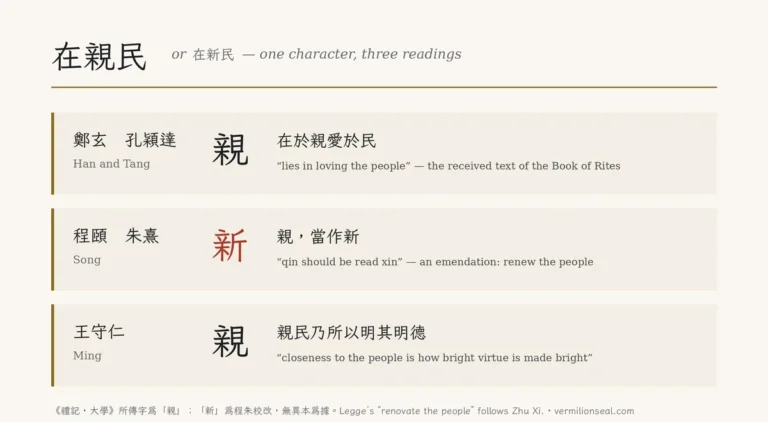
Here is the dispute. The received text of the Book of Rites reads 在親民. 親 means close, dear, kin; as a verb, to be close to, to love as one’s own. The Tang commentary of Kong Yingda takes it at face value: 在親民者,言大學之道,在於親愛於民, “‘in being close to the people’ says that the way of the great learning lies in loving the people”. That is what the sentence said for its first thousand years.
Zhu Xi’s first note on the sentence is four characters long and changes the book:
The emendation
程子曰:「親,當作新。」……新者,革其舊之謂也,言既自明其明德,又當推以及人,使之亦有以去其舊染之污也。
“Master Cheng says: ‘Qin [close] should be read xin [new].’ … To renew means to reform the old: having made one’s own bright virtue bright, one should extend it to others so that they too can rid themselves of the filth of their old habits.”
朱熹《大學章句》引程頤 · ctext.org
The argument is not arbitrary. The Great Learning is built as a short “classic” followed by “commentary” sections that expound its phrases one by one, and the section that expounds this principle quotes three older texts — the inscription on King Tang’s basin, 苟日新,日日新,又日新, “if one day new, then day by day new, and again day new”; the Announcement to Kang, 作新民, “rouse up the new people”; and the Odes, 其命惟新, “its mandate was new”. All three say 新. Cheng Yi and Zhu Xi reasoned that a commentary section built entirely on “new” must be expounding a principle that said “new”, and that 親 was a scribal slip for a character it resembles. Zhu Xi then wrote 新民 throughout his own notes, and, because the Four Books became the examination syllabus, so did everyone else for six hundred years.
Wang Yangming refused. His Inquiry on the Great Learning, dictated in 1527, is framed as a series of questions from a student, and the second question is exactly this one:
Wang Yangming keeps the old reading
曰:然則何以在「親民」乎?曰:明明德者,立其天地萬物一體之體也,親民者,達其天地萬物一體之用也。故明明德必在於親民,而親民乃所以明其明德也。是故親吾之父,以及人之父,以及天下人之父,而後吾之仁實與吾之父、人之父與天下人之父而為一體矣。
“He asked: then why does it lie in ‘being close to the people’? I said: making bright virtue bright is to establish the substance of being one body with heaven, earth and all things; being close to the people is to carry out the function of being one body with heaven, earth and all things. So making bright virtue bright must lie in being close to the people, and being close to the people is precisely how one makes one’s bright virtue bright. Thus I am close to my own father, and extend it to other people’s fathers, and to the fathers of everyone in the world, and only then is my humaneness really one body with my father, other people’s fathers, and the fathers of everyone in the world.”
王守仁《大學問》 · 維基文庫
For Wang, 親 is not a corruption but the point. “Renewing the people” makes the second principle something a cultivated person does to others, after finishing his own cultivation; “being close to the people” makes it the same act seen from outside — the love of others is how the inner brightness exists at all. Later in the dialogue he adds that Zhu Xi’s reading also forces the book’s “root and branch” into two separate things, when a tree’s root and its tip are one tree. Wang published the Great Learning in its original Book of Rites order as well, undoing Zhu Xi’s rearrangement, and the two decisions go together: leave the text alone.
So which is it? The text says 親. The Book of Rites as it has come down to us says 親, and Zhu Xi himself does not claim a copy that reads otherwise. 新 is an emendation with a good argument behind it and no textual witness. When a translation says “renovate” or “renew the people” — as Legge’s does — it is translating Zhu Xi, and when it says “love” or “be close to the people”, it is translating the Rites. Neither is wrong, but a reader is entitled to know which book is in front of them, and English editions rarely say.
Third principle: rest in the highest good
止於至善. 止 is to stop, to come to rest, to abide. Zheng Xuan glosses it as 猶自處也, “like settling oneself”; Zhu Xi as 必至於是而不遷之意, “the sense of reaching that point and not shifting from it”, and he defines 至善 as 事理當然之極, “the utmost of what is right in each affair”. The book’s own commentary section on this principle is more concrete than either: it lists where different people come to rest — 為人君,止於仁;為人臣,止於敬;為人子,止於孝;為人父,止於慈;與國人交,止於信, “as a ruler, rest in humaneness; as a minister, in reverence; as a son, in filial devotion; as a father, in kindness; in dealings with the people of the state, in trustworthiness”. The highest good is not one thing. It is the right stopping-place for each role, and the second sentence of the book — know where to rest and you gain fixity, stillness, ease, deliberation, attainment — is a description of what happens once you have found yours.
Wang Yangming, characteristically, moved it inside: the highest good is 明德、親民之極則, “the ultimate standard of bright virtue and closeness to the people”, which is to say the innate knowing (良知) that already tells right from wrong. He calls it the compass and square to the other two principles’ circle and square: without it, making virtue bright drifts into the emptiness of the Buddhists and Daoists, and being close to the people sinks into the scheming of the hegemons. That is a Ming philosopher’s reading, not the text’s, but it shows how much weight the tradition put on the little word 止.
Reading it today
Zhu Xi called these three 大學之綱領, the guiding ropes of the whole book, and the eight steps that follow — from investigating things to bringing peace to the realm — are how the ropes are pulled; those are the subject of a separate entry. What is worth keeping from this one is small and practical. When you meet the three principles in English, check the second. “Renew the people” means the translator followed Zhu Xi; “love the people” or “be close to the people” means the Book of Rites as it stands. And when you meet them in Chinese, the character on the page is 親, whatever the footnote says it ought to be.
For the other text in the Four Books whose editorial history is usually hidden from English readers, see who compiled the Analects and which Analects translation to read. For a Confucian book whose very authenticity is the question, see can the Kongzi Jiayu be trusted. And for another classic whose opening line the tradition reads two ways, see hexagram 15 of the Yijing.
FAQ
What are the three principles of the Great Learning?
明明德, making bright virtue bright; 親民, being close to the people (read by Zhu Xi as 新民, renewing the people); and 止於至善, resting in the highest good. Zhu Xi called them the book’s 三綱領, three guiding principles.
Does the Great Learning say 親民 or 新民?
The text of the Book of Rites reads 親民, “be close to the people”, and the Tang commentary reads it as loving the people. Cheng Yi and Zhu Xi argued it should be 新民, “renew the people”, because the book’s own commentary section quotes three texts about newness. Wang Yangming rejected the change. Legge’s English “renovate the people” follows Zhu Xi.
Who wrote the Great Learning?
Unknown. It is a chapter of the Han-dynasty Book of Rites. Zhu Xi conjectured that its opening “classic” section preserved Confucius’s words as transmitted by his disciple Zengzi, and that the rest was written by Zengzi’s students, but he marked this as probable, not certain.
What does 明明德 mean?
The first 明 is a verb, “to make bright”; the second is an adjective describing 德, virtue. Zheng Xuan read it as displaying one’s virtue in conduct; Zhu Xi as recovering the innate clarity of one’s Heaven-given nature; Wang Yangming as the humaneness that feels itself one body with all things.
明德 travels well beyond this text. It reappears, by way of the Book of Documents, in the eighty-one characters of the Loushi Ming, where a small room is said to be made fragrant by nothing but the virtue of the man in it.
Sources
- 《禮記・大學》「大學之道,在明明德,在親民,在止於至善……知所先後,則近道矣」;傳文「湯之盤銘曰:苟日新……康誥曰:作新民……詩曰:周雖舊邦,其命惟新」「為人君,止於仁……與國人交,止於信」(附理雅各 1861 英譯 “to illustrate illustrious virtue; to renovate the people; and to rest in the highest excellence”) — ctext.org (accessed 5 Sep 2026)
- 朱熹《四書章句集注・大學章句》「大學者,大人之學也」「程子曰:親,當作新」「明德者,人之所得乎天……以復其初也」「新者,革其舊之謂也」「止者,必至於是而不遷之意。至善,則事理當然之極也」「此三者,大學之綱領也」「右經一章,蓋孔子之言,而曾子述之」 — ctext.org (accessed 5 Sep 2026)
- 《禮記正義》卷六十 大學第四十二,鄭玄注「明明德,謂顯明其至德也。止,猶自處也」;鄭《目錄》「名曰大學者,以其記博學可以為政也」;孔穎達疏「在親民者,言大學之道,在於親愛於民」 — 維基文庫 (accessed 5 Sep 2026)
- 王守仁《大學問》(嘉靖丁亥 1527,錢德洪錄)「明明德者,立其天地萬物一體之體也,親民者,達其天地萬物一體之用也」「至善者,明德、親民之極則也」「但不當分本末為兩物耳」 — 維基文庫 (accessed 5 Sep 2026)



