
Four phrases hang in more Taiwanese offices and classrooms than any others from the classics: 修身、齊家、治國、平天下 — cultivate the self, order the household, govern the state, bring peace to the realm. They are usually introduced as Confucius’s words, and in English they have become a ladder for leadership books. The sentence they come from is longer, older than its attribution, and runs in two directions. It has eight steps, not four; the eight steps of the Great Learning begin with a verb that three of the greatest Chinese commentators could not agree on; and the text itself says that the middle of the ladder, not the top, is the point. Here is the passage, its order, its source, and what has been dropped.
The passage
The eight steps, both ways
古之欲明明德於天下者,先治其國;欲治其國者,先齊其家;欲齊其家者,先修其身;欲修其身者,先正其心;欲正其心者,先誠其意;欲誠其意者,先致其知,致知在格物。物格而後知至,知至而後意誠,意誠而後心正,心正而後身修,身修而後家齊,家齊而後國治,國治而後天下平。自天子以至於庶人,壹是皆以修身為本。
“The ancients who wished to make bright virtue bright throughout the realm first governed their states. Wishing to govern their states, they first ordered their households. Wishing to order their households, they first cultivated their persons. Wishing to cultivate their persons, they first set their minds right. Wishing to set their minds right, they first made their intentions sincere. Wishing to make their intentions sincere, they first extended their knowledge; and extending knowledge lies in ge wu [reaching, or investigating, or rectifying, things]. Things being ge-d, knowledge was complete; knowledge complete, intentions were sincere; intentions sincere, minds were right; minds right, persons were cultivated; persons cultivated, households were ordered; households ordered, states were governed; states governed, the realm was at peace. From the Son of Heaven down to the common people, all alike take the cultivation of the person as the root.”
《禮記・大學》 · ctext.org(附理雅各英譯)
I have left 格物 untranslated in the box, for a reason that will take a section to explain. Everything else is plain, and the first thing to see is the shape.
Two directions
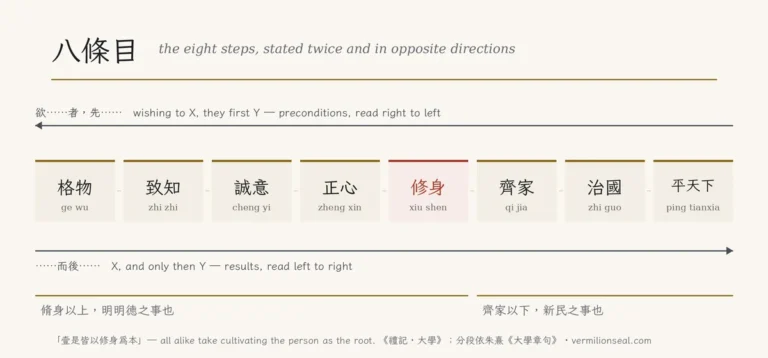
The passage states its eight items twice. The first run goes backwards from the goal, each clause beginning 欲……者,先……, “one who wishes to X must first Y”: from peace in the realm back through state, household, person, mind, intention, knowledge, to 格物. It is a chain of preconditions. The second run goes forwards, each clause joined by 而後, “and only then”: things ge-d, then knowledge, then intention, then mind, then person, then household, then state, then the realm. It is a chain of results.
Laid out in the forward order, the eight are:
The eight items in order
格物 → 致知 → 誠意 → 正心 → 修身 → 齊家 → 治國 → 平天下
ge wu (reach/investigate/rectify things) → zhi zhi (extend knowledge) → cheng yi (make intentions sincere) → zheng xin (set the mind right) → xiu shen (cultivate the person) → qi jia (order the household) → zhi guo (govern the state) → ping tianxia (bring peace to the realm)
朱熹《大學章句》:「此八者,大學之條目也。」 · ctext.org
Zhu Xi (1130–1200) named them the 八條目, the “eight items” or eight steps, the counterpart of the three principles in the book’s first sentence. He also drew the line that the popular four-phrase version erases. In his note on 壹是皆以修身為本, “all alike take cultivating the person as the root”, he writes: 正心以上,皆所以脩身也。齊家以下,則舉此而措之耳 — “everything from setting the mind right upwards is the means of cultivating the person; everything from ordering the household downwards is simply taking this and applying it.” The eight are not a staircase of equal treads. Four of them lead into 修身 and three lead out of it, and the text says so itself: 修身為本, the person is the root. When the scroll on the wall reads only 修身齊家治國平天下, it has kept the trunk and the branches and cut off the roots.
Where the passage comes from
The Great Learning is the forty-second chapter of the Book of Rites, compiled in the Han dynasty from earlier material. Its author is unknown and its date is argued about, with proposals running from the late Warring States to the early Han. In the Han catalogue of Zheng Xuan it was simply a chapter that “records how broad learning can be used for government” — a manual for the governing class, which is exactly what the eight steps read like: the person addressed is 古之欲明明德於天下者, the man of old who wished to make virtue shine throughout the realm. Not everyone wished that. The passage’s closing sentence widens the frame to everyone from the emperor to the commoner, but the ladder it describes ends in a throne room.
The attribution to Confucius comes from Zhu Xi, and it is worth reading what he actually wrote:
Zhu Xi’s attribution, with its hedge
右經一章,蓋孔子之言,而曾子述之。凡二百五字。其傳十章,則曾子之意而門人記之也。舊本頗有錯簡,今因程子所定,而更考經文,別為序次如左。
“The above is the one chapter of the Classic — probably the words of Confucius, transmitted by Zengzi. Two hundred and five characters in all. The ten chapters of commentary are Zengzi’s meaning as recorded by his disciples. The old text had a good many displaced strips; now, following Master Cheng’s determination and re-examining the text of the Classic, I have arranged it in the order given below.”
朱熹《大學章句》 · ctext.org
蓋 means “probably”, “I take it that”. Zhu Xi is proposing a lineage — Confucius spoke, Zengzi passed it on, Zengzi’s students wrote up the rest — and he marks it as a proposal. The Book of Rites chapter itself never says “the Master said” of this passage; it uses 子曰 only twice, later, for two short remarks about litigation and about a bird knowing where to perch. So “Confucius said: cultivate the self, order the household…” is, strictly, “Zhu Xi supposed that Confucius said”. The eight steps are Confucian in every sense that matters; they are not a quotation from Confucius. The same care is needed with the Analects, whose Confucius is also a compilers’ construction.
Notice too the last sentence of the passage: Zhu Xi rearranged the book. The Rites text had the eight steps followed immediately by the section on sincerity of intention; Zhu Xi moved paragraphs around to make each commentary section follow the principle it expounds, decided that the section on the first two steps had been lost, and wrote a replacement for it. That replacement is the reason English readers think they know what the first step means.
The first step: three readings of one verb
格物. 物 is “things” (or, as all three commentators agree, “affairs”). 格 is the problem. It is a verb of arriving, reaching, coming up against, and also of a standard or a grid; and the whole of later Chinese philosophy can be sorted by what a thinker did with it.
Zheng Xuan, in the Han, read it as “to come”: 格,來也。物,猶事也。其知於善深則來善物,其知於惡深則來惡物 — “ge means to come; wu means affairs. If one’s knowledge of good is deep, good things come; if one’s knowledge of evil is deep, evil things come.” Things arrive in response to the quality of your knowing. It is a theory of moral resonance, not of study.
Zhu Xi read it as “to reach to the utmost”, and made it the foundation of learning: 格,至也。物,猶事也。窮至事物之理,欲其極處無不到也 — “ge means to reach; wu means affairs. To exhaustively reach the principles of things and affairs, wishing that there be nowhere their utmost point is not attained.” His supplementary chapter spells it out: since every mind can know and every thing has a principle, the learner must 即凡天下之物……益窮之,以求至乎其極, “go to each thing in the world and probe its principle further, seeking to arrive at the ultimate”, until one day everything is suddenly clear. This is the reading Legge translated as “the investigation of things”, and it is the reading that let nineteenth-century Chinese coin 格致 as the first word for natural science.
Wang Yangming — who as a young man, by his own account, had tried Zhu Xi’s method on the bamboo in front of a pavilion and watched first a friend and then himself fall ill from the effort — read it as “to rectify”:
Wang Yangming on the first step
物者,事也,凡意之所發必有其事,意所在之事謂之物。格者,正也,正其不正以歸於正之謂也。正其不正者,去惡之謂也。歸於正者,為善之謂也。
“‘Things’ are affairs. Wherever an intention issues there must be an affair, and the affair the intention is directed at is called a ‘thing’. ‘Ge‘ means to rectify: to rectify what is not right so that it returns to the right. To rectify what is not right means to get rid of evil; to return to the right means to do good.”
王守仁《大學問》 · 維基文庫
On Wang’s reading the first step is not the study of the world but the correction of one’s own intentions as they meet the world, and “extending knowledge” (致知) is not accumulating information but acting on the innate knowledge of right and wrong that one already has. He adds, tellingly, that the eight steps 雖有先後次序之可言,而其體之惟一,實無先後次序之可分 — “though one can speak of an order of before and after, in their substance they are one, and there is really no before and after to divide”. For Wang the ladder is a way of talking, not a schedule.
Three commentators, three verbs: come, investigate, rectify. An English reader who meets “the investigation of things” is reading Zhu Xi, and should know that the Han and the Ming both read the sentence differently.
What the book says the middle steps mean
The Great Learning defines two of its own steps in the commentary sections, and both definitions are more homely than the abstractions suggest. Sincerity of intention is 毋自欺也,如惡惡臭,如好好色, “not deceiving oneself — as one hates a foul smell, as one loves a lovely sight”, and its test is 君子必慎其獨, “the noble man is watchful when alone”. Setting the mind right is described by its failures: when there is anger, fear, fondness or grief, the mind 不得其正, “does not get its rightness”, and 心不在焉,視而不見,聽而不聞,食而不知其味 — “when the mind is not present, one looks and does not see, listens and does not hear, eats and does not know the taste”. The step from a right mind to a cultivated person, and from a cultivated person to an ordered household, is then explained by partiality: we cannot see the faults of those we love, and a man who has not cultivated himself cannot order the house he loves.
What the ladder is not
Two things follow for the way the eight steps are used in English. First, 平天下 is not “world peace”. 天下, “all under heaven”, is the realm ruled by the Zhou king and his lords, and 平 is to level, to settle, to bring to order. The text’s own gloss on the final step is administrative: a ruler who treats the old as old and the young as young finds his people following suit, and who “measures with the carpenter’s square” — 絜矩之道 — refusing to inflict on those below him what he resents from those above, and the reverse. It is about governing a territory well, not about ending war on earth.
Second, the passage is not a career plan in which one finishes one’s own development and then moves on to management. The two-direction structure forbids that reading: the backward run says you cannot govern without a cultivated person at the centre, and the forward run says the cultivated person’s household and state follow, as results, not as promotions. The text’s one flat statement of priority is 壹是皆以修身為本, and “root” is a botanical word, not a rung. Business writing that turns the Great Learning into a leadership pipeline is doing to it what has been done to the Art of War, and to wu wei from the other side: taking a text about rulers and re-addressing it to whoever is buying. For the choice of an English Analects to read the Confucius that Zhu Xi thought was speaking here, see which Analects translation.
FAQ
Who said “cultivate the self, order the household, govern the state, bring peace to the realm”?
Nobody is named. The words are from the Great Learning, a chapter of the Han-dynasty Book of Rites by an unknown author. Zhu Xi in the twelfth century conjectured that the passage was “probably” Confucius’s words transmitted by Zengzi; the text itself does not say so.
What are the eight steps of the Great Learning in order?
格物、致知、誠意、正心、修身、齊家、治國、平天下: reaching (or investigating, or rectifying) things; extending knowledge; making intentions sincere; setting the mind right; cultivating the person; ordering the household; governing the state; bringing peace to the realm. The text gives them first backwards as preconditions, then forwards as results, and names cultivating the person as the root.
What does 格物致知 mean?
The first two steps, and the most disputed. Zheng Xuan read 格 as “come” (things respond to the depth of one’s knowing); Zhu Xi as “reach” (investigate the principles of things to the utmost, which became “the investigation of things” in English); Wang Yangming as “rectify” (correct one’s intentions as they meet affairs, and act on innate moral knowledge).
Does 平天下 mean world peace?
No. 天下 is the realm under the Zhou king, and 平 is to settle or bring to order. The book’s own commentary on the step describes fair administration of a state — treating others as one would be treated by those above and below — not the end of war.
Sources
- 《禮記・大學》「古之欲明明德於天下者,先治其國……國治而後天下平。自天子以至於庶人,壹是皆以修身為本」;「所謂誠其意者,毋自欺也……故君子必慎其獨也」;「所謂修身在正其心者……心不在焉,視而不見,聽而不聞,食而不知其味」;「所謂平天下在治其國者……是以君子有絜矩之道也」(附理雅各英譯 “the investigation of things”) — ctext.org (accessed 5 Sep 2026)
- 朱熹《四書章句集注・大學章句》「格,至也。物,猶事也。窮至事物之理,欲其極處無不到也。此八者,大學之條目也」「正心以上,皆所以脩身也。齊家以下,則舉此而措之耳」「右經一章,蓋孔子之言,而曾子述之。凡二百五字……舊本頗有錯簡」;補傳「所謂致知在格物者,言欲致吾之知,在即物而窮其理也」 — ctext.org (accessed 5 Sep 2026)
- 《禮記正義》卷六十,鄭玄注「格,來也。物,猶事也。其知於善深則來善物,其知於惡深則來惡物」;鄭《目錄》「以其記博學可以為政也」 — 維基文庫 (accessed 5 Sep 2026)
- 王守仁《大學問》「物者,事也……格者,正也,正其不正以歸於正之謂也」「蓋其功夫條理雖有先後次序之可言,而其體之惟一,實無先後次序之可分」 — 維基文庫;《傳習錄》卷下「眾人只說格物要依晦翁,何曾把他的說去用?我著實曾用來。初年與錢友同論做聖賢,要格天下之物……因指亭前竹子,令去格看。錢子早夜去窮格竹子的道理,竭其心思;至於三日,便致勞神成疾」 — 維基文庫 (accessed 5 Sep 2026)



