
A good many sayings that circulate in English as “Confucius said” do not come from the Analects. They come from the 《孔子家語》, the Kongzi Jiayu or School Sayings of Confucius: forty-four chapters of conversations, anecdotes and speeches, several times the length of the Analects, and much more generous with the kind of extended, quotable teaching that the shorter book withholds. Whether the Kongzi Jiayu can be trusted is a question with a thousand-year history, a Qing dynasty verdict of “forgery”, a twentieth-century reversal driven by bamboo slips from Han tombs, and — as of now — no settled answer. This entry sets out the case on each side from the primary sources and from a Taiwanese journal article that argues the revisionist position, and ends with how this site handles a quotation whose only source is the Jiayu.
Where the book comes from, according to itself
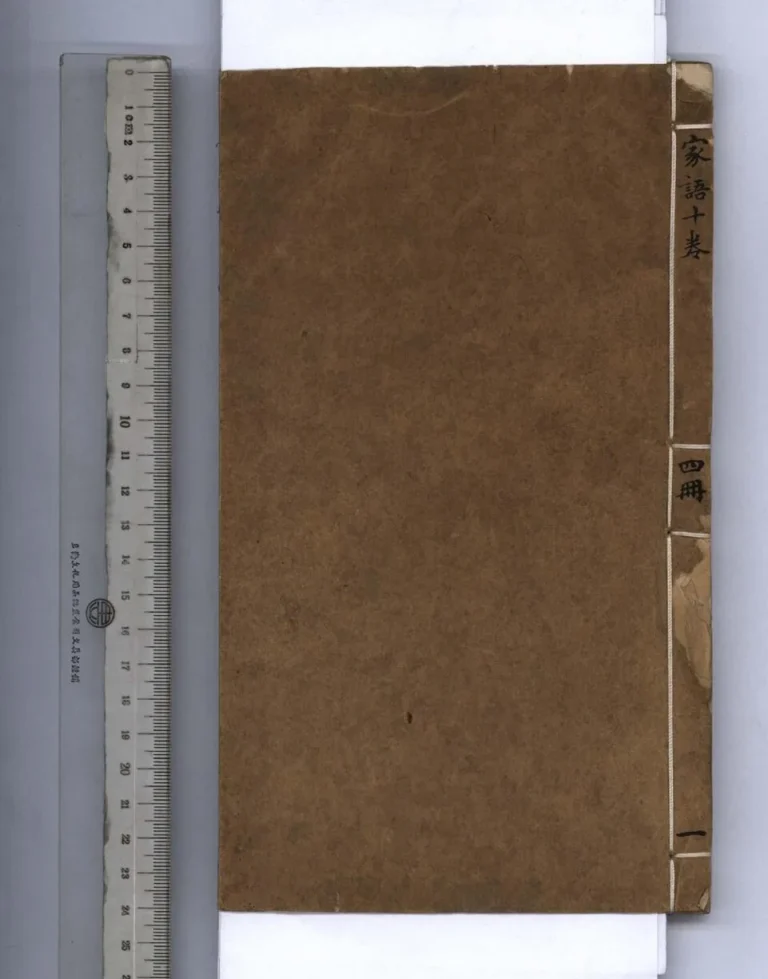
The received Jiayu carries a commentary by Wang Su (195–256), a scholar of the Wei kingdom, and a preface in which Wang explains how he came by it. A descendant of Confucius in the twenty-second generation, Kong Meng, had the book among his family papers and brought it to him; Wang found that it agreed with his own views point for point. There is also a postface attributed to Kong Anguo, the Han scholar, describing how he collected scattered copies through friends at court and arranged them by category into forty-four chapters. The Han imperial catalogue does list a Kongzi Jiayu — in twenty-seven juan, a different size — and the Tang commentator Yan Shigu, annotating that entry, wrote that it was “not the Jiayu that exists today”.
So the book has a pedigree: a family archive, a Han editor, a Wei commentator. It also has a problem, which is that every link in that pedigree is vouched for by Wang Su, and Wang Su had a reason to want a book exactly like this one.
The case for forgery
Wang Su spent much of his career attacking the ritual scholarship of Zheng Xuan, the dominant classicist of the previous generation. He wrote a treatise, the Shengzheng lun, to refute Zheng, and in it he cited the Jiayu as evidence — for instance on the wording of a poem about relieving the people’s cares — that Zheng could not have known. Zheng’s defenders noticed. Ma Zhao, in the Jin dynasty, put it in one sentence that the Qing editors later quoted: 《家語》,王肅所增加,非鄭所見 — “the Jiayu was added to by Wang Su; it is not what Zheng saw.”
The Song scholar Wang Bo made the charge total. In his Jiayu kao he argued that the forty-four chapters were Wang Su’s own assembly — 自取《左傳》、《國語》、《荀》、《孟》、二戴記,割裂織成之, “taken by himself from the Zuo Tradition, the Guoyu, Xunzi, Mencius and the two Records of Ritual, cut apart and woven together” — and that the Kong family postface was Wang’s own composition too. The editors of the Qing imperial library, writing the entry on the book for the 《四庫全書總目提要》 in the 1780s, went through the evidence and reached a verdict that has been the standard one ever since:
The Qing imperial catalogue’s verdict
反覆考證,其出於肅手無疑。特其流傳已久,且遺文軼事,往往多見於其中,故自唐以來,知其偽而不能廢也。
“Examined again and again, there is no doubt that it came from Wang Su’s hand. Only, it has circulated for so long, and lost writings and stray anecdotes are so often found in it, that since the Tang people have known it to be spurious and yet have been unable to discard it.”
《四庫全書總目提要》卷九十一・子部儒家類・《孔子家語》十卷 · 維基文庫
The Siku editors were not merely counting authorities. They give a worked example. A Song writer, Shi Shengzu, had argued the reverse of Wang Bo — that the Da Dai Liji borrowed from the Jiayu, not the other way round — on the grounds that a capping ceremony in the Da Dai uses the words “the late emperor” and “Your Majesty”, which could not have been said in the early Zhou, whereas the Jiayu‘s version uses only “king”. The Qing editors reply that the Da Dai chapter explicitly says the offending words are from a Han capping speech, that Shi had run two speeches together, and that Wang Su, lifting the chapter, had made the same conflation and then quietly deleted the Han words and substituted “king” to make it look ancient. 《家語》襲《大戴》,非《大戴》襲《家語》: the Jiayu copies the Da Dai, not the reverse. That is a philological argument, it is checkable, and it has not, to my knowledge, been overturned.
The case from the tombs
In the twentieth century the sceptical tradition hardened. Gu Jiegang and the “doubting antiquity” school listed the Jiayu among the typical forgeries. Then the ground gave up some evidence. In 1973, bamboo slips from Tomb 40 at Dingzhou in Hebei — a Western Han princely burial — were found to contain material paralleling the Jiayu, in a text the excavators titled 《儒家者言》, “Sayings of the Ru”. In 1977 a wooden tablet from the Shuanggudui tombs at Fuyang in Anhui, sealed in 165 BC, was found to carry chapter titles that correspond to Jiayu chapters. Both are three centuries older than Wang Su.
The strongest recent statement of what this means, in a Taiwanese venue, is a forty-page article in the National Palace Museum’s 《故宮學術季刊》 (vol. 26, no. 1, 2008) by Yang Chao-ming of Qufu Normal University — a scholar from Confucius’s home town, and the leading advocate of the book’s authenticity. Yang’s account runs the pedigree forward rather than backward: disciples “withdrew and recorded” what they heard; after Confucius’s death the material was gathered under Zisi; Kong Anguo’s postface describes a real Han-dynasty act of collection — 乃以事類相次,撰集為四十四篇, “so he arranged them by category and compiled them into forty-four chapters”; and the Dingzhou and Fuyang finds show that this material existed, under something like these headings, in the second and first centuries BC. His conclusion, on the first page:
《孔子家語》雖有後人「潤色」和撰集時的整理加工,但其出發點仍然是為了保留記錄「夫子本旨」。
“Although the Kongzi Jiayu has been ‘polished’ by later hands and worked over in the course of compilation, its starting point was nonetheless to preserve a record of ‘the Master’s original meaning’.”
Yang also lines up internal evidence — passages of the Liji that correspond to the Jiayu, material in the Kongcongzi from the Kong family — and reads the whole as a family transmission that Wang Su annotated rather than invented.
What each side has actually shown
It helps to separate the claims, because “the Jiayu is genuine” and “the Jiayu is a forgery” are each doing more than one job.
The tombs have shown that some of the material in the Jiayu is Western Han or earlier. That kills the strong form of the forgery charge — that Wang Su invented the book out of the Zuo Tradition and Xunzi in the third century AD. Nobody who has read the Dingzhou slips can hold Wang Bo’s position as he stated it.
The tombs have not shown that the received forty-four chapters, in their present wording, are pre-Wang Su. Parallels and chapter titles establish that a tradition of Confucius anecdotes existed and was being organised under headings by 165 BC; they do not establish that the sentences Wang Su printed are the sentences in those tombs, and where we can compare, the Han material is different. Yang himself concedes “polishing” and “working over”. The Siku‘s capping-ceremony argument — a specific place where the Jiayu‘s text looks like a doctored copy of a Han text — is untouched by anything found in a tomb.
And the motive stands. Wang Su used the book against Zheng Xuan on exactly the points where it favoured him. A man may annotate a genuine family text and still improve it where it helps his argument. The excavated material makes the honest position “an early collection, edited and in places rewritten in the third century by someone with an interest” — which is neither of the two slogans.
How this site treats a Jiayu quotation
This matters for a practical reason. Because the Jiayu is long, fluent and full of the sort of extended moral teaching that translates well, it is heavily quoted in English, and the attribution is nearly always flattened to “Confucius said”. On this site a saying whose only source is the Jiayu is labelled as such and marked as an attribution under dispute. It is not a fabrication; it is not the Analects; it is a text some of whose material is demonstrably Han and some of whose wording is plausibly Wei, and the reader is entitled to know which book a sentence came out of. For how even the Analects is a construction of its editors rather than a transcript, see who made the Confucius we read in the Analects?; the study discussed there, by Lee Kwai-sang, sets the Jiayu‘s Confucius — rather more interested in punishment and administration — beside the Analects‘ as evidence of how much the compilers chose.
If you are working from an English translation of Confucius, it is worth knowing which of these books a translator has drawn on and how they mark the difference; see which Analects translation should you read? And for the same pattern on the Daoist side — a text that excavation pushed earlier without settling who wrote it — see did Laozi live before Confucius?
For a Confucian dispute that turns on one character rather than a whole book, see the Great Learning’s three principles.
FAQ
Is the Kongzi Jiayu a forgery?
The Qing imperial catalogue concluded that the received text came from the hand of Wang Su (195–256), who used it to attack a rival scholar, and it gives a specific example of doctored wording. But bamboo slips from Han tombs at Dingzhou (1973) and Fuyang (1977) contain material paralleling the book, three centuries before Wang Su. The current honest position is that the book preserves early material that was edited, and in places rewritten, in the third century.
Who was Wang Su and why does it matter?
A Wei dynasty classicist who wrote the commentary on the Jiayu and the preface explaining where it came from. He was also the leading opponent of Zheng Xuan’s ritual scholarship and cited the Jiayu against Zheng on contested points — which is why, since the Jin dynasty, scholars have suspected him of shaping the text to suit his argument.
What did the Dingzhou and Fuyang finds prove?
That collections of Confucius anecdotes with headings matching the Jiayu‘s existed in the Western Han, sealed in tombs of 165 BC and the mid first century BC. They disprove the claim that Wang Su invented the book from scratch. They do not prove that the received wording is Han.
Should I quote the Kongzi Jiayu as Confucius?
Quote it as the Kongzi Jiayu. It is a real early source of a kind, but it is not on the same footing as the Analects, and the attribution of any particular sentence to Confucius is contested.
Sources
- 《四庫全書總目提要》卷九十一・子部一・儒家類一・《孔子家語》十卷(內府藏本):王肅自序、《漢書・藝文志》二十七卷與顏師古注、馬昭「《家語》,王肅所增加,非鄭所見」、王柏《家語考》、史繩祖《學齋佔畢》、公冠篇考證、「反覆考證,其出於肅手無疑……知其偽而不能廢也」 — 維基文庫 (accessed 5 Sep 2026)
- 楊朝明〈《孔子家語》的成書與可靠性研究〉,《故宮學術季刊》第 26 卷第 1 期,國立故宮博物院,2008 秋,頁 1–40 — PDF:孔安國後序「乃以事類相次,撰集為四十四篇」(頁 6);王柏「割裂織成」說(頁 20);定州 40 號漢墓竹簡(頁 28)、阜陽雙古堆漢簡(頁 29–30);結論「雖有後人『潤色』……保留記錄『夫子本旨』」(頁 1) (accessed 5 Sep 2026)
- 班固《漢書・藝文志》「《孔子家語》二十七卷」 — ctext.org (accessed 5 Sep 2026)
- 《孔子家語》原文(王肅注本) — ctext.org



