Ask an English-language website why Chinese New Year exists and you will usually get a monster. The 年獸 — the “Nian beast” — comes down from the mountains once a year to eat livestock and children; it fears the colour red, loud noise and fire; so people paste red paper on their doors, set off firecrackers and stay up all night. The nian monster story is told as if it were the ancient root of the festival, and it is a tidy story. It is also, as far as anyone has been able to show, a modern one. It appears in no early text I can find, and in Taiwan the people who went out collecting folk tales in the twentieth century did not find it either. What they found instead was stranger, more local, and much better at explaining why the last week of the year looks the way it does.
What the oldest dictionary says 年 means
Start with the word. The character 年 today means “year”, and the festival is 過年, “passing the year”. If a beast called Nian were behind the festival, one would expect the oldest lexicon in the language to know something about it. The 說文解字, compiled around AD 100, gives the character (written in its older form 秊) a two-character definition:
The Shuowen on 年
秊:穀孰也。从禾千聲。《春秋傳》曰:「大有秊。」
“Nian: grain ripening. From 禾 (grain), with 千 as phonetic. The Spring and Autumn commentary says: ‘a great harvest year.’”
許慎《說文解字》卷八・禾部 · ctext.org
A year, in the oldest Chinese sense, is a harvest: the grain coming in. The character sits in the grain radical next to 稔 and 秋, both also glossed “grain ripening”. There is no animal anywhere near it.
The one early text that does explain New Year firecrackers is the sixth-century 《荊楚歲時記》, the Record of the Seasons in Jing-Chu, and it is worth quoting exactly, because it is the passage people reach for when they want the beast to be old. On the first day of the first month, it says, 先於庭前爆竹,以辟山臊惡鬼 — “first, bamboo is burst in the courtyard, to drive off the shansao and evil ghosts”. The 山臊 is a mountain sprite of the kind that appears in early bestiaries. It is not called Nian, it is not said to fear red, and nothing in the text connects it to the name of the year. The 年獸 as a creature with that name and those three fears is in none of the early sources I have checked; if a reader can point me to a pre-twentieth-century text that names it, the corrections page is open.
Where the Nian monster came from, in Taiwan at least
The clearest account I know of the beast’s arrival is by the folklorist 溫宗翰 Wen Zong-han, who edits the Taiwanese folklore journal 民俗亂彈 and whose conference paper on New Year legends (2012) was later excerpted by the history site StoryStudio. His conclusion, after going through every period of Taiwanese folk-tale collecting, the written sources, and oral interviews, is direct:
過年由來源自年獸故事的說法,最早版本就是來自教科書;事實上,總覽全臺灣各時期民間傳說採集,以及文獻史料,乃至於口述訪談,可以發現年獸故事並非根源自臺灣的傳統。
“The claim that New Year originates in the Nian-beast story first appears, in its earliest version, in school textbooks. In fact, surveying folk-tale collections from every period in Taiwan, the documentary sources, and oral interviews, one finds that the Nian-beast story is not rooted in Taiwanese tradition.”
He adds that the versions in popular story-books were mostly copied along from those post-war textbooks. That is a claim about Taiwan, and I will keep it there: I am not in a position to say when the beast first appeared in print on the other side of the strait, only that no early text carries it and that in Taiwan its route was the classroom, not the village. The same thing, Wen notes, happened to the Dragon Boat Festival and the Qu Yuan story — a case we take up separately in was the Dragon Boat Festival really created for Qu Yuan?
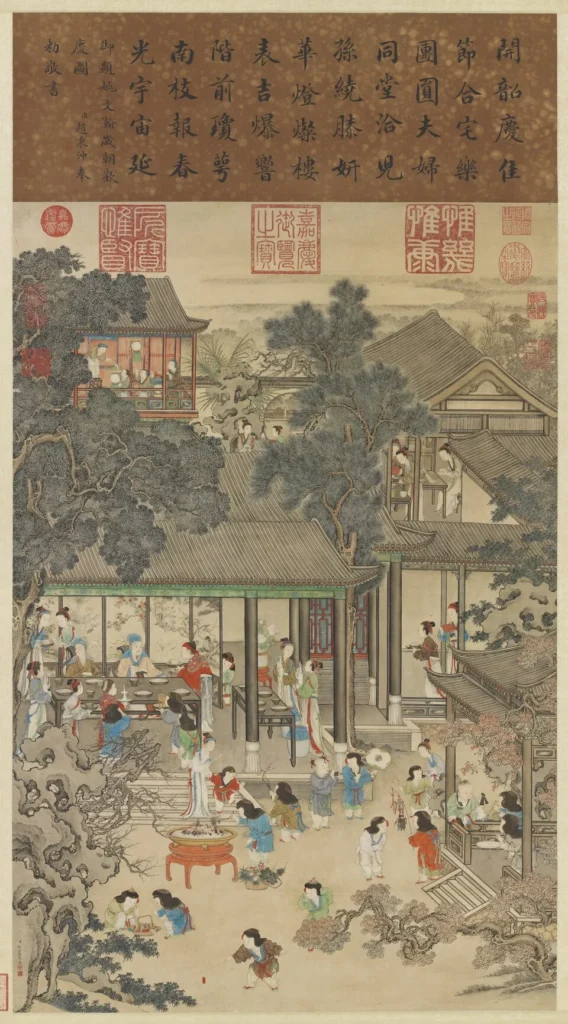
The story Taiwan actually told: the island was going to sink
What the collectors did find is a tale with no beast in it at all. It was first written down in 1936, in 李獻章 Li Xian-zhang’s 《臺灣民間文學集》 (Collected Taiwanese Folk Literature); it was discussed again in the Japanese-era journal 《民俗臺灣》; and after the war, when 胡萬川 Hu Wan-chuan’s county-by-county folk-literature surveys went out, versions turned up in Qingshui and Guishan among other places. Wen calls it, not unfairly, Taiwan’s Last Supper.
It goes like this. The people of Taiwan were fond of worship — they would sacrifice to any god and any ghost, and every autumn and winter ran a string of thanksgiving rites. But they never thanked the 燈猴, the “lamp monkey”, the humble stand that held up the candles on the offering table. One winter solstice, aggrieved, the lamp monkey went up to the Jade Emperor and reported that the Taiwanese wasted food: they took the solstice rice-balls and stuck them to the window frames for fun. The Emperor, furious, decreed that the island would sink into the sea.
The other gods pleaded; the decree stood. At the year-end 尾牙 rite, when people made their last offering to the Earth God, the Earth God could not bear it and warned them, while also asking Guanyin to intercede. The people, not wanting the gods to go down with them, burned incense and sent the deities back to heaven — which is why, the story says, the gods are seen off on the twenty-fourth of the twelfth month and heavenly soldiers come down on the twenty-fifth to keep watch in their absence. Then they killed their chickens and ducks for a farewell sacrifice to gods and ancestors, cooked everything, and sat down with their families for what they believed was their last meal together. After dinner they divided up the household money so that everyone would have something to spend on the road to the underworld. Then the whole family sat up through the night, waiting for the end.
It did not come. At dawn the island was still there. People burned incense in thanks, went out to see whether the neighbours had survived, and greeted each other with congratulations; that is the first day’s 走春, the “spring walk”, and the reason everyone says 恭喜. On the second day married daughters went back to check on their parents’ households — 轉外家, the return to the natal home. On the fourth day the gods were hurriedly invited back. On the fifth, satisfied that the whole island was safe, everyone went back to work.
Read that against the actual calendar of the Taiwanese New Year and every piece lands: the send-off of the gods, the reunion dinner (圍爐, “surrounding the stove”), the red envelopes (壓年, money “pressing down the year”), the vigil (守歲, or in Taiwanese simply 不睏, “not sleeping”), the first-day greetings, the second-day visit to the wife’s family, the fourth-day welcome of the gods, the fifth-day return to work. The Nian beast explains firecrackers and red paper. The sinking island explains the whole week.
The Guishan version, in the collectors’ own transcription
The Guishan telling collected in Hu Wan-chuan’s surveys puts the threat in the villagers’ own words, and it is not a monster:
The warning, in Taiwanese
十二月二九暗乎,會大地動啦。抑算講歸的人攏會死。
“On the night of the twenty-ninth of the twelfth month there will be a great earthquake. And they say everyone will die.”
龜山版本,見溫宗翰〈過年的由來〉引胡萬川民間文學採集 · storystudio.tw
Wen’s point about this is worth carrying over into English, because it is the kind of thing that gets lost when a festival is exported as a package. The lamp-stand and the earthquake are things a Taiwanese household actually lived with; a large beast from the mountains is not. The sinking-island story has, in his phrase, a strong Taiwanese character: it turns the year’s end into a moment when the space people live in is about to be destroyed, and the rituals into a way of preparing carefully for that end rather than falling into disorder. That is a reading of why the last night of the year is spent awake, together, with the accounts settled and the money divided, and it makes more sense of the customs than a beast that is scared of the colour red.
Why the beast won anyway
None of this means the Nian beast is worthless. It is a good children’s story, and a story that fits a classroom: one villain, one trick, three customs explained in a paragraph. The sinking-island tale is longer, needs a lamp-stand and a winter-solstice rice-ball to get going, and ends with a whole island thinking it is about to die. It is not hard to see which one a textbook would pick.
Wen’s own explanation for why the older story disappeared in Taiwan is institutional: before textbooks were opened up to multiple publishers, festival education in schools covered essentially two festivals, New Year and the Dragon Boat Festival, and both were taught with a single origin story. The island tale survived in the mouths of older speakers, in Japanese-era ethnography and in the post-war county collections, but not in the place where most people learned what the festival was for.
What this means for a reader outside Taiwan is simple enough. If you want a one-line origin for Chinese New Year, “a monster” is not documented, and “the grain came in” — the Shuowen‘s 穀孰 — is. If you want to understand why the customs of the last week look the way they do, at least in Taiwan, the story to read is the one in which the gods are sent home, the family eats what it thinks is its last meal, and everyone stays up to see whether the island is still there in the morning. For the customs themselves, see the Chinese New Year taboos that are actually observed in Taiwan; for why the date moves each year, see why Chinese New Year changes dates.
FAQ
Is the Nian monster a real ancient legend?
Not in any text I can find. The oldest dictionary defines 年 as “grain ripening”; the sixth-century festival calendar explains firecrackers by a mountain sprite called 山臊, not by a beast named Nian; and the Taiwanese folklorist Wen Zong-han, after surveying every period of folk-tale collecting in Taiwan, found that the story entered through post-war school textbooks rather than from local tradition. It is a modern origin tale, whatever its exact date of composition elsewhere.
What is the Taiwanese story of the origin of New Year?
That the Jade Emperor, told by a neglected lamp-stand that the Taiwanese wasted food, ordered the island to sink. People sent the gods home, ate a last meal, divided the money and stayed up all night; at dawn the island was still there. The customs of the last week of the year — sending off the gods, the reunion dinner, red envelopes, the vigil, the New Year greetings, the daughter’s visit home, welcoming the gods back — are explained as the aftermath. It was first written down in 1936.
What is a 燈猴?
Literally “lamp monkey”: in the story, the candle-stand on the offering table, personified as a minor spirit who was never thanked. The word is not in the Ministry of Education’s Taiwanese dictionary, so treat the gloss as the tale’s own, not a standard term.
Does the word 年 have anything to do with an animal?
No. In the Shuowen it is written 秊, classified under the grain radical, and defined as grain ripening — a harvest, hence a year.
Sources
- 許慎《說文解字》卷八・禾部:「秊:穀孰也。从禾千聲。」 — ctext.org (accessed 5 Sep 2026)
- 宗懍《荊楚歲時記》:「正月一日……先於庭前爆竹,以辟山臊惡鬼。」 — 維基文庫 (accessed 5 Sep 2026)
- 溫宗翰〈過年的由來:追溯一段臺灣人神相挺的古老故事〉,故事 StoryStudio,2016-02-07(原載《民俗亂彈》;節錄自〈毀滅與重生──論臺灣過年傳說與習俗中的時空神聖性〉,「華人宗教變遷與創新:媽祖與民間信仰國際研討會」,2012) — storystudio.tw:沉地傳說全文、1936 李獻章《臺灣民間文學集》、龜山版本引文、年獸來自教科書之判斷 (accessed 5 Sep 2026)
- 教育部《臺灣台語常用詞辭典》:「燈猴」查無詞條(完全符合 0 筆) — sutian.moe.edu.tw (accessed 5 Sep 2026)
- 李獻章編《臺灣民間文學集》,1936(依溫宗翰文轉引;本站未見原書)