
A reference library of Chinese civilisation · written in Taiwan
Two and a half thousand years of thought, written down and still argued over. Here it is in English, with the original beside it.
The Analects and the Tao Te Ching; 道 and 氣 as their own tradition defines them; the characters in the forms they were written in; and the festivals and temple practice that are still ordinary life here. Every line is traceable to its source — that part is the seal, not the subject.
Look up a quotation, a concept, or a character — every entry gives the original text and where it comes from.
知之為知之不知為不知是知也
Analects 2.17, the house rule
01 目錄
The library, in five parts
- QuotesWhat Confucius, Laozi and Sunzi actually wrote — the passage in its own words, its chapter, and what the popular English version left behind.
- Concepts道, 氣, 無為 — the working vocabulary of the tradition, defined the way its own texts define it.
- Traditional charactersThe written form itself: how a character was built, what it once pictured, and why the traditional shape still carries that history.
- Classical textsThe Analects, the Tao Te Ching and the rest — what each book is, how to read it, and the centuries of commentary that shaped what it means.
- Living traditionThe tradition as a living thing: the festival calendar, temple practice and folk belief, as they are observed in Taiwan today.
Recently added
 Classical textsZhuangzi: Forget Each Other in the Rivers and LakesThe four characters everyone quotes are the first half of a sentence whose second half rejects them.
 Classical textsZhuangzi’s Three in the Morning: Nobody Is DeceivedAsk anyone in Taiwan what 朝三暮四 means and you will be told it describes a person who cannot hold to a decision…
 Living traditionThe Double Ninth in Taiwan: Kites, Gift Money, and a Plant That Is Not DogwoodThe Double Ninth festival falls on Sunday 18 October in 2026, and in Taiwan it arrives less as a climb than as…
 Classical textsMei Xia Yu Kuang: Zhuangzi’s Phrase Now Means the OppositeA phrase from the Zhuangzi about how to test a pig now means things are getting worse. Taiwan’s own idiom dictionary records the reversal, and then contradicts itself about it.
 Classical textsDa Qi Wan Cheng: The Oldest Copies of Laozi Do Not Say ‘Late’On the sports pages in Taiwan, da qi wan cheng is a compliment with a faint apology folded into it. A badminton…
 Classical textsZhuangzi’s Useless Tree: The Half of the Quote He Never WroteSomewhere in Taiwan this week a newsletter, a graduation speech or a shop sign will quote Zhuangzi's useless tree. The line runs…
 Classical textsZhuangzi Mourning His Wife: The Idiom Says the OppositeZhuangzi drummed on a tub when his wife died, but he says he grieved first. In Chinese the phrase now means a widower’s grief.
03 圖
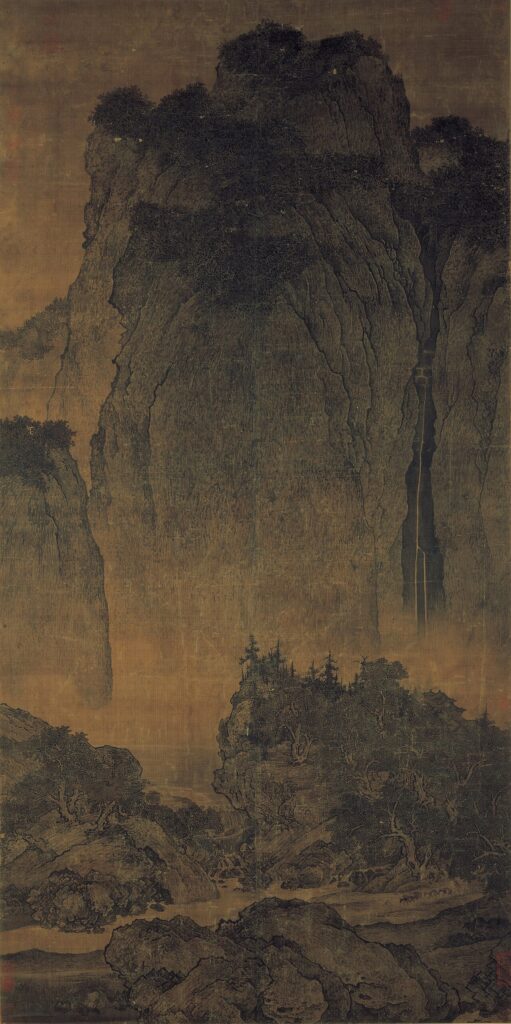

谿山行旅圖
Travelers Among Mountains and Streams
- Painter
- Fan Kuan 范寬
- Period
- Northern Song
- Collection
- National Palace Museum, Taipei
Look for the travellers of the title: a mule train at the foot of the mountain, a few strokes high. The painting is here for the same reason the site is — the original, shown whole, with its source named.
04 真
Why you can trust what you read here
Every entry goes back to the text.
Writing about Chinese culture in English has a quality problem: much of it is several steps removed from primary sources, repeating earlier English writing rather than anything anyone actually wrote in Chinese. Here, every entry goes back to the text: read against the primary source by someone who reads classical Chinese, with nothing published until that check passes. Where the sources are genuinely unclear, the entry says so rather than choosing for you.
- The original, beside the EnglishEvery entry gives the original text and where it comes from.
- Read against the primary sourceNothing is published until that check passes.
- Corrections in publicWhen something turns out wrong, the correction is logged. See the log.
Read the full methodology, including which editions are used and how translations are made.