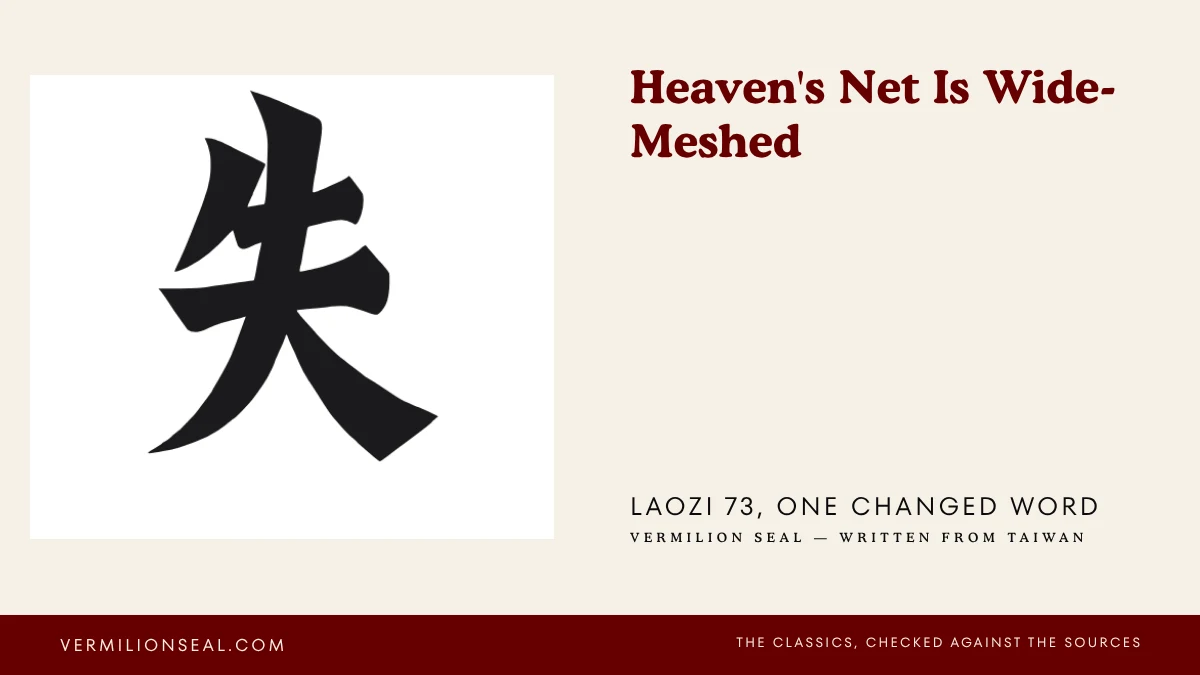
The last line of chapter 73 of the Daodejing is eight characters long, and in Taiwan you meet it most often at the top of a police press release. Heaven’s net is wide-meshed — 天網恢恢 — and then the clinching half: nobody gets out. That is how the saying runs today, in Chinese and in English alike. What Laozi wrote in that second half is a different character, and it makes a different claim. The received text says 疏而不失: the mesh is loose, and the net loses nothing. The version everyone quotes says 疏而不漏: the mesh is loose, and nothing leaks out. One character. A cosmos of difference between a thing that keeps perfect accounts and a thing that catches fugitives. This piece follows that character through the oldest copy we have, five centuries of commentary, Taiwan’s own government dictionaries, the full-text database of its courts and two English translations, to pin down where the swap happens and who makes it.
The sentence, and the sentence people quote
Chapter 73 is short and it is not about crime. It opens on a pair of alternatives — being bold in daring gets you killed, being bold in not daring keeps you alive — and then refuses to say which is which, because nobody knows what Heaven dislikes. Only at the end does the net appear, as the last in a run of four descriptions of how the way of Heaven operates: it wins without contending, answers without speaking, arrives without being summoned, and plans while seeming slack.
《老子》第七十三章(王弼本)
勇於敢則殺,勇於不敢則活。此兩者,或利或害。天之所惡,孰知其故?是以聖人猶難之。天之道,不爭而善勝,不言而善應,不召而自來,繟然而善謀。天網恢恢,疏而不失。
Bold in daring, and you are killed; bold in not daring, and you live. Of these two, one benefits and one harms — who knows the reason for what Heaven dislikes? Even the sage finds this difficult. The way of Heaven: it does not contend, and is good at prevailing; does not speak, and is good at answering; is not summoned, and comes of itself; is slack, and is good at planning. Heaven’s net is wide-meshed; loose, and it loses nothing. (My translation.)
Text of the Wang Bi recension as printed in the Chinese Wikisource edition of 《道德經(王弼本)》, cross-checked against the Siku Quanshu printing of Wang Bi’s commentary. Both read 疏而不失.
Nothing in the chapter is about apprehension. The four parallel clauses are all about a kind of efficacy that does not announce itself, and the net is the summary image for it: so coarse you would expect things to fall through, and yet the tally comes out complete. Read in place, the line is a statement about the reliability of a process. Read as a slogan, it is a threat. The difference is carried almost entirely by one character.
疏, 失, 漏: three characters, out of Taiwan’s own dictionaries
It is worth going slowly here, because the whole argument rests on the third one.
恢恢 (huī huī) is a reduplication meaning vast, ample, wide. It describes the net’s extent, not its tightness. In the silk manuscript the second 恢 is not written out at all but marked with a repetition sign, which is one small sign that the phrase was already formulaic when that copy was made.
疏 (shū) is widely spaced, thinned out, far apart — the mesh of a net with large holes. The Heshanggong recension writes it with the variant form 踈. Same word.
失 (shī) is first of all to lose or mislay — to let something slip out of one’s keeping. On that sense the grammatical subject is the net, or Heaven that holds it, and 不失 is a statement about the holder: it mislays nothing, the record is complete, nothing drops out of the account. But the Revised dictionary also lists a second sense I have to put on the table, because it cuts against the neat version of this argument: 錯過、種放, to miss or to let go, as in 機不可失, an opportunity not to be missed. Read on that sense, 不失 could already mean the net lets nothing get past it. So the original character is not quite as single-minded as I would like it to be.
漏 (lòu) is to leak — what a roof does, or a cracked vessel, or a net with a hole in it — and what a reader pictures is the stuff going through. Here too the dictionary is more generous than the argument wants: among the senses of 漏 are 遺忘、疏略, to omit or overlook, as in 遺漏. That is the holder’s perspective again.
So the honest version is narrower than “one character reverses the meaning”, and I would rather give the narrow version. The two characters are not disjoint; their ranges overlap at both ends. What differs is the default picture, and defaults are what idioms are made of. Say 失 and the first thing most readers see is a thing lost from a store; say 漏 and the first thing they see is a thing escaping through a gap. Put the first into chapter 73 and the sentence reads as a description of how an impersonal process stays complete. Put the second in and it reads as a warrant. The chapter that opened by saying even a sage cannot tell which way Heaven’s preferences run has been nudged — not forced, nudged — towards a guarantee of arrest.
What the oldest copy says
If the swap were ancient — if the earliest witnesses were split — there would be no story. They are not split, as far as the evidence goes.
馬王堆帛書乙本 (Mawangdui silk manuscript, text B)
天罔恢﹦疏而不失
Heaven’s net is vast-vast; loose, and it loses nothing. Here 罔 stands for 網 and the mark ﹦ is a repetition sign for the doubled 恢. The final two characters are the ones at issue, and they read 不失.
As transcribed in the Chinese Wikisource edition of 《老子(帛書本)》. Text A is broken off across exactly these eight characters and cannot be used as a witness either way; text B also lacks the clause 是以聖人猶難之 that the received text has.
So the two oldest usable readings — the Han-period silk manuscript and the recension Wang Bi commented on in the third century — agree on 不失. I want to be careful about what that does and does not prove. It does not prove that 不漏 never existed in a manuscript nobody has dug up. It does mean that the burden sits on the popular form, and that the drift has to be explained somewhere later. The same pattern turned up when I looked at the excavated readings of 大器晚成: the dug-up copy is often the one that makes the familiar version look like an edit.
Wang Bi has nothing to say about it
Here is the detail I did not expect, and it changed how I wrote the rest. Wang Bi, the commentator who did more than anyone to make Laozi a philosophical text rather than a manual, writes notes on the four clauses about the way of Heaven and then stops. His note on the fourth clause ends 未召而謀之,故曰,繟然而善謀也 — and the next thing on the page is chapter 74. On 天網恢恢,疏而不失 he says nothing at all. Both printings I checked agree.
Silence is not an argument, but it is a useful baseline. Nothing in Wang Bi’s chapter 73 contains the characters for punishment, execution or penalty. What it contains is 天唯不爭,故天下莫能與之爭 — Heaven alone does not contend, and so nothing in the world can contend with it. Whatever the net is doing in Wang Bi’s reading, it is not doing police work. That reading is of a piece with chapter 5’s 天地不仁, where Heaven and Earth are explicitly not in the business of favouring anybody.
How the net acquired a magistrate
Read the commentaries in order and the line does not drift so much as get recruited, in stages, by people with a professional interest in the outcome.
Heshanggong (Han, chapter title 任為) is the first to put an observer inside the net: 天所網羅恢恢甚大,雖疏遠,司察人善惡,無有所失 — what Heaven nets is vast indeed; though far-meshed, it inspects human good and evil, and loses nothing. That is already a move. The net now has a function, and the function is moral audit. But Heshanggong is emphatically not handing the net to the state. In the very next chapter, 制惑, he does two things in quick succession. On 常有司殺者 — there is always the one who does the killing — he glosses that officer as Heaven itself: 司殺者謂天,居高臨下,司察人過。天網恢恢,疏而不失也, the one who kills means Heaven, which looks down from on high and inspects human faults; Heaven’s net is wide-meshed, loose, and loses nothing. And a few lines earlier, on 而為奇者,吾得執而殺之。孰敢, he writes 老子傷時王不先道德化之,而先刑罰也 — Laozi grieves that the kings of his day did not first transform people by the Way and virtue, but went first to punishment. For Heshanggong, Heaven keeps the ledger precisely so that rulers need not reach for the knife. He is quoting the net against penal government, not for it.
Emperor Xuanzong of Tang is where the character for punishment enters the net itself.
《唐玄宗御註道德真經》, commentary on chapter 73
天之網羅,雖恢恢疏遠,刑淫賞善,毫分不失。
Heaven’s netting, though vast and far-meshed, punishes the licentious and rewards the good, and does not lose so much as a hair’s breadth.
《唐玄宗御註道德真經》. The operative addition is 刑 — punish — which is in neither the text nor Wang Bi.
Note what has happened. The commentator has kept 不失 word for word, and has still arrived at the policing reading, by supplying a subject for the verb: the net is not merely complete, it is complete at punishing and rewarding. The emperor did not need to change the character. He changed the sentence around it.
From there the readings fan out. Emperor Huizong of Song keeps it to retribution without the apparatus of state — 積善積惡,殃慶各以其類至,所以為不失, good and evil accumulate and calamity or blessing arrives each according to its kind, and that is what not-losing means. Lin Xiyi, in the Song, stays with natural order: 天道恢恢,譬如網然,雖甚疏闊而無有漏失者,言善惡吉凶,無一毫不定也 — like a net, very loose and yet nothing leaks or is lost. That phrase of his, 漏失, is worth marking: by the Song a commentator reaches for 漏 and 失 together as a compound, which is exactly the sort of pairing out of which one half later walks off alone.
And then the Ming founder, who wrote his own commentary on Laozi and had the most direct stake of anyone in the answer: 居動以時,順其事而賞罰焉……天憲不昏,雖不速而必報 — act in season, reward and punish according to the matter, Heaven’s statutes are not dim, and though retribution is not swift it is certain. 天憲, Heaven’s statutes, is a legal term. The net has become a legal instrument, and its holder is an emperor describing his own practice. One caveat on where that sits: the Daozang printing I used runs chapters 73 and 74 together under a single block of annotation, and both phrases fall inside it, with the second standing closer to chapter 74’s material on people who do not fear death. I would not want to pin either sentence to chapter 73 alone.
Count the readings and a pattern falls out that I want to state carefully, because it is small. Of the commentators here, exactly two put punishment into the net — Xuanzong with 刑, the Ming founder with 賞罰 and 天憲 — and both of them were reigning emperors. The ones who kept it to natural order or to impersonal retribution are Wang Bi, who says nothing; Heshanggong, who quotes the net against penal government; and Lin Xiyi. Huizong, also an emperor, stays with retribution rather than law. So the sample is far too small for a thesis about power, and one emperor sits on the other side of it; but it is at least worth noticing that the two readings which hand Heaven a penal code were written by men who already had one. The same thing happens to 無為 and to chapter 60’s small fish, both of which get read as endorsements of whatever the quoter already wanted to do.
Taiwan’s dictionary does the whole slide in one paragraph
I expected to find the two forms in different places — the original in a classical database, the popular version in newspapers. What I found is that Taiwan’s standard reference work prints both, forty characters apart, in a single run of prose, and arrives at the penal reading by the end of it.
教育部《重編國語辭典修訂本》, entry 天網恢恢, definition field, in full
上天的法網雖寬大稀疏,但絕不會縱容作惡的壞人。語出《老子》第七三章:「天網恢恢,疏而不失。」後以比喻犯法者難逃國法制裁。明.無名氏《尋親記》第三三齣:「此人如果太奸豪,天網恢恢豈可逃。」《兒女英雄傳》第一八回:「母親、父親,你二位老人家,可曾聽見那紀賊父子,竟被朝廷正法了?可見天網恢恢,疏而不漏。」也作「天道恢恢」。
Heaven’s net of law, though broad and loose-meshed, will never indulge a wrongdoer. From Laozi chapter 73: “Heaven’s net is wide-meshed; loose, and it loses nothing.” Later used as a figure for the lawbreaker being unable to escape the sanction of the state’s law. [Ming citation, anonymous, Xunqin ji, scene 33:] “If this man is truly so villainous, Heaven’s net is wide-meshed — how can he escape?” [Ernü yingxiong zhuan, chapter 18:] “Mother, father, you two — have you heard that the Ji villain and his son have been put to death by the court? You see, Heaven’s net is wide-meshed, and nothing leaks out.” Also written 天道恢恢.
Ministry of Education Revised Mandarin Chinese Dictionary, entry 53427 (the page loads its content with JavaScript). The identical 159-character definition is transcribed as an appendix record in the Dictionary of Chinese Idioms, record 7706, under the heading 辭典附錄〉修訂本參考資料; it is not a full idiom entry there and has no separate source or citations fields. Verified against the g0v moedict mirror, which matches character for character.
Read that definition as a sequence and it is a complete miniature of the drift, in the order the drift happened. It opens by calling the net 法網, a net of law, which is already an interpretation. It quotes Laozi correctly, with 不失. It says “later used as a figure for” — the one honest hinge in the paragraph, conceding that what follows is reception rather than meaning. It then gives a Ming play in which the question has become 豈可逃, how can he escape; escape has entered, though the character has not. And finally it quotes a Qing novel in which the character has changed too.
The Ernü yingxiong zhuan citation is the earliest printing of 疏而不漏 I have been able to point at, and it is worth seeing in its setting, because the setting is not a courtroom.
《兒女英雄傳》第十八回
只見他並不回答這話,早退回去坐下,冷笑了一聲,望空叫道:「母親!父親!你二位老人家可曾聽見那紀賊父子竟被朝廷正法了?可見『天網恢恢,疏而不漏』。只是你養女兒一場,不曾得我一日孝養……」
She did not answer, but went back and sat down, laughed coldly once, and called out into the air: “Mother! Father! Have you two heard that the Ji villain and his son have been put to death by the court? You see — Heaven’s net is wide-meshed, and nothing leaks out. Only, you raised a daughter, and never had a single day’s care from me…”
Chinese Wikisource, 《兒女英雄傳》 chapter 18. The Ministry of Education’s rendering of this passage differs from the Wikisource text in punctuation only; the characters are the same.
A daughter speaking to her dead parents about a state execution: the form 疏而不漏 arrives in the mouth of someone who has just watched the court do what she could not. That is the right birthplace for it. The sentence is no longer describing a process; it is a person’s relief that the apparatus worked.
The Ministry’s entry for 天網 on its own, meanwhile, simply lists both destinations as separate senses: first 自然的制裁。即天罰、天懲, natural sanction, that is, Heaven’s punishment, cited from Laozi 73 with 疏而不失; and second 王法、國法, royal law, the law of the state, cited from Cao Zhi. Two senses, one entry, no comment on how you get from the first to the second.
In Taiwanese courts, the net changed owner
This was the part that made me rewrite a section, so I will give the correction rather than the tidy version I started with.
I assumed 天網恢恢,疏而不漏 would be all over Taiwanese official documents, since it is the standard opening of a local police press release — two separate Hualien crime reports in a single month both begin with precisely those eight characters plus an exclamation mark, one on a drugs arrest and one on a vehicle theft. It is a formula, and as far as I can tell the formula lives in the news rather than in the files. Searching the Ministry of Justice, the National Police Agency and the Judicial Yuan on 14 October 2026 for the phrase as written produced nothing I could verify in a press release or official paper: the hits a search engine reports are loose matches that do not survive being opened and read. That is a negative result from one afternoon’s searching, not a proof of absence.
What does appear is a near-identical phrase with the first character replaced: 法網恢恢,疏而不漏. The net of law is wide-meshed, and nothing leaks out. Entering 疏而不漏 in the search box of the Judicial Yuan’s full-text judgment system returned seventy-six judgments when I ran it on 14 October 2026 — the query is a form submission rather than a link, so that is the way to reproduce it — spread across the Supreme Court, the high courts and a dozen district courts, and overwhelmingly in the 法網 form. In the one I read line by line, a 2026 Keelung fraud judgment, the phrase is not the judge’s own: it is quoted as the name of a Telegram group the defendants used, which tells you how thoroughly the expression has entered the ambient language.
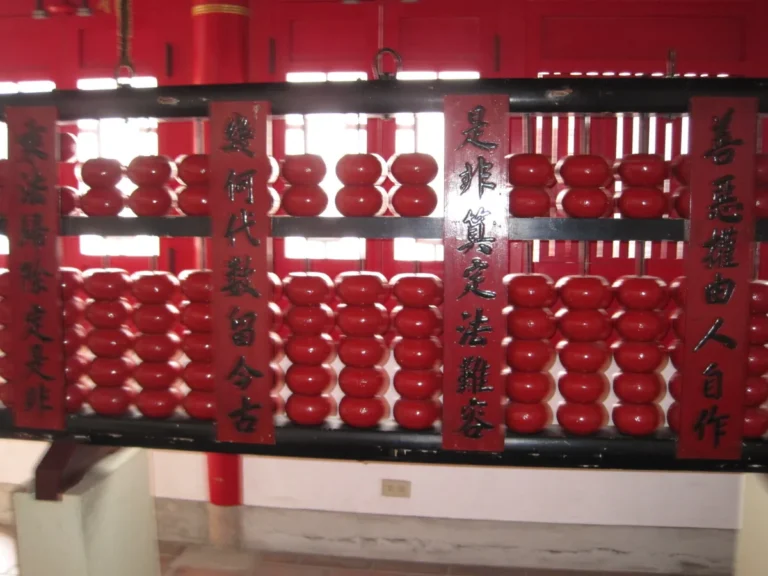
So the drift is not one substitution but two, and the second one is almost a confession. 失 became 漏, which moved the sentence from accounting to escape. Then, in the register where escape is a working concept, 天 became 法, because by that point Heaven was doing a job that the law does, and the law was the honest word for it. Laozi’s line has been edited until it says what the people quoting it meant in the first place. Taiwan’s own religious landscape got there independently: the City God temples, where you go to swear an oath before a god, have for centuries run on exactly the image of divine jurisdiction that the Tang and Ming commentators put into the text. The temple in the photograph above is one of them. Its abacus says 疏而不失; everything else about the building says 疏而不漏.
The English versions split too, over an unambiguous character
Two translations of chapter 73 are old enough to be out of copyright and stable enough online that I could check them character against character. They disagree, and they disagree in exactly the place the Chinese does not.
Legge, in 1891: the meshes of Heaven’s net are large, “far apart, but letting nothing escape”. Goddard, in 1919: “its meshes are wide but it loses nothing”. Legge has written the sentence about a fugitive; Goddard has written the sentence about a complete account. The received text both were working from reads 失, so there was no textual question dividing them.
And — given the dictionary senses above — Legge was not simply wrong. 失 can mean to miss or to let go, so “letting nothing escape” is a defensible reading of the character that is actually there. What Legge had was not a textual excuse but an idiomatic one: by 1891 the penal reading had been available in Chinese for more than a thousand years — since Xuanzong put 刑 into the commentary around 732 — and had become the ordinary way the eight characters were understood, even though it was never the only way, as Lin Xiyi and Huizong show. A translator reaching for “escape” was translating the idiom the character had been absorbed into rather than mistaking the character.
That is worth dwelling on, because it is the opposite of what this site usually finds. Most of the time the English versions are where a line goes wrong. Here they are downstream. The drift happened in Chinese, in commentary and then in lexicography, and the translators arrived long after. The same shape turned up in the Zhuangzi line about forgetting one another in the rivers and lakes, where the drift was likewise internal to Chinese and the English versions were the ones that kept the sentence whole. If you want to know which translation to reach for in general, that is a separate question with a messier answer.
Unverified. The renderings usually attributed to Arthur Waley, D. C. Lau and Robert Henricks all speak of something slipping through rather than being lost, and if that is right it would make the count four to one. I am not quoting them here, because I could not get at a text of any of the three that I would trust — what circulates online is unattributed and inconsistent, and I have not had the print editions in front of me. The Henricks case in particular would be worth settling, since he translates the Mawangdui manuscripts, whose text reads 不失. I will add the three when I can check them properly, and will say so on the corrections page if the check changes the picture.
Reading the line where it sits
None of the above makes 疏而不漏 a wrong thing to say. It is a real idiom with four hundred years of use behind it, and when a police officer in Hualien writes it at the top of a report, the officer is using the language correctly as the language now stands. The claim is narrower: that sentence is not chapter 73, and you cannot read chapter 73 through it.
Put 不失 back and the chapter holds together. It opens by saying that we cannot tell which of two courses Heaven dislikes, and that even a sage finds this hard. It then lists four ways in which Heaven is effective without being assertive. The net closes the list by insisting that this slackness is not sloppiness — that the absence of grabbing is compatible with nothing being mislaid. Heaven is not watching you. Heaven is, in the mode this text keeps describing, not doing very much at all, and the results still come out even.
Put 不漏 in and the chapter contradicts its own first half. A net from which nothing escapes needs to know who it is after, and the chapter has just finished saying that nobody knows what Heaven dislikes. The received reading is the one that makes the eight characters belong to the chapter they are in; the popular reading is the one that makes them portable.
One last small thing, offered with its limits attached. This passage is the earliest attestation of 天網 I have been able to locate: searching the Chinese Wikisource corpus returns nothing in Zhuangzi, the Chuci, the Shiji, the Hanfeizi or the Huainanzi, and the early hits that do turn up are later — Ban Gu’s 幽通賦 in the Eastern Han, Cao Zhi in the third century. Three caveats, all of which matter. That corpus does not contain the excavated pre-Qin manuscripts — Guodian, Shanghai Museum, Tsinghua — where an earlier instance could perfectly well be sitting. It carries no dates, so “earlier” is doing work I have not independently argued, since the date of chapter 73 is itself contested. And no earliest-attestation-I-can-find is evidence that anyone coined anything. So I am not going to say Laozi invented the image. I will say only this: on the evidence I can reach, the first time Heaven is described as holding a net, the thing said about the net is that its holes do not cost it anything. The holes were the point.
What is not here
Four gaps, listed because they are mine rather than the record’s, and because a reader checking my work should know where the thin ice is.
I have left out the Ming commentary of Hanshan Deqing, which reads the line as 報應昭然, retribution made plain, because the only text of it I could reach is a modern simplified-character edition that I have not checked against a print copy. If it holds, it belongs with Huizong rather than with Xuanzong: retribution, not punishment. I have likewise not found Cheng Xuanying’s Tang sub-commentary online in a form I would trust, so the Tang is represented here by an emperor and nobody else — which, given what the argument is about, is a gap worth naming.
The three twentieth-century translations are unverified, as set out above. And I have not quoted the couplet carved on the frame of the abacus in the photograph, or the plaque in the same temple’s entrance, although both are locally famous and both bear directly on the point: the Wikimedia record for that photograph describes only the object, and I could not find a text of either inscription from the temple or from the heritage authorities that I would be willing to put inside quotation marks. Photographs of inscriptions are evidence that something is written there. They are not a transcription.
FAQ
Is it 疏而不失 or 疏而不漏?
Both are in use; only the first is in the text. The Wang Bi recension, the Siku Quanshu printing of it, the Heshanggong recension and the Mawangdui silk manuscript all read 疏而不失, and Taiwan’s Ministry of Education dictionary itself quotes Laozi with 不失 before going on to record 不漏 as the later idiom. If you are quoting the Daodejing, use 不失. If you are quoting the proverb, 不漏 is what the proverb says.
What is the difference in meaning, exactly?
失 is to lose or mislay, and its subject is the net: nothing drops out of the record. 漏 is to leak, and attention falls on whatever goes through the hole: nobody gets away. The first is a claim about the completeness of a process, the second a claim about the futility of flight.
Who changed it?
No single person, as far as the record shows. The earliest printing of 不漏 I can point to is chapter 18 of the Qing novel Ernü yingxiong zhuan, and a Ming play already has 豈可逃 — “how can he escape” — with the original character still in place. The penal reading is older than the new character: Emperor Xuanzong of Tang glosses the line 刑淫賞善, punishing the licentious and rewarding the good, while quoting 不失 faithfully. The sense moved first and the character followed.
Does the Mawangdui manuscript settle it?
Partly. Text B reads 天罔恢﹦疏而不失, with 罔 for 網 and a repetition mark for the doubled character. Text A is damaged across this exact clause and is no witness either way. So the oldest usable copy supports 不失, which is not the same as proving no ancient copy ever read otherwise.
Did Wang Bi comment on the line?
No. His notes on chapter 73 cover the four clauses about the way of Heaven and stop; the final eight characters have no commentary, and chapter 74 begins immediately after. Nothing in his chapter 73 mentions punishment.
Which English translation gets it right?
Of the two I was able to verify word for word, Goddard’s 1919 version renders the character as it stands — “its meshes are wide but it loses nothing” — while Legge’s 1891 version has the meshes “far apart, but letting nothing escape”. The renderings commonly attributed to Waley, Lau and Henricks are also about something slipping through, but I have not checked those against a text I trust and so am not quoting them.
Why do Taiwanese court judgments say 法網恢恢?
Because by the time the phrase reached that register it was describing the work of the law rather than of Heaven, and 法網 is the accurate word for that. A full-text search of the Judicial Yuan’s judgment database for 疏而不漏 returned seventy-six judgments on 14 October 2026, overwhelmingly in the 法網 form. The Ministry of Education’s definition of 天網恢恢 makes the same substitution in its opening words, glossing Heaven’s net as 上天的法網.
Sources
- Chinese Wikisource, 《道德經(王弼本)》 — Wang Bi recension with his commentary; chapter 73, including the absence of any note on the final clause.
- Chinese Wikisource, 《老子道徳經(四庫全書本)》 — independent printing of the same recension, used as a cross-check.
- Chinese Wikisource, 《老子(帛書本)》 — Mawangdui silk manuscripts A and B in parallel; the clause in question.
- Chinese Wikisource, 《老子河上公章句・德經》 — Heshanggong commentary, chapters 73 and 74.
- Chinese Wikisource, 《唐玄宗御註道德真經》 — the Tang imperial commentary, chapter 73.
- Chinese Wikisource, 《宋徽宗御解道德真經》 — Emperor Huizong’s commentary, chapter 73.
- Chinese Wikisource, 《道德真經口義》 — Lin Xiyi, Song, chapter 73; the source of the compound 漏失.
- Chinese Wikisource, 《大明太祖高皇帝御註道德真經》 — the Ming founder’s commentary; this Daozang printing annotates chapters 73 and 74 in a single block.
- Chinese Wikisource, 《兒女英雄傳》 chapter 18 — the passage the Ministry of Education cites for 疏而不漏.
- Ministry of Education, Taiwan, Revised Mandarin Chinese Dictionary, entry 53427, 天網恢恢 — the 159-character definition quoted above. Content renders via JavaScript.
- Ministry of Education, Taiwan, Revised Mandarin Chinese Dictionary, entry 53426, 天網 — the two senses, natural sanction and the law of the state. Content renders via JavaScript.
- Ministry of Education, Taiwan, Dictionary of Chinese Idioms, appendix record 7706 — the same definition transcribed under 辭典附錄〉修訂本參考資料.
- g0v, moedict open-data mirror of 天網恢恢 — machine-readable copy of the Ministry entry, used to verify the quotation character by character.
- Judicial Yuan, Taiwan Keelung District Court, 115 金訴 74 (18 September 2026) — the judgment in which 法網恢恢疏而不漏 appears as the name of a messaging group. The full-text search at the Judicial Yuan judgment system returns seventy-six judgments containing 疏而不漏.
- China Times, 4 November 2025 and 29 November 2025 — two Hualien police reports in one month, each opening with 天網恢恢,疏而不漏!
- University of Hong Kong, Chinese-English Current Affairs Glossary — the entry pairing 天網恢恢 疏而不漏 with “justice has a long reach”, fixing the popular form in professional practice.
- James Legge, The Tao Teh King (Sacred Books of the East 39, 1891), chapter 73 — “far apart, but letting nothing escape”.
- Dwight Goddard, Laotzu’s Tao and Wu Wei (1919), chapter 73 — “its meshes are wide but it loses nothing”.
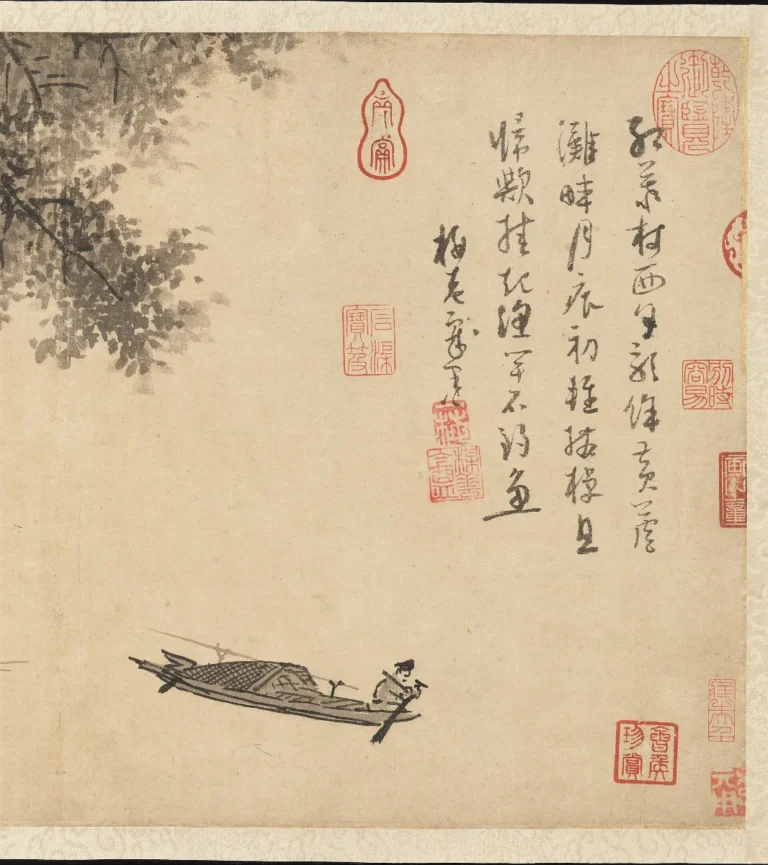
- Metropolitan Museum of Art, Wu Zhen, Fisherman, Yuan dynasty, ca. 1350, accession 1989.363.33 — the handscroll reproduced below, released under CC0.