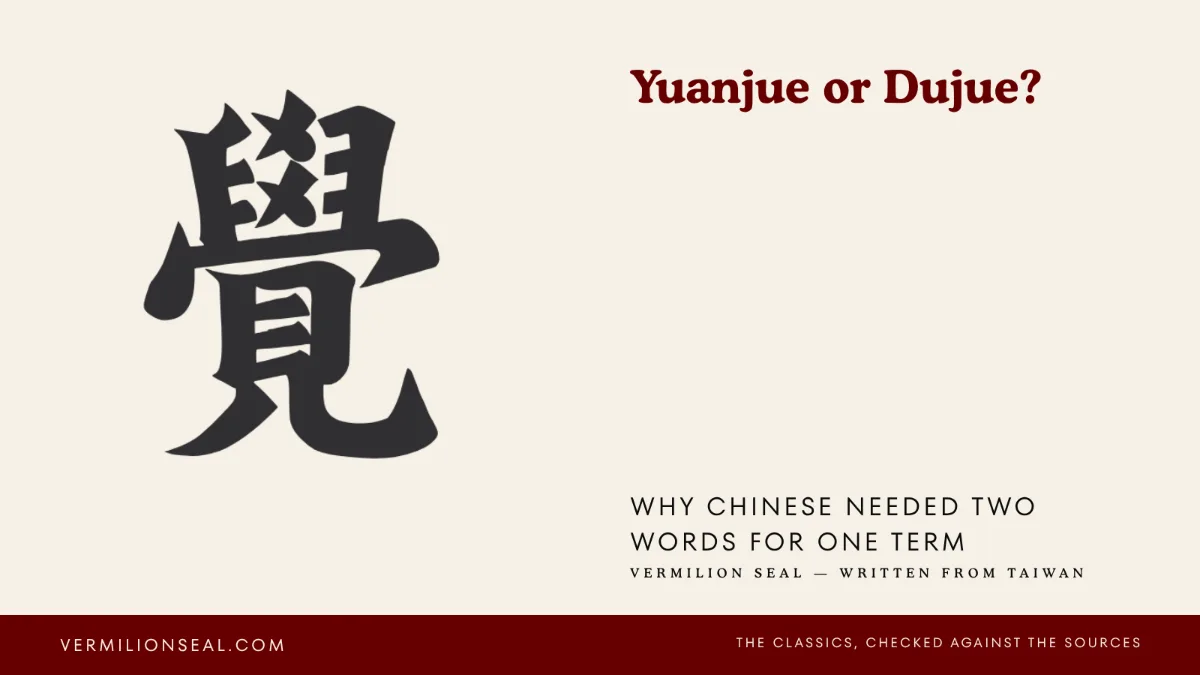
The pratyekabuddha meaning you will find in English is “solitary Buddha”: someone who awakens by himself, in an age with no Buddha to teach him, and does not found a teaching in turn. That is one of the two things the word has meant. Chinese Buddhism, which had to render the term into its own language over several centuries, ended up with two different translations that are still both in use — 緣覺, “awakened through conditions”, and 獨覺, “awakened alone” — plus a transliteration, 辟支佛, for when a writer wanted to commit to neither. The two translations are not a matter of taste. They answer to two different accounts of what such a person is, and the oldest Chinese commentary on the subject says plainly that there are two kinds.
Two words, two etymologies
The twelfth-century lexicon of Buddhist terms, the Fanyi Mingyi Ji, gives the standard summary under the transliterated headword:
The lexicographer’s entry
辟支迦羅:孤山云:「此翻緣覺,觀十二緣而悟道故。亦翻獨覺,出無佛世,無師自悟故。」……獨覺稱麟喻者,名出《俱舍》;名為犀角,出《大集經》。檇李云:「獨覺亦觀十二因緣,亦可名為緣覺。但約根有利鈍,值佛不值佛之殊,分二類也。」
“Pratyeka: Gushan says, ‘This is translated “awakened through conditions”, because he awakens to the Way by contemplating the twelve links of conditioning. It is also translated “awakened alone”, because he appears in a world without a Buddha and awakens by himself without a teacher.’ … The name ‘qilin-like’ for the solitary awakened one comes from the Abhidharmakośa; the name ‘rhinoceros horn’ comes from the Great Collection Sutra. Zuili says: ‘The solitary awakened one also contemplates the twelve conditions, so he too may be called awakened-through-conditions. The two classes are distinguished by whether the faculties are sharp or dull, and by whether or not he meets a Buddha.’”
《翻譯名義集》卷一,宋 法雲編(CBETA T54, no. 2131) · CBETA via deerpark.app
The two renderings track two ways of hearing the Indic word. Pratyeka means “each, single, individual”, which gives 獨, “alone”. But the person so named was also defined by what he awakened to — pratītya-samutpāda, dependent origination, the chain of twelve conditions — and by the fact that a small condition (緣) is what triggered it. The older translations, the ones the lexicon calls “this is translated”, gave 緣覺; Xuanzang, revising Buddhist vocabulary in the seventh century, settled on 獨覺 and used it throughout the Yogācāra corpus he brought back from India. Both words survived because both were needed.
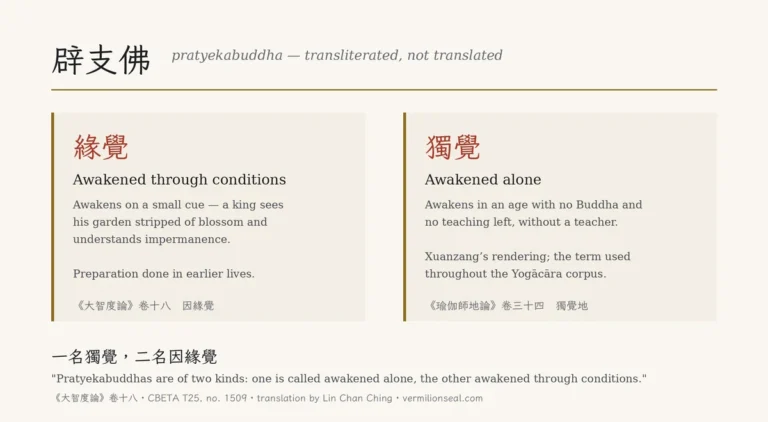
The Great Treatise: there are two kinds
The clearest early statement is in the Great Treatise on the Perfection of Wisdom, translated by Kumārajīva in 402–406. A questioner has asked how, if the path is the same, one tells a hearer (聲聞, the disciple who becomes an arhat) from a pratyekabuddha. The answer begins with a story and ends with a taxonomy.
Awakened by a garden
答曰:道雖一種,而用智有異。若諸佛不出、佛法已滅,是人先世因緣故,獨出智慧,不從他聞,自以智慧得道。如一國王,出在園中遊戲。清朝見林樹華菓蔚茂,甚可愛樂。王食已而臥,王諸夫人婇女皆共取華,毀折林樹。王覺已,見林毀壞,而自覺悟:一切世間無常變壞皆亦如是。思惟是已,無漏道心生,斷諸結使,得辟支佛道,具六神通,即飛到閑靜林間。如是等因緣,先世福德、願行、果報,今世見少因緣,成辟支佛道,如是為異。
“Answer: the Way is of one kind, but the use of wisdom differs. When no Buddha has appeared, or the Buddha’s teaching has already perished, such a person, through causes in former lives, brings forth wisdom on his own; not hearing it from others, he attains the Way by his own wisdom. It is like a king who went out to amuse himself in a park. In the clear morning he saw the trees in flower and fruit, luxuriant and very lovely. The king ate and lay down to sleep; his wives and attendants all went picking the flowers and broke the branches. When the king woke and saw the grove ruined, he awakened of himself: everything in the world is impermanent and perishes, just like this. Having reflected thus, the mind of the undefiled Way arose, he cut off the fetters, attained the way of the pratyekabuddha, gained the six powers, and at once flew off to a quiet forest. Through causes such as these — merit, vows and practice in former lives ripening as their fruit — he sees a small condition in this life and attains the way of the pratyekabuddha. That is the difference.”
《大智度論》卷十八(CBETA T25, no. 1509) · CBETA via deerpark.app
Note the phrase 今世見少因緣: “in this life he sees a small condition”. A broken branch, a fallen flower. The king does not reason his way through the twelve links; he sees one thing and the rest follows, because the work was done in earlier lives. This is what 緣覺 names — awakening on a cue. The treatise then gives the classification:
The taxonomy
復次,辟支佛有二種:一名獨覺,二名因緣覺。因緣覺如上說。獨覺者,是人今世成道,自覺不從他聞,是名獨覺辟支迦佛。獨覺辟支迦佛有二種:一、本是學人,在人中生;是時無佛,佛法滅。是須陀洹已滿七生,不應第八生,自得成道。是人不名佛,不名阿羅漢,名為小辟支迦佛,與阿羅漢無異;或有不如舍利弗等大阿羅漢者。大辟支佛,亦於一百劫中作功德,增長智慧,得三十二相分:或有三十一相,或三十、二十九相,乃至一相。於九種阿羅漢中,智慧利勝,於諸深法中總相、別相能入;久修習定,常樂獨處。如是相,名為大辟支迦佛,以是為異。
“Further, pratyekabuddhas are of two kinds: one is called ‘awakened alone’, the other ‘awakened through conditions’. The one awakened through conditions is as described above. The one awakened alone attains the Way in this very life, awakening by himself and not hearing it from others; he is called the solitary pratyekabuddha. Solitary pratyekabuddhas are again of two kinds. The first was originally a learner, born among humans at a time when there is no Buddha and the Buddha’s teaching has perished; a stream-enterer who has completed seven lives and is not due an eighth, he attains the Way by himself. Such a person is not called a Buddha and not called an arhat; he is called a lesser pratyekabuddha, and he is no different from an arhat — some are even inferior to great arhats like Śāriputra. The great pratyekabuddha has also made merit for a hundred aeons and increased his wisdom, and obtains some of the thirty-two marks — perhaps thirty-one, or thirty, or twenty-nine, down to one. Among the nine grades of arhat his wisdom is the sharpest; he can enter the general and particular characteristics of the profound teachings; he has long practised concentration and always delights in solitude. One with such marks is called a great pratyekabuddha. That is the difference.”
《大智度論》卷十八(CBETA T25, no. 1509) · CBETA via deerpark.app
Two things in this passage undercut the English shorthand. First, “solitary Buddha” is not a Buddha: the text says outright that the lesser kind 不名佛, “is not called a Buddha”, and is 與阿羅漢無異, “no different from an arhat” in what he has attained. Second, “solitary” is only half the category. The 因緣覺, the king in the garden, is the other half, and he is the one whose story everyone remembers. When Chinese writers say 緣覺 they are, strictly, naming the garden king; when they say 獨覺 they are naming the man who awakens in an empty age. Usage blurred this long ago — the lexicon’s second authority already says the solitary one “may also be called awakened-through-conditions” — but the words were coined for a real distinction.
Xuanzang’s version: what a solitary awakened one does
The Yogācārabhūmi, the encyclopaedic treatise Xuanzang translated in the 640s, devotes a short section to the “stage of the solitary awakened” (獨覺地) and organises it under five heads: 種姓、道、習、住、行 — his nature, his path, his training, his abiding, his conduct. It is here that the single horn comes in. Those who complete the first kind of training 名麟角喻, “are called qilin-horn-like”: they live alone in the forest, as the qilin — standing in for the Indian rhinoceros, which the Sanskrit names — was imagined to carry one horn. Those who complete the second and third kinds 名部行喻, “are called group-faring”: they are willing to live with others of their kind. The English “solitary” fits only the first.
And this is what they do:
The conduct of the solitary awakened
云何獨覺行?謂一切獨覺,隨依彼彼村邑聚落而住,善護其身、善守諸根、善住正念,隨入彼彼村邑聚落,或為乞食。或濟度他下劣愚昧,以身濟度,不以語言。何以故?唯現身相為彼說法,不發言故。示現種種神通境界,乃至為令心誹謗者生歸向故。
“What is the conduct of the solitary awakened? All solitary awakened ones dwell near this or that village or town, guarding the body well, keeping the senses well, abiding well in right mindfulness; they enter this or that village or town, sometimes to beg for food, sometimes to deliver others who are lowly and foolish — delivering them by the body, not by words. Why? Because they teach the Dharma to them only by showing their bodily form; they do not speak. They display various kinds of supernormal states, even so far as to make those whose minds slander them turn towards refuge.”
《瑜伽師地論》卷三十四〈獨覺地〉,彌勒菩薩說,唐 玄奘譯(CBETA T30, no. 1579, p. 478) · CBETA via deerpark.app
以身濟度,不以語言: “delivering by the body, not by speech”. This is the doctrinal reason the figure never founds a school and never becomes a Buddha in the full sense. A Buddha teaches; a pratyekabuddha shows up in the village, begs, and is seen. The awakening is real, and the Yogācāra text does not belittle it, but its whole effect on others is by example and by the occasional display of power. It is a strange and rather moving category — the person who has understood everything and says nothing about it — and it is entirely lost when the word is rendered as a kind of Buddha.
Where the word turns up
In practice a Chinese reader meets 緣覺 most often inside a four-character compound, 聲聞緣覺, “hearers and awakened-through-conditions”, which Mahāyāna texts use as a single label for the two lesser vehicles, the paths that end one’s own suffering without vowing to end everyone’s. In that use the individual meaning of the word hardly matters; it is half of a dismissal. The garden king, the rhinoceros, and the man who teaches without speaking are all still there in the sources, but you have to open the commentaries to find them, which is what this entry has done.
For the other half of the compound, see what arhat means, with the same commentary’s three readings of that word. For how Xuanzang’s choice of one character over another shaped an entire school’s name, see mind-only or consciousness-only; for the vocabulary of the treatise quoted above, see the eight consciousnesses and the storehouse consciousness. And for a Chan text on awakening that comes through correction rather than solitude, see Huineng on correcting faults.
FAQ
What does pratyekabuddha mean?
Literally “individually awakened”. Chinese renders it two ways: 獨覺, “awakened alone” (in a world without a Buddha, without a teacher), and 緣覺, “awakened through conditions” (by contemplating dependent origination, often triggered by a small event). The transliteration 辟支佛 covers both.
Is a pratyekabuddha a Buddha?
Not in the full sense. The Great Treatise on the Perfection of Wisdom says the lesser kind “is not called a Buddha” and is “no different from an arhat” in attainment. What sets him apart from an arhat is that he awakened without hearing the teaching; what sets him below a Buddha is that he does not teach and did not vow to liberate all beings.
What is the difference between 緣覺 and 獨覺?
The Great Treatise names two kinds: the one who awakens on a small cue in this life after preparation in earlier lives (the king who sees his garden ruined), and the one who awakens by himself in an age with no Buddha. Later usage treats the two Chinese words as near-synonyms, but they were coined for these two cases.
Do pratyekabuddhas teach?
Not by speech. Xuanzang’s Yogācārabhūmi says they deliver others “by the body, not by words”, teaching only by showing their form and, at times, supernormal powers. This is why the tradition holds that they do not found a lineage.
Sources
- 《大智度論》卷十八「問曰:若辟支佛道亦如是者,云何分別聲聞、辟支佛?答曰:道雖一種,而用智有異……如一國王,出在園中遊戲……今世見少因緣,成辟支佛道」;「復次,辟支佛有二種:一名獨覺,二名因緣覺……是人不名佛,不名阿羅漢,名為小辟支迦佛,與阿羅漢無異……如是相,名為大辟支迦佛」 — CBETA T25, no. 1509 — deerpark.app (CBETA mirror) (accessed 5 Sep 2026)
- 《瑜伽師地論》卷三十四〈獨覺地〉「云何獨覺地?當知此地有五種相。一者、種姓,二者、道,三者、習,四者、住,五者、行」「由初習故成獨覺者,名麟角喻。由第二、第三習故成獨勝者,名部行喻」「云何獨覺行?……以身濟度,不以語言。何以故?唯現身相為彼說法,不發言故」 — CBETA T30, no. 1579, p. 477–478 — deerpark.app (accessed 5 Sep 2026)
- 《翻譯名義集》卷一〈辟支迦羅〉條:「此翻緣覺,觀十二緣而悟道故。亦翻獨覺,出無佛世,無師自悟故」「獨覺稱麟喻者,名出俱舍;名為犀角,出大集經」「但約根有利鈍,值佛不值佛之殊,分二類也」 — CBETA T54, no. 2131 — deerpark.app (accessed 5 Sep 2026)