
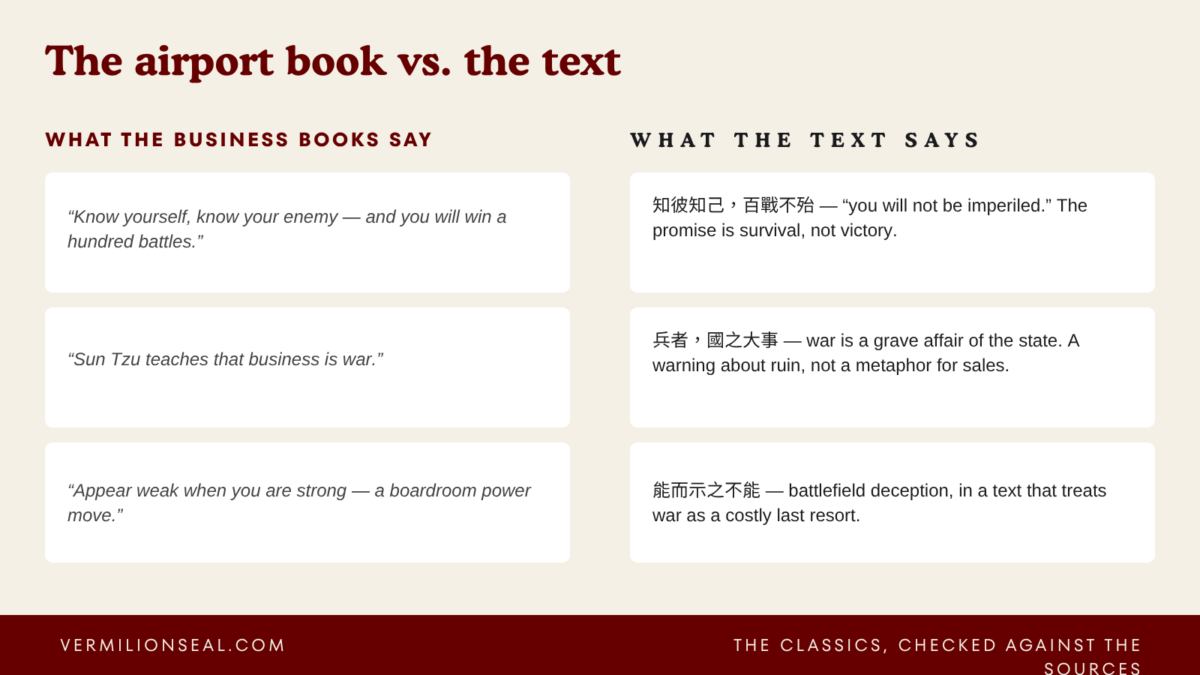
The most quoted line of the Art of War in English business writing is “know yourself and know your enemy and you will win a hundred battles.” The received Chinese text puts the enemy first, and it does not say you will win. It says you will not be endangered. Both halves of that sentence were changed on the way into English, and the change is in the direction you would expect.
This is not an argument that Sunzi has nothing to say to people who run companies. It is an argument that the book being quoted is not the book that exists. Below, three lines checked against the text, and then what the Art of War is actually about — which is stranger and more useful than the version on the airport shelf.
All quotations are from the received text at the Chinese Text Project, with the standard English of Lionel Giles, whose 1910 translation is out of copyright and is where most English quotation of Sunzi ultimately comes from. Giles was Keeper of Oriental Printed Books and Manuscripts at the British Museum; his translation is free at Project Gutenberg.
One: the enemy comes first, and the promise is survival
From Attack by Stratagem:
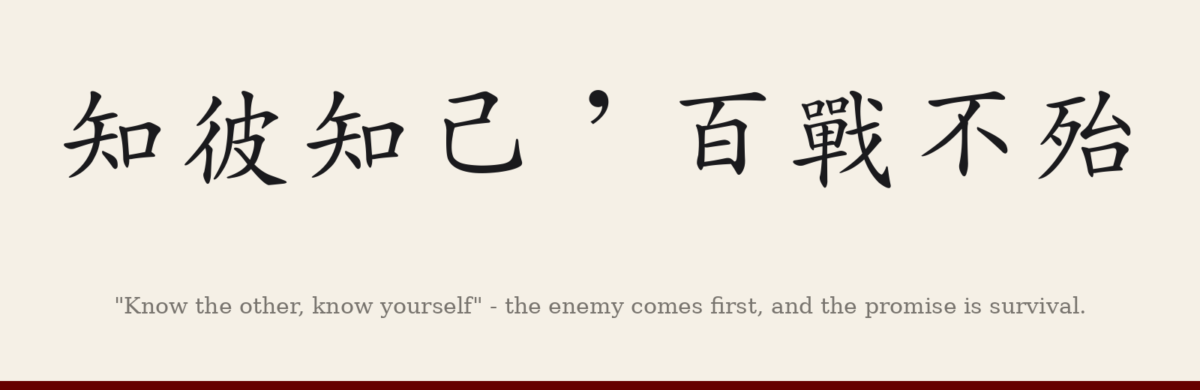
知彼知己,百戰不殆;不知彼而知己,一勝一負;不知彼,不知己,每戰必敗。
“If you know the enemy and know yourself, you need not fear the result of a hundred battles. If you know yourself but not the enemy, for every victory gained you will also suffer a defeat. If you know neither the enemy nor yourself, you will succumb in every battle.”
Two things have gone missing.
The order. 知彼知己 — know the other, know yourself. The popular English inverts it, and the inversion is not innocent: “know yourself” first turns a line about intelligence-gathering into a line about self-development. The Chinese begins outside your own head.
The verb. 不殆 is not be endangered. Giles renders it “you need not fear the result”, which is faithful. The business version — “you will win a hundred battles” — promises victory where the text promises only that you will not be destroyed. And look at the two clauses that follow, which are almost never quoted: knowing yourself but not the enemy gets you a win-loss record of one to one. Knowing neither loses every time. The best case in the whole sentence is not losing.
That is the book’s actual temperament, and it survives the trip into English very badly.
Two: the highest skill is not fighting at all
From the same chapter, and usually quoted with its first half removed:
是故百戰百勝,非善之善者也;不戰而屈人之兵,善之善者也。
“Hence to fight and conquer in all your battles is not supreme excellence; supreme excellence consists in breaking the enemy’s resistance without fighting.”
The sentence is built as a pair, and the first half is the surprising one: winning every battle you fight is not the highest good. Cut that clause and you have a line about efficient victory. Keep it and you have a line that treats a hundred victories as evidence of a failure further upstream — you should not have been fighting a hundred times.
A book that says this is not a book about how to compete harder.
Three: war is expensive, and that is the argument
From Waging War:
故兵貴勝,不貴久。
“In war, then, let your great object be victory, not lengthy campaigns.”
In context this is not motivational. The chapter it closes is an accounting exercise: chariots, armour, the daily expenditure of a thousand pieces of silver, the ruinous cost of provisioning an army at distance, the way a long campaign blunts weapons, exhausts troops and empties a treasury until some third party takes advantage of the wreckage. The conclusion — prize a quick decision, not a long campaign — is what the arithmetic forces.
Quoted alone, it becomes “move fast”. In the text it means: you cannot afford this, so do not start unless you can finish.
What the book is actually about
The opening sentence of Laying Plans sets the frame for everything after it:
孫子曰:兵者,國之大事,死生之地,存亡之道,不可不察也。
“The art of war is of vital importance to the State. It is a matter of life and death, a road either to safety or to ruin. Hence it is a subject of inquiry which can on no account be neglected.”
死生之地 — the ground of life and death. 存亡之道 — the road to survival or extinction. The subject is a state deciding whether to commit to something it may not survive, and the recommended procedure is calculation before commitment: assess, compare, and if the assessment is unfavourable, do not go.
Three consequences that the business reading tends to lose:
- The costs are borne by people who did not choose. The Art of War counts corpses, exhausted farmers and emptied granaries. A competitor is not an enemy state and a quarterly target is not 死生之地.
- Deception is a method of war, not of commerce. 兵者,詭道也 — “all warfare is based on deception” — is followed immediately by its concrete forms: appear unable when able, appear far when near. Sunzi is describing what one does to an army one is trying to destroy. Transposed to a market, the same advice describes fraud.
- The best outcome is that nothing happens. Business writing needs a book about winning. This one keeps recommending that you not play.
Why the business reading persists anyway
Not because readers are careless. Because the text invites it.
Mark Metcalf, writing in Education About Asia, makes the point precisely: the precepts are “sufficiently malleable” to be read many ways, and lifting a passage out of context licenses advice about as Sunzian as “buy low, sell high.” Classical Chinese is compressed — no tense, no number, subjects often dropped — and a short aphorism will carry almost any reading you bring to it. That is exactly why the commentary tradition exists, and why an Art of War with no notes is an Art of War with the translator’s assumptions silently installed.
There is a serious case on the other side. Peter Ping Li and Monsol Yang have argued in Management and Organization Review for taking classical Chinese strategic thought seriously in management scholarship. The disagreement is not whether Sunzi can be applied. It is whether the application should begin by reading him.
And nobody is sure who wrote it
The traditional account, from Sima Qian’s Shiji, credits the general Sun Wu, in the service of the King of Wu in the fifth century BCE. Modern scholarship treats that account with caution; the Sinologist Lisa Raphals refers to Sun Wu as the apocryphal author of the Sunzi, and Britannica places the text in the early Warring States period rather than the fifth century.
What settled part of the question was an accident. In April 1972, construction workers at Linyi in Shandong broke into two Western Han tombs. The Yinqueshan bamboo slips they found included thirteen chapters of the Art of War and sixteen chapters of a second military text, the Sun Bin bingfa, which had been lost for roughly fourteen centuries. Their existence as two separate texts ended a long-running scholarly suspicion that “Sun Bin” was a duplicate of Sun Wu, and fixed a date by which the Art of War demonstrably existed in recognisable form.
What the slips did not do is confirm that Sun Wu was a real man, or that the book was written in the fifth century BCE. A book whose authorship is uncertain and whose date is contested is a strange thing to cite as the timeless wisdom of a single ancient general.
How to actually read it
- Read whole chapters. They are short. Every line above changes meaning when the sentence around it is restored.
- Keep the Chinese in view. ctext prints the original beside Giles, free.
- Check the word order when you quote. The received text reads 知彼知己. If a book prints it the other way round, that tells you something about the book.
- Notice what it recommends against. The strongest advice in the Art of War is repeatedly: do not begin.
Read that way, it does have something to say to anyone making a large irreversible commitment — but what it says is mostly don’t, unless the numbers say you can finish. That is a harder sell than “crush the competition,” which may be why the other version is the one in print.
Where to go from here
The classical texts section covers what each book is and the commentary tradition that decides what it means; the quotations library gives individual lines with the original beside the English and a link to the source; the concepts library handles terms like 勢, which is among the hardest words in the text to put into English and is routinely flattened to “momentum”.
How every passage here is checked, and which editions are read, is set out on the methodology page. When we get something wrong, the correction is public in the corrections log.
If the Art of War is the classic most misused as a business manual, the Zhuangzi is the one most misused as a self-help manual: the empty boat parable shows how a passage addressed to a prince became a meme about not taking things personally.
For another classic turned into a management ladder, see the eight steps of the Great Learning.



