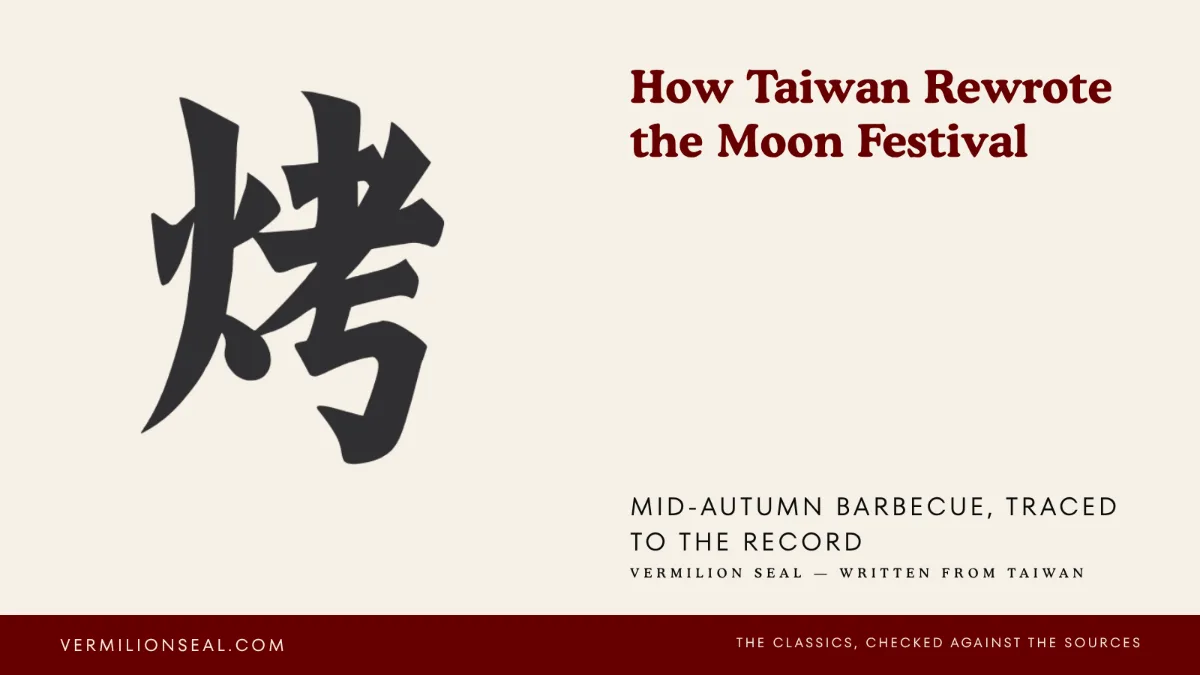
Ask anyone in Taiwan what they are doing for the Mid-Autumn Festival and the answer is rarely “admiring the moon”. It is barbecue. On the fifteenth day of the eighth lunar month — 25 September in 2026 — pavements, riverside parks and apartment courtyards across the island fill with charcoal smoke, and supermarkets sell grill sets the way Western shops sell turkeys in November. This is not an ancient rite. It is a custom younger than most people’s parents, and the story of how it took over the holiday is a small lesson in how folk traditions actually form.
What the Mid-Autumn Festival is
The festival — 中秋節, “mid-autumn” — falls on the full moon of the eighth lunar month, which lands somewhere between early September and early October each year. It is a public holiday in Taiwan, and the traditional programme is straightforward: family reunion under the fullest moon of the year, mooncakes, and pomelos, whose skins children wear as hats because the fruit’s name (柚, yòu) sounds like the word for “to bless and protect” (佑).
The moon itself carries the legend of Chang’e (嫦娥), the woman who swallowed an elixir of immortality and floated to the moon, leaving her husband behind. It is a story, not history — the versions contradict each other even within early sources — but the image of a figure in the moon watching over separated families is why the festival’s core value is reunion. The full moon stands for the circle of the family, complete for one night.
None of that involves grilled pork on a skewer. So where did the barbecue come from?
The story everyone tells: the soy-sauce advert
The explanation you will hear most often in Taiwan goes like this: in 1986, the soy-sauce maker Wan Ja Shan ran a television advert with the slogan 「一家烤肉萬家香」 — “one family grills, ten thousand households smell the fragrance”. The rival brand Kimlan answered with barbecue-sauce campaigns of its own the following year. The advertising war, so the story goes, invented a holiday custom out of thin air, and Taiwan has grilled ever since.
The slogan everyone quotes
一家烤肉萬家香
“One family grills, ten thousand households smell it.” — Wan Ja Shan, 1986. Its 1959 ancestor promised three households, not ten thousand.
TVBS 食尚玩家 · UDN 報時光 · See the 1959 advert
It is a tidy story — a whole national tradition conjured by a jingle. I grew up hearing it repeated as settled fact. It is also, on the record, not quite true.
What the record actually shows
Taiwanese journalists and archive researchers have dug into this, and the newspaper trail is older than the advert by a generation.
The earliest known version of the slogan is not from 1986 at all. In 1959, Wei Chuan was already running press advertisements for its soy sauce under the line 「一家烤肉三家香」 — “one family grills, three households smell it” — as documented by UDN’s archive project Time.udn, which reproduces the original print advert. Wan Ja Shan’s famous 1986 slogan raised the number from three households to ten thousand, but the pairing of soy sauce with grilled meat was nearly three decades old by then.
Nor did people wait for television to start grilling. A 1973 report in the Economic Daily News (經濟日報) describes Mid-Autumn night outings built around “barbecue bonfire parties and moon-viewing”. By 1981, the Min Sheng Bao was listing barbecue facilities among a resort’s holiday attractions, and by 1982 grilling was being used as a Mid-Autumn selling point. The 1986–87 advertising war, in other words, did not create the custom. It amplified something families in Taiwan were already doing, and retailers finished the job: once hypermarkets began stacking grill racks, charcoal and marinade next to the mooncakes every September, the equation of Mid-Autumn with barbecue became self-sustaining.
There is even a rival origin claim worth recording precisely because it cannot be right. In 2007 an inventor named Chang Hsin-lun wrote to the United Daily News claiming the whole custom was his accidental doing, starting from 1990. The 1959 advert and the 1973 news report make the claim impossible — but its existence is a useful reminder of how quickly a custom barely fifty years old attracts competing origin myths. This is exactly how “ancient traditions” are made.
Why barbecue, of all things?
The advert explains the smell; it does not explain the appeal. The more convincing reading, made by Taiwanese commentators looking back at the custom’s growth, is social. Grilling is the one style of cooking that is genuinely collective: someone fans the charcoal, someone skewers, someone brushes sauce, everyone hovers. For an industrialising society whose family members increasingly lived and worked apart, a cooking method that requires the whole group fitted the festival’s reunion ideal better than a restaurant table ever could. The moon says the family should be a complete circle; the grill gives everyone in the circle a job.
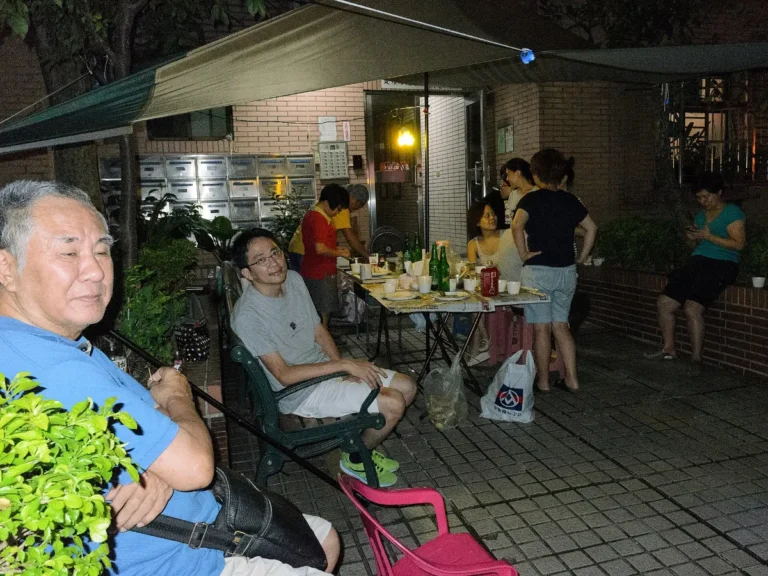
Whatever the mechanism, the custom is now thoroughly institutional. Taipei’s city government opens designated barbecue zones in its riverside parks for the holiday every year — 23 designated areas in 2024, announced by official press release, with the Hydraulic Engineering Office maintaining a standing list of which riverside parks permit grilling. When the city government publishes maps of where you may legally set up your charcoal, the argument about whether something counts as a “real tradition” is over.
What barbecue did not displace
The rest of the festival economy is alive and, if anything, escalating. Mooncakes remain the holiday’s official currency — the weeks before Mid-Autumn are corporate gifting season, and the boxed sets that companies exchange run from bean-paste classics to absurd luxury collaborations. Pomelo growers time their harvest to the festival, with the wendan pomelos of southern Taiwan treated as the prestige fruit of the season. And the custom has stayed a specifically Taiwanese one: in China and Hong Kong the same full moon brings mooncakes and lanterns but no grill, which is why visitors from elsewhere in the Chinese-speaking world find the smoke as surprising as Westerners do. The barbecue layer grew here, out of local adverts, local retail and local sociability, and it stayed here.
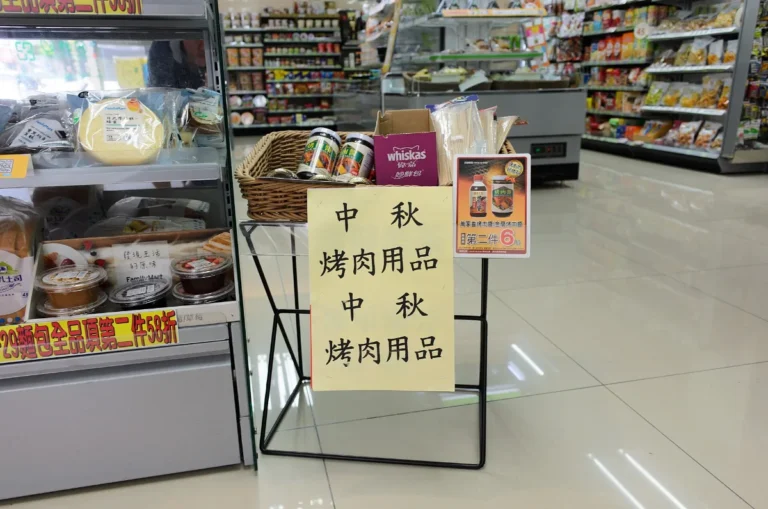
The public-order side has grown with it. Because the holiday puts open charcoal fires in dense cities, the question of where you may grill is now managed policy rather than improvisation: Taiwan’s major cities publish lists of permitted zones each year, and public broadcaster PTS runs an annual round-up of the legal barbecue areas across the six special municipalities. The custom is barely fifty years old and it already has infrastructure, regulation and an annual news cycle.
A tradition rewritten, not replaced
It would be wrong to say barbecue displaced the older festival. The older layers are all still there: bakeries still fight their annual mooncake war, pomelos still pile up in every market, and families that keep temple habits still make offerings on the day — the same temples where people throw moon blocks the rest of the year. What Taiwan did was add a layer, the way the seventh lunar month added layers to become the Ghost Month observed today. Customs on this island are sedimentary. The barbecue is simply the newest stratum, and because everyone can date it, you can watch the process that presumably produced all the older strata too.
That is the honest answer to give a visitor who asks whether Mid-Autumn barbecue is “traditional”. It is about fifty years old, it was pushed along by two sauce companies and every hypermarket on the island, and it is tradition now by any test that matters: it recurs, it is collective, and skipping it feels like missing the holiday. More of Taiwan’s living traditions work this way than the guidebooks admit.
FAQ
When is the Mid-Autumn Festival in 2026?
Friday, 25 September 2026 — the fifteenth day of the eighth lunar month. It is a public holiday in Taiwan.
Did a soy-sauce advert really start Taiwan’s Mid-Autumn barbecue?
Not by itself. The famous slogan aired in 1986, but a nearly identical advert ran in 1959, and newspapers describe Mid-Autumn barbecue outings from 1973. The adverts amplified an existing habit; retail promotion then locked it in.
Where can you legally barbecue in Taipei during the festival?
Only in designated areas. Taipei opens riverside-park barbecue zones for the holiday period each year (23 zones in 2024) and publishes the list through the city government and its Hydraulic Engineering Office.
What do people eat at a Taiwanese Mid-Autumn barbecue?
Thin-sliced pork and beef, sausages, chicken wings, corn, king oyster mushrooms and stuffed tofu pockets, most of it brushed with sweet barbecue sauce and eaten pressed between slices of white toast — a fully Taiwanese format with no mainland counterpart.
The same gap between the festival in the books and the festival on the ground opens on the ninth of the ninth, when Taiwan pays out gift money and flies kites rather than climbing anything. See the Double Ninth in Taiwan.
Sources
- Time.udn (UDN archive project), 〈中秋節烤肉竟不是來自這廣告!一家烤肉「萬家香」之前還有個「三家香」〉 — 1959 Wei Chuan advert, 1973 Economic Daily News report, 2007 Chang Hsin-lun claim. time.udn.com (accessed 1 Sep 2026)
- TVBS 食尚玩家, 〈中秋節何時開始流行烤肉?〉 — 1973/1981/1982 newspaper timeline; 1986 Wan Ja Shan and 1987 Kimlan campaigns. supertaste.tvbs.com.tw (accessed 1 Sep 2026)
- Taipei City Government press release, 〈中秋烤肉去哪裏?北市河濱開放23處指定區域〉 (2024). gov.taipei (accessed 1 Sep 2026)
- PTS News, 〈中秋3天連假10/4展開 六都合法烤肉區一次看〉 (2025) — annual round-up of legal barbecue zones across the six municipalities. news.pts.org.tw (accessed 1 Sep 2026)
- Taipei Hydraulic Engineering Office FAQ, 〈臺北市河濱公園開放烤肉的場地有那些?〉. heo.gov.taipei (accessed 1 Sep 2026)
The festival moves around the Gregorian calendar for the same reason New Year does; why Chinese New Year never falls on the same day explains the rule that fixes both.